
Shaun Robinson/Diedre DS. Sense
Season 4 Episode 33 | 26m 46sVideo has Closed Captions
Shaun Robinson/Diedre DS. Sense | Episode 433
Stephen Henderson catches up with native Detroiter, Access Hollywood Host & lifetime film producer Shaun Robinson. Veteran Detroit hip-hop artist Deidre D.S. Sense paired her latest album "Copper St. Chrysalis" with what she called her Quarantine Concert Series. Peter Whorf catches up with Ricardo Lorenz to talk about his album King Mangoberry that was just nominated for two Latin Grammy awards.
Problems playing video? | Closed Captioning Feedback
Problems playing video? | Closed Captioning Feedback
One Detroit is a local public television program presented by Detroit PBS
Shaun Robinson/Diedre DS. Sense
Season 4 Episode 33 | 26m 46sVideo has Closed Captions
Stephen Henderson catches up with native Detroiter, Access Hollywood Host & lifetime film producer Shaun Robinson. Veteran Detroit hip-hop artist Deidre D.S. Sense paired her latest album "Copper St. Chrysalis" with what she called her Quarantine Concert Series. Peter Whorf catches up with Ricardo Lorenz to talk about his album King Mangoberry that was just nominated for two Latin Grammy awards.
Problems playing video? | Closed Captioning Feedback
How to Watch One Detroit
One Detroit is available to stream on pbs.org and the free PBS App, available on iPhone, Apple TV, Android TV, Android smartphones, Amazon Fire TV, Amazon Fire Tablet, Roku, Samsung Smart TV, and Vizio.
Providing Support for PBS.org
Learn Moreabout PBS online sponsorship- Hi, I'm Christy McDonald and here's what's coming up on One Detroit Arts and Culture this week.
Detroit native and Emmy award-winning TV host Shawn Robinson on her new ventures for Lifetime Television and roles for black women in Hollywood.
Plus, Michigan State professor Ricardo Lorenz on his Latin Grammy nominations.
Then local hip-hop artist Deidre D.S.
SENSE Smith on connection in music.
And the love affair between Detroit and Vernors.
It's all ahead this week on One Detroit Arts and Culture.
- [Female voiceover] From Delta faucets to Bear paint, Masco corporation is proud to deliver products that enhance the way that consumers all over the world experience and enjoy their living spaces.
Masco, serving Michigan communities since 1929.
- [Male voiceover] Support for this program provide by, the Cynthia & Edsel Ford Fund for Journalism at Detroit Public TV.
The Kresge Foundation.
Community Foundation for Southeast Michigan.
- [Female Voiceover] The DTE Foundation is a proud sponsor of Detroit Public TV.
Among the state's largest foundations committed to Michigan focused giving, we support organizations that are doing exceptional work in our state.
Visit DTEFoundation.com to learn more.
- [Male voiceover] Business Leaders for Michigan, dedicated to making Michigan a top 10 state for jobs, personal income and a healthy economy.
Also brought to you by.
The Fred A.
And Barbara M. Erb Family Foundation.
And viewers like you.
(upbeat pop music) - Hi, and welcome to One Detroit Arts and Culture, I'm Christy McDonald.
Thanks so much for being with me this week.
This show is created to highlight all of the great arts and culture organizations and events across the area in a time where the pandemic continues to keep us all distanced and safe.
Coming up on the show this week, Detroit native, TV host and now executive producer Shawn Robinson catches up with Stephen Henderson on American Black Journal about her new projects.
Also ahead, the music of Ricardo Lorenz and the MSU wind symphony, nominated this year for two Grammy awards.
Plus Deidre D.S.
SENSE Smith, Detroit hip-hop artist and activist on new music in connection.
And then to try to remember when, made in the Motor City, our love affair with Vernors.
It's all ahead on the show.
We're starting off with Emmy award winning TV host and Detroit native, Shawn Robinson.
She's added a new title to her resume.
She made her debut as executive producer of two new Lifetime movies as part of her partnership with Bishop TD Jakes.
Stephen Henderson spoke with Shawn on American Black Journal.
- I don't trust her.
- Can we just focus on the meeting please?
- Can we focus on not letting a stranger into our business?
- I understand how you feel.
All right, Reagan, just talk to me, please.
- We need to get this right.
- I understand that.
- We could lose one of our biggest clients.
- I know.
- But, I do love your pitch.
It's really good.
- Yeah, most of them are Keisha's ideas.
She should be in this meeting.
- I'm not gonna allow a stranger to come into our office.
Our company depends on this.
- Yeah, but I'm just trying to do the right thing.
I know I may have just met her, but she's my sister, Reagan, it just feels wrong.
- So, of course you've had a really, really remarkable career in Hollywood.
But this new work is kind of a different turn.
Let's start with the names for these programs.
Lust and Envy, now there's something kinda ominous about those words.
- Well, Steven, okay.
First of all, I actually started my career in Detroit.
WGPR channel 62, a long, long time ago.
But most people who know me nationally, know me from Access Hollywood, where I spent 16 years covering the red carpet, and interviewing all the celebrities in Hollywood.
And I started thinking towards the end of that period what I wanted to do.
What I wanted the next or additional chapter to look like.
And I knew that I wanted to be a content creator, to produce content.
And you know, as journalists, we're really producers at heart because we've had to produce our own stories many times coming up the ranks.
And we had to have a vision for our stories.
And so, a friend of mine who worked at Essence magazine at the time, this is back in 2016, told me about a galley of this book Lust that he'd received.
It had not reached store shelves yet, it had just, the galley came to his desk, and he said, "Shawn, it's written by author Victoria Christopher Murray.
She's writing each of the seven deadly sins.
And the first one, Lust, is about to come out.
You should call her and option the entire series."
And so, that's what I did.
I knew Victoria, so I called her up and optioned these books.
Now I'm an executive producer for the first time through Lifetime, and I'm so thrilled.
I'm really, really happy.
- Even though it's 2021, things aren't all fair, things aren't all equal.
And it's still tough for women in Hollywood, and of course black women in Hollywood to get opportunities to do the kind of work that you're doing.
Executive producing is kind of the height of work in Hollywood, and it's still pretty exclusive.
- Yes, and that's why I love that I have this partnership with Lifetime.
Because, as a black female, we run into many closed doors here in Hollywood, and listen, every sector.
But, in terms of Hollywood, it is very, very tough.
And so for this door to be opened, and for me to be able to open the doors for other black women, for other women of color, for people of color, is really important for me because I know how tough it is.
Listen, it's tough for everybody, but equally, it's extremely, you have to have a lot of perseverance out here.
So to be a person that is able to create opportunities for other people is, it's just a thrill for me.
And that's how I want to use my platform.
And create great movies.
At the end of the day, it has to be entertaining.
- The work that you're doing, what do you hear from young women about the challenges that they face right now, and how different that might be from what you faced as a young person here in Detroit?
- Well, you know, Stephen, my foundation is working on a documentary about implicit bias towards black girls.
I'm focusing on the lives of black girls, and how the biases that they face every single day, coming from adults black and white, that are preventing them from achieving their dreams.
That are affecting their self esteem, and their chances for success, and how we all, as a society, suffer when a marginalized group isn't able to reach their fullest potential.
We all suffer as a society.
As black females, we're used to being pushed to the side so that other people can rise.
And we need to start focusing on our girls.
It doesn't take anything away from anybody else, but we need to make sure that their needs are being met.
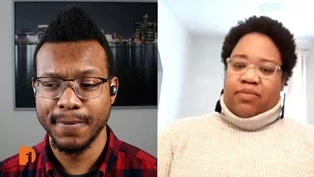
- It really has been a long year for musicians who haven't been able to get close with their audience and their fans because of COVID.
But it hasn't stopped them from reaching out in new ways.
Detroit hip-hop artist and activist, Deidre D.S.
SENSE Smith created what she calls her quarantine concert series.
One Detroit's Bill Glover has more.
(upbeat hip-hop music) ♪ One of you, I.
♪ One of you, I.
♪ One of you, I.
- To give people a little bit of sense as to who you are, what you've been doing, how long have you been a artist, musician in Detroit?
- Close to 20 years, I would say.
I started as a teenager hitting the open-mic circuits.
And I was essentially a vocalist.
R&B, neo-soul, that wave was big then.
But I'd always been an emcee at heart.
And oddly enough, I was nominated for a Detroit music award for best R&B.
And around that time, I was really itching to step into the waters of hip-hop.
♪ Stop by and it's off limits.
♪ I guess it's just this.
♪ Me, you're just fit.
♪ Since it's intense.
♪ Been this way since.
♪ I could grab mics.
♪ Why you want to act like that?
♪ ♪ I ain't the best doin this.
- And I'm more comfortable as a hip-hop artist.
So for the last 20 years or so, I've been really pushing that hip-hop agenda.
♪ The feeling is just incredible, don't you agree?
♪ - Your latest release is Cooper Street Chrysalis.
First of all, tell us about the name of that album.
Cooper Street Chrysalis, what brought that about?
- That's my homestead.
I'm a native Detroiter, an east side girl, and that's where my family home is.
Cooper Street is home to me.
It always will be.
My family was one of the first black families to integrate into the neighborhood that was primarily Jewish and Italian at the time.
And so my roots run deep on the east side of Detroit.
- Artists are always open to a challenge to something new, to something changing.
Whether it be good or bad, there's a way for an artist to participate, to distill, to translate.
And you did something recently with taking us through a walk in the park.
Tell us a little bit about what that was, and what got you to the point in wanting to put this out.
- Much like the rest of the world, my world had gotten a little quieter.
Naturally reclusive, a bit introverted, and so I really felt like this was the time to show the rest of the world how to operate in such quiet stillness.
I think that if you change your perspective about what this time is about, and search for the silver lining if you have the guts to, You'll find that this is an opportunity to reinvent yourself.
To tap into those facets of yourself that was your plan B.
And artists know all to well about plan Bs, and being told to consider your plan B.
Well now, plan Bs are at the forefront.
Being an artist, I got up with my plan B self, and I show my audience how you can make lemonade out of B.
♪ And walk on a whole new journey ♪ ♪ Of love where we both feel worthy.
♪ ♪ Shucks, I blush for you ♪ Say I'm ready ♪ No B, you blush when I say you're pretty.
♪ - If you feel like you're in a place of despair, what better way to get yourself out of that than to take an artistry of nature?
Look around at the colors.
Listen to the sounds of that first and foremost.
And within that, you'll find something to draw on.
You'll reinvent yourself eventually or come back to yourself.
Whatever you need to do with yourself, you'll eventually do it if you get out in nature.
And so those that were a little more reluctant to come out, I decided to come out.
I decided to walk the streets.
I decided to walk the park.
Those that are in a fear of isolation, I decided to show them what isolation looks like when you choose to change your perspective.
(upbeat hip-hop music) - Isolation isn't loneliness, it's an opportunity to get to know yourself.
And that's all I was doing.
I was taking folks on a ride with me as I got to know myself, I reinvented myself.
They were familiar with me for my long locks, and I cut those and I cropped my hair, and I wanted to be just as naked and vulnerable as being a vocalist made me.
- What is one of the things that you're looking forward to most?
- I'm looking forward to the alleviation of fear.
I want to see those people that I've seen a certain amount of fear come over them, I want to see them free and certain again.
I would put out little videos on Instagram, and I would say, "I can't wait to see you on the other side of this."
Just anybody who would view the videos, I would always end it with, "I can't wait to see you on the other side of this."
" I look forward to seeing you on the other side of this."
And so I want to see those that make it on the other side of this along with me, and you will.
I want to see you smile again.
I want to see you confident again.
I want to see you hug again.
I want to see you kiss again.
I want to see all those things that make us human again.
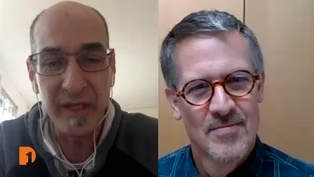
- Many of you know the voice of Peter Whorf on our public radio station WRCJ.
Well, he's been doing a lot of interviews for us here on One Detroit Arts and Culture.
And a few months ago, he caught up with Ricardo Lorenz, professor of composition at Michigan State's College of Music.
Ricardo's album, King Mangoberry, features the MSU wind symphony and acclaimed maracas player, Manuel Alejandro Rangel.
And it was nominated this year for two Latin Grammy awards.
- What moved you to originally create King Mangoberry?
- Well, I was trying to think how best to explain this because it's complex, it has many layers.
But I think the simple way of describing it, Peter, is by saying that it's a story of cultural bridging, cultural dissonance, cultural awakening (calm orchestral music) - It all started with a visit of my very good friend from New York City, Anthony Themar, a wonderful pianist.
He visited Venezuela to perform my piano concerto.
I'm talking about maybe 20 years ago.
And while in Venezuela, we went to one of these many fruit stands.
It's like instead of hot dog stands, there's fruit stands in Caracas.
And he had the audacity to order, not a fresh juice made of mango or passion fruit or bananas or strawberries, but one that would mix strawberries and mango.
And believe it or not, that was shocking to the person that was making these.
It's almost like nobody had ever thought to have the idea of mixing them.
So what this made me realize is that-- Well on the first hand, the reason this man was shocked, was making his drinks, was because he thought it was a bad idea to ruin the strawberry that's exotic in Venezuela with such an ordinary fruit as the mango is in Venezuela.
Everybody has a mango tree in the back yards.
So he didn't understand why somebody wanted to ruin the strawberries.
In our case, it's the opposite, right?
I mean you run to the US, the mango's the exotic and we have strawberries everywhere.
So that got me thinking, wow we're raised with these take them for grated.
What's exotic for some is not exotic for others.
And in those take it for granteds, we lose opportunities of discovering things because we're just so embedded in our culture, we don't see those things.
And it takes somebody coming from a different culture to see those things we don't see.
(calm orchestral music) - But that's what happened to my friend.
He just saw something very simple for him, and suddenly is just opened up a new way of thinking with something so simple.
Again, it's a joke about my friends.
We've started saying mangoberry to anything that was culturally awkward.
Almost like a lost in translation kind of thing.
- Kind of an Odd Couple?
- An Odd Couple, exactly.
And one that would talk about how we don't know where we're missing out because of our upbringing and our education.
- I was also amazed that this surprising instrument came to the front of the stage during this piece.
The melody of the maraca just blew me away.
(upbeat orchestral music) - It is true, it is also for some the main story.
By the way, Manuel Delanhail, the maraca player just won two awards in Venezuela.
Venezuela has these, like the Grammys in Venezuela, they're called the Pepsi awards and it's given by Pepsi Cola.
And these awards have been given for eight years.
So this is the eighth installment.
And he won two awards in classical music.
One as best piece and one as best classical performer.
Now think about it, he won over pianists, cellists, soprano singers, a pair of gourds that have to be shaking relative to those sounds.
(maracas shake) - So yeah, that is a very big story that of course is part of this story.
But I kind of take it for granted because I've lived with that piece for so long, Peter.
That piece I wrote 20 years ago.
However, the piece that has been nominated in this album is a new version for wind symphony.
- Right.
- As opposed for this orchestra.
But I've been living with it for so long that I take it for granted.
But you're right, that is a major story.
The fact that the piece that has been nominated of best classical composition, is a concerto for Venezuelan maracas and wind symphony.
- And we're going to finish up the show this week with a story from our Detroit Public Television documentary's Remember When: Made in the Motor City.
I love these stories because they're all about the unique things that come out of Detroit.
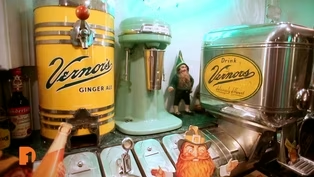
And this one is about our love affair with Vernors.
(upbeat piano music) (soda fizzes) - You went into grandma's house and opened up the refrigerator and there was Vernors.
It was all you had.
- [Narrator] The history of America's oldest surviving soda pop brand actually rests in a suburban Detroit basement.
- Some people might say it's an obsession.
Vernors is such a small company compared to a Coke or a Pepsi or something like that.
You'd never really thought they'd have hundreds, thousands of different advertising items.
- [Narrator] Keith Wunderlich even has the life-size gnome that greeted visitors outside the bottling plant 100 years ago.
- The story goes that the gnome's job was to protect the secret recipe for Vernors - When we would go to Bobalo, we took the bus and got in and went into the Vernors plant and had a Boston cooler, which was ice cream and Vernors.
And that was the best.
- A Boston cooler is Vernors and vanilla ice cream mixed like a milkshake.
If the ice cream's just floating in the Vernors, it's a float.
- [Narrator] During the civil war, a young James Vernor served in the medical corps.
He'd worked at a Detroit drug store well before duty called.
- He would be a delivery boy, and of course all good drug stores had a soda fountain.
And so he was also messing around with a formula for ginger ale.
- [Narrator] When he returned to Detroit, an oak cask full of his ginger ale formula was sitting there waiting for him.
- That four years of the civil war was the magic touch for the formula.
And that became the extract that they made Vernors out of.
- [Narrator] James Vernor became the first registered pharmacist in the state of Michigan.
He was a storekeeper and a florist as well.
- So he did everything.
It was kind of the CVS of the late 1800s.
Where there were all sorts of things that you could buy in his store.
- [Narrator] But the ginger ale side of the business eventually took over.
Mr. Vernor moved to Woodward and Jefferson and made it a destination location.
- There was the main soda fountain downtown on the river that was absolutely huge.
Just a palace of a soda fountain.
It was such a special time where going to the soda fountain was a night out.
- [Narrator] James Vernor even moved into politics.
He ran for mayor.
Now had he not lost, James Vernor could have been sitting there instead of, what's his name?
Hazen Pingree.
In the 1950s, the Vernors plant moved over to Gratiot Avenue.
Vernors was being bottled in other cities across the country, but it was an acquired taste.
- It just had a kick that other ginger ales didn't.
You had to learn how to drink Vernors because you had to stop breathing about here or you wouldn't be taking a sip.
(bottle hisses) - When I open a bottle of Vernors today, the first thing I do is put the cap back on and shake it.
And then open it and I put the cap back on and shake it again because I like Vernors when it's just Vernors, no carbonation.
It's very good when it's hot like tea.
- [Narrator] In Detroit we drank it when we were sick.
We cooked with it.
And there's Tiger great Bill Freehan on deck with a six pack.
- Isn't it nice to discover something natural?
Like this juicy Valencia orange and this new natural flavor orange pop from Vernors.
- [Narrator] Yep, Vernors actually tried to expand it's product line with other sodas.
- [Woman] Black cherry, red pop.
- [Narrator] The new pops, well they fizzled.
But the ginger ale, it lives on.
Maybe not as strong as it used to be, but it's still the oldest soft drink brand in the country.
It's now owned by the Dr. Pepper, Snapple Group down in Texas.
- I remember when I had my first Vernors when I was a little kid.
I will never forget how fizzy it was, it burned my nose.
That is gonna do it for One Detroit Arts and Culture.
For all the stories that we're working on, just head to our website at onedetroitpbs.org and tell us what you think.
If you have any story ideas for us, find us on social media at One Detroit.
Have a great week.
I'll see you next time.
Be well and take care.
- [Female voiceover] You can find more at onedetroitpbs.org.
Or subscribe to our social media channels and sign up for our One Detroit newsletter.
- [Female voiceover] From Delta faucets to Baer paint, Masco corporation is proud to deliver products that enhance the way that consumers all over the world experience and enjoy their living spaces.
Masco, serving Michigan communities since 1929.
- [Male voiceover] Support for this program provided by, the Cynthia & Edsel Ford Fund for Journalism at Detroit Public TV.
The Kresge Foundation.
Community Foundation for Southeast Michigan.
- [Female voiceover] The DTE Foundation is a proud sponsor of Detroit Public TV.
Among the state's largest foundations committed to Michigan focused giving, we support organizations that are doing exceptional work in our state.
Visit DTEFoundation.com to learn more.
- [Male voiceover] Business Leaders for Michigan, dedicated to making Michigan a top 10 state for jobs, personal income and a healthy economy.
- [Male voiceover] Also brought to you by the Fred A.
And Barbara M. Erb Family Foundation and viewers like you.
(calm pop music) (calm piano plays)
Video has Closed Captions
Clip: S4 Ep33 | 5m 48s | Diedre DS. Sense | Episode 433/Segment 2 (5m 48s)
Made In the Motor City - Ginger Pop
Video has Closed Captions
Clip: S4 Ep33 | 4m 4s | Made In the Motor City - Ginger Pop | Episode 433/Segment 4 (4m 4s)
Ricardo Lorenz + Peter Whorf - King Mangoberry
Video has Closed Captions
Clip: S4 Ep33 | 5m 53s | Ricardo Lorenz + Peter Whorf - King Mangoberry | Episode 433/Segment 3 (5m 53s)

Video has Closed Captions
Clip: S4 Ep33 | 5m 31s | Shaun Robinson | Episode 433/Segment 1 (5m 31s)
Providing Support for PBS.org
Learn Moreabout PBS online sponsorship
- News and Public Affairs

Top journalists deliver compelling original analysis of the hour's headlines.

- News and Public Affairs

FRONTLINE is investigative journalism that questions, explains and changes our world.












Support for PBS provided by:
One Detroit is a local public television program presented by Detroit PBS