State of Affairs with Steve Adubato
Shawn Hyland; Cythnia Rice; Dale Caldwell
Season 7 Episode 21 | 26m 32sVideo has Closed Captions
Shawn Hyland; Cythnia Rice; Dale Caldwell
Shawn Hyland, Director of Advocacy at NJ Family Policy Center, sits down with Steve to provide his perspective on parental notification in public schools; Then, Cynthia Rice, Senior Policy Analyst at Advocates for Children of NJ, discusses a critical point in the childcare crisis; Later, Dale Caldwell, Ed.D., President of Centenary University, talks about the issue of segregation in NJ schools.
Problems playing video? | Closed Captioning Feedback
Problems playing video? | Closed Captioning Feedback
State of Affairs with Steve Adubato is a local public television program presented by NJ PBS
State of Affairs with Steve Adubato
Shawn Hyland; Cythnia Rice; Dale Caldwell
Season 7 Episode 21 | 26m 32sVideo has Closed Captions
Shawn Hyland, Director of Advocacy at NJ Family Policy Center, sits down with Steve to provide his perspective on parental notification in public schools; Then, Cynthia Rice, Senior Policy Analyst at Advocates for Children of NJ, discusses a critical point in the childcare crisis; Later, Dale Caldwell, Ed.D., President of Centenary University, talks about the issue of segregation in NJ schools.
Problems playing video? | Closed Captioning Feedback
How to Watch State of Affairs with Steve Adubato
State of Affairs with Steve Adubato is available to stream on pbs.org and the free PBS App, available on iPhone, Apple TV, Android TV, Android smartphones, Amazon Fire TV, Amazon Fire Tablet, Roku, Samsung Smart TV, and Vizio.
Providing Support for PBS.org
Learn Moreabout PBS online sponsorship- [Narrator] Funding for this edition of State of Affairs with Steve Adubato has been provided by Holy Name.
The Turrell Fund, supporting Reimagine Childcare.
Johnson & Johnson.
New Jersey Sharing Network.
Horizon Blue Cross Blue Shield of New Jersey.
Here when you need us most.
The Healthcare Foundation of New Jersey.
PSEG Foundation.
Operating Engineers, Local 825.
And by The New Jersey Economic Development Authority.
Promotional support provided by Northjersey.com and Local IQ.
Part of the USA Today Network.
And by New Jersey Globe.
[INSPRATIONAL MUSIC] - Hi, everyone, Steve Abubato.
We kick off the program talking about a compelling, controversial important issue with Shawn Hyland, Director of Advocacy for an organization called New Jersey Family Policy Center.
The website will be up.
Mr. Hyland, thank you so much for joining us.
- Thank you, Steve.
Thanks for having me on today.
- You got it.
Shawn, help us understand.
What is the greatest concern you and others at the New Jersey Family Policy Center have as it relates to public school education policy in the state of New Jersey as it relates to what parents should or should know, do or do not know, as it relates to their children and what their children are saying potentially to teachers and others about their sexual identity, their sexual orientation, and what's the problem?
- Well, there's a number- - This is not new policy.
- Yeah.
There's a number of issues that's been going on for a few years here in the state.
I think right now it's becoming a top headline issue because when school boards begin to really listen to the concerns of parents, and pass policies to make sure parents are notified and involved in their child's social and emotional wellbeing the attorney general slapped them with civil rights violations and that's when it's really became a top headline issue.
All we're asking for is to make sure parents are not kept in the dark throughout their child's own development.
It's a very trying time, adolescence, and to complicate that with gender identity issues, parents should be there with their child and not be sidelined by the state government.
- What about parents, many of whom I know personally, who are not okay at all with their child expressing, take transgender issues out of the equation for a second but have said if their child says to them, "I think I'm gay" at 10, 12, 11, 8, 14, whatever it is that the parent doesn't respond well and that child now is put at greater risk and has greater challenges at home.
What do you say to those children and those who believe those children need to be protected from parents who potentially are not as accepting as some others?
- Well, these policies that have been passed, specifically I know in the Monmouth County school districts, when a child comes in and asserts the gender identity or you know, their sexual orientation, that doesn't trigger a phone call right away to the parent.
The teacher, the administrator sits down with the student, talks to the student, tries to find out about the student's home life and family before they involve the parent or inform the parent.
And if there are situations where a parent is abusive, I mean, teachers are mandatory reporters anyway.
They would have to call Children and Family Services but to keep all parents in the dark because of those very few situations, that's problematic.
- Mr. Hyland, what do you say to those- we've had several people on and the transgender community who argue that they are more at risk than ever before.
They are being bullied.
They're being targeted.
They are at risk for physical harm.
Get this statistic, 80 to 90% of young adults, excuse me, young students who struggle with their gender revert back to their biological birth gender.
You have argued, "It's a phase.
We don't need hormones and sex reassignment."
You're saying it's a phase that, this is from you, a direct quote from you that children who say at 8 or 10 or 11, 12, this is what I think is going on with me, it's just a phase, it's a fad?
- Yeah, I think for many students as they're growing up now with social media and with transgender ideology just really saturated on social media, now being implemented in the schools, they're becoming more confused than ever.
Studies do show that most students, when the time they hit adulthood, do grow out of gender dysphoria.
That's why most nations, in the UK, Finland, Sweden that used to be the tip of the spear on this issue have hit a pause button.
They shut down the gender affirming care clinics for minors.
They're more cautious in transitioning minors 'cause they realize that many of them are going through a very troubling time of adolescence with their mental social development.
And they need coaching, they need love, they need therapy, they need counseling, they need help not harm.
Putting 'em on puberty blockers, cross sex hormones, sex reassignment surgeries, that's not the answer to this issue.
- But what does that have to do with public schools and what parents are told or not?
That has nothing, public schools aren't doing any of that.
- No, but when they know a child is struggling in this area and they know that these children that struggle in this area have a greater risk of mental health issues, have trauma in their lives, have different things they're wrestling with and struggling with, to tell parents that they don't need to be involved or informed of that situation, that's not right.
Parents shouldn't be kept in the dark.
No one loves a child more than their mother and their father, and I think we can all agree- - No one should love their child more than their mother or father.
But you do acknowledge that's not the case across the board?
- No, I would- no, except if it was a physical abusive situation, I don't know any other situation where the state- - How about emotionally and psychologically abusive in the sense that, No, we don't accept this.
We don't accept what you say you feel inside.
We don't accept you saying you believe you're gay.
We don't accept you believing that the gender that you were born into is not the right gender for you, for whatever reason.
Take physical abuse out of it.
So you don't believe that there are a significant number of parents out there who are not "accepting" and in fact, therefore, defacto put all kinds of pressures on kids that they shouldn't be facing because they're facing so much already.
You're the one who mentioned social media, but on top of that, being rejected by parents.
Not abused physically, I'm not talking about that.
- Well, I think that's a conversation we have to have in America.
I think right now what's going on is we're trying to impose upon all families that they have to adopt and agree with and affirm the religious beliefs, the sexual beliefs of the state government.
There's many parents- - Hold on, where's the religious part?
- Well, because coming from sex and gender, there's a very subjective view that's been introduced now in a, I guess, relativistic, postmodern debate in the 21st century.
It used to be biological, it used to be a very objective category that male and female meant man and woman.
- So you've argued that the family unit, the traditional family unit, the family unit as you define it, is one man and one woman only, one man and one woman only.
Am I, do I have that wrong?
- No, that is the traditional family unit.
That's still the mainstream global view of the family unit in 85% of all nations around the globe.
According to our belief system, the Christian-Judeo belief system, it is the very first institution God ever made.
It's a divine institution.
It's a very good institution.
The mother, father, family unit.
- So if someone, if two women, they're lesbians, and they consider themselves Christians, Judeo-Christians as you describe, and they want to have a family and I know many of them personally, very close to me personally, they have the wrong family structure because they are two women who are raising a child?
Two men who are Judeo-Christian, but happen to be gay, they're raising a child, they're wrong?
- I mean, I, among millions of others across the world, tens of millions of others across the world, we have very firm biblical convictions about a family unit consisting of a mother and a father, a man and a woman, a husband and a wife.
And that's the religious beliefs of millions of people around the world.
It doesn't have to be your belief or anyone else's belief.
You have to respect the religious beliefs of other cultures.
- Do you respect people's sexual orientation and how they choose to build a family given their unique situation.
And the fact that you don't get to decide that it's a male and a female, and that's the way the family is.
One size fits all, right?
- Yeah, I don't get to decide.
I think the Supreme Court made a decision here in America along those lines, but we have the right to express and teach and believe religiously what a family unit is.
Someone cannot impose their beliefs upon me, and I cannot impose my beliefs upon somebody else.
It's a religiously free society.
- Shawn Hyland is a Director of Advocacy for New Jersey Family Policy Center.
Mr. Hyland, I wanna thank you for joining us.
We appreciate it.
- Thank you, Steve.
I appreciate it.
- You got it.
Stay with us, we'll be right back.
(grand music) - [Announcer] To watch more State of Affairs with Steve Adubato, find us online and follow us on social media.
- We now welcome Cynthia Rice, Senior Policy Analyst for Advocates for Children of New Jersey.
Their website will be up.
Cynthia, good to see you again.
- Nice to see you as well.
- We've been part of a group of folks.
You're the advocates.
We are attempting to provide public awareness around childcare issues.
Reimagine Childcare will come up on the screen, our longtime initiative, to talk about the importance of accessible, affordable, quality childcare.
We just did an interview earlier today with Congresswoman Mikie Sherrill, fighting on the federal level to fight from, fight New Jersey and the nation falling off what has been called the childcare cliff, meaning if the feds don't come in with a certain amount of money to support childcare, a lot of childcare centers are gonna close.
Not hyperbole, not being dramatic, that's real.
We're taping at the end of September.
We'll know when the show airs whether that happened.
It's a long-winded way of getting to this.
What is your view of the federal government's role?
Everyone in Congress says they're all committed to childcare.
Where's the resources, please?
- You know, I think that during COVID, the federal government stepped up to the plate for childcare, and what it did was it looked at the whole system and supported the whole system.
In fact, it really was a lifeline to programs that we've known were essential to working families and to our economy.
And the problem is that money is going to run out, a little bit later for New Jersey, because the governor has put money in to extend it to next year, but make no mistake about it, that cliff is here without the federal government stepping up and making childcare the public good that it is, and funding it that way.
- Well, what would happen, Cynthia, people would say, well, what does that mean, the childcare cliff, you fall off the cliff?
Let's pray that it gets funded.
If it were not to be funded, make it clear what falling off the cliff means, not just to those who operate childcare centers, but to parents, but especially for children and communities that desperately need quality, affordable, accessible childcare, please.
- So first, you know, we're still reeling from the pandemic.
In fact, nationwide, one in 10 programs closed and never reopened.
We're still down 40,000 childcare staff.
The biggest issue is staffing.
It's hard when you're funded either through federal dollars or private pay, you know, tuition parents pay, it is not sustainable, and it's very difficult to attract and retain staff.
So what does that look like for a parent?
Well, the Century Foundation recently put out a report and said what will happen if we actually experience the cliff effect?
And what we know at least in New Jersey, is that more than 100,000 childcare centers will close.
I'm sorry, 100,000 children will lose their slots, and 1,300 childcare programs will close.
And who does that most affect?
Well, it'll affect parents, but mostly it affects mothers, and we need women in the workforce, and the reality is when there's an inadequate supply of care, it's the mothers who struggle with trying to balance either going back to work part-time or leaving their jobs entirely, and so that has an incredible pressure on our economy.
- I'm just trying to understand some of these numbers, put these numbers in context.
150,000 infants and toddlers live in New Jersey where all adults are working.
The capacity of our center-based programs is 68,000.
- Yes.
- Only 55,000 children are actually being served, because we don't have enough staff.
- That's right, and that's an ACNJ report.
And what it looked like, what it looked at was, well, how many children actually need care?
And this is just for children under three.
This is not looking at the entire early childhood system.
Under three, that's the most expensive period in a child's life for care, and as a consequence, and it's hard work when you're thinking about one adult for four babies.
It's very hard work.
And yet unfortunately, for the most part, our priorities in making sure that we have quality, that we can pay for quality staff to be in those classrooms is very, very difficult.
It's hard to imagine working for $14 an hour, our current minimum wage, for what?
For caring for and educating babies, four babies per adult, and as a consequence, they're going elsewhere, and really, who can blame them when there are offers in Amazon and Target providing higher salaries and often benefits, which many childcare programs cannot provide.
- Let's put the dollars in perspective, not only in terms of what childcare professionals workers are paid, $14 an hour compared to what is out there in the marketplace.
You made it clear, and it's obvious how difficult it is, or why someone would, why wouldn't they go make more money?
That being said, your report, the Advocates for Children of New Jersey, by the way, their website is up.
Go on their website to find out more.
We can only do so much in a particular segment.
The average cost for childcare for one infant is $1,400 a month?
- Yeah.
- Who can afford that?
- Now think if you have two children, and that is the problem is that, you know, our federal government has often focused, and rightfully so, on our low income working families, and that's important.
But at the end of the day, whether you live in Newark or you live in Summit, if you're a childcare center, you are struggling, because centers in more affluence communities, they really can't raise their tuition, because families, even those who aren't eligible to receive assistance through childcare, they can't afford childcare.
If you have, you know, two children, it is just too expensive, and that's the problem.
It's the whole system that needs support, not just those programs that support low income working families.
That was the beauty of the COVID dollars.
It looked at everything.
- So check out our website.
You'll see the website, SteveAdubato.org up.
Go back and look at, I suggest that anyone who cares about this childcare issue actually go back and look at the series of interviews that we did with State Senator Teresa Ruiz who was leading the effort in the state legislature.
That's not endorsement, it's just a fact.
She's fighting for more dollars, more programs, more resources.
Cynthia, can New Jersey, through the efforts of Senator Ruiz and others who support that effort, can we do this alone as a state, so state by state, or do you have to have the feds, please?
- So this has to be a team effort that no one state, as strong an advocate as the senator is, no state can do it alone.
It's just, it's a heavy lift, and that's why it has to be both the federal and state government.
Senator Ruiz has an incredible package of bills that begins to look at childcare, the totality again of the system, but the dollars, the dollars that support what we know children need is not there, and that's why we turn to the federal government, and we have great advocates at the federal level.
Congresswoman Sherrill is really leading the charge in her recent, a recent bill that was introduced in Congress, the Childcare Stabilization Act.
It is looking again at making sure it's not just one segment of the system that gets support, but the whole system.
And she's asking, she and her colleagues are asking for $16 billion.
That's no small amount of money, but that's what's needed.
- We will monitor that, Cynthia, the work of that's going on in Congress or not, and the work going on in the state legislature or not, along with the executive front office, Governor Murphy's team as well.
Cynthia Rice, Senior Policy Analyst for Advocates for Children of New Jersey.
We thank you so much for joining us.
We appreciate it.
We'll talk to you soon.
- Thank you, Steve.
- You got it, stay right there, we'll be right back.
(grand music) - [Announcer] To watch more State of Affairs with Steve Adubato, find us online and follow us on social media.
- Once again, we're joined by our good friend and colleague, Dr. Dale Caldwell President of Centenary University.
Dale, good to see you.
- Good to be here.
Good to see you, Steve.
- Last time we were having a conversation about how segregated New Jersey schools are, which has all kinds of ramifications.
You're also not only the President of Centenary but also highly involved in New Brunswick as a leader in the educational community, Board of Education.
and our daughter's in public middle school here in Montclair, and it's pretty integrated.
Montclair is one of the most integrated school systems in the nation, partly because they have magnet schools, partly because there's busing.
But then high school happens, my friend.
- Right.
- And I see all sorts of decisions being made.
We have to make a decision in that regard.
Do you move away from the public school system and go to a private school or whatever?
People can go to another town.
It's a long way of asking, do many New Jerseyans, and Americans, but particularly in New Jersey, the sixth most segregated schools in the nation, do we choose to segregate ourselves and our children, particularly in high school?
- Well, Steve, I really think, and my dad knew and marched with Dr. King, so I'm obsessed about poverty.
And the issue really is more around poverty than race.
And that people look at school systems where they have high free and reduced lunch and they say, "Well I don't want my student, my kid in that school system because there are a lot of poor people there."
And so we have that segregation instead of really integrating and realizing that regardless of your income, there's some brilliant students who come from very little means.
And the world is becoming more diverse.
So by going to diverse schools, you're preparing your students for the realities of the world.
- How much of it is fear?
- A lot of it is fear.
A lot of it is the fear of the unknown.
- Talk about that.
- Yeah, the reality is that change, we grow up in these segregated school systems so we're comfortable with people just like us.
And we also, if you look at the stereotypes of social media and other things, this group is that way and that group is this way, and it starts to feed into these stereotypes.
So they look at kids in New Brunswick as being a certain way, even though it's not true.
Then look at kids in the suburbs- - Hold on.
- And it's a stereotype.
- I'm sorry to interrupt.
- Yeah.
- Sorry for interrupting.
You talked about East Brunswick as the neighboring town, right?
I believe you said- - Yes, yes.
- 80% of their students are white.
95% of your students are Black and Hispanic.
- Yeah.
- So say for argument's sake, there are, I believe, close to 600 public school districts in the nation.
Excuse me, in the state, 600 public school systems.
Some of the towns are too small to have an actual school system.
One superintendent, principal of the high school, its own middle school, administrators, teachers, the cost is astronomic.
So while people complain about taxes, trust me, there's a question here.
They complain about property taxes, school cost being one of the biggest, right?
- Yeah.
- Costs in driving up property taxes.
So let's merge New Brunswick with East Brunswick.
You have a combined school district, only one superintendent, one high school.
Look at how we could cut the cost and potentially cut your taxes, which everyone says is such a big issue.
Tell us, please, Doctor, what would happen if that proposal went out public?
What do you think the discussion would be like?
- Well, the discussion is about jobs.
The discussion is about employment.
What a lot of people don't realize, and I'm also president of the Educational Services Commission of New Jersey, which is the largest shared service program in the state.
And the reality is that people, it's about jobs.
You know, we've tried to merge and do cooperative busing and other things, and people's brother is hired by the busing company.
And there's a lot of politics that goes into this breakdown.
- But nothing to do with race?
- We've gotta stop.
- Yeah, I got the jobs thing.
Trust me, turf, Home Rule, all that.
New Jersey is a Home Rule state.
My town, my high school, our football team, our police department, our fire department.
Listen, I live in Montclair.
We combine... Years back when they wanted to combine the fire departments between Montclair and Glen Ridge 'cause Glen Ridge is a small town, right?
No, we can't have!
But Glen Ridge couldn't afford to have their own.
All these years later, somehow it seems to work really well.
- Exactly.
- Question.
You haven't mentioned race.
- Mm-hmm.
- As a factor and fear around parents say in, and this is no...
I'm not being critical of parents in East Brunswick, but a lot of parents, a fair number of parents, whether they would say publicly or not, are afraid of having their kids integrated with African American kids who come from New Brunswick.
Am I exaggerating that concern?
- It's a fear of the unknown.
I mean, it's a fear of the unknown.
And so one of the things that I've really, and I'm the first African American President of Centenary University, and I'm really letting people know that an African American, I grew up in Harlem, but I went to private schools, you know, is no different than anybody else.
And that's part of what, you know, one of the things we're doing is called intercultural competence.
And we haven't taught that in school.
And so we, colleges have to do that to educate people that it doesn't matter what you look like.
You all bleed the same blood.
- Hm.
- You're focused on the same stuff, but people have these stereotypes.
- You hopeful, Dale?
- I'm very hopeful.
I'm very hopeful - Because?
- Because I believe in the good of humanity, and I've seen it with me.
There are people, you don't know how many people say, "Dale you play, a Black guy plays tennis?"
You know, a Black guy does, he went to Princeton, a Black guy.
And it's not racist.
It's the fact that they've never interacted with a Black guy that went to an Ivy League school.
And so I don't look down.
I say, "Hey, it's my job to educate people."
And if we do more of that, we'll have more integration.
We'll have a better country.
- Where's your grit come from?
- My dad, and I feel blessed, Steve, as I know you do too.
I feel that, you know, but for the grace of God, I'd be homeless on the street.
So I have a responsibility to kind of give back and try to, and that keeps me going.
That keeps me energized.
If I was focused on money and a nice house and a nice car, I'd be depressed.
(laughs) - And, you know, let me also say this.
Back in the day.
I hate when people say back in the day, but it is back in the day, my late dad, Steve Adubato Sr. who- - Great guy.
- Dale knew very well when Dale was in state government at the time.
- Mm-hmm.
- And my dad was building charter schools and a community center.
I would be remiss if I did not say that Dr. Dale Caldwell was incredibly helpful to The North Ward Center, the organization my dad founded, and the Robert Treat Academy, the charter school that he founded in Newark as well.
I don't know why.
I just remember- - He was a great man, a great man.
He's missed.
- He is.
Hey Dale, we'll continue the conversation about the future of higher education on the previous episode.
Trust me, this "New York Times Magazine" about university life and the future of higher education is one thing.
Talking about why our schools are so incredibly segregated, the sixth most segregated schools in the nation when we're not all that, well, we're diverse as a state, but not the way kids go to school.
Complex stuff.
Hey Dale, thank you, my friend.
We'll talk soon.
- Thank you.
Thank you so very much.
- Thank you Doctor, see you next time.
- [Narrator] State of Affairs with Steve Adubato Is a production of the Caucus Educational Corporation.
Funding has been provided by Holy Name.
The Turrell Fund, supporting Reimagine Childcare.
Johnson & Johnson.
New Jersey Sharing Network.
Horizon Blue Cross Blue Shield of New Jersey.
The Healthcare Foundation of New Jersey.
PSEG Foundation.
Operating Engineers, Local 825.
And by The New Jersey Economic Development Authority.
Promotional support provided by Northjersey.com and Local IQ.
And by New Jersey Globe.
- At the Turrell Fund, We know childcare creates transformative early learning experiences for young children, and helps families succeed.
Childcare is essential for the economy, driving financial growth and sustainability across all sectors.
The Turrell Fund envisions a New Jersey in which every infant and toddler has access to high quality, affordable childcare In order to grow, develop and thrive.
Our children are our future.
For more information, visit TurrellFund.org.
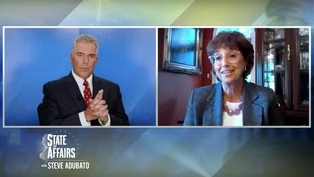
The Childcare Cliff and the Funding That is Needed
Video has Closed Captions
Clip: S7 Ep21 | 9m 33s | The Childcare Cliff and the Funding That is Needed (9m 33s)
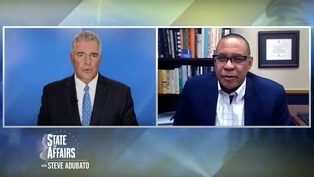
Long-Standing Segregation in NJ Public Schools
Video has Closed Captions
Clip: S7 Ep21 | 8m 27s | Long-Standing Segregation in NJ Public Schools (8m 27s)
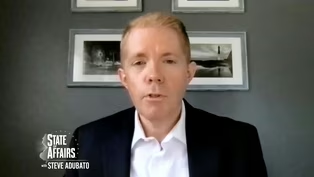
Should Schools Notify Parents of a Child's Gender Identity?
Video has Closed Captions
Clip: S7 Ep21 | 9m 29s | Should Schools Notify Parents of a Child's Gender Identity? (9m 29s)
Providing Support for PBS.org
Learn Moreabout PBS online sponsorship
- News and Public Affairs

Top journalists deliver compelling original analysis of the hour's headlines.

- News and Public Affairs

FRONTLINE is investigative journalism that questions, explains and changes our world.












Support for PBS provided by:
State of Affairs with Steve Adubato is a local public television program presented by NJ PBS