
Shawnee National Park Movement
1/26/2023 | 26m 46sVideo has Closed Captions
Shawnee National Park Movement
There’s a movement to reclassify one of Illinois’ most famous areas – the Shawnee National Forest. Hear from advocates for a Shawnee National Park and Climate Preserve, plus visit with the SI Roller Girls team as they get back in their groove post-COVID.
Problems playing video? | Closed Captioning Feedback
Problems playing video? | Closed Captioning Feedback
InFocus is a local public television program presented by WSIU
Support provided by:

Shawnee National Park Movement
1/26/2023 | 26m 46sVideo has Closed Captions
There’s a movement to reclassify one of Illinois’ most famous areas – the Shawnee National Forest. Hear from advocates for a Shawnee National Park and Climate Preserve, plus visit with the SI Roller Girls team as they get back in their groove post-COVID.
Problems playing video? | Closed Captioning Feedback
How to Watch InFocus
InFocus is available to stream on pbs.org and the free PBS App, available on iPhone, Apple TV, Android TV, Android smartphones, Amazon Fire TV, Amazon Fire Tablet, Roku, Samsung Smart TV, and Vizio.
InFocus
Join our award-winning team of reporters as we explore the major issues effecting the region and beyond, and meet the people and organizations hoping to make an impact. The series is produced in partnership with Julie Staley of the Staley Family Foundation and sponsored locally.Providing Support for PBS.org
Learn Moreabout PBS online sponsorship(inspiring music) (camera beeping) (bright music) - Welcome to another edition of "InFocus."
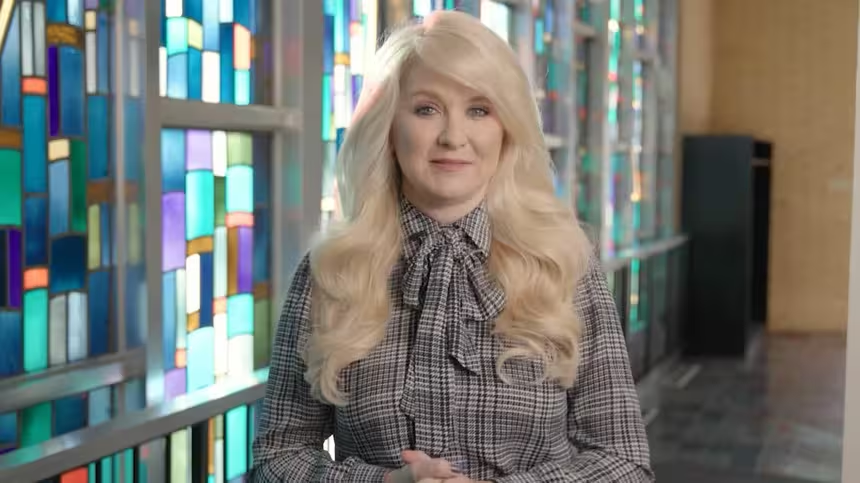
I'm Jennifer Fuller.
We're talking this episode about a potential change that could impact the entire state and, perhaps, the region as a larger picture.
There is an effort underway to change the designation of the Shawnee National Forest, which covers much of far southern Illinois into a National Park.
Talking about that today, we've got Les Winkeler and John Wallace who are leading up the committee that will lead that effort trying to get that change put in place.
Gentlemen, thanks for stopping by.
- We appreciate you having us.
- Thank you.
- So for people who are unfamiliar with the Shawnee National Forest, can you tell us a little bit about it?
It's a large expansive land and it has lots of of unique aspects to it.
- It certainly does.
It's the largest single ownership of land in the entire state.
It spans 290,000 acres from the Mississippi River to the west to the Ohio River on the east.
And in that area is included seven federally designated wilderness areas.
We have 90 different Natural Areas Inventory Sites on the Shawnee that were recognized by the state back in the 1970s.
Beautiful vistas, LaRue-Pine Hills is considered one of the most diverse, botanically diverse areas in the Midwest, if not the country.
In fact, it's known to have more species of plants than the entire Smokey Mountains National Park.
And then we have places like Garden of the Gods on the east side of the forest which is that iconic photo of Camel Rock that is on the Illinois quarter now.
So it encompasses quite an interesting area that we believe needs better recognition and protection.
- People may be familiar with other National Forest areas.
There's the Mark Twain National Forest.
There's, I believe, the Hoosier National Forest in Indiana.
But why the designation change?
What would change if you changed from a National Forest to a National Park?
- The reason we're wanting the change in designation is that we just feel that the National Park Service, it's the next logical step, is what we're saying.
The National Forest Service has gotten us to this point where we have this beautiful resource.
It's one of the most ecologically diverse areas in the country, but the National Park Service focuses more on tourism, it focuses more on education, and it's just suited to what this area needs right now.
The National Park Service designation would, if not eliminate, minimize natural resource extraction plus the National Park Service's goal and mission statement is to make the area more accessible, to bring people in and, in our economically depressed area, I mean, it's just vital that we do something.
I mean, the coal industry is gone.
We have no other large industries in Southern Illinois.
And this is a way to create, not to create, but to maximize our tourism potential.
- We hear a lot when it comes to the economy about how important tourism is, not just for far southern Illinois, but for the state as a whole.
What have you seen when you're researching how the National Park Service works with states and with regional tourism agencies in terms of bringing people in and letting them know about the organization?
- Well, just the amount of free publicity that the change in designation would bring is incredible.
If you go to any bookstore, and I'm assuming some of those still do exist, if you go to any bookstore, there are shelves and shelves of, you know, on individual National Parks.
You know, what to do when you go to Yellowstone, what to do when you go to the Grand Canyon.
And plus there are compilations where farmers and voters each have their National Park guides where you go.
And those are best sellers every year.
Every year they sell over 200,000 copies of those.
So can you imagine what that kind of publicity would cost you?
And the other thing is that, since the pandemic, travel in the United States has changed markedly.
Road trips are back in vogue again.
So the Rand McNally Atlas is booming again.
Like 600,000 copies of that flies off the shelf every year.
And in the new Rand McNally Atlas, there are 75 pages devoted to National Parks.
So every time you saw a car zip by you on the interstate, one of those Ram McNally atlas is in the backseat.
There's information on Southern Illinois and the Shawnee National Park and Climate Preserve in that car.
- You mentioned Shawnee National Park and Climate Preserve.
That's a specific designation that you want to have added, not just to make it a National Park, but really to have the Shawnee Forest, the Shawnee National Forest now, work towards something.
Is that right?
- Yes, what is so important is the fact that we're facing a climate emergency.
And one of the things that the UN's Intergovernmental Panel on Climate Change has documented is the fact that natural systems, natural ecosystems do a wonderful job of sequestering atmospheric carbon, taking that carbon dioxide out of the air that's causing the warming of our planet and storing it.
And forests are the best mechanisms we have on land and especially mature forests.
And the best examples of mature forests are on the National Forest.
And the best example of mature forest in the state of Illinois is in the Shawnee.
And so that will hopefully take this mindset of resource extraction out of the mix.
The Forest Service has a production mandate to produce products, primarily wood products.
And there is a definite tie in with the wood products industry and the impact that it has on natural systems.
Once trees are cut and removed from an area, the forests then become carbon sources instead of carbon sinks.
And that's what we needed, more carbon sinks.
So we want it designated as a climate preserve.
It would be the nation's first climate preserve.
And we're hoping that it will become a model for other public lands throughout the country, because we can't do it with the Shawnee alone.
But we also want it to be a preserve so that some of the recreational uses that people have grown accustomed to historically on the Shawnee National Forest can continue.
Hunting, trapping, dispersed camping, things like that, that you can still do it on preserves, National Preserves.
We have 63 National Parks right now in the country and 21 National Preserves.
Most of them are associated with the National Park.
And each preserve has its own little nuance, its own reason for being formed.
And with the crisis that we're facing, we need preserves to protect the climate and to get us down to that important 350 parts per million of carbon dioxide load in our atmosphere so that we don't have more of these catastrophic events that we've seen in the past recently.
- I wanna get to some of that nuance here in just a moment, but before we get too much further, there's a certain process that you have to go through in order to change these designations.
You can't just pick up the phone and say, "Hey, let's change the name", and, by so doing, change the agency to which you report.
So tell us a little bit about the process and where it stands.
- The first step, it takes an act of Congress to create a National Park.
And that's the reason that we're going the National Park route.
A National Monument can be created by the stroke of the president's pen, but conversely, the next president can come in and nix it and all those protections are gone.
That's why we wanted the National Park designation because it would then, again, take an act of Congress to get rid of it.
The first step, the first thing we're looking for right now is that the Department of the Interior would have to come in and do a feasibility survey.
And in order for that to happen, we have to get a member of Congress or one of our senators to go before Congress and get that approved.
They would then do the feasibility study and then decide whether or not, you know, this area is appropriate for our National Park, which we obviously think is a slam dunk, but you know, that's not our decision.
So that's where we stand right now.
We just recently met with some of Senator Duckworth's staff.
She's on several environmental committees.
So she seems like the logical person to carry the ball for us.
So that's kind of where we stand right now.
We're working on that and trying to drum up local support.
- Sure.
And refresh my memory, I think that there are no other National Parks in Illinois.
Some national monuments, but no other National Parks?
- If you go to the National Park Service website, there is a lack of National Parks in the Midwest.
They are looking to add to their inventory in the Midwest.
I can't think of a better place than here.
And they're also looking for places that are heavily used by migratory birds.
And since we're on the Mississippi Flyway and the Shawnee is home to thousands and thousands of migratory birds each spring and fall, this just seems like the logical place.
- Certainly.
John, you mentioned some of the nuance that comes with a Climate Preserve or with a preserve.
And a lot of people, when I read or I hear about any criticism of this proposal, they say, "Well I don't wanna lose the access that I have to the Shawnee National Forest."
And it was for things like what you mentioned, hunting, trapping, camping, perhaps equestrian trails, ATVs, those sorts of things.
How would this change under your proposal?
- The changes would be relatively minimal.
First of all, I want to point out that the Shawnee has no legalized altering vehicle use on the National Forest right now.
And just considering the impacts for more internal combustion engines, we're certainly not planning on incorporating that into the initiative.
But National Parks, generally, do not allow public hunting, sport hunting.
And so preserves, our National Preserves are areas that are, have many of the same features as National Parks, but allow for more flexibility with management.
And that's where we want to maintain that hunting, these uses that we've become accustomed to.
The places that we're looking to create a National Park, or part of the National Park, is Garden of the Gods, Bell Smith Springs, LaRue-Pine Hills, Little Grand Canyon, places like that, that are so unique and our recreation areas currently don't allow hunting anyway.
And then that way, those places that people have hunted and trapped for years can continue to do that.
And we can still have this informal dispersed camping as well in those areas.
That isn't something, usually, that is allowed in National Parks.
There's remote camping, there's primitive camping, but it has to be in a designated area and it's very controlled.
A little more flexibility with a preserve.
And the big difference though is the climate aspect where we're not going to, we're going to push for no resource extraction.
So we won't have timber cutting, we won't have oil and gas drilling, mining, things like that, that are really detrimental to the climate anyway.
- Along that line, a lot of National Parks have an educational mission as well.
They encourage school trips, they have lots of their own educational opportunities for families to bring their kids or for people who just want some general education.
How do you think that the Shawnee National Park and Climate Preserve, I have to make sure I get that name right, would increase in terms of the educational missions that you see at places like Southern Illinois University, the community colleges that are bordered or perhaps in some cases included in that territory?
- Well, one thing that's, my wife and I traveled to Badlands National Park this summer and it's a quarter of the size of the Shawnee and they had two distinct visitor centers.
The Shawnee National Forest doesn't have any.
We have parts of the Trail of Tears go through the forest.
We have stops on the Underground Railroad.
We have Millstone Bluff.
We have stone forts that indigenous people used hundreds of years before Europeans came through.
And again, I'm not saying anything negative, but it's not the Forest Service's job, it's not their stated mission to do those things.
The National Park Service does.
That's what they do.
That's in their wheelhouse.
I foresee, you know, I foresee a lot more educational opportunities.
I spoke to a friend of mine the other day who works for Fish and Wildlife now, which is also in the Department of Interior, which the National Park Service is, and he was just talking about the significant budgets that the Park Service has for interpretation and education, that, you know, to be perfectly honest, the Forest Service just doesn't have that revenue to do those things, which is why we think it's so important that the Park Service become involved.
- Certainly.
John, you mentioned earlier the fact that the Shawnee National Forest stretches from river to river, from the Mississippi to the Ohio, and how the climate preserve would help capture the carbon that we're trying to get out of the air.
How do you think that would help in terms of river health if it were switched to a climate preserve?
- Well, forests are incredible for holding soil in place and, at least, it used to be, that Illinois's largest export by weight used to be topsoil.
- Oh, wow.
(Les chuckles) - So forests hold topsoil in place and it's going to improve water quality whenever forests are allowed to keep standing.
I think that it would definitely increase interest in the two rivers.
And, you know, there's so much history with our rivers.
You know, they were the highways prior to highways that people used to traverse this nation.
And, so it's real important to highlight the uniqueness of southern Illinois, that area between the rivers.
You know, we have the confluence of the Ohio and the Mississippi just around Cairo.
And then when you throw in economic impacts, you know, Alexander County is just economically devastated.
And here, you know, we currently have the US Forest Service taking logging off parts of Alexander County and the timber is going elsewhere.
Those resources are so important to keep in the ground, literally, and on the ground for our enjoyment as well as for the benefit of the climate.
Another thing that is real important, too, is there's concern, there's a lot of people that work for the US Forest Service.
Jobs are very important, are significant in southern Illinois.
It is actually encouraged within federal agencies to transfer over, to have these transitions, you know, and that could easily happen.
Our previous forest supervisor actually came from, which is the US Forest Service is in the Department of Agriculture, he actually came from the Department of Interior.
So, those things happen.
We can keep a lot of these employees on the Shawnee and still make it better for all the people in southern Illinois.
We went through about 17 years of having an injunction against commercial logging on the Shawnee and we've had these great cottage industries spring up.
And now let's, you know, let's encourage that industry instead of bringing in a new one and try to throw a lot of tax dollars, you know, at that industry and keep the jobs flowing right here.
- [Jennifer] Sure.
- If I can add too about the economy.
If you look at the 11 counties of southern Illinois that encompassed the Shawnee region, they are among the poorest counties in the state.
I did a little research last week where median incomes for each county and every one of those 11 counties is in the bottom 15, bottom 50, excuse me, of Illinois.
It goes, I mean, down, John mentioned Alexander County.
I think it's something like median income is $34,000 which is like 44%, I believe, below the state average.
And there, I think there are like 18% of people in Alexander County that make $15,000 or less.
The amount of children living beneath the poverty line is close to, is over 50% in some of these counties.
So bringing in more jobs, bringing in tourism, having these cottage industries spring up, we think will be a win-win.
And when you look at the map of Southern Illinois, the Shawnee is spread throughout the state.
This is gonna benefit people in Carbondale, Murphysboro, Harrisburg, Cobden, Vienna, you know, and just everywhere.
So we think it could be a great economic driver and studies have shown that.
- With that, we're out of time, but we'll certainly keep an eye on how these things are going.
Les Winkeler and John Wallace, thanks so much.
- Thank you.
- Thank you for having us.
- To another form of recreation now, and roller derby saw a resurgence in the early 2000s, both in this country and around the globe.
But COVID-19 put a stop to all of that for everyone.
Now WSIU's Benjy Jeffords takes us to a recent scrimmage where one local team is hoping to get out of the gate with a bang.
- [Benjy] It's been almost three years since the So Ill Roller Girls have had any type of public event.
- [Announcer] And he is through the pack.
- [Benjy] Until January when they held an open gender scrimmage.
- [Announcer] Reenters the pack.
Now he'll be on his scoring round.
- [Benjy] Lead co-president, Elizabeth Cook, whose derby name is Dread Pirate Robyn, says the pandemic took a heavy toll on the team.
- We decreased in numbers pretty significantly.
We had quite a few people that decided that was their timeline to retire.
Derby definitely takes a toll on your body and just being at home all the time made it difficult to want to come out and spend three hours every Tuesday night practicing.
- [Announcer] Rolling Thunder for yellow team and Cruella to Kill for black.
(whistle blares) - [Benjy] Even though the team wasn't able to bond on the track, they found other ways to connect as a pack.
- [Elizabeth] It also showed us how close to each other we were.
There was a lot of communication despite not having practice.
We all really missed each other and missed this building.
Coming back here for our first few practices back felt like coming home.
It was just a big family reunion and so much fun.
- [Announcer] Reenters the pack now.
- [Benjy] With fewer members on the roster, the team set out to recruit new members ahead of public events.
- We're all so excited.
We've been trying to pump this up on social media.
We've been just going over the lists of this is what we used to do.
We do have a few skaters from neighboring leagues who this is their very first game ever.
So they've been preparing since pre pandemic to skate and then of course there were no games for a few years.
So this is their debut game.
- [Benjy] Cook say team members are located all over southern Illinois and beyond.
- We are from a little bit of everywhere.
Everything from Harrisburg, McLeansboro, Murphysboro.
We have a couple of skaters that come up from Paducah.
So we have just a little bit of everywhere.
We have some sister skaters that are from the Cape Gerardo team that join us a lot.
Some sister skaters from the Evansville team.
So a little bit of everywhere.
Some that come down from Springfield for every game.
So all over the place.
- [Benjy] Raymie Hart, also known as Diana Slama, started competing a few years ago and is a captain of the Cape Girardeau Roller Derby team, but is always invited to visit Marion when the So Ill Roller Girls have an event.
- I like the getting together with all of your friends and everybody is always so great.
They have a lot of fun and, even though we're on opposing teams, then we still like having fun and being together and raising money for charity.
- [Benjy] After many months of COVID-19 forcing the team to sit in the penalty box, they finally got the chance to lace up their quad skates for practice.
(whistle blares) - We've been training for a little less than a year now.
So we've been back on skates, sometimes only one Tuesday a month, but most Tuesdays for the last year we've been back in the building.
So we've been working on getting our conditioning back up.
- [Benjy] Even with months of practice, injury is always a concern in this contact sport.
Cook says it doesn't matter if it's a Women's Flat Track Derby Association sanctioned bout or a friendly scrimmage, they always have medics on hand.
- Before the first pair of skates gets laced up, the medic checks in and make sure everybody's here.
So safety is our number one priority during games, even more than scoring points or winning.
Number two priority.
Having fun is our number one priority.
- [Benjy] Cook says some of the new skaters are a little nervous during their first public scrimmage.
(whistle blares) - They've all heard tales that a couple of our skaters hit really, really hard and that is the truth.
We have some skaters with a lot of years of experience that I don't personally wanna be hit by and I'm the one who trained them how to skate and now I want nothing to do with being hit by them, which is why I coach instead of skating.
- [Benjy] As a coach, Cook says there's not a lot of requirements to roller derby.
(audience cheering) - Tenacity.
You have to wanna stick with it even when your legs feel like jelly after a practice.
But that's it.
You don't have to know how to skate.
We are recruiting right now for anyone that is an adult and wants to play.
Those are the requirements.
You just have to show up for a practice.
We teach you how to skate.
I've had skaters that have gone from couldn't make an entire lap around the track to bout ready in under a year.
So it does not require any kind of skating skill for sure.
(audience cheering) (whistle blares) - [Benjy] The team is always scouting for new members every chance they get.
- Some of us just saw people that looked like they would enjoy roller derby, 'cause, even though there's not a type, there is a type.
We're all very different people, but there are people that we feel like need a place to go and have a release.
- [Benjy] Hart says on top of all the fun and helping community organizations, roller derby can be therapeutic.
(whistle blaring) - It's a great way to kind of let off some steam and just give back to the community.
So I really like that.
And just so many friends you make along the way.
- [Benjy] Cook is also a licensed therapist and agrees with Hart on the benefits of roller derby.
- I feel like I use that license a lot more just as a coach and on skates.
And I feel like I personally need a lot less mental health work if I am able to skate it out.
And that's really something that a lot of skaters feel, is that Derby is our therapy.
- For "InFocus", I'm Benjy Jeffords.
(bright music)

- News and Public Affairs

Top journalists deliver compelling original analysis of the hour's headlines.

- News and Public Affairs

FRONTLINE is investigative journalism that questions, explains and changes our world.












Support for PBS provided by:
InFocus is a local public television program presented by WSIU