State of Affairs with Steve Adubato
Shennell McCloud; Linda Smith; Eric Stiles
Season 5 Episode 37 | 26m 16sVideo has Closed Captions
Shennell McCloud; Linda Smith; Eric Stiles
Shennell McCloud talks about the racial wealth gap in NJ and the importance of representation and diversity in the nation’s democracy; Linda Smith discusses the military’s child care program, the ways COVID-19 impacted the child care industry, and the importance of child care for the nation’s economy; Eric Stiles shares the connection between environmental justice and social justice.
Problems playing video? | Closed Captioning Feedback
Problems playing video? | Closed Captioning Feedback
State of Affairs with Steve Adubato is a local public television program presented by NJ PBS
State of Affairs with Steve Adubato
Shennell McCloud; Linda Smith; Eric Stiles
Season 5 Episode 37 | 26m 16sVideo has Closed Captions
Shennell McCloud talks about the racial wealth gap in NJ and the importance of representation and diversity in the nation’s democracy; Linda Smith discusses the military’s child care program, the ways COVID-19 impacted the child care industry, and the importance of child care for the nation’s economy; Eric Stiles shares the connection between environmental justice and social justice.
Problems playing video? | Closed Captioning Feedback
How to Watch State of Affairs with Steve Adubato
State of Affairs with Steve Adubato is available to stream on pbs.org and the free PBS App, available on iPhone, Apple TV, Android TV, Android smartphones, Amazon Fire TV, Amazon Fire Tablet, Roku, Samsung Smart TV, and Vizio.
Providing Support for PBS.org
Learn Moreabout PBS online sponsorship- [Narrator] Funding for this edition of State of Affairs with Steve Adubato has been provided by Hackensack Meridian Health.
Keep getting better.
The Turrell Fund, supporting Reimagine Childcare.
PNC, Grow Up Great.
NJM Insurance Group.
Serving New Jersey'’s drivers, homeowners and business owners for more than 100 years.
The New Jersey Education Association.
The New Jersey Board of Public Utilities, Clean Energy program.
The North Ward Center.
The Russell Berrie Foundation.
Making a difference.
And by NJ Best, New Jersey'’s five-two-nine college savings plan.
Promotional support provided by Jaffe Communications.
Supporting innovators and changemakers with public relations and creative services.
And by Insider NJ.
[INSPRATIONAL MUSIC] - Welcome everyone.
I'm Steve Adubato.
You're looking at someone we've had on before, back by popular demand, Shennell McCloud, CEO of Project Ready.
Shennell, how are you?
- I'm so good.
Thank you so much for having me, Steve.
I'm really excited to be here today.
I'm hopeful that I can talk about the urgent need for the black women's agenda in New Jersey.
- Why don't you do that?
But first, as we put up the website for Project Ready, tell everyone what it is and then go right into it.
- Absolutely.
So, Project Ready is a social justice organization that I founded a little over four years ago, with the purpose of making sure there were activating voters across the city of Newark, and also adding some supports to our voters across the state of New Jersey.
- Shennell, (sighs) voting has changed dramatically.
People, back in my day, right?
Not your day, my day.
Hey, there's a day.
(Shennell laughing) It's Tuesday, November whatever.
You go and you vote that day.
It's not that way anymore.
Why is that relevant when it comes to issues of race and racial inequities regarding voting?
- I think what's exciting about the difference in between what was happening in your day, versus what's happening in the current day, is making sure that people have all opportunities to access democracy.
We're now seeing people who are voting by mail.
We're seeing people who are engaging in our early voting process, which was just initiated in this past election.
And we're seeing people turn out to the polls, now that it's safe.
And this past election, we're seeing, as the data comes in, a little over 30% of New Jersey voters that participated in the early voting process, which to me is a sign that people are excited about this access and excited about us getting closer to a more fair democracy.
- Shennell, across the country, in New Jersey as well, but across the country more so, there are other states that are saying, "Hey, wait a minute.
The 2020 election taught us a lot.
We need to make it hard."
I take that back, I don't want to editorialize.
"We wanna make sure you have an ID to be able to vote.
We wanna make sure you are who you say you are when you vote."
And then there are others, Stacey Abrams and others down in Georgia who say, "Wait a minute.
That is not about confirming who's voting, but it's about making it harder for minorities to vote.
Play that out.
- Yes, absolutely.
So, I think everything that you listed absolutely has made it harder for our black and brown residents to vote.
And this is one of the reasons why our organization has been working to lead the charge to make sure that people not only have access to vote-by-mail and early in-person voting and online voter registration, but we're now advocates for some additional activities that can support people with voting.
For example, same-day voter registration.
Where are we with that?
Ensuring that people still continue to have a vote-by-mail ballot.
And finally, and this has been a big push of mine, making sure that all of our county clerks have the resources and tools that they need to be able to educate the voter about how they can engage in democracy with some of these new opportunities.
- Shennell, I say, let's play word association.
I've done this with a lot of different people.
I say, "January 6th, 2021."
You say?
- (sighs) It was a tragic day.
It was a day where, if I'm being honest with you, I felt...
I'm a mom, I'm a black woman, and I am someone who is attempting to continue to believe in the democratic process that is supposed to honor and protect me, and honor and protect my children.
And what I saw that day put me in direct conflict with my ability to be able to continue to entrust in the democratic process that I'm hopeful that my kids are gonna be able to engage in, to the fullest extent as we move forward.
I never wanna see anything like that again, Steve.
I never wanna see anything like that again.
And my hope is, as we continue to move forward, and as we start to consider, with new legislators in place, ways that we can protect and honor our people of color, we won't see anything like that again.
- By the way, you're gonna see a graphic as I say this right now.
It's a series we've been doing for a couple of years now, well before January 6th, called Democracy at a Crossroads.
You'll see it on your screen.
Now you may ask, why am I asking Shennell McCloud about January 6th?
Because for me, and it's not, again, an opinion, it is a responsibility for everyone in the media to not just understand what happened that day, but what the implications are for our democracy of that day.
Because if people think, "Hey, it was a one day thing."
Bad enough, if it were a one day thing, but a lot of people are worried about political violence, which we'll be talking about a lot, moving forward.
Real quick, before I let you go, talk about the way racial wealth gap.
How big is it?
What do we need to do?
Shennell?
- Yeah, absolutely.
So, New Jersey has one of the largest wage gaps in the country between white men and black women at 55-- - What is it?
- What'd you say?
- What is it?
Compare it.
- It's at 55 cents on the dollar.
- Okay, for every dollar a white guy earns, go ahead?
- So sorry.
For every dollar, a white person earns 55 cent more than a black woman.
- Is that a white male, or just a white person?
- It's a white man.
- 55 Cents?
- It's a white man.
55 Cents, yes.
And I think what we're seeing here is, and again, I wanna bring this back to the urgent need for us to address a strong policy agenda that honors and protects our black women, for a few reasons.
One, because it's just the right thing to do.
But also, when we look at how people are showing up and showing out to vote, we know that our black women, based on national results, are showing up and they are showing out to vote, but in this recent election, we did not actually see our black and brown people showing up in a similar way that they did in 2017.
- Why do you think that was, Shennell?
- It's a good question.
I think one of the reasons, is that people, our black and brown people, are not feeling heard.
They need to actually see people who are giving them a reason to vote.
And if I may add one other thing, I think that people also need to start seeing more representation, more fair representation, in democracy.
For example, New Jersey's three most powerful leaders are white men.
The governor.
- White, middle-aged, older men.
They just elected a state Senate president, after Senator Sweeney was voted out of office.
and Nick Scutari, who we'll have on the show, I believe from Union County.
Dare I say?
A middle-aged white guy.
That's three.
Three for three.
- Yes.
That's three.
- The governor.
- The governor, the Senate President.
- And Nick Scutari.
What's the message there?
- The message is that it's tone-deaf.
If we are saying that we want to fairly represent the people who are voting and the people who are making sure that we continue to honor fair democracy, we need to actually see those people represented in office.
- Yeah.
There is a Lieutenant Governor in the state, Sheila Oliver, who was the speaker at the house in the assembly.
There is not another, if I'm not mistaken, another elected statewide leader.
And in the leadership down in Trenton there, as Shennell said, three middle-aged, older white guys.
- Yes.
- It is what it is.
People will decide how they view that.
But Shennell, hey, listen.
Continue to come back and educate us, engage us.
And we're honored to have you with us, Shennell.
Thanks so much.
- Awesome.
Thank you so much, Steve.
I really appreciate the time.
- You got it.
I'm Steve Adubato.
Stay right there.
We'll be right back.
(grand music) - [Announcer] To watch more State of Affairs with Steve Adubato, find us online and follow us on social media.
- We're now joined by Linda Smith, who is director of the Early Childhood Initiative at the Bipartisan Policy Center.
Linda, great to have you with us.
- Well, thank you for having me.
I appreciate it.
- You got it, describe what the center is.
- Well, we're a Washington D.C. based think tank that tries to take ideas from the both sides of the aisle to create better policies for some of the most pressing issues in America and obviously childcare is one of them.
- Yeah, you mentioned childcare that have been engaged, people, I'm sure, are tired of hearing me say this, but we have a series called "Reimagine Childcare."
We're constantly looking to try to understand childcare challenges, but from your perspective, what is the direct connection between the need for affordable, accessible, quality childcare and the economic vitality of our nation?
- Well, I think it goes without saying that America can't work without childcare.
It really is that simple and so for parents to be active, productive members of our economy, they need to have their children cared for and in a way that makes them feel good about it.
They can't be at work worried about what's happening with their children while they're not there.
- The center has looked at, examined, studied, tried to make sense of, the military's childhood system.
What is it and why is that a model for us to better understand?
- Well, I think the military system is a model for several reasons actually.
First of all, it is a business model.
The military does childcare because they need childcare for mission readiness.
In other words, you're not going to the front lines if you don't have childcare.
So, they early on recognized the importance of childcare when it came to the basic business of the Defense Department.
I think that the other thing that's important about the military's model that is missed by a lot of people is the way the military actually funds childcare.
I think perception number one is that parents don't pay for it in the military and they do.
The other piece though is that the government through the DOD, through the government funds, basically matches on a dollar for dollar basis what parents pay.
So, parent fees are matched dollar for dollar, but the way the money goes into the program is what makes it different and makes it successful and the way it goes into the program is the money goes directly to the programs to buy down the cost of care for parents.
- Well, can that model, the military model, can and how, it'd be used as a model across the nation?
- Well, I think it really can and it needs to be because I think one of the things that we just learned in COVID was that we have a very fragile supply of childcare in this country.
When COVID hit and the programs closed, they closed because they didn't have any income.
They were very unstable.
We've lost what we think is at least 10% of our supply over the last couple of years and it's gonna be hard to get that back.
So, the reason that the military model is what the nation needs to think about is that we need a system where we support these programs, keep them viable as businesses, but at the same time, allow parents' choice and so what you see going on right now in our country is a lot of conversation about giving parents more access, giving parents certificates, vouchers, whatever you want to call them, to go out and buy care.
But, without the care, the supply being addressed, we're not solving the problem.
Where do you take that voucher if we don't have enough childcare providers out there?
- And we've had so many, by the way, check out our website at steveadubato.org, you'll see on the screen, so many interviews that we've did, we've done so many interviews and segments about the fact that it's so difficult to find quality childcare professionals to be with those children, which then in turn closes childcare centers down, which even if they're open, limits the number of childcare classrooms or the number of children that can be taken care of, it's this vicious cycle.
Let me ask you something, Linda, how do we avoid, and again, our job is not to be advocates, but rather to be engaged in public awareness, but how do we avoid the messaging or the message that, this childcare thing, it's a nice thing to do, but it's sorta like daycare and we've had enough of these social spending programs and we need to cut down on that, we need to cut spending on them, we need to be more fiscally prudent and it's a nice thing to do, but it's not a necessary thing to do.
I'm just saying some people think that, what is the appropriate retort to that?
- Well, I think it's multiple.
We just talked a little bit about the issue of parents can't go to work without childcare, but I think the science has been crystal clear now for about 20 or 30 years on the science and the neuroscience, the brain development and we really do know now that the first three years are very critical to a child's later success in life.
So, it's not just that parents need it to go to work, we need quality childcare because of our education system.
We're feeding kids into our schools who aren't ready for that because they're coming out of experiences that haven't prepared them for it.
We have health issues.
There's so many aspects of childcare that aren't- It's just not one dimensional and I think the payback for investing in childcare goes without saying, the economic impact studies have been done, the ROI, the return on investment, that's all been done.
We know these things, we just need to act on them now.
- Before I let you go, the biggest impact of COVID as we do this program at the end of 2021, scene, a little bit later, biggest impact of COVID on childcare overall?
- Well, I think it's been on the workforce because when COVID hit the workforce was just simply laid off.
There was no money to pay them, the income to the programs stopped and we have a workforce that was already in trouble.
I think we know that the average way to childcare workers is $12 an hour in this country.
You can make a lot more than that going down the street to a fast food restaurant in this country.
So, what is the incentive?
And I want to stress that the workforce issues are real.
You started out saying that, that they were having trouble recruiting staff.
Well, half of the childcare workforce in this country qualifies for public assistance programs, that said, half of the workforce also have degrees of some sort, whether an AA or a BA.
So, it's not an under-qualified staff, it's an underpaid staff and that's because parents can't pay anymore, so we have really got to fix this.
- Linda Smith, the Director of the Early Childhood Initiative at the Bipartisan Policy Center based in Washington, DC.
Linda, we thank you for joining us, educating us and helping us better understand.
Thank you, Linda.
- Thank you.
- We'll be right back after this.
(grand music) - [Announcer] To watch more State of Affairs with Steve Adubato, find us online and follow us on social media.
- We're honored to be joined by Eric Stiles, who's the President and Chief Executive Officer of the New Jersey Audubon.
Good to have you with us, Eric.
- It's a pleasure to be here.
- Absolutely.
I'm sorry.
You were gonna say?
- Just repeating.
I'm thrilled to be on the show and thanks for all you and your team do to bring the key stories to the Garden State.
- That's very kind of you.
The New Jersey Audubon, describe what it is as we put the website up.
- So there's two things that we focus on.
One is connecting people and nature and making sure that's a fundamental human right and not a mark of privilege or affluence.
And so you can unpack that in all sorts of exciting ways in our very diverse state.
And the second thing is really focusing on the Noah's Ark.
Making sure that the wildlife, the habitat, the waters of New Jersey today are there for future generations and hopefully in better conditions.
- So let's talk about environmental justice.
I want to read a quote that you've put out there and it's profound, it's provocative, it's important.
Let me take my glasses for this, as you get older on the air, you know.
"Every person has the fundamental right to safe, welcoming, and positive experiences in nature, free of violence, threat, harassment, or harm."
Why should that even be said?
Why does it need to be said?
- You know, sometimes you gotta go back to the basics.
I'll never forget there was a retreat from folks, all sides of the spectrum.
And it was an evangelical minister that said, "Look, unless the environmental community begins with visions and values, you will never be successful.
You always go to strategies and tactics."
So I think in order to really build people into seeing themselves as part of a big movement, a big tent, you have to be very deliberate, very inclusive.
And I need to recognize that as a white heterosexual male, that grew up in the Judeo-Christian faith, I'm welcomed in just about every park.
It is a safe experience for me and people like me.
- Same here.
- But that should be a human right.
So there's studies after studies that show kids that grow up surrounded by nature, lower rates of anxiety, lower rates of depression, as adults.
Studies after studies that show urban communities with well-managed parks, lower rates of crime, higher property values, better physical condition of the occupants, increase mental health.
Studies after studies show that when kids engage in outdoor learning as part of their education, you have higher attendance rates.
So you think about some of the issues of our great cities.
You have higher grades, higher college placement.
Not that everyone needs to go to college, but there's so many -- - They need the opportunity to go to college, though.
- Yes, it needs to be equitable.
It needs to be inclusive.
It needs to be just.
- But hold on a sec, I'm sorry.
Time is always an issue even on public broadcasting.
What the heck is the connection between the way our parks have been set up and institutional structural racism?
What's the connection?
- That's a great question.
So prior to the 19, well, I'd say the 2000s prior to Jim McGreevey, the state overwhelmingly spent its dollars for land acquisition, outside of our great urban centers.
And it was understandable at the time it was a race for space, right?
So as suburbs are building out, we wanna buy up the lands in the hinterland so it protects our water.
It protects open space and so forth.
Understandable at the time.
But boy, we inadvertently left so many folks from New Jersey behind.
We hear about food deserts.
We talk about public health deserts.
We also have park deserts in this state.
So this is really about reinvesting in areas that have been treated in an unjust manner.
The same communities that have the very high pollution loads, also the poor air quality, tend to also have a lot fewer acres of open space.
I had mentioned this to someone earlier.
I grew up in Atlantic County, outside of Atlantic City.
There was an old train line that was being converted Rails-to-Trails.
The town I grew up in, Linwood, was overwhelmingly white.
The train line went from Summers Point through Linwood to Northfield and then into Pleasantville, which was an overwhelmingly, at the time African-American community.
What I heard as an eight and nine year old in my town was we can't let the trail run to Pleasantville, because it's gonna become a criminal highway.
Not from my parents, but that was the conversation.
I mean, that is wrong on so many levels.
So.
- And public policy reflected, often reflected that rhetoric.
- If you actually look at where the dollars were being spent, yeah.
So it was consistent with that rhetoric and that pattern even recently talking about creating an open space.
Someone approached New Jersey Audubon about taking open space in Somerset Hills.
And we said, okay, well, you know, we have to make this accessible to the public.
In order to get, and this is a fair trade-off.
We have fought tooth and nail for this.
If you're going to get property tax abatement, it has to be available for the public.
And it was Tom Gilmore, past CEO, chatting with me and we said, okay, but this is a, and that person was hemming and hawing.
And we finally forced the conversation.
We said, who are you worried about specifically coming to park here?
He said, well, are you going to have buses from Newark?
Now this is not - So there it is.
So there it is.
- There it is right there, it's a mic drop moment.
- Still today.
Okay, still today.
So we're going into 2022.
It is still there.
For those who question, come on, why?
Steve, why are you guys doing so much on racism?
Why confront our, see our series Confronting Racism you'll see it out there.
Enough!
Enough already.
We got the message, but a lot of it's in the past, is it?
- Well, I think I would say that it isn't in the past, but there is some good news starting with... - Give us some good news, got about a minute left.
Give me some good news.
- Starting with Governor Jim McGreevey, the expenditures of state open space funds have flowed back tremendously to our city.
So if you look at the expenditures from 2000 to the present, really beginning to reinvest in these great cities.
- P.S.
I live in Essex county, I live in Essex county.
The county government, and I just, because someone we've interviewed before, Joe DiVincenzo, the County Executive, the amount of urban park activity is off the charts.
That's not editorializing it's a fact.
I'm sorry, go ahead.
- And look at the new greenway, the Montclair to Jersey City, what?
- The greenway, Montclair to Jersey City, could you ride your bike?
- $60 Million dollars.
- That's awesome.
- So we're beginning to put our money where our mouth is.
Before, I'd say that we would say that our issues were colorblind were, were race blind, but they weren't.
It, it followed a lot of the same policies, exclusionary zoning, and so forth.
I think in New Jersey, the future is bright.
We are at this tipping point and New Jersey is also the tip of the spear.
We're very diverse.
We're a highly educated, highly affluent state.
We have a ways to go, but we have all of the right ingredients to be successful.
- Hey, Eric, this is the first time you've joined us.
Let's make sure it is not the last.
We learned a lot from you and we appreciate the work that you and your colleagues at the New Jersey Audubon are doing every day.
Thank you so much.
- Thank you so much Steve.
- You got it, and I'm Steve Adubato, that is Eric Styles.
See you next time.
- [Narrator] State of Affairs with Steve Adubato Is a production of the Caucus Educational Corporation.
Funding has been provided by Hackensack Meridian Health.
The Turrell Fund, supporting Reimagine Childcare.
PNC, Grow Up Great.
NJM Insurance Group.
The New Jersey Education Association.
The New Jersey Board of Public Utilities, Clean Energy program.
The North Ward Center.
The Russell Berrie Foundation.
And by NJ Best, New Jersey'’s five-two-nine college savings plan.
Promotional support provided by Jaffe Communications.
And by Insider NJ.
(Music playing) NJM Insurance Company has been serving New Jersey policy holders for more than 100 years.
But just who are NJM'’s policy holders?
They'’re the men and women who teach our children.
The public sector employees who maintain our infrastructure.
The workers who craft our manufactured goods.
And New Jersey'’s next generation of leaders.
The people who make our state a great place to call home.
NJM, we'’ve got New Jersey covered.
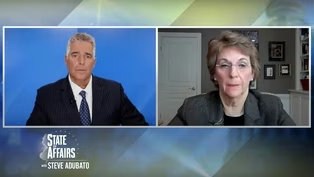
The Importance of Child Care in the Military and the Country
Video has Closed Captions
Clip: S5 Ep37 | 8m 48s | The Importance of Child Care in the Military and the Country (8m 48s)

The Need for Envirionmental and Social Justice
Video has Closed Captions
Clip: S5 Ep37 | 9m | The Need for Envirionmental and Social Justice (9m)
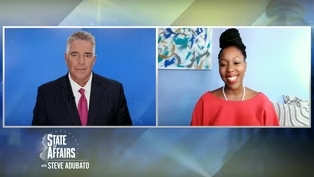
Representation and Diversity in Today's Democracy
Video has Closed Captions
Clip: S5 Ep37 | 9m 12s | Representation and Diversity in Today's Democracy (9m 12s)
Providing Support for PBS.org
Learn Moreabout PBS online sponsorship
- News and Public Affairs

Top journalists deliver compelling original analysis of the hour's headlines.

- News and Public Affairs

FRONTLINE is investigative journalism that questions, explains and changes our world.












Support for PBS provided by:
State of Affairs with Steve Adubato is a local public television program presented by NJ PBS