
Shepherd’s Bay Farm
Season 17 Episode 4 | 28m 45sVideo has Closed Captions
On their farm Kathy and Terry Sletto stay connected to a long family heritage of wool-production.
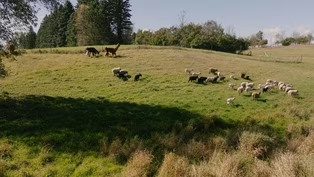
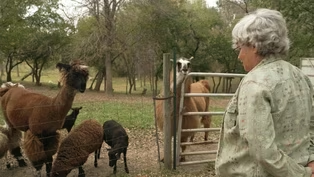
On their farm near Alexandria, Kathy and Terry Sletto stay connected to a long family heritage of wool-production through their collection of sheep, rabbits, and guard llamas.
Problems playing video? | Closed Captioning Feedback
Problems playing video? | Closed Captioning Feedback
Postcards is a local public television program presented by Pioneer PBS
Production sponsorship is provided by contributions from the voters of Minnesota through a legislative appropriation from the Arts and Cultural Heritage Fund, Explore Alexandria Tourism, Shalom Hill Farm, West Central...
Support provided by:


Shepherd’s Bay Farm
Season 17 Episode 4 | 28m 45sVideo has Closed Captions
On their farm near Alexandria, Kathy and Terry Sletto stay connected to a long family heritage of wool-production through their collection of sheep, rabbits, and guard llamas.
Problems playing video? | Closed Captioning Feedback
How to Watch Postcards
Postcards is available to stream on pbs.org and the free PBS App, available on iPhone, Apple TV, Android TV, Android smartphones, Amazon Fire TV, Amazon Fire Tablet, Roku, Samsung Smart TV, and Vizio.
Providing Support for PBS.org
Learn Moreabout PBS online sponsorship(bright music) - [Narrator] On this episode of "Postcards."
- [Kathy] Oh, there, look at, they're perking up their ears now.
(bowl rattling) - [Terry] They're going the wrong way.
You gotta do something.
- You're doing really good today.
- And she said, well, I don't suppose you'd be interested in this old spinning wheel, would you?
And, and I just, I just jumped at the chance.
If you watch closely while others think you should be shoveling manure, it's amazing what you'll see and learn.
(upbeat music) - [Narrator] "Postcards" is made possible by the Minnesota Arts and Cultural Heritage Fund and the Citizens of Minnesota.
Additional support provided by Margaret A. Cargill Philanthropies.
Mark and Margaret Yeakel Jolen on behalf of Shalom Hill Farms, a retreat and conference center in a prairie setting near Windom, Minnesota.
On the web, at shalomhillfarm.org.
Alexandria, Minnesota, a year-round destination with hundreds of lakes, trails, and attractions for memorable vacations and events.
More information at explorealex.com.
A better future starts now, West Central Initiative empowers communities with resources, funding, and support for a thriving region.
More at wcif.org.
(machine buzzing) - They're smart.
And if you work with them, they'll work with you.
These are a little tense today, can you tell?
They might do a little bit of kicking.
(lively music) (machine buzzing) (lively music) (machine buzzing) (lively music) - There's three after this one, Kate.
Your numbers are off.
- [Kathy] Oh, no.
- Nothing new about sheep, right?
(serene music) - My husband, when he was a kid, he and his dad raised sheep.
And I grew up on a farm too, and loved all animals, but we did dairy and beef cattle, we didn't have sheep.
So, when Terry and I bought this piece of land, we were both really excited.
We got our first three sheep, we got Shetlands that were pure bred, registered Shetlands.
But, pretty soon we got seven more sheep and I hit some angora rabbits, and then we began breeding sheep.
And it snowballed from there.
And as the years have gone by, coyotes have become a problem where they weren't, when we first started raising sheep, we didn't have that problem.
We learned that llamas actually have a fiber that can be spun and used.
And, they were great guardians of sheep.
And then we both kind of fell in love with llamas and just their quirky personalities.
- Food will get you anything.
Oh, including a fight.
- Yeah.
We have three guard llamas.
Francis, the older one is, is not great at her job, but she, she has produced two sons who are fabulous guard llamas.
(marching music) (quirky kazoo music) Forget it, you're full of spit.
If you reach out, they'll back away.
But they like to come, right, they have no concept of your personal space.
Your breath is so bad.
(playful music) We had a lamb that was born and she was just very tiny.
We didn't think she would live.
She was just tinier than a loaf of bread.
And this is, she's probably a month or more old here, but she used to be smaller than the barn cats.
And she just had the run of the whole place.
She was the boss of everyone.
Everyone fell in love with her and she just became a pet.
We assumed she would be a wool producer like the others.
We had her fleece sheared.
And we discovered that it was very, very coarse.
When you're in the sheep or the wool business, that's basically a trip to the slaughterhouse if you've got a coarse fleece.
But, we just couldn't bear to, to do that to her, so, one day our daughter-in-law said, have you ever heard of those dryer balls?
And so we created a whole industry for Calamity Jane, and it's one of our best sellers, I guess, is Calamity Jane's dryer balls.
She beat the system basically Calamity Jane wears the bell because she's one of the senior citizens of the flock now, and she's sort of the dominant member of the flock.
(bell clanging) (playful music) (machine buzzing) Typically, we shear once a year in the spring for the adults when it's warm enough so they're not gonna suffer from the cold.
And sometimes we shear in the fall, the lambs that are gonna be going to market because they have got the best, most beautiful softest wool.
And it's clean.
It's not full of hay.
We sell as many as we can of the lambs to people for wool production.
And we keep some, if some of our older ones have died, we'll save some.
But unfortunately, we only have enough pasture and hay for maybe 40 sheep, so, a bunch of them have to go.
They'll be going to auction.
And it's a really interesting demographic, I guess, used to be slaughterhouse buyers is what you would see, it would be kind of these crusty old men with semis that would load up a lot of sheep.
Now, a lot of the immigrant groups, they like sheep and goat meat.
And so, you'll see families come in and buy two or three sheep, so, it's different kinds of buyers.
And then the fun ones are, there's the 4-H kids that are coming to look for a 4-H lamb.
So, they'll buy like one lamb.
- Actually, I bought a couple of ewe lambs when I was about 12 years old and used them for a 4-H project And grew up to about 25 ewes by the time I took off for the service, so, we had a deal at 4-H at the county fair here a few years ago at honoring people who had been in 4-H for many generations.
And there was three generations of our family that have all showed sheep at the fair.
It was my dad, myself, and our youngest son.
- Yeah, if you got any questions, just ask us.
We'll try to answer them for you.
- Yeah, the sheep shearer is really an important person in the world of a shepherd.
You know, that's what Tim, he is used by many, many people like us that they really care about the fleece, the results.
It can't be just hacked up and in really awful pieces.
- I'm a farmer.
And I started shearing sheep when I was 15, but we had sheep when we're growing up.
And when the sheep shearer came, we skipped school to help.
And then I really got shearing sheep when I went to parochial school, Lutheran School of Long Prairie, my teacher was a, he had a shearer machine.
So him and I would go together.
He'd shear one, Id shear one, so we did that back and forth for lots of years, so.
But, it was a lot of fun.
(machine buzzing) About 50 years I've been in the public shearing sheep.
Every sheep has a different personality, just like people.
Come every year, every one of 'em be different.
It's always fun, it gives you a challenge, The end, man.
- [Terry] You gotta do something.
- You're doing really good today.
(serene music) (Tim speaking indistinctly) (serene music) - You know, back in the olden days, like Terry's family, anytime you had someone that came to your farm to work that was a tradition where you would prepare a meal and not a frozen pizza, it was a serious meal.
Meat and potatoes and dessert.
And so, today I've baked a couple of hot dishes.
They're and they're specialties, they're Norwegian Lutheran funeral hot dishes.
So I thought, the crew here, you know, needed that.
And so, we'll see how that turned out.
(bowl clattering) Okay, here we have my mother-in-law's famous tater tot hot dish.
And here's my mother's tomato noodle hot dish, we don't call it a casserole, you call it a hot dish.
We're in Minnesota.
(upbeat music) When I was a little girl, I had a aunt who had a handicap, where she had polio and one hand was pretty much paralyzed.
And she had these therapy sessions that she was supposed to do.
And one of the things they told her to do is she should knit.
And she'd say, well, I might have to knit, but I'm not gonna knit alone.
And she would force me to sit with her.
And I was probably six, six to eight years old sitting on the couch.
And she would make me sit and knit when I wanted to be outside playing.
And I didn't like it at first, but then I, you know, I could make little outfits for the cats, you know, for the barn cats or, you know, a little coat for the dog.
And then it became really fun and I just got hooked on it, so, I've been knitting since I was a little kid.
(serene music) I typically knit when it gets dark.
So, in the winter, I get a lot of knitting done in the summer, I don't much done.
I make a lot of hats and mittens just because they're quicker and I can get a lot more done.
And I, I just like to have some examples of what can be done with our yarn and our wool when we go to festivals.
I have a sweater that I can show you, or, yeah, Terry will bring it and it's a very old Norwegian pattern.
And then to make the hat I kind of adapted part of the sweater.
Yeah, here's the, this I made for our youngest granddaughter, and it's from our own sheeps yarn, but the thickness of the yarn varies so much that when I used an actual pattern, I don't have a yarn that fits what the pattern calls for.
And so I did this and it was too big.
And then, so, I adapted the pattern and made it a little smaller.
And I ended up making three sweaters like this before I had one that actually fit her at that, at the age she was at, and... So, I use this as just kind of an example of what you can do with our yarn.
It's fun if you like, what they call color work to be knitting with like two different colors of yarn at once.
But, you have to really concentrate when you do it.
So, you don't wanna be watching anything very good on TV when you do this.
(somber music) All three of my children were knitters when they were very young.
And everybody started making a scarf.
And I think I, my oldest son has a scarf, I still have it like in my knitting basket, this little really ragged looking scarf.
And my daughter about a year ago, really got into knitting and she has made some really nice things.
And then my youngest son, he was the one that throughout his childhood actually knit and was kind of like a crazy designer.
He'd make these fingerless gloves with different sizes of fingers and, you know, kind of weird designs.
(upbeat music) - After shearing the sheep, we wash the wool to get it nice and clean.
And what we end up with after that is stuff that looks like this.
It's kind of a, almost a tangled mess.
So, the next step would be carding it to get to all the fibers in line before it can be spun.
This carding rig is something that came from my family.
I'm sure it's gotta be in the neighborhood of 100 years old.
I'm not real sure of what the origin of it is, but, well, this is what we got.
In order to use this one place some wool in these combs, it's just a whole bunch of little wires sticking up here.
These are pointed this way and these are pointed this way so that when you drag it across, whoop.
That aligns all the fibers.
(comb rustling) This one over here, this is a much more modern version.
It's called a drum carder.
(carder rustling) Much easier, much quicker.
And then when we take it off.
This is what's called a batt.
Just peel it off this, the drum.
(carder rustling) And all your fibers are nicely aligned.
- Thank you.
- [Terry] And now I'll hand it over to Kathy so she can do the spinning.
(foot pedal tapping) (serene music) - The same aunt who taught me to knit, when she was gonna sell her house, she was going through things in the attic and she said, well, I don't suppose you'd be interested in this old spinning wheel, would you?
And, and I just jumped at the chance.
And so she told me the story of it, and it was made by my great-great-grandfather, Lars Moen.
Let's see.
This is Lars Moen and his wife Joran.
Why do they look so angry?
He brought with him from Norway a wood lathe.
Then the first winter, he made a spinning wheel for his wife and one for each of his daughters.
Yeah, and that was in the late 1860s.
And this one was passed down.
It was used for, I think, really steadily into the 1940s at least.
It had originally been held together only by wooden pegs and the glue made from the oxen's horns and hooves.
And he could not read or write, but he could make his last name was Moen, so, he carved the initial M. So, he kind of signed it.
(bright music) (serene music) I would say each sheep produces maybe two pounds of really prime wool.
And so, if we've got 40 sheep times 2, that's from the sheep.
And then the rabbits each can produce, you know, maybe half a pound a year.
So, it's a lot of wool.
It's like way, way too much wool.
As we got more and more sheep, there was just no way that I could keep up with that.
But, we do sell a lot of our fleece to hand spinners at festivals.
And then what doesn't sell, that's what goes to the mill to be made in the yarn.
I've got a bunch of angora rabbits and that I do all by hand on a spinning wheel.
(footsteps rustling) This is Daphne, a french angora rabbit.
So she's been raised for her wool.
And I, I really like her color, it's called chinchilla.
And it's kind of a salt and pepper look.
The French angoras never existed in the wild, they were kind of crossbred by people for an animal that will just sit, because you have to do so much with their wool, they'll just sit on the table where a lot of rabbits would not just sit on the table, especially when there's like a cat on the shelf below.
There's Little Man.
(serene music) See, they're very tolerant.
No, don't fight kitty.
You're too aggressive Little Man.
(playful music) This is angora rabbit's wool, and it's very fuzzy.
They call this the bloom of the angora.
It's all hand spun.
I harvest it with a scissors from the rabbit about three times a year, spin it on the spinning wheel.
And then I ply together three or four strands to make this yarn.
And it's probably the most luxurious yarn you find in Minnesota.
You can find some really nice yarn from musk ox, but they're not around here.
Yeah, I put the picture and the name of each rabbit on the mittens or hat that it's made from.
Just they deserve credit for, I mean, they've made a huge contribution there.
And this is my mother's suitcase from before she was married.
She traveled the world and then she married my dad and was stuck at home with children and the housework and cooking.
This must have been kind of her teenage heartthrob.
We don't know who it is.
We often get comments, we ask people who, who it is.
Somebody said Montgomery Clift.
(playful music) We had an old sheep and her name was Ada.
She was one of those first three sheep that we got.
And we tend to keep the sheep until they're, until they die of old age, where we figure they deserve a few years of peaceful retirement.
And so, Ada was at that point where she hadn't had a lamb in a few years and she really wasn't producing wool.
And she had very clearly had cataracts.
And we believe she had some form of sheep dementia.
The other sheep will call for their lambs.
And when they go into the barn at night, they stand by the door and they call, and then their lambs run to them and they go in for the night.
Ada every night would stand by the door and call for her lambs, but she hadn't had lambs for years.
And so there was no answer and it was always sad.
We also had this crazy half wild barn cat, a great big orange and white cat.
And we started to notice he was riding around on the back of Ada, it's warm on the back of a sheep.
But, we thought he was taking advantage of her for her warmth 'cause she really didn't know what was going on, so we would shoo him off.
But, we began to notice that in the evening when Ada would stand by the door and call, Oliver, the cat, came and they would sleep together.
He would nestle up beside her and he became kind of her eyes and ears.
And he took care of her.
And when she died of old age, she was well into her teens.
Oliver stayed here for about a week, and after that he left the farm.
And we never saw him again.
It was like his work was done.
If you watch closely while others think you should be shoveling manure, it's amazing what you'll see and learn.
- People think this is a, you know, a- - [Kathy] Photoshop - Photoshop.
- We're not that good.
- Yeah, thanks for, you know, thinking we can do that, but we can't.
- No.
(serene music) - They love to be with their flock and to graze and to be outside and to lay, you know, lay outside in the summer in the grass under the trees.
So, I think they do have quality of life.
What we try to do is let them live kind of the way they lived on the Shetland islands.
We try to not make them too commercial.
(serene music) (playful music) Yeah, it's been quite a journey with the sheep and the llamas and the angora rabbits.
I had an office job for many, many years and I always had too many animals.
If somebody had to get rid of their cat that's tried to murder their husband, I would take it home.
I didn't tell Terry that that's why I brought the cat home, but... Peaches, Peaches was his name, the man killing cat.
One time someone said, I've heard of a camel for sale, and Terry put his foot down.
That was kind of, that was bad.
You know, I could never make a living at this.
I spend too much time with cats and too much time with making the wool perfect.
- I used to do a little bit of crop farming, but not much.
But, it was kind of a hobby for us, you know, we both had full-time jobs, so.
But, we liked the farming and the lifestyle that came with it, and that's why we settled on this.
35 years we've been here, yeah.
- [Kathy] Oh, there, look at, they're perking up their ears now.
- [Terry] They're going the wrong way.
(bowl rattling) (sheep bleating) (serene music) - I was at the gas station one day, and two guys were, they were buying bait and they were talking and they said, yeah, you know, I was fishing, it was great in that, that sheep bay, that bay where you can see the sheep grazing.
And so, that just kind of made its way into being Shepherd's Bay Farm.
(serene music) Jed, do you wanna do tricks and treats?
Let me get the treats out for you.
Jed?
Jed, he has no treats.
Up, Jed, up.
He has to hold someone's hand when he gets up because of his bad back.
Okay, Jed.
Jed, you wanna jump?
Good kitty.
I think animals don't nearly get the credit that they deserve.
There's so many times that they have just surprised me with their empathy.
And you think they're, they're just animals, they don't really know anything but how they, you know how the families stick together.
One individual doesn't thrive on their own.
You have to thrive as a community.
There's just been so many, many, many examples of how animals have shown really wisdom and kindness and goodness that sometimes you don't find in people.
(serene music) (upbeat music) - [Narrator] "Postcards" is made possible by the Minnesota Arts and Cultural Heritage Fund and the Citizens of Minnesota.
Additional support provided by Margaret A. Cargill Philanthropies.
Mark and Margaret Yeakel Jolen on behalf of Shalom Hill Farms, a retreat and conference center in a prairie setting near Windom, Minnesota.
On the web at shalomhillfarm.org.
Alexandria, Minnesota, a year-round destination with hundreds of lakes, trails, and attractions for memorable vacations and events.
More information at explorealex.com.
A better future starts now.
West Central Initiative empowers communities with resources, funding, and support for a thriving region.
More at wcf.org.
(upbeat music)
 New
NewPreview: S17 Ep4 | 40s | On their farm, Kathy and Terry Sletto stay connected to a long family heritage of wool-production. (40s)
 New
NewVideo has Closed Captions
Clip: S17 Ep4 | 26m 50s | On their farm, Kathy and Terry Sletto stay connected to a long family heritage of wool-production th (26m 50s)
Providing Support for PBS.org
Learn Moreabout PBS online sponsorship

- Arts and Music
The Best of the Joy of Painting with Bob Ross
A pop icon, Bob Ross offers soothing words of wisdom as he paints captivating landscapes.











Support for PBS provided by:
Postcards is a local public television program presented by Pioneer PBS
Production sponsorship is provided by contributions from the voters of Minnesota through a legislative appropriation from the Arts and Cultural Heritage Fund, Explore Alexandria Tourism, Shalom Hill Farm, West Central...