
Shrooms, Reparations, and the City Budget
Clip: Season 5 Episode 32 | 6m 28sVideo has Closed Captions
On the ballot: psychedelics, reparations, and input on the city of Detroit's spending.
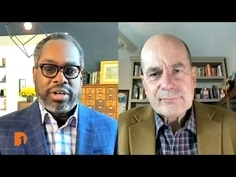
Next Tuesday, Detroiters will decide the mayoral and city council races. They'll also get to approve or reject 3 ballot proposals that involve decriminalizing psychedelics, the creation of a reparations committee, and having more citizen input on how the city’s budget gets spent. One Detroit contributors Stephen Henderson from American Black Journal and Nolan Finley from The Detroit News weigh in.
Problems playing video? | Closed Captioning Feedback
Problems playing video? | Closed Captioning Feedback
One Detroit is a local public television program presented by Detroit PBS
Shrooms, Reparations, and the City Budget
Clip: Season 5 Episode 32 | 6m 28sVideo has Closed Captions
Next Tuesday, Detroiters will decide the mayoral and city council races. They'll also get to approve or reject 3 ballot proposals that involve decriminalizing psychedelics, the creation of a reparations committee, and having more citizen input on how the city’s budget gets spent. One Detroit contributors Stephen Henderson from American Black Journal and Nolan Finley from The Detroit News weigh in.
Problems playing video? | Closed Captioning Feedback
Where to Watch One Detroit
One Detroit is available to stream on pbs.org and the PBS app.
Providing Support for PBS.org
Learn Moreabout PBS online sponsorship- All right, Nolan.
So in addition to like new city council and having a mayor's race in November, we have some ballot proposals in the city of Detroit, three of them let's start with the one that would make people goofier in the city.
The one that would be utilized mushrooms, psychedelic mushrooms.
What do you think about that?
- I love mushrooms on my pizza, Steve, but I'm not sure about this one because it decriminalizes, but it doesn't actually make them legal.
I guess that's not within the purview of city voters.
So it decriminalizes mushrooms.
And I am all for the legalization of drugs, almost any drug, but I do think that the legalization should become with a regulatory framework to protect people, just like we do with alcohol.
This one doesn't come with any such framework.
- No, and it is a very piecemeal approach to the idea of what to do about illegal drugs.
More generally, I don't know that we should just go down the list and tick different things off and say, well, we'll decriminalize this, but not that you should have a pretty broad discussion about how we want to deal with drug enforcement in cities like Detroit.
I am not as much in favor of legalizing drugs as you are.
I think in a city like Detroit, especially given the problems we have with employment in particular that are tied to drug is something we want to think about.
It's something we really want to talk about and what it does to communities for the sales to communities.
But this one seems it was come out of left field, like someone was doing mushrooms and came up with an idea that, Hey, this shouldn't make.
- Well our efforts to criminalize drugs and keep them illegal, that hasn't worked from using them.
And I think it's time to stop and revisit that because it has, The whole criminalization process has ruined a lot of lives, apart from the drug use.
Other one on the ballot would replace our representative democracy with direct democracy or at least would risk doing that.
It would allow ballot proposals to appropriate money from the city treasury from the city budget.
And man, I think that's terrible idea.
You get a situation like California, where almost every decision is made by a ballot proposal.
We elect leaders, mayor council for a reason to make these decisions.
- Yeah.
You know, one of the things that I think people don't think about when these kinds of ideas come up is that this would be available to everybody.
It's the activist community that is pushing this because they want to have more say over how the city spends its money.
They presumably would like corporations and corporate interests to have less say, but this would just give them just as much say.
Anybody would be able to do this and convince enough voters with a campaign to allow them to do it.
It's just normal way to run a government.
This is not, it's not efficient.
It's dangerous.
There's a lot of very small interest groups who corporate or a grassroots who could, who could end up deciding how we spend big parts of the budget.
It's better to, to lobby the people that we elect and say, look, I want you to do this.
And sometimes you win.
Sometimes you lose.
- Absolutely.
And finally, a proposal to establish a reparations committee commissioned to study paying reparations for slavery and past discrimination.
What should that look like, Steve?
- I mean, I think continuing the discussion that has been started about the things that have been done by government particular, to disenfranchise African-Americans, to steal from us, to assign us to the second class, I'm all in favor of all of that in theory.
And I think it is perfectly appropriate for the city of Detroit to be part of that, that inquiry, you know, this is a continuation of an idea that was rejected as part of a massive rewrite of the city charter.
This is pulling that one idea out and saying, why don't we go ahead and talk about it?
I think it's a step we got to take.
- Well, I mean, if they're looking at creating programs to help small businesses, to improve education, scholarships, to deal with the effects of long-term racism across the spectrum.
I think that's one thing and direct checks written to individuals, I think is quite another, you'd have to be certain that racism is going to end with this generation because what are you going to do for the next generation then that suffers many of the same, same effects.
- Yeah.
Well I think, I mean, you know, the idea here is to start thinking about it, to start looking at how do you unpack, first of all, the responsibility for what's happened.
And then second of all of what you might do about it, you know, the idea of compensating people for being wrong is not new.
When it comes from Americans, we did it after the Holocaust in large measure, people were made whole for the things that happened to them.
Japanese Americans were paid recompense in, in large measure for the mistreatment during the second world war.
That's something we've got a history of African-Americans have been left out of that conversation.
I don't think that makes a lot of sense.
- In both those cases.
So they were the actual victims being compensated, not generations later.
And I think you know, it's a different approach than, and so, but a lot of cities are doing this.
A lot of studies are studying it and it's taken different forms.
So voters will have a chance to decide all of these, all of these issues next Tuesday.
- Absolutely.
- We'll make sure.
to give you the latest on the election results next week, right here on One Detroit.

Future of Work: What It Takes to Create Quality Workplaces
Video has Closed Captions
Clip: S5 Ep32 | 7m 5s | Knowing your transferable skills can help you navigate from industry to industry. (7m 5s)
Student Reporting Labs: A Conversation on Racial Inequality
Video has Closed Captions
Clip: S5 Ep32 | 7m 47s | High school student Micah Martin produced an in-depth conversation on racial inequality. (7m 47s)
Providing Support for PBS.org
Learn Moreabout PBS online sponsorship New Episode
- News and Public Affairs

Top journalists deliver compelling original analysis of the hour's headlines.

- News and Public Affairs

Today's top journalists discuss Washington's current political events and public affairs.




 New Episode


 New Episode
 New Episode
 New Episode
Support for PBS provided by:
One Detroit is a local public television program presented by Detroit PBS