
Sierra Hull
Season 1 Episode 4 | 26m 46sVideo has Closed Captions
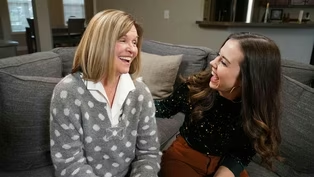
Becky Magura asks mandolin virtuoso Sierra Hull what she'd do with a clean slate.
Becky Magura asks mandolin virtuoso Sierra Hull what she'd do with a clean slate.
Problems playing video? | Closed Captioning Feedback
Problems playing video? | Closed Captioning Feedback
Clean Slate with Becky Magura is a local public television program presented by WNPT
Sierra Hull
Season 1 Episode 4 | 26m 46sVideo has Closed Captions
Becky Magura asks mandolin virtuoso Sierra Hull what she'd do with a clean slate.
Problems playing video? | Closed Captioning Feedback
How to Watch Clean Slate with Becky Magura
Clean Slate with Becky Magura is available to stream on pbs.org and the free PBS App, available on iPhone, Apple TV, Android TV, Android smartphones, Amazon Fire TV, Amazon Fire Tablet, Roku, Samsung Smart TV, and Vizio.
Providing Support for PBS.org
Learn Moreabout PBS online sponsorship(gentle music) - [Becky] Sometimes life gives you an opportunity to reflect on what you would do with a clean slate.
Our guest on this episode is Sierra Hull, singer, songwriter, and mandolin virtuoso, who calls Nashville home.
♪ I've thrown away my compass ♪ ♪ Done with the chart ♪ ♪ I'm tired of spinning around ♪ ♪ Looking for direction, a Northern Star ♪ ♪ I'm tired of spinning around ♪ ♪ I'll just step out ♪ ♪ Throw my doubt into the sea ♪ ♪ For what's meant to be will be ♪ - [Becky] Sierra Hull's positively stellar career started early.
She had her Grand Ole Opry debut at the age of 10, only to be called back just a year later to perform with her hero and mentor, Alison Krauss.
(bluegrass music) Sierra hails from Byrdstown, Tennessee, located in the Upper Cumberland region, and has deep family ties and traditions that launched her on this musical journey.
Influenced by her parents to learn an instrument, Hull was soon hooked on the mandolin and became a crowd favorite at bluegrass jams all across the country.
(bluegrass music) She played Carnegie Hall at the age of 12, signed with Rounder Records at the age of 13, played the Kennedy Center at the age of 16, received a Presidential Scholarship at the Berklee College of Music and performed at the White House at the age of 20.
(mandolin music) In recent years, she's gone from child prodigy to creating the very mature Grammy-nominated album "Weighted Mind."
♪ Weighted mind ♪ - [Becky] Produced by legendary bluegrass musician Bela Fleck, it was her third album, and filled with heartfelt, original tunes.
♪ If my love leaves me ♪ ♪ What shall I do ♪ - [Becky] Sierra won the IBMA's Mandolin Player of the Year award three times in a row and became the first woman to capture that prestigious title.
Following up on a demanding touring schedule, where she also learned to master the art of coffee, we visited Sierra in the home that she shares with her husband, Justin Moses, also an accomplished and award-winning musician.
Sierra, I've been watching you, actually, I think I've known you since you were 10.
- About as long as I've known anybody in my musical world, really.
(Becky laughs) I mean, I remember seeing you on the Smithville Fiddler's Jamboree, local TV, when I was, you know, just getting started.
I think I was nine the first time I went there.
- Right.
Right.
- Started playing at eight.
So it was very early on that I got to know you.
- You know, it's just, it's a treasure.
You're a treasure, really.
- Aw.
- [Becky] And how did you get started playing mandolin?
- You know, I've always been a music fan.
Music was always a part of my life from as far back as I can remember.
Like, hearing music in church.
My mom, I remember her, sitting on her lap when I was probably two or three, learning to sing a song, you know.
Music is just, as you know, in this kind of part of the world, it's kind of a way of life for a lot of people, especially when you grow up here in music and church.
And everybody from my granny to, you know, my Aunt Betty sings, and so my mom always had this real natural singing voice.
She had a natural ear for harmony.
Although nobody had really taught her that, you know, she could always kind of hear those things.
But my dad was always a music lover.
And so when I was growing up, I grew up right next door to my great-aunt and uncle.
So my granny's older sister Betty and my Uncle Junior, and Junior was, you know, self-taught, like, not a shredding musician by no means, but just like played fiddle, mandolin, and guitar a little bit.
He'd play old tunes like "Wildwood Flower" or, you know, he'd play fiddle with the kind of old time style with the fiddle way down, you know.
- Oh.
- Below the neck and kinda on the shoulder.
And I don't even know if he knew how to play many chords on the mandolin, but I remember seeing the instrument in his hand and he would, you know, you'd walk in his house, especially later on, in my kind of early teenage years, after he had retired, he would always be playing music.
So then he got my dad into it and it was really my dad who got this real bug for bluegrass and started getting into wanting to learn to play and going to some local festivals and got my brother and I into it.
And from there, it was just like we got kind of eat up with it.
- But you loved it.
- I fell in love with it immediately, yeah.
- And so Alison Krauss was your mentor.
You followed her.
You loved her at that early age.
- Yeah.
- Did you emulate her style?
- Oh, the very best I could.
(both laughing) Yeah, total, total.
Just copycat the best I could.
I mean, I was such a huge fan.
I mean, there was music I loved, obviously, but I remember being about nine and getting that first Alison record and it was just like, "What is this?"
And, you know, it was like a real fire of like, "Wow, this..." Like, she became my hero, and I was, you know, just couldn't get enough of those albums.
And then she had such a great band and being able to hear somebody like Adam Steffey play mandolin on those records, as a mandolin player, was also a big influence to me, aside from just Alison singing and all that.
So, yeah, big hero, for sure.
- Well, so, I know that you, she did call you at home one day and your dad had been like, I've read that he'd say, "Now, you need to practice, 'cause one day Alison Krauss is gonna call you."
- Yeah, I mean, it was my dream to get to play with her, honestly.
I mean, it's like, I don't know why the dream was so specific, but it was my dream to play with her on the Grand Ole Opry.
I mean, we would watch the Opry on the weekends, and it was on TV every weekend back then, and I have photos that, you know, my mom had kept or whatever, that I drew playing on stage with her.
And then mom had me write my age on it, so like nine years old.
So I know it was before I met her that I was drawing these pictures of, you know, playing with her.
So, yeah, my dad would always say, "Well, you've been a little lazy lately.
You haven't been practicing very much.
So, I mean, if you, if you don't get to practicing, one of these days, she's gonna call you and you're not gonna be ready."
You know?
- Yeah.
- And so I'd be like, "Oh.
Well, I guess I better get to practicing."
Like, that could happen, you know?
So my parents were just really amazing at helping me believe that that could be possible.
- You went from Byrdstown, that's where you're from, up in the Upper Cumberland part of Tennessee.
Beautiful area.
The home of Cordell Hull; you're related to Cordell Hull.
- Yep.
- Yep.
Right.
And you got a scholarship, a Presidential Scholarship to Berklee School of Music in Boston.
So Byrdstown to Boston.
- Yeah.
- What was that like?
- It was kind of a crazy, crazy thing as growing up, you know, a bluegrass kid.
That's all I ever wanted to do; I wanted to play.
And I had enough opportunities early on that, you know, it felt like I could just, outta high school, start playing and start touring and, you know, make a living doing that.
And so that's kind of what I had been thinking, "I can't wait to..." You know, I always tried to make good grades in school and I loved school as an experience, but I really wasn't planning on going to a music school.
I wasn't planning on, you know, kind of putting what I thought was gonna be my opportunity, my career, so to speak, on the back burner.
- [Becky] Right.
- And I thought there's no way I could be able to go to music school and have that still kind of coexist.
That I'd have to wait.
But the folks at Berklee reached out to me when I was maybe a sophomore, saw a video of me playing or something, and said, "Hey, we'd love you to consider coming to school here."
And at that time, they were trying to expand and start what was called the American Roots Program.
So it was kind of an exciting time when lots of young players from sort of the acoustic bluegrass folk world were interested in going there.
And so, you know, when I got that Presidential Scholarship, it was the first time that a bluegrass artist had been given that.
And I just kind of, there was a part of me that was like, "This wasn't in the plan!"
Like, "I don't know if I wanna do this."
But then there was a part of me like, "This is insane if I don't do this."
What an amazing opportunity to get to, you know, essentially go to school for free and be able to have this experience and sort of even go represent the music I love, in a way, you know, and be part of this sort of early generation of players around the start of a program like that.
So I was really fortunate the way that worked out.
And it was, you know, I say the things I learned at school were great, in some ways so different, 'cause I had never studied music in that way before.
I mean, bluegrass is such an organic, kind of learning by ear and sitting under the shade tree jamming kind of thing, you know?
So it was definitely a different experience, but I think just moving to Boston alone was a good experience for me as a young person to experience that.
- Oh, absolutely.
I think I just applaud you for doing that - Well, thanks.
- 'cause it's a big deal.
Well, you know, you record, you signed with Rounder Records while you were still in high school, right?
- Yeah.
I signed at 13 and made my first record, I think I put the first record out at 16.
- [Becky] Wow.
- Something like that.
Made the first record in high school and then made the second record when I was at Berklee.
- I admire you because the person that you are is the person that we see here on camera.
It's the person that people see on stage.
You're just so genuine.
- Thank you.
- You're so approachable.
You're so gracious and humble.
And that is a true reflection, I think, of probably your upbringing and your roots, but also just you.
- Well, you know that old saying, "Don't get above your raisin'."
(both laugh) You know?
- Right.
- I think that that was pretty ingrained into me as a young person.
I think that, you know, music is cool and this is fun and it's great that you're getting to do these things, but at the end of the day, that's meaningless if you're not a good human first.
And so, yeah, grateful my parents always kind of kept my feet on the ground in that way, you know?
- That's awesome.
You know, I love your, I love your album.
- [Sierra] Thank you.
- Well, I love all your albums, actually, but "Weighted Mind" was really, that's the one that Bela Fleck produced, right?
- Mm-hmm.
Yep.
- And then your new one, your newest one is "25 Trips."
- Trips.
Yep.
- Was that because you were 25?
- I wrote a lot of that record around that time in my life, yeah.
So, you know, 25 was kind of an interesting period of time, 'cause it was the year I got married.
It was the year I got my first Grammy nomination.
It was the year I, you know, certain things in my career.
I met Dolly Parton for the first time.
- Wow.
- You know, stuff like that, where it was just like, "Wow, this was kind of an incredible year."
And sort of really brought to light that sort of experience of like, "Oh my gosh.
Sometimes you gotta stop and smell the roses."
And it's so easy to just kind of be looking ahead at everything down the line.
So a lot of the record kind of reflects those themes of sort of trying to slow down and enjoy things, but also, you know, kind of feeling like it's easy to go, "Oh, I'm excited for what's happening a month from now," and kind of thinking ahead.
So that balance, you know.
- Well, it's different.
The music is really... You're a wonderful storyteller, for one thing.
- [Sierra] Thank you.
- And your lyrics are very, just sometimes vulnerable, sometimes really open, so reflective, and the music takes a twist that's not typical bluegrass.
In fact, I would say bluegrass often is band-related.
This feels very personal, like it's you-focused.
Can you share a little bit about both?
Both of these albums reflect that to me.
- Yeah.
"Weighted Mind" was really a bit of a step into a different territory for me as a songwriter.
I think I had always been kind of working toward those sounds for a while.
Even, you know, a few of the things on that record I had written even in high school.
I remember starting some of those things but hadn't really put them all in one place to kind of share those things.
So when I decided to do that record with Bela, one of the things, I had actually already started recording some of that music in a bigger band setting and then I changed direction, started working with him.
And he was like, "What if he made a record that was almost solo?"
You know, he actually thought it would be cool if I made a completely solo record, just mandolin and voice, and focused on, there's an album of Tony Ross' that I really love and so many of us in the bluegrass world kind of revere called "Church Street Blues" and it's just mostly Tony and a guitar.
And he was like, "I don't know that anybody's done that with a mandolin.
What if you just take your sort of songwriter self with your instrumental self and try to really make this unique thing?"
So it kind of reframed the way I would think about kind of approaching my own music.
'Cause when you grow up in that bluegrass setting, playing, you know, a lot of the instrumentation, everybody kind of has their role and that's part of the beauty of it.
It's like, you know, the mandolin does this thing in the bluegrass context and you might play a 30-second solo or you might, you know, kick a song off or play some backup behind the voice, but when you're solo, there's no band there.
So it sort of opens up the possibilities of what you can explore within the instrument and the songwriting process.
So, you know, it was fun to do that.
And I think moving into "25 Trips," it was sort of me trying to figure out how to take that still vulnerable feeling of sharing who I am when all the things are stripped away, but figure out how to do that with more instrumentation and more people involved.
- It's so beautiful.
It's just such...
The songwriting is just so beautiful.
- [Sierra] Thank you.
- So who inspires you?
- Oh my gosh.
I'm so inspired by just so many different genres, and, you know, it's like even saw Bonnie Raitt on the Grammys the other night and was just reminded like, "Oh my gosh, that voice!"
So I've like been listening to her again lately.
Of course, you know, people like Joni Mitchell.
I mentioned Dolly Parton.
It's like in the bluegrass world, that list, those people are forever my heroes.
I mentioned Alison.
People like Chris Thile.
People, you know, Ricky Skaggs, Tony Rice, the list kind of goes on and on there.
But, yeah, I just, I love all kinds of different styles of music, so I try to, you know, listening to Billie Holiday on Valentine's Day 'cause who doesn't love that kind of just beautiful, you know, it's just, there's so much to love and enjoy out there.
It's hard to, you know, soak it all up, but I try.
- Well, and speaking of Valentine's Day, you're married to a pretty famous guy, Justin Moses, who I'm sure inspires you.
And you two are just the most dynamic duo.
- Oh, thank you.
I mean, gosh, yeah, it's kind of amazing getting to be married to somebody that loves music like I do, and, you know, in so many ways.
He's from Tennessee, too.
We grew up very similarly, you know, growing up in the bluegrass world and a lot of the same kind of community festivals and things like that that, you know, gives us sort of that shared experience and background.
It's great that we get to travel together some and play together, and I feel really fortunate about that.
Of course, there's times where, you know, we both really love it.
So occasionally we're like, "No, this is what I think about this."
"No, this is what I think about this," but it's great.
I always know that he's gonna be somebody that I can bounce ideas off of when I'm working on music, and the same when he's working on music.
So it's, we're lucky to have that, I know.
- There's a song on "25 Trips," I think, or is it "Weighted Mind," "Beautifully Out of Place."
- That's "25 Trips."
- It is on "25 Trips"?
- Yeah.
- Did he inspire, was there something he said to you?
- Yeah, basically, he's the reason I ended up writing that song, 'cause I was trying to write for this record and just was, you know, sometimes I think you get in periods of time where you're trying to come up with stuff and it's just easy to be your own worst critic, so much so that it's like you feel like nothing you're doing is good enough.
And so then you start working on something and throw it away.
Work on something, throw it away.
And he walked in our little music room over here one day.
I was working on something and he said, "What's wrong?"
He could just tell I was like, "Ugh."
You know, just in one of those, "I'm just getting nowhere with this," you know, frustrated.
And so, yeah, he just gave me a sweet little pep talk and he was like, "I'm your biggest supporter.
I'm your biggest fan and you know that."
He said, "But you gotta believe in yourself, too, or you're not gonna be able to get anywhere with it.
You gotta learn to trust yourself and trust that what you're working on is good enough, that you've got something to say and that's okay."
And, you know, little did he know that was, I guess, just what I needed to hear.
He was headed off somewhere and then that song just fell out, you know, the opening lyrics, "You believe in me, but I can't see what you see.
How long will it take me to trust myself?"
You know, it just like, just fell out.
♪ You believe in me ♪ ♪ But I can't see what you see ♪ ♪ How long is it gonna take me ♪ ♪ To trust myself ♪ - Well, it's beautiful.
- Thank you.
- Just beautiful.
There's so many songs.
We could talk about every song on the album.
- Oh, thank you.
That means a lot.
- But the name of this show is "Clean Slate," and the purpose of that is getting someone, you're pretty young and you may not need a clean slate, but if you did, what would you focus on?
- You know, I do think it's funny you bring up that song "Beautifully Out of Place."
I think, you know, I've always been pretty true to myself as a person.
I don't feel like I'm usually somebody that's, you know, swayed too easily by this trend or that trend.
I've always tried.
But it is, I think it's hard, and sometimes, growing up, where you are taught to keep your feet on the ground, to be humble, I think sometimes that learning to really trust yourself is sometimes something I've struggled with.
Like where it'll take me a long time to make a decision that I kind of already know the answer to.
- Right.
- You know what I mean?
And so I think if I could go back and tell my younger self, "It's okay.
Learn to really trust yourself now and don't feel like you have to always drag your feet."
- Do you often feel like you have to get validation?
- I think so.
Yeah.
Yeah.
I'm definitely somebody... And not that it's a bad thing to take advice from people and, you know, I'm always, like, wanna be open to hearing what other people have to say, but, yeah.
But I think sometimes not having to always feel like, you know, sometimes that can be confusing too.
You can get too much feedback coming your way to where it sort of makes you be stuck in a place for a period of time.
Whereas sometimes it's kind of like, "No."
Sometimes you you do have sort of a path or a inspiration in front of you or something that is ultimately where you need to go or where you're gonna wind up going.
But, yeah, sometimes I feel like I've sort of needed validation from this person or that person before I can really trust that, "Oh, that's the thing."
You know?
- Your lyrics are so personal.
Do you often worry, is there a sense of vulnerability that you, while you're crafting it, do you worry that, "Oh my gosh, so-and-so's gonna know this is about them."?
(Sierra laughs) - Sometimes.
Like, sometimes, a little bit.
I do think there's a little bit of, you know, wanting to, just, out of respect for whoever that you might be writing about.
Like, I wrote a a song not too long ago about my granny, called "Spitfire," and I just think she's got the most amazing life.
This isn't one anybody's heard yet.
But, you know, thinking about, like, she's had a crazy...
Her story is amazing.
The woman needs a movie.
(Becky laughs) But trying to find inspiration and sometimes I think being able to kind of write songs in a way that, you know, can sort of tell the stories of other, or tell stories about myself.
But also, you know, at the end of the day, I think people know when you're being honest, and I think that, at least for me as a listener to other people and their music, when I know somebody is singing something that feels truthful and honest in their lyric, whether it's super vulnerable or kind of written in a way that might be read between the lines, whatever it is, I think you can usually tell the difference in that versus just kind of phoning in a lyric.
- Right.
No, I think you're absolutely right.
And the people that you talked about earlier, Bonnie Raitt and Joni Mitchell and Dolly Parton, those are fine examples.
- The most amazing examples of it.
Yeah.
So I try to remember that.
Yeah.
There's always that little part of like, "I don't know.
I hope that this does feel vulnerable to do," but I think, you know, it gets a little easier to be more open and sharing songs and just being like, that's just kind of part of it, I think.
- If you could, if you could change one thing today that would make a big difference in your life, what would that be?
- Oh my gosh.
Well, I think that I love music so much that I, at times, if I'm not careful, and this is something that I can say I'm currently trying to make sure that I am aware of at this point in my life, where I'm coming off of like 12 of the busiest months I've ever had.
Last year was just an insane touring year.
Amazing in so many ways.
A lot of really fun opportunities and tours that I got to do.
But it's easy for me to be a "yes" person and a workaholic, so to speak, to where I'm just constantly going, going, going.
My to-do list is, you know, stacked a mile high at all times.
And even though I really love it, it can wear a person down, you know?
And I think that I'm trying to just make sure that I do stop and smell the roses and that I can make sure that I'm, even though I'm not good at resting, to be honest, I'm not good at it.
Like, I find if I try to take a, "Here's a Sunday.
I'm gonna sit at home and do nothing," it's like I'll be good for a couple hours and then I'm kind of like, "Okay, now what do I need to be doing?"
(both laugh) You know, it's very hard when you live that musical life to turn it off, especially when it's the thing that you're passionate about.
So I think I'm just trying to remind myself that my music actually, I think, will thank me later by being inspired, by living, by making sure I'm leaving time to also just live my life and not constantly be grinding and working on things for my career, even though I really care about it and I love it.
But just making sure that like, "Hey, these are good years to enjoy."
Making sure I'm taking a walk and sometimes doing nothing.
- Yeah.
Hoo, sister, are you speaking to me.
- Yeah.
I know.
- I need to listen to you, for sure.
- I'm trying to tell myself that now.
- Well, so, in the few minutes we have left, what are some things, what's some new things that you're doing, trying, new people that you're working with that we need to be looking for?
- So I'm working on new music.
I'm really excited about this, this period of time where I feel like I'm sort of doing some rebuilding of my team and refocusing of my career and in a way that feels like an exciting place to be in because, you know, I'm not like a young, young artist.
Because I started so young, it feels like I've been doing this for so many years now.
But I do feel like I've still got, you know, so many hopefully great years ahead of me as a musician and a lot of things to explore.
So I'm working on new music that I hope will be able to be released in the next year or so.
And it's a real kind of exciting creative period of time for me, I think, where it's like I feel like I'm able to kind of lean back into my roots and hopefully bring some of that with the singer songwriter stuff, but also getting into some exploring of the more instrumental side of things, too.
And I'm excited about just being able to sort of have, hopefully even this year be a moment of pause and rest and refocusing, where I can actually have time to work on that music and have, you know, a larger offering down the line.
So I'm excited about that.
- So you know we chose your song to be our theme song.
- I heard that.
- "Compass."
- Yes.
- So how about that?
That spoke to me so much about this idea of "Clean Slate" and can you tell me a little bit about that and how you feel?
- Well, first off, I'm honored that you would wanna use it.
That means so much.
That song, it's... You know, it was chosen to be the, it's the second track on the album, followed by this instrumental opening, but it's the first real song on that album.
And part of the choosing of that was just by design, because that song is all about, you know, tired of spinning around, trying to find your direction, and sometimes you just have to step out and trust that what you're doing, you know, kind of going back to what we were saying earlier about trusting yourself, just being able to sort of say, "I'm gonna throw my doubt into the sea, 'cause what's meant to be will be."
I think we spend a lot of time stressing over stuff that may or may not happen.
And it's like, there's so much that's just not in our control.
And so I think being able to, you know, sometimes just go, "You know what?
I've gotta put one foot in front of the other and set sail somewhere.
And this seems like where I think my heart is telling me I need to go," and that's an important thing and we can't worry about all the rest.
(Sierra laughs) - Right.
- Because that's gonna happen.
So, yeah.
So that song definitely has meant a lot to me and was the opening of that record for that reason and sort of thematically what a lot of that record was built around.
And so it means a lot you guys would wanna use it.
- Oh, it's perfect.
And thanks for setting sail on this new show for us.
- Hey, thanks for having me.
(gentle music) ♪ I'm throwing away my compass ♪ ♪ Done with the chart ♪ ♪ I'm tired of spinning around ♪ ♪ In one direction ♪ - Okay.
I heard something about you that I didn't know that maybe most people don't know, that you're an aspiring barista and can make coffee.
- Yeah, I was out on my fall tour last year and my bass player decided to bring his espresso machine on the bus.
So he had the, you know, he had the Breville, he had the nice grinder, and so we kind of had the joke going that, you know, Cafe Coveney - that's his last name - was open at 9:00 AM every morning or whatever.
So I was a barista in training and so now we've opened up a location here in my home.
Yeah, I do love coffee.
So I'm getting close on the milk frothing process.
(bluegrass music)
Video has Closed Captions
Preview: S1 Ep4 | 30s | Becky Magura asks mandolin virtuoso Sierra Hull what she'd do with a clean slate. (30s)
Providing Support for PBS.org
Learn Moreabout PBS online sponsorship













Support for PBS provided by:
Clean Slate with Becky Magura is a local public television program presented by WNPT