
"Silence the Violence,” the Black Church addresses gun violence
Season 54 Episode 26 | 26m 46sVideo has Closed Captions
Our "Black Church in Detroit" series examines the role of the Black church in helping to reduce gun
Our Black Church in Detroit series examines the efforts to reduce gun violence in the community. We’ll talk about what the church is doing to help promote peace. Plus, we’ll take you to this year’s “Silence the Violence” march and rally at Church of the Messiah in Detroit.
Problems playing video? | Closed Captioning Feedback
Problems playing video? | Closed Captioning Feedback
American Black Journal is a local public television program presented by Detroit PBS
"Silence the Violence,” the Black Church addresses gun violence
Season 54 Episode 26 | 26m 46sVideo has Closed Captions
Our Black Church in Detroit series examines the efforts to reduce gun violence in the community. We’ll talk about what the church is doing to help promote peace. Plus, we’ll take you to this year’s “Silence the Violence” march and rally at Church of the Messiah in Detroit.
Problems playing video? | Closed Captioning Feedback
Where to Watch American Black Journal
American Black Journal is available to stream on pbs.org and the PBS app.
Providing Support for PBS.org
Learn Moreabout PBS online sponsorship- Just ahead on "American Black Journal," our Black Church in Detroit series examines the efforts to reduce gun violence in the community.
We'll talk about what the church can do to help promote peace.
Plus, we'll take you to this year's Silence the Violence March and Rally at the Church of the Messiah.
Stay right there.
"American Black Journal" starts right now.
- [Announcer 1] Across our Masco family of companies, our goal is to deliver better living possibilities and make positive changes in the neighborhoods where we live, work, and do business.
Masco, a Michigan company since 1929.
Support also provided by the Cynthia & Edsel Ford Fund for Journalism at Detroit PBS.
- [Announcer 2] The DTE Foundation is a proud sponsor of Detroit PBS.
Through our giving, we are committed to meeting the needs of the communities we serve statewide to help ensure a bright and thriving future for all.
Learn more at DTEFoundation.com.
- [Announcer 1] Also brought to you by: Nissan Foundation, and viewers like you.
Thank you.
(light upbeat music) (light upbeat music continues) - Welcome to "American Black Journal."
I'm your host, Stephen Henderson.
Today, we're continuing our Black Church in Detroit series, which is produced in partnership with the Ecumenical Theological Seminary and The Charles H. Wright Museum of African American History.
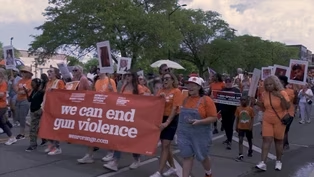
June is Gun Violence Awareness Month, and the Church of the Messiah in Detroit held its 19th Annual Silence the Violence March and Rally earlier this month.
The event, which was founded by the church's senior pastor, the Reverend Barry Randolph, honors shooting victims and brings together residents, faith leaders, elected officials, and law enforcement to find ways to end gun violence.
"American Black Journal" contributor Daijah Moss was there and she produced this report.
- [Group] No justice, no peace!
No justice, no peace!
(drum beating) No justice, no peace!
(drum beating) - My son died 10 years ago.
He was actually murdered, mistaken identity.
So I'm just making sure families have what they need, and especially those surviving siblings.
- Growing up, I've seen a lot of violence.
My dad was sentenced to jail for a violent gun crime.
And just all around in my environment, I've seen people getting robbed, hurt, and killed.
I felt like there was nobody to protect me.
I felt endangered.
I felt like being outside was just hard.
My mama didn't like me riding bikes and doing a lot of kid stuff just because there was a lot of violence going on.
(audience chattering indistinctly) - I am a parent who lost children to gun violence at the hands of my abuser.
Gun violence is in our home, our schools, our neighborhoods, and in our communities.
Though we experience so much heartache, we do not walk alone.
Our unity is our greatest strength.
And our voices, when joined together, are louder than any act of violence.
- Today as we declare to silence the violence, we stand in solidarity with the survivors, with grieving families, with community leaders, and with every resident who believes our city can be safer, stronger, and more united.
Behind every statistic is a name.
Behind every name is a mother praying, a father grieving, a child waiting for a sibling who is never coming home.
And that is why we cannot afford to be comfortable.
We cannot afford to be silent.
We cannot afford to be bystanders.
We cannot afford to be spectators.
The best way to stop violence is to prevent violence.
The best way to prevent violence is to build peaceful communities.
(audience applauding) - I want to say, God is good!
(podium pounding) - [Audience] All the time!
- And all the time... - [Audience] God is good!
- When we do our chants, make as much noise as you possibly can.
We're gonna wake up the entire city of Detroit.
- Pastor Barry.
- Yes, sir.
- With Silence the Violence and what you and this congregation have been doing, God has definitely answered those prayers.
Violence in the city of Detroit, gun violence in particular, continues to go down.
Last year, we closed out 2025 with the lowest number of murders, homicides in the city of Detroit in over 60 years.
(audience cheering and applauding) You know that it's about gun violence awareness each and every day, not just the month of June.
We gotta keep up the fight.
Thank you.
(audience applauding) (marching band music) - We have a very combatitive generation.
To be conflicting is positive.
To be negative is in trend.
To be violent means you're in style.
So we have a whole culture mindset that we have not been able to address because of the infiltration of music, video, food, community, poverty, absent fathers.
So there's so many reasons that our mindset has been transformed to literally, it's a method of defense.
If you are not violent or you're not carrying a gun, then you're a victim.
The main thing that people really have to do is that we have to start caring.
People don't care.
- I think we lack self-love.
We don't value ourselves, right?
So it's hard.
I mean, it's easy to take a life when you don't value your own life.
- I was arrested for gun violence.
I was caught with a gun charge, CCW.
And I ended up getting in this program called The Peoples Action, and they helped steer my path a different way.
I know that's crazy to say, but I am actually glad that I did get arrested so that I could actually get my head on straight, because deep down, I knew I wasn't that type of kid.
Kids younger than us really need us, 'cause I feel like a lot of kids look up to us.
So I feel like none of that is worth it, you know what I'm saying?
Live your life, start a family, get a good job.
Chase your dreams.
- We just gotta understand that we are all in this together, you know what I mean?
Regardless for the people that commit violence, for the people who have violence committed against them, right?
It all hurts us the same, because we got family, you know what I mean?
And you know, it's undeserving for a kid or anybody to not make it home at night to their loved ones.
- If you see something, say something.
Nurture those who are going through.
A lot of the mental health issues are underlying grief that are not addressed.
So make sure they have resources.
Make sure they need, you know, have what they need.
And put the guns away.
Lock them up.
Make sure they're in a safe place, and just support those who are in need.
- Ricochet.
Where will it land today?
In the sacred space of schools where children carry tomorrows in their backpacks.
We declare their futures are not targets.
We answer together, "Not here."
Not another child, not another family, not another community.
We rise in love.
We stand in unity.
We act with urgency because the question has answered, has echoed long enough.
And today, we stand together.
Today, together, we change where it lands.
- [Leader] Silence the violence!
- [Group] Silence the violence!
- [Leader] In nonviolence!
- [Group] In nonviolence!
- So strong community partnerships are key to addressing the root causes of violence.
The Black Church is an integral part in that effort.
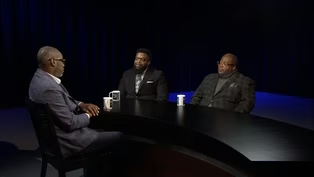
Here to talk about reducing gun violence are Reverend Lawrence Rodgers, Senior Pastor at Second Baptist Church, and Teferi Brent, who is the Director of the Mayor's Office of Neighborhood and Community Safety.
Welcome to "American Black Journal."
- Thank you.
- Yes, thank you.
- 19th Annual Silence the Violence March.
This is, I think, one of the great focal points in the city that brings people's attention to the idea that we still struggle an awful lot with violence, and gun violence in particular.
The Black Church is where that was founded.
I love that, I love that detail that Pastor Barry came up with this idea, and you could see all kinds of churches involved.
But I want to start with having the two of you talk about the bigger role that Black churches play in reducing violence in in our city.
You are home to the population here, the Black population in this city.
Everybody goes to, I say, at least one church in Detroit.
We have so many.
So talk about the role that the Black Church has played and is playing in that violence reduction that we have to be mindful of all the time.
I'll start with you, Reverend Rodgers.
- I want to thank you so much for the invitation to speak on this important subject.
One of the places where the Black Church has served tirelessly around gun violence are the many funerals- - Yes.
- That we have to officiate, where we have to comfort families- - Mm-hm, and communities, entire communities.
- And communities.
And we have to develop messages of hope and restoration in a great tragic event.
And that's oftentimes the work that is not elevated or thought about, but it's a labor to spend your career having to bury- - To bury people.
- People who lives were cut short due to gun violence.
- And when you're doing that, talk about the work that goes beyond that funeral with the family and the community, a church that loses somebody to gun violence.
- Absolutely.
So I feel that it's oftentimes in the wake of such tragedies that we really elevate the teachings of Jesus, teachings of restoration, teachings of collective and community healing around themes such as repentance and also themes such as forgiveness, helping individuals be talked off the ledge of perpetuating gun violence in response to someone who they are grieving, who they lost.
And so, I mean, that is a deep work.
It's oftentimes a silent work.
It's a unseen work, but it's a critical work.
- Yeah.
Yeah.
Teferi, you kind of have a foot in two different worlds that touch on this.
Of course, you're working with the mayor and the city's efforts to sort of intervene in gun violence.
But you also are really involved at Fellowship Chapel, where I know this issue is center in some of the work.
So give us a sense from your standpoint in both of those worlds, I guess where we are with this idea of reducing gun violence.
- Yeah.
I think it's critical to understand that the Black Church has always been the substratum of all significant Black social movements in this country.
We have always been the undergirding, right, the lynchpin that has really drove all liberation movements, all peace movements.
And we've really been the standard for the entire world.
Every other movement and every other form of struggle by every other culture group was really borne out of the example that we have historically set as the Black Church.
I think for me theologically, you know, we need to understand that the very foundation of the church is the ideal of peace, for Scripture teaches us that we are to strive for peace and promote it.
The Scripture teaches us that Jesus is the Prince of Peace.
The Scripture teaches that we are to be ambassadors of peace.
It says, "Blessed is the peacemaker, for his is the son of God," right.
So the church has a mandate to be intimately involved in not just addressing the back end of violence, which of course, as Pastor referenced, helping the families through the grieving process and the healing journey.
But more importantly, the church's ultimate responsibility has to be involved in the prevention and the intervention.
And it's always been the church that really, that has initiated that movement.
I mean, when you look at here in the city of Detroit, the architect of the urban peace and justice movement- - Yes.
- Which became really the stepping stone for what we now call community violence intervention, right, or the Build Peace Movement, was a woman who was married to a pastor, who was a bona fide Christian.
Her name is Ms.
Clementine Barfield.
19, July of 1986, her son, who was my friend, Derick Barfield, was murdered, right.
And then January of 1987, the Spirit moves in her, she gets activated.
She organizes other surviving mothers and fathers, and she starts a organization called Save Our Sons and Daughters.
- SOSAD, right.
- Save our Sons and Daughters created the programming that addressed the issues in our community that the criminal, the issues in our community that lead to criminogenic behavior.
You know, it addressed illiteracy.
It spoke and met and addressed the concerns of men who were incarcerated.
It set up a peace programming in DPS.
In fact, she created a peace curriculum.
You know, she was doing diversionary work.
She was dealing with shooters in the community.
I mean, in fact, SOSAD was known to be the place that before individuals got involved in gang violence, before they pulled the trigger, they would come to the SOSAD building for a moratorium.
It was Ms.
Barfield who set up a SOSAD office in Homicide in DPD, right.
I'm saying, so all of this work around peace, right, has always been rooted in the Black Church.
Pastor Barry is just a continuation.
I am a continuation of the foundation laid by Ms.
Barfield in the early 1980s.
- Yeah.
Yeah.
What about the city's role in all of this?
And the transition from one mayor to the next, the trends that are happening in the city, which for us in Detroit, you know, have been kind of a bright spot lately.
I mean, we are seeing reductions in some of the violence that we've lived with for a long time.
Talk about from that city standpoint, though, where we are and what we're doing.
- Oh, yeah.
So we are continuing to work.
I want to first acknowledge and applaud the previous mayor, Mike Duggan, for working with us to construct what we call the ShotStopper program.
- Right.
- Which is a CVI program that involves seven different CBOs who are directly involved in doing community violence intervention work on the ground.
So I want to applaud him for that.
I would definitely want to applaud then-Council President Sheffield and Councilman Durhal and Councilwoman Calloway and Councilman Tate and others who were intimately involved in making sure that this CVI programming was funded and resourced for the long-term, right.
Madam Mayor, when she becomes mayor, she transitions, of course, from council president to becoming mayor.
It was one of her initiatives, right?
- Yes.
- One of her platform items to establish an Office of Violence Prevention, which we call the Mayor's Office of Neighborhood and Community Safety.
There are over 60 of them throughout the country at the local level, and 12 at the state level.
So Madam Mayor was just, you know, she recognized the data, she did the research, and she saw the trends, and she saw what was effective when it comes to addressing gun violence.
And she understands you cannot arrest your way - Right - Into public safety.
You cannot prosecute your way into peace.
You have to create programming utilizing a whole of government interagency public health approach to address the root causes of criminogenic behavior that leads to violent acts.
So this is what the office is designed to do.
The office is designed to build community-based safety initiatives through a public health lens to help us address the variables that contribute to violent behavior before violence occurs in the first place.
- Yeah.
Yeah.
Reverend Rodgers, I want to talk to you about young people, and young people particularly in your congregation and how you address this issue with them.
I mean, so much of the violence in the city visits on our young people.
I feel like they are also pushed in many ways by folks they know who are involved in violence.
I mean, it's kind of where it takes root often.
So I wonder what that looks like in your congregation and how you address it with them.
- I really appreciate that question, because it's important that when we look at the matter of gun violence, that we don't only look at it from a macro level of numbers and, you know, numbers and slogans, et cetera.
- Yeah.
- These are real people's lives.
- Yeah.
- This is real trauma.
Sometimes it's generational trauma.
And so it matters that we continue to humanize and elevate the stories.
That's important and that's critical.
And I believe that something that's also very important, is that young people need to see in every church a healthy model for a conflict resolution.
- [Stephen] Hmm.
- 'Cause sometimes there's violence happening with individuals, but there's just not any guns involved.
- Right.
- And so the young people have to see conflict resolution modeled so that they can de-escalate conflicts that they experience in their world.
- Yeah.
- That is critical.
And we have taught conflict resolution classes.
It's also important that churches consider having gun safety programs.
I work with the Council of Baptist Pastors of Detroit and Vicinity, where I serve as the Chair of Political and Social Action, and we brought in a gun instructor to have gun safety classes and to bring gun locks for us to pass out to our members, and to also go to our churches and talk about gun safety, 'cause many of the deaths from gun violence are accidental fires.
- Accidental, yeah.
- So a young person got a hold of a gun and fired it and actually harmed themselves, if not tragically killed themselves.
Furthermore, there's about, I believe it's about 44,000 gun deaths annually in America.
About 62% of that are due to suicide.
- Suicides, right.
- Someone has decided to take a firearm and to end their life.
And it's important that we talk about mental health.
Our churches are ground zero to destigmatize mental health.
We have got to do the work of destigmatizing mental health, of being willing to admit that we are depressed, to not hide behind religious clichés, such as I'm too blessed to be stressed, which really makes no sense because Jesus was so stressed in the Garden of Gethsemane that the Bible says that his sweat was like droplets of blood.
That's how stressed he was.
And there's not a single blessing that I can ever receive that's not gonna come with some stressing as well.
So these sort of sayings further stigmatize people who are stressed, who are depressed, who are anxious, who are dealing with a personality disorder or some issue, which also feeds into conflict management as well.
So it's important that we do the destigmatization.
So I tell my church that, you know, I go to therapy.
I tell my church about my own mental health and how I am in the process of healing, and how I've been in the process of being healed.
- [Stephen] Yeah.
- Because it's important that we ourselves- - That they see themselves in you.
- Show our people, yeah, so that they will feel comfortable to go out and get help as well.
And I just want to also say that this is not an either/or proposition.
Because some people, they will commit suicide as a way to end it, and others will live in a very destructive way, which is a longer way of killing yourself.
- Right.
- But the end goal is still your self-destruction.
- Yeah.
- And both of these matters could be both fueled by depression.
So mental health is also critically important that our churches help to do the work.
We should have mental health programs.
We have 'em at Second all the time.
Mental health programs, community outreach programs to help people to destigmatize mental health, to get help, and also conflict resolution programming so that young people can learn how to de-escalate.
And if I could also say quickly, that is even more important in the social media age.
- Yeah, right.
- Where they see reactionary behavior all the time while they're scrolling.
We have to start teaching them another way: consequential thinking, long-term thinking, how to respond instead of react.
- Yeah.
Yeah.
We only have a couple minutes left, but I want to get you to talk just a little about goals for the city's involvement here, this new office that the mayor has.
In the short-term, obviously building on the CVI work is one of them.
But talk about some other things that you hope to achieve this year and in the next.
- Yeah.
Well, without question, I mean, CVI, our community violence intervention groups, are the very, very core, right.
It's the substratum upon which the rest of the ecosystem lands, right?
And the ecosystem is responsible for serving those individuals who are on the ground and those organizations who are in the community doing the work to address some of the issues that our wonderful Pastor was alluding to.
- Yeah.
- Right, you know.
So it is our vision and it is our objective within the first year to build out our DV/IPV intervention and prevention programming.
- Okay.
- Which, you know, it is our intentions to also build out our conflict resolution restorative practice coordination centers and programming.
We will have a liaison that's responsible for helping to teach that in our communities throughout the city.
It is our intentions to also strengthen and to build a strong reentry services department within my office, right, where we would have a reentry liaison who's responsible for addressing the needs of justice-impacted people, adults and children, male and female.
Those are some of the things that we are hoping to build out within the first year.
Then of course, we're gonna also have a survivor services and survivor advocacy liaison who will be responsible for resourcing those victims of gun violence and victims of sexual assault and victims of domestic violence.
But domestic violence and intimate partner violence is a big issue because as we begin to improve in regards to homicides, you know, we're at a 65-year low.
In 2025, we had 165.
When I started this work in 1987 under Ms.
Barfield, or rather, when Ms.
Barfield started this work in 1987, we had 637 homicides, right.
- Right.
- So we're down to 165, you know, and that was inconceivable.
- Right.
- So as we get better in that space, as we get better at expanding our public safety model to include community stakeholders, we have to now get more granular in our analysis of the data to see what is causing great harm in our community.
And what we've discovered is that 19.5% of our homicides has a DV/IPV nexus.
So we have to do what Pastor said.
We have to equip our neighborhood association leaders, our block hub leaders, our families within our communities with conflict resolution skills, with restorative practice skills, with de-escalation skills, with anger management skills, with critical thinking skills to help address conflict in a more peaceful way.
- Yeah.
Yeah.
Okay.
Reverend Rodgers, Teferi Brent, great to have both of you here, and congratulations on the work.
- Thank you so much.
- Yeah.
That is gonna do it for us this week.
You can find out more about our guests at americanblackjournal.org and connect with us anytime on social media.
Take care, and we'll see you next time.
(light upbeat music) (light upbeat music continues) - [Announcer 1] Across our Masco family of companies, our goal is to deliver better living possibilities and make positive changes in the neighborhoods where we live, work, and do business.
Masco, a Michigan company since 1929.
Support also provided by the Cynthia & Edsel Ford Fund for Journalism at Detroit PBS.
- [Announcer 2] The DTE Foundation is a proud sponsor of Detroit PBS.
Through our giving, we are committed to meeting the needs of the communities we serve statewide to help ensure a bright and thriving future for all.
Learn more at DTEFoundation.com.
- [Announcer 1] Also brought to you by: Nissan Foundation, and viewers like you.
Thank you.
(light piano music)
 New
NewAnnual “Silence the Violence” march honors victims of gun violence
Video has Closed Captions
Clip: S54 Ep26 | 5m 52s | Hundreds of people came together at a church in Detroit to silence the violence. (5m 52s)
 New
NewBlack Church in Detroit series examines efforts to stop gun violence
Video has Closed Captions
Clip: S54 Ep26 | 17m 20s | Our “Black Church in Detroit” series examines how the church can help prevent gun violence. (17m 20s)
Providing Support for PBS.org
Learn Moreabout PBS online sponsorship New Episode
- News and Public Affairs

Top journalists deliver compelling original analysis of the hour's headlines.
 New Episode
- News and Public Affairs

Today's top journalists discuss Washington's current political events and public affairs.

 New Episode
 New Episode
 New Episode
 New Episode
 New Episode
 New Episode

 New Episode
 New Episode
Support for PBS provided by:
American Black Journal is a local public television program presented by Detroit PBS