
Siomara Wedderburn;Beth Gottung; Colette Michelle Barrow
6/18/2022 | 27m 31sVideo has Closed Captions
Siomara Wedderburn;Beth Gottung; Colette Michelle Barrow
Siomara Wedderburn, Director of Wellness, UrbanPromise joins Steve Adubato to bring attention to the ways this non-profit is helping young people succeed; Beth Gottung, Executive Director and Co-Head, Montclair Film explains why Montclair Film matters now more than ever; Colette Michelle Barrow, Executive Director, University Hospital, brings awareness to the Trauma Recovery Center.
Problems playing video? | Closed Captioning Feedback
Problems playing video? | Closed Captioning Feedback
Think Tank with Steve Adubato is a local public television program presented by NJ PBS
Siomara Wedderburn;Beth Gottung; Colette Michelle Barrow
6/18/2022 | 27m 31sVideo has Closed Captions
Siomara Wedderburn, Director of Wellness, UrbanPromise joins Steve Adubato to bring attention to the ways this non-profit is helping young people succeed; Beth Gottung, Executive Director and Co-Head, Montclair Film explains why Montclair Film matters now more than ever; Colette Michelle Barrow, Executive Director, University Hospital, brings awareness to the Trauma Recovery Center.
Problems playing video? | Closed Captioning Feedback
How to Watch Think Tank with Steve Adubato
Think Tank with Steve Adubato is available to stream on pbs.org and the free PBS App, available on iPhone, Apple TV, Android TV, Android smartphones, Amazon Fire TV, Amazon Fire Tablet, Roku, Samsung Smart TV, and Vizio.
Providing Support for PBS.org
Learn Moreabout PBS online sponsorship- [Narrator] Funding for this edition of Think Tank with Steve Adubato has been provided by Horizon Blue Cross Blue Shield of New Jersey.
Here when you need us most, now and always.
The Healthcare Foundation of New Jersey.
Investors Bank.
The North Ward Center.
The New Jersey Economic Development Authority.
New Jersey Institute of Technology.
NJIT makes industry ready professionals in all STEM fields.
The Fidelco Group.
Summit Health a provider of primary, specialty, and urgent care.
And by NJM Insurance Group.
Serving New Jersey'’s drivers, homeowners and business owners for more than 100 years.
Promotional support provided by Northjersey.com and Local IQ.
Part of the USA Today Network.
And by Meadowlands Chamber.
Building connections, driving business growth.
[MOTIVATIONAL MUSIC] - Hi, I'm Steve Adubato, we kick off this very important compelling program with Siomara Wedderburn, who's Director of Urban Promise Wellness Center in Camden, New Jersey.
Good to see you, Siomara.
- Thank you, Steve, it's good to be here with you today.
- You got it, tell everyone what Urban Promise is.
- Yeah, so Urban Promise is a non-profit in the city of Camden.
We've been in the city for over 30 years.
We started as a small summer camp in a church basement years ago.
When we've grown exponentially, we are a youth development organization.
Really our commitment, Steve, is to helping young people succeed in life and to cultivate leaders from within the community.
- How much has COVID impacted the young people of Camden often described as one of the most challenged, some people call it the poorest city.
I don't know where they get those statistics but I know that it's challenged in a lot of ways in Camden.
Have the young people of Camden been disproportionately challenged because of COVID please.
- Yeah, well, I think, Steve, that our young people continue to try to figure out what normal looks like, right now as the pandemic, as we work to recover from it, many of our young people have had to take on roles within their families of helping with their younger siblings, caretaking responsibilities as our families, grapple with work, their working families.
And so for many of them during the pandemic they were not able to stop working, they were not able to work from home.
And so we saw a lot of older siblings taking care of younger siblings.
A lot of our students experience anxiety and fear, and so the work of our wellness program, Steve is really just that, it's creating safe spaces for our young people to be able to show up and talk about the issues that are affecting their lives.
It's creating that safety for them, it's allowing them to be able to show up authentically, to be able to name, what they're experiencing to have language to put around those experiences, right?
How does a five, six, a teenager begin to grapple with what a pandemic is?
So you ask me how their families are faring.
You have many families who were sort of middle income who were doing well, really they were launched into survival mode.
The moment that they lost their support systems, some of them lost employment, lost the savings.
They had to utilize their savings to stay home with their children because who was going to be there with them, right.
And so you're talking about the difference between what's healthy and manageable and what isn't right?
And for many of our families, you do hear all of the negative things about Camden, but I wanna point out something, Steve, and that is that our families are resilient, and there is so much beauty in every city, and that the challenges that our youth face in Camden are in a lot of ways no different than the challenges faced in the suburbs.
However, it is that access to resources that makes it different, right?
It's the disparities that exist, right?
It is not having food in the city, right?
Not being able to find food sources during the pandemic, not being able to go to work like you did every single day, not having childcare, right?
Do most of us "who are more comfortable" Where we are particularly in the suburbs.
Do you think we understand, I know this is a deep philosophical question, but it's also a real raw question.
Do you think most of us even begin to understand what you're describing A and B care enough about it?
- Yeah, I think it's hard to conceptualize, Steve.
I'll use this illustration, we were all in this perfect storm of sorts, right?
We all experienced this and it was a collective traumatic event for all of us.
However, how you weather the storm really had a lot to do with what type of shelter you had.
And what you're describing is I'm very sheltered, right?
I have resources at my disposal, many of our families weather the storm in rain jackets, weather the storm with an umbrella didn't have the type of shelter and support and resources that some of us are blessed to have every single day.
And so, no, it's not the same.
It is hard to conceptualize.
I do think that there is, I believe in humanity, I believe in our ability to connect and relate and engage with one another, and one of the reasons why I love the work that we do is because the Wellness Center sits there, right?
We are at the intersection of some of the hardest things that people experience, and we are looking It is about those adverse childhood experiences that we-- - ACEs, adverse childhood experiences and PS put up the website for Urban Promise as Siomara keeps talking to us, ACEs, make that real for us.
- Yeah, it's these adverse childhood experiences that don't discriminate that many of us experience, but we know that depending on your ZIP Code, you are more likely to experience more of them, right?
And these things that we experience also impact our longevity, right?
How long we anticipate that we'll live and they impact our quality of life.
And so I'll break it down to the most simple statistic is that, if you live in Haddonfield, New Jersey, your life expectancy is 20 years longer than a child growing up in the city of Camden, and that bothers me-- - And how far away is Haddonfield from Camden?
- About four miles, and that bothers me, Steve, it bothers-- - So you zip code, Your ZIP Code, once again, and people are like, well, I'm in Haddonfield, that's not my problem, well, okay.
Well, just imagine four miles away what we're talking about here.
Siomara, I'm sorry for interrupting, but I wanna do this very quickly.
You're talking about whole complex set of challenges, but at Urban Promise, we're talking about teaching mindfulness, yoga, meditation breathing exercises, minute or so left.
How does that help, particularly with young people?
- Well, what happens, Steve, is that we're equipping young people with some some skills that they need to navigate life.
I don't know about you, but I didn't grow up in a family where I understood what it meant to name my feelings or to work through them, right.
- I'm sorry, what did you say?
I'm sorry(laughs) No, no, I totally understand what you're saying.
Your feelings, we're not interested in your feelings, we don't talk about our feelings, go ahead, I'm sorry.
- Exactly, and so what we're doing with our young people is we're teaching them these skills in kindergarten, first, second, third, fourth, fifth through high school, right?
We're giving them the language to name what they're going through, giving them skills, so that they can navigate those spaces, right?
We're not afraid to have the conversations.
We are creating safety for them, so we know that trauma happens, and there's a saying Steve, hurt people, hurt people.
Well, there's another part to that saying and that is that healing happens in relationship and healthy relationships.
And so we strive to model for our young people what healthy relationships look like, to cultivate relationships for them, to give them spaces where they can show up authentically, right?
And they can begin to navigate those spaces.
- We had this young man and I'll call him Jose for the purpose of our story.
Jose came to us in second grade and he had already been kicked out of three schools.
His internal dialogue was that he was a bad kid, right?
They had no control over his anger.
And this is what he believed about himself.
And after about a year of working with us, I sat in my office on a particularly rough day for Jose.
He was sent to my office because he was just having a moment.
And I will tell you, I said to Jose, my question to him right away was, "Hey, what's in your toolkit."
It's the language that we use with our kids, right?
What's in your toolkit because we want them to embrace the tools that work for them.
Everything does not work for everybody, you mentioned, we offer mindfulness breathing, all types of techniques.
Jose looked at me, he looked at me and then he closed his eyes and he began to do a breath practice that I taught him.
And right there, me and Jose began breathing together.
And it may seem like a really small thing, Steve.
- No, it doesn't.
- But here's the thing, Jose now understands that he is capable of self-regulating, he does have control over his anger and he has some tools that he can use in everyday life, and it is a complete transformation in his life.
And that's the beauty of what we do, right?
- Incredibly important work, Siomara Wedderburn at Urban Promise Wellness Center, Camden.
Siomara, thank you so much, we really appreciate it.
- Thank you.
- You got it, stay with us, We'll be right back.
To watch more Think Tank with Steve Adubato, find us online and follow us on social media.
- We're pleased to welcome from our good friends at Montclair Film, Beth Gottung, who is executive director and co-head of Montclair Film.
Beth, how are we doing today?
- I'm great.
How are you, Steve?
- I'm great.
As we put up the website from Montclair Film.
We've done so many programs and so many segments connected to the work that Montclair Film is doing.
Describe what it is and why it matters now more than ever.
- Sure.
Montclair Film is a great organization that is now bringing year round programming to our community, and we're elevating different voices and perspectives, and stories through visual storytelling.
And you know, I think as the world gets a little bit more unsettled it's so important that we're hearing from each other, that we're learning about what's happening in other communities and I think one of the great things about Montclair Film is that you have the opportunity to both be educated and entertained.
There's such a wide range of programming, that you can find something that really interests you.
- And I am biased because as a community member living in Montclair for many years, when Montclair Film started, Bob Feinberg, Evie Colbert, and check out our last interview with Bob and Evie.
It's not just a big deal for Montclair, it's a big deal for New Jersey, and for the eastern part of the country.
But let me ask you this 'cause Tom Hall is with you, he's a colleague with you.
So the co-head, what does that mean?
- Sure, so Tom was doing it all, basically.
I'm not sure how he was-- - (laughs) That happens in nonprofits a lot.
- It does, it does.
You know, as someone who's been in nonprofit for a long time, I understand that.
But Tom was the executive director and artistic director for about eight years and really, as we've continued to grow and for many people that don't know this, but we also purchased the Clairidge Theater on Bloomfield Ave.
So we went from...
Yes, it's exciting.
We went from having-- - You were there opening, the opening of it was fabulous, they've done a great job.
Go ahead, I'm sorry, Beth.
- No, that's okay.
They did a beautiful job renovating it after it had been closed for, you know, almost two years with COVID.
So with the expansion into the Clairidge and now having six theaters plus our Investors Bank Film & Media Center at 505 and the film festival, it was growing, you know at a speed that it was pretty hard for someone to do it all.
So Tom is brilliant.
He and the programming team select great content to come to the community.
And it was actually his proposal that they split the executive director and artistic director position.
And so here I am.
- Let's talk about the 11th annual Montclair Film Festival is it October, 2022?
- October 21st through the 30th, 2022.
- And we don't know exactly how this virus will be playing out as we move forward.
We're taping this in the spring of 2022.
In person all hybrid or are we gonna adapt and pivot as always do as we get closer?
- We were able to be all in person last year and the hope is that we'll be able to continue to do that and offer as many programs as we've been able to offer pre pandemic.
But we are always ready to, you know, pivot as needed.
I think, you know, you know, the ninth annual they did all virtual, they did a lot of remote programming, they did a drive-in theater programming, so-- - It was great.
- They're gonna do... We're gonna do whatever it takes to continue to make sure that the festival happens and it's a huge success.
- Let me ask you this from an artistic perspective, for filmmakers, particularly first time filmmakers to have their work seen, exposed, featured as part of Montclair Film and the Montclair Film Festival.
We can't overestimate this, what does it mean?
- You know, it's an opportunity to get their voice out into the community.
And Montclair Film is really respected, so we get guests from all over the country.
So similar to, you know, when we get a film from California or France, that we might not have had an opportunity to see that same thing goes for our local filmmakers, their films are now, maybe they get their start at Montclair Film and then they're seen by other people they're recommended and it really helps them get their voice out to a broader community.
- Absolutely.
And I know that we're approaching the summer of 2022, this would be seen.
Yes, we do repeat programs and segments.
But I know that the educational programs are big and there's summer initiative as well.
Talk about it.
- Yeah, a lot of people don't know about our education.
So I appreciate you highlighting that.
Soon-- - That's the website's up right now as you're speaking, go ahead.
People can find... Do they click Beth educational programs?
I don't remember what the website looks like.
- Yeah.
so we have an entire section of our website dedicated to the education programs and we're working on updating it because we've been... As the film piece is growing, so is the education piece and Sue Hollenberg and her team are just phenomenal.
So we offer programming over the summer for students, film making, storytelling, production, every piece of what goes into making a film.
For the most part, we are able to offer those classes either at 505 or at an offsite location.
- We take 505 Bloomfield Avenue.
- Sorry, 505, yes.
The Investors Bank Film & Media Center at 505 Bloomfield.
And the other piece that we just launched this year is an impact series.
And those are a group of carefully curated films that we're working to bring into schools or we're working to bring students into the Clairidge Theater to see those films.
And they're meant to discuss, you know, important issues that we're facing right now.
Social justice, racial justice, environmental issues.
And Montclair High has been able to come and see some of the films and the students watch the film and then they engage in, you know, an hour long dialogue after about what the film meant to them.
Sometimes we're able to bring the filmmakers in.
So we're really offering a wide range of educational programs - Real quick, before I let you go.
The Junior Jury is what?
- The Junior Jury is a group of, I believe it's 15 students high school students who are selected to watch and review movies and they get to vote on their favorite movie from the film festival and they do some reviews and things like that.
So it's really...
It's a nice opportunity for students to engage in the work that we're doing.
And we do also, in addition to the Junior Jury, we have a student film collective that's one Sunday every month.
And same thing we bring in high school students they watch a film and then they engage in a question and answer after the film.
So that's all listed on our website and again, like maybe lesser known programs that are really spectacular and we would encourage everybody to check that out - Beth, before I let you go you've been in the nonprofit world for a while.
- Yeah.
- I have as well and-- - I know we've crossed paths a handful of times, at Montclair State, KIPP.
- And we're always raising money (laughs).
- Yes.
- Well, why that doesn't change, no money, no mission, that does not change.
Real quick, you've been a lot involved in a lot of nonprofits.
30 seconds or less, why has working for Montclair Film, working with Montclair Film been so exciting for you personally and professionally?
- Yeah, again, I think it goes back to the entertain and educate piece.
I have always loved to learn, I would've been in college for, you know, 20 years if I could have been.
And I just...
It exposes you to so many new opportunities.
I saw a film called "Paper & Glue" plug for JR at the film festival that I would've never seen otherwise.
And now he's doing great work in Ukraine.
Like it's just something I would've never been exposed to.
So I love the cultural piece, but I also love what it does for the community and that it brings people out, it gets people talking, it, you know, it gets people, not that the restaurants aren't amazing in Montclair and don't have their own following, but it does, It really brings people out and gets them engaged.
And then education is near and dear to my heart.
And the work that Sue is doing is really spectacular and I wanna help her continue to elevate that and have the resources to not just have it in Montclair but to have it in the surrounding communities.
We've been working with schools in Newark and we wanna continue that.
- To Beth and the entire team, to Bob Feinberg, Evie Colbert and the folks who actually made Montclair Film possible who started it.
It's not even, it's getting close to back in the day, it wasn't that long ago but it it's an extraordinary group.
And we wish you and everyone in Montclair Film all the best.
Thank you, Beth.
- Thank you so much.
We appreciate it.
- You gotta it.
Stay with us, we'll right back.
To watch more Think Tank with Steve Adubato, find us online and follow us on social media.
- We're now joined by Dr. Colette Michelle Barrow, Executive Director, of Community and Population Health at University Hospital.
Good to see you Dr. Barrow.
- Hi, good evening, good to see you as well.
- It's all good.
Listen, I wanna find out what this trauma recovery center is at University Hospital.
What is it, and what exactly is untreated trauma?
Please doctor.
- So, here at University Hospital we have a number of victim service programs.
One of them being the trauma recovery center.
It is a 16 week program for individuals that are survivors of interpersonal violence.
And by interpersonal violence, I'm talking about a range of victimizations including whether it's rape, gunshot wounds, stabbings, assaults, abuse, the list goes on, bullying, it goes on.
- Listen, I'm curious about this untreated.
Meaning it's not acknowledged or it's not acknowledged but not dealt with.
Help us understand that.
- So I think it's both.
I think you can have trauma that is acknowledged but that is untreated.
That's probably the one that all of us at point of our life we've experienced some level of trauma, but all of us have not received therapeutic care.
In this particular program, the trauma recovery center, individuals go through 16 weeks of therapeutic case management with licensed social workers who provide therapy.
And then we also have a psychiatrist if necessary that provides them with medication management.
And also a psychologist that works with the social workers to make sure that these individuals are receiving the care that they need.
And so, you have those first group of folks that know they need help, they've suffered some sort of trauma in their life and it's impacting their life, it's impacting the way they live and they wanna get help.
And then you have other people that are living with trauma every day who have not yet, whether it's because they don't have access to mental health services or simply they don't know that they need it yet.
- Dr. Barrow, describe your background and experience coming into this role, describe it.
- Certainly.
So, I'm a PhD, and so working in a hospital, I always distinguish myself that way.
I started my-- - Yeah I have to tell people, excuse me but I-- Our kids will often say, I've said this on the air dad, you're a PhD.
You're not a real doctor.
You're not the kind of doctor who can help anyone.
You actually help people?
- Yes, I actually help people.
- You're PhD who helps people?
Go ahead.
- That helps.
Yes, I teach and I help.
- See?
- So that's a great combination.
(laughs) - That's right.
So you have that background coming in.
Here's where I'm really trying to get at.
Is what interests you from a professional and personal point of view in the subject and the reality of trauma, people's experience with trauma?
- You know other day I was driving down a center of Newark.
And on this particular block, there were a number of boarded up buildings.
And right next to it was a school, the elementary school.
And I began thinking about the lived experience of young children who are coming out of the building every day and seeing boarded up buildings.
I also thought about these children that perhaps are living in communities where there's poverty but also there's violence, right?
There's a threat of violence.
There's hearing about violence.
Newark has a high rate of crime.
Newark also unfortunately suffers from a great rate of gun violence.
What does the individual living in that community, what do they go through?
What do they experience?
Those are the persons, many individuals that have experienced trauma themselves, or they've witnessed it.
These individuals need help.
I have lived, I grew up in an inner city community.
- Where'd you grow up?
- I grew up in East Harlem.
And so, the era I won't give away my age, they say it's improper or it's rude to do so.
When I grew up in east Harlem on Park Avenue, there was prostitution.
I was surrounded by a number of substance abuse support services.
I was right next to at a place where people would go to get methadone treatment.
And so, the community I lived in had a lot of drug infestation and also crime.
And so, living in that community, you, yourself, you take on whether or not we realize it or not.
And that's the need for a place like a trauma recovery center.
Whether we realize it or not we are living with trauma every single day.
And so, most people who live in communities or have experiences like this are not seeking the care again because it's either access or they don't know how to get the care that they need.
And so, I'm driven by my own experiences.
- It's clearly personal and professional for you.
And one of the things I want I wanted to follow up on is the hospital based violence intervention program.
- Yes.
- What is it?
- So, the hospital based violence intervention program which we call HVIP, it also works with individuals who are survivors of violent crimes, whether it's in many cases, this program dealing with those who are are survivors of gunshot wounds, stabbings, assaults.
But this is a little different.
These are individuals that have dealt with what you refer to as street crime.
And so, in this program, we have community health workers.
These are peer peers.
People who come from similar communities, have lived similar experiences, and they're able to relate to these individuals.
Research says that if a person is a first time, right?
A first time injury of from something like this, that if they receive intervention, they're less likely to endure another injury.
And so, most of these situations, these are intentional crimes that were done towards these individuals.
So, the community health workers are working with them through the process of healing, connecting them to additional resources that they may need.
They're helping them fill out their victim compensation application, which is a tedious process.
Helping them get support that they need, referring them to legal services if they need that.
And the list of things that they do for them, it goes on and on - Before I let you go, I have 30 seconds left.
Is it fair to say, clearly it sounds like a such a self evident response to this question.
COVID has exacerbated issues of trauma and violence clearly particularly in urban communities, right?
- Yeah, certainly.
It certainly has.
I mean, I think especially in urban communities where you're already dealing with high rates of health disparities.
You're already dealing with socioeconomic and inequities.
And so, to have a pandemic on top of that exacerbates what people are going through.
And Newark faced, and and other communities like Newark faced higher rates of deaths due to COVID.
And so, individuals living there have seen or experienced and have lived with the reality of their family members and friends suffering and some dying, unfortunately from COVID.
- Dr. Colette Michelle Barrow, we appreciate not only you joining us, but more importantly, the work that you and your colleagues do every day at University Hospital.
One of our institutions of, I was to say higher learning, but it is actually a learning institution and our great friend, Dr. Shereef Elnahal, who's gone on to do other important work.
But University Hospital is one of the healthcare organizations that supports what we do.
I wanna thank you so much, Dr. Barrow for joining us.
We appreciate it.
Wish you all the best.
- Thank you so much.
- I'm Steve Adubato.
That is Dr. Barrow.
We thank you for watching us.
We'll see you next time.
- [Narrator] Think Tank with Steve Adubato has been a production of the Caucus Educational Corporation.
Funding has been provided by Horizon Blue Cross Blue Shield of New Jersey.
The Healthcare Foundation of New Jersey.
Investors Bank.
The North Ward Center.
The New Jersey Economic Development Authority.
New Jersey Institute of Technology.
The Fidelco Group.
Summit Health And by NJM Insurance Group.
Promotional support provided by Northjersey.com and Local IQ.
Part of the USA Today Network.
And by Meadowlands Chamber.
- Are you looking to be a part of a dynamic, forward-thinking business service organization?
At Meadowlands Chamber, every day we connect, collaborate and innovate, helping to drive business and economic growth in the greater Meadowlands and New Jersey.
I invite you to visit our Meadowlands Chamber headquarters, an open office facility with access to resources for our members' businesses and networking needs.
Together, we will build the chamber of the future, and the next generation of leaders.
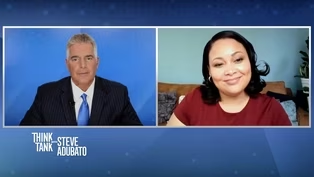
How This Non-Profit is Helping Young People in Camden
Video has Closed Captions
Clip: 6/18/2022 | 9m 21s | How This Non-Profit is Helping Young People in Camden (9m 21s)
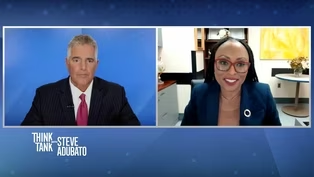
Treating Interpersonal Violence at University Hospital
Video has Closed Captions
Clip: 6/18/2022 | 8m 52s | Treating Interpersonal Violence at University Hospital (8m 52s)
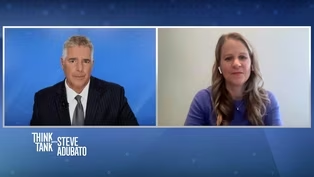
Why Film Matters Now More Than Ever
Video has Closed Captions
Clip: 6/18/2022 | 9m 49s | Why Film Matters Now More Than Ever (9m 49s)
Providing Support for PBS.org
Learn Moreabout PBS online sponsorship
- News and Public Affairs

Top journalists deliver compelling original analysis of the hour's headlines.

- News and Public Affairs

FRONTLINE is investigative journalism that questions, explains and changes our world.












Support for PBS provided by:
Think Tank with Steve Adubato is a local public television program presented by NJ PBS