
Sit-down with CCSD Superintendent, Nevada Attorney General
Season 6 Episode 3 | 26m 46sVideo has Closed Captions
Discussions on CCSD news and a look at Nevada’s fight against opioid addiction
CCSD Superintendent Jesus Jara gives an update on everything happening in the school district before classes start in a few weeks. Then Nevada Attorney General Aaron Ford explains the state’s fight against opioid addiction and fentanyl trafficking
Problems playing video? | Closed Captioning Feedback
Problems playing video? | Closed Captioning Feedback
Nevada Week is a local public television program presented by Vegas PBS
Sit-down with CCSD Superintendent, Nevada Attorney General
Season 6 Episode 3 | 26m 46sVideo has Closed Captions
CCSD Superintendent Jesus Jara gives an update on everything happening in the school district before classes start in a few weeks. Then Nevada Attorney General Aaron Ford explains the state’s fight against opioid addiction and fentanyl trafficking
Problems playing video? | Closed Captioning Feedback
How to Watch Nevada Week
Nevada Week is available to stream on pbs.org and the free PBS App, available on iPhone, Apple TV, Android TV, Android smartphones, Amazon Fire TV, Amazon Fire Tablet, Roku, Samsung Smart TV, and Vizio.
Providing Support for PBS.org
Learn Moreabout PBS online sponsorshipWe go one-on-one with Nevada's Attorney General and the Clark County School District's superintendent this week on Nevada Week.
♪♪♪ Support for Nevada Week is provided by Senator William H. Hernstadt.
-Welcome to Nevada Week.
I'm Amber Renee Dixon.
Punishments for selling and possessing fentanyl in Nevada got more severe this past legislative session thanks to a bill from Nevada Attorney General Aaron Ford.
He joins us to discuss that and more ahead.
But first, the first day of school in the Clark County School District is August 7.
From staffing to safety, there's a lot to go over.
And joining us now for that is CCSD Superintendent Dr. Jesus Jara.
Dr. Jara, welcome to Nevada Week.
(Dr. Jesus Jara) Thank you for having me.
Thank you.
Exciting days.
(in unison) Exciting days ahead.
-Yes.
-As of this taping, Thursday, July 27, the school district is in somewhat contentious contract negotiations with the Clark County Education Association, the largest teachers union in the district.
They want a 10% raise in the first year of a contract, 8% in the second year.
The district and yourself have countered.
Even with the historic amount of education funding that the Governor just approved, those raises would put the district in the red, in a budget deficit.
But the union says, we're not buying it.
So what more is there to this story?
-Well, I think there's a lot.
I think it's more of the philosophy in where we need to be as a district.
So one of the things that were brought to the table is really looking at a holistic approach on how teachers are paid.
Look, I think I said it in my State of the Schools, my Board has been committed, the community has, our teachers need to be well paid.
100%.
We're all in agreement.
I think it's more on the philosophy and how we get there.
I'm looking at it as an entire approach of retention, of also recruitment.
You know, that's why we negotiated an increase in the first year, salary to increase to 50,000.
Get it over-- -For first-year teachers?
-For first-year teachers.
So that's one, and we came to an agreement this past year.
So we have historic amount of money that has been invested by the Governor.
The Governor came out really strong.
Really proud of that when we, when we saw that.
But now it's we have a salary schedule, that it's really, from what we're hearing from educators as they're leaving, and I hear it all the time.
I mean, people come to the bargaining table that the teachers are not being compensated for staying here.
I mean, we're-- so what we're proposing is, really, teachers need to be the-- need to be paid for their years of service into this community and for their education experience, for their master's, their doctorate.
So I think it's more the philosophy.
Hopefully we get there.
Because you're right, we have bargaining today and tomorrow.
August 7 is the first day of school.
I mean, I just welcomed first-year teachers into the Clark County this morning.
I mean, I have this afternoon.
So we're excited because the kids are going to come and we'll be ready.
So hopefully we get to the table with some honest conversations about where we need to be and look at the philosophy.
But what I'm excited about, I just announced yesterday, a tentative agreement with our administrators union.
We're very close, very close.
I can't give the details, but we're very close with our support staff, our Teamsters, and our police.
So I think, you know, I'm optimistic and hopefully we get there.
Our teachers deserve a pay raise.
Our teachers deserve a salary that pays them for their years of service and pays them for their degrees.
-As we speak, school starts in less than two weeks, and there are currently more than 1,000 teacher vacancies in the district.
What are you doing to fill those positions?
-So our, our principals have long-term subs that we've already hired that they've brought in.
Some of them are in the ARL program.
There are returning retirees today.
You know, as I'm walking into first year-- -ARL stands for?
-ARL is Alternative Route to a License.
So there-- they didn't get a degree in education.
They probably got-- I did.
I mean, I got a degree in sports medicine, but I was a science teacher.
7 1/2 years of, years to complete my licensure when I was-- this was back in 27 years ago in a different state.
So that's one.
We'd bring in returning retirees.
So we're monitoring that.
So we actually have 856 classrooms right now to date.
94%.
It's an increase from 92%.
I still have vacancies.
So what our principals will do, you know, as we continue to hire, we have 579 in the pipeline to process.
So one of the things we will do as we continue to monitor principals, we'll collapse classrooms, larger class sizes, which is not ideal.
And then we'll, you know, do probably buyouts and different things.
Those are some of the individual things that we have.
So as a district, I'm concerned, but it's something that we have to work through and to be able to address.
The legislature this past year built the, you know, put into legislation, you know, kind of a pipeline for growth into our high schools to become teachers.
We've invested with Nevada State College, Nevada State University.
We've invested in using our ESSER dollars to pay for the students that are in the teaching program there, pay their tuition so they can come and teach.
We also invested for our support staff.
They want to go in and get their college education so they can become teachers.
So my Board-- -There's a long-term plan.
-Yeah, there is a long-term, and we have the-- we have the short-term, right, the immediate concern that we have.
And one of the things that I think the public needs to understand, and it's I think this is why the long-term needs to be that investment, address the short-term.
But you know, the last time this school district opened fully staffed was in 1994.
So I think what we're doing now is going to really address and close that gap.
-I want to talk about school safety now.
What kind of improvements can students and teachers expect?
The Las Vegas-Review Journal did report that there will not be metal detectors this year.
-Yeah.
No, there not-- there will not be.
I mean, we're still studying, right?
It's not something we're just going to really implement without the research behind it.
One of the things that we, you know, I just want you to know and one of the things that I was very supportive, and all superintendents, working with the Governor and his staff on his bill on safety.
So we really worked hand-in-hand with his office to really address the safety in our schools.
-How so?
-Well, I think it's, you know, when you really look at the bill, that it's really to address the behavior, the violent acts, that are happening in our schools.
-We're talking about reforming the restorative justice.
-Exactly.
And I think that's one.
Our efforts are going to continue.
We started since last year really looking at the single point of entry, the fencing, the instant alert.
We've instituted all of that.
We're going to continue.
-Every teacher has instant alert?
-Every employee.
It's not just the teachers.
Every custodian, every office manager in every building, you have an instant alert system in place.
I want you to think about safety as a layered approach, because one thing is not going to fix it all.
So we did that.
One of the things we're doing now is all our campus monitors.
The Board readjusted their pay.
All our campus monitors now have--there's going to be a standardized training, a set of expectations from de-escalation to also looking at how do you talk to kids, how do you address students, the target-- when there's a violent attack, how do you address, but then also provide wraparound services.
So that's happening for all our campus monitors before they come in.
One of the other things that we're also, you know-- the reminder to our families and to our kids on the discipline Code of Conduct.
So there is some accountability that we will then be addressing as a school and as a community for parents.
But the first line of defense is the parents.
Ask your kids what's going on.
Check the bookbags.
I mean, last year we, we confiscated 33 weapons, 33 guns on campus.
Those are things that are coming in from the community.
So as a community, how we're going to address that, and our police department working with all the municipalities to address, not getting into the gun issue, that's not my issue, but my issue is guns in school is a problem.
-And the reforms to restorative justice, they better enable schools to expel and suspend students for violent acts.
You think that'll make a difference?
-I think there's going to be a level of accountability.
One of the things that we did last year, we added the reengagement.
One of the things that I've been, I've been very happy with is the reengagement, including the parents in that counseling, because to me, it's not-- and I can tell you, the Governor said to all superintendents when he first met with us, it's not about throwing them out, putting them on the street.
That doesn't help the community.
It's how do we change that behavior, which is part of the restorative practices, the restorative justice.
Because throwing them out in the street doesn't help.
Leaving them at home doesn't help.
It's putting them in a place where you're going to reengage them.
Parents have to be involved in that reengagement process.
And I think that's going to be a big part of the solution.
-A concern of yours I know is catching students up academically post-COVID.
Where do you think CCSD students are now?
-So I'm looking at the preliminary data that has come in, and that will be released by the State in September.
We've seen some minor improvements in math, I could just tell you.
And I go back to the math improvement is we, finally for the first time in over a decade, invested in curriculum using our ESSER dollars.
So we have aligned curriculum.
All our teachers, all our schools-- -ESSER dollars being federal funding.
-Yes.
I'm so sorry.
The ESSER dollar is a federal funding that we received from the Biden administration.
We were able to buy material.
So we've seen some of the, some of the success there.
English and reading, you know, we didn't make the gains as I'm looking at it.
Obviously, there's still a lot of calculations that need to happen.
I'm still concerned.
So it's how do we do it with after school, with summer?
Because it's not about adding more to the school day, but it's how do we extend the learning.
And I think that's one of the things that I'm excited.
We just adopted new curriculum for English, language arts, and reading that our teachers will be able to use this year.
So we're seeing some gains, but we have to accelerate.
One of the things that this community has to understanding, and across the country, our 3rd graders were our kindergarten babies in COVID.
-Yeah.
-So they were-- they did kindergarten and 1st grade, those two, those two years distance ed.
So there's-- which is where you need the teacher.
So, you know, we're monitoring.
We're monitoring all of this by cohort because, you know, we need to be mindful, and then how do we accelerate it?
And that's one of the things we're doing.
-Dr. Jara, wishing you and the students and the entire district, support staff, teachers a successful school year.
Before we let you go, though, what are you most excited about this year?
-Welcoming, you know.
Thank you by the way.
But just being back in school, seeing our kids, seeing our kids learning.
Our educators work so hard.
Everybody does.
And I think what the exciting piece is, is that we've had a great year and then how do we accelerate to continue on that trajectory.
-Dr. Jara, thank you for your time.
-Thank you.
-According to the Southern Nevada Health District from January 2018 to July 2022, fentanyl killed 653 people in Clark County.
In fact, the Drug Enforcement Administration calls the synthetic opioid the greatest threat to Americans today.
Here now to discuss the new legislation aimed at protecting Nevadans from that threat is Nevada Attorney General Aaron Ford.
Attorney General, welcome to Nevada Week.
(Aaron Ford) Thank you for having me back.
-So your bill, which Governor Lombardo signed into law, addresses the trafficking of fentanyl.
And prior to it, high-level trafficking was considered the distribution or possession of more than 400 grams of fentanyl.
Now it's if someone has between 42 and 100.
First off I'm thinking, well, what happens if they have over 100 grams?
Is that no longer considered high-level trafficking?
-Well, the laws that were on the books prior to the legislation will kick in.
It certainly will be prosecutable.
No question.
-Okay.
Okay.
So now that that is high-level trafficking, you're significantly lowering the threshold for how much is considered high-level trafficking, punishable by at least 2 to 15 years in prison.
What are your realistic expectations for what that punishment will do when you have groups like the National Institute of Justice saying that more severe penalties do little to deter crime?
-Well, listen, I think the first thing we have to do is to bifurcate the conversation.
We're talking about trafficking in these bills and not mere possession.
Those are two different issues that we need to be talking about.
To be sure, there may be some overlap every once in a while, but possession of any amount of fentanyl in this state is already a felony.
Possession.
We're talking about trafficking, those who do more than possess, who in fact possess with the intent to sell and to distribute.
And so trafficking is the issue that we're talking about here.
And so to the extent we are able to capture those individuals who are more than individuals who are merely possessing for potential personal use, we're able to, in our estimation, cut down on the amount of fentanyl that will be in the streets and capable of distribution.
And we think this is an important step forward to provide law enforcement the tools it will need.
Let me be clear about something else.
This isn't simply a public health-- or public safety issue.
It's also a public health issue, was the reason why my bill has combined efforts to address both of those from that particular paradigm.
And we will continue working to do that in both particular arenas as well.
-How are you addressing the health aspect?
-Well, on the health aspect, if those-- if someone gets arrested, for example, under this trafficking statute and they happen to be a substance use abuser, substance abuser of fentanyl or heroin or some form of opioid, they will now receive medicated assisted treatment in our jails and our prisons as a requirement under this statute to the extent funds are available.
So that's an approach that we take to ensure we are looking at this from both a public health approach and a public safety approach.
Not to mention the work that the funds, I'm sure we'll talk about later, from opiate litigation are bringing in to help on the public health side of things as well.
So we're looking forward to working with people to abate the problem on that side as well.
-So if someone is addicted and is arrested, there will be medication for them to kick that drug?
-Hopefully.
-Okay.
So we talked about high-level trafficking.
But now the definition of simply trafficking.
It used to be called low-level trafficking, and that was the possession/distribution of between 100 and 400 grams of fentanyl.
Now it's just 28 and 42 grams.
The argument against this, which you sort of addressed already, was that you're going to be putting low-level drug dealers and perhaps users of fentanyl who pool their money to buy this amount of fentanyl in jail, overcrowd the system, and not get them maybe the rehabilitation that they need.
How would you respond to that?
-Well, let me first highlight the fact that it's not typical that people are buying fentanyl.
They may be looking to buy an opioid that has been laced with fentanyl.
And therein lies the problem, because fentanyl has adulterated so many drugs at this stage that it was difficult for us to be able to get the first iteration of our bill passed.
The first iteration said that low-level trafficking began at 4 grams-- -Right.
- --which, as some opponents of the bill indicated, was the size of a sugar packet.
And so understanding that that was a real issue, we took that into account--we, as in those of us who were advocating on behalf of this bill--and tried to compromise and found the ways to not pull into those who, into this particular criminal statute, those who may be addicted to opioid use and may be using for personal use.
Instead, direct them toward public health approaches.
But instead, focus on those who are, you know, who have more than personal use amounts and be able to charge them with trafficking.
We think that that's going to be beneficial.
It's a compromise that I think finds the right balance.
And we're proud of that.
-You originally wanted 4 milligrams to be considered low-level trafficking, or simply trafficking.
-That's right.
-And that is a small amount.
-It is.
-But for perspective, it's only 2 milligrams that can be deadly.
-That's right.
-It's hard to imagine the amount when I'm trying to picture it in my head, how much someone is actually in possession of.
-Yeah, and one of the compounding issues is that we in our state don't have the equipment to do what we call quantifiable assessments of what drugs are, what amount of drugs are in a particular compound or substance.
And so even the packet that says 4 milligrams-- or 4 grams may only have 2 milligrams of fentanyl in it, but the entire weight of 4 grams is what will be charged under the statute.
And so we're looking to even modify our criminal statutes more in the going forward basis as we are able to precisely determine what amount of drug is in a particular compound.
-So trafficking is now 28 grams to 42 grams, punishable by 1 to 10 years in prison.
An important aspect of this, I think, for you was that piece of the legislation about substances that are laced with fentanyl and punishments for people who sell it, knowing that there's fentanyl in it but they don't inform the customer.
Why was that so important to you?
-Because those are the individuals that we should certainly be going after, those who are purposefully selling this product that is killing people to those and not informing those of that, of that particular circumstance.
So what we have done is to be able to create a new penalty for exactly that type of circumstance.
And again, that was working with advocates-- stakeholders on both sides of the issue, or rather, on all sides of the issue, frankly, to come to even that particular compromise in the bill as well.
-Stakeholders like?
-You name it.
ACLU, community groups, public defenders, the District Attorney's Office, law enforcement agencies.
You name it.
Across the board.
Anyone who had an interest in this, we welcomed to the table as I do with all of my legislation.
And so we received information from everyone, as many folks as we could, to come to a final resolution on this bill.
And it passed in the form we're talking about now.
-And the punishment for that is 2 to 20 years in prison.
You just want to get these people off the street.
-Absolutely.
-Okay.
I want to move to another topic now and that's somewhat connected, in that opioid addiction can lead to people using fentanyl.
Your office recently reached a $285 million settlement with Walgreens for the role that your office says Walgreens played in the opioid epidemic.
What role do you think Walgreens played?
-Well, part of the role that Walgreens and other defendants in our litigation have played is that they didn't properly monitor the dispensing of opioids into our communities.
They didn't have systems in place to ensure that, that inappropriate amounts of fentanyl--pardon me--of opioids were not being put into our communities.
And they've led to-- and that's what ultimately led to opioid abuse, which has ultimately led to the fentanyl crisis.
Because once we started pulling back on the opioids that people looked-- began looking for alternatives to that, and they went to the street, found heroin.
And heroin oftentimes has been laced with fentanyl as well.
So, you know, there are, there's a cause and effect, we think, that's associated with the opioid crisis with the beginning being these pharmaceutical companies, these distributors, these manufacturers, these pharmacists-- pharmacies rather, that were dispensing this, producing and dispensing this, this opioid.
And we want to hold them accountable.
-What should pharmacies have done?
-Well, they should have had in place what we call systems to ensure that there wasn't a--it's called a suspicious, suspicious order, essentially, suspicious use order--and systems to ensure that we weren't giving out and overprescribing medication or dispensing it and being able to inform appropriate individuals about that so that we could address it.
-With that settlement, it's now up to over $1 billion that you've brought in through the state's opioid litigation to the state.
How is that money going to be spent and divided?
-Yeah, well, 1.1 billion to be a little more precise.
But that money will be coming in over the course of the next 20 years, depending upon the settlements that we've entered into, and distributed pursuant to what we call the One Nevada Agreement.
Some of that money goes to the state.
Some of it goes to the municipalities that are signatories to the One Nevada Agreement.
And each of those recipients has undertaken what's called a, it's-- I can't think of the phraseology they use.
But ensuring that-- a needs assessment.
That's what I was looking for.
They've undertaken a needs assessment to see how they want that money to be spent.
And they will make that determination.
Some of the money has already begun to be spent.
But it has to be used to abate the crisis as opposed to doing other things.
It has to address abating the opioid crisis, and we've been able to bring in money to help do that.
-Congratulations on the $1.1 billion.
-Thank you.
-I want to move on to affirmative action now.
So the U.S. Supreme Court recently ruled that it is unconstitutional for universities to consider race when they are doing student admissions.
Now there are Republican attorneys general who have written a letter to Fortune 100 CEOs saying that, as a result of that ruling, the diversity, equity, and inclusion practices of businesses are also now illegal.
You say absolutely not.
Why?
-Yeah, well, you know, people have been attacking diversity in education and in employment environments for a long time now.
I'm disappointed and dismayed, obviously, with the Supreme Court decision on affirmative action in our schooling system.
I went to Texas A&M University on a diversity scholarship.
I am the worst nightmare of those who are opposed to affirmative action, a success story, one who matriculated into an institution, graduated from the institution, and I ultimately have five degrees, including a PhD, two master's degrees, and my law degree.
And now I sit here as Attorney General, and it's because of diversity programs that were intended to help abate and help to redress unlawful discrimination that has existed for generations.
So you know, I support affirmative action programs, always have.
It is about inclusion and diversity and not about exclusion and displacement.
And so reading that opinion did disturb me.
It was no surprise, although I'm saddened by the fact that some of my Republican attorneys general, not all of them, only 13 of them, did sent a letter to some Fortune 100 companies indicating that now they're attacking DE&I efforts, diversity, equity, and inclusion efforts, at the corporate level.
We don't believe the decision even applies in a particular end, and so my office penned a letter that was signed on by 20 other Democratic attorneys general, letting Fortune 100 companies know that DE&I programs are absolutely appropriate and legal under the law, and the affirmative action case has nothing to do with it at all.
And so we're gonna stand by that and support those companies who support these efforts.
And hopefully, our letter is going to provide a little bit of consolation to them in that regard.
-Yeah, some relief.
Before you go, there is something I have been wanting to run by you for several months now.
Back in November, after the elections, we had Jon Ralston, CEO of The Nevada Independent, on, the political pundit.
We were talking about the elections.
Former President Donald Trump had just announced he was going to run for the President again.
You sent out an email to your supporters seeking some donations to try and, you know, tame the Trump machine or take it down in some regards.
I asked him about that email.
Here's what he said.
So Nevada Attorney General Aaron Ford used Trump's announcement at a third run for Presidency to send an email and ask for campaign donations.
He just got reelected.
What's behind that do you think?
-(Jon Ralston) Shamelessness brazen attempt to raise money off of Trump's announcement as if Aaron Ford can stop Donald Trump in some way.
Ford's one of the most ambitious politicians I've ever met.
He used to tell people way back when he was getting started that he would eventually be Governor and then he would run for President.
I kid you not.
So he has been open about this.
He's nakedly ambitious.
Not necessarily a character flaw.
In fact, it may be good in the business that he is in.
But I do think that he is going to run for Governor in four years.
-And so you think that might have been his, his announcement?
Not announcement, but-- -It kind of was an announcement of sorts.
Although, I said that on Twitter.
I don't think he appreciated it.
-I imagine he didn't.
So Aaron Ford, will you be running for Governor in 2026?
-Listen, Jon Ralston is known for stirring the pot, so to speak, and he's quite frequently wrong.
He has no clue what Aaron Ford's ambitions are, except for me to say this: I enjoy the job I'm doing right now.
I was recently reelected into this position by the largest majority in the state of anyone running statewide.
That to me means that the people in our state appreciate the work that we're doing, and I'm looking forward to continuing that work for the next three years.
-Are you considering running for Governor?
-I will consider doing what we're doing right now, which is ensuring that the people in this state are able to have a person focused on justice in the Office of Attorney General.
-All right.
Nevada Attorney General Aaron Ford, thank you so much for joining Nevada Week.
And thank you for watching.
For any of the resources discussed, please go to our website, vegaspbs.org/nevadaweek.
♪♪♪

A Conversation with CCSD Superintendent Jesus Jara
Video has Closed Captions
Clip: S6 Ep3 | 11m 35s | Dr. Jara discusses what students and teachers can expect this upcoming school year. (11m 35s)
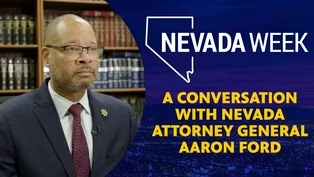
A Conversation with Nevada Attorney General Aaron Ford
Video has Closed Captions
Clip: S6 Ep3 | 14m 27s | Nevada Attorney General Aaron Ford discusses Fentanyl trafficking in our state. (14m 27s)
Providing Support for PBS.org
Learn Moreabout PBS online sponsorship
- News and Public Affairs

Top journalists deliver compelling original analysis of the hour's headlines.

- News and Public Affairs

FRONTLINE is investigative journalism that questions, explains and changes our world.












Support for PBS provided by:
Nevada Week is a local public television program presented by Vegas PBS