
SIU Debate Professor recaps Governors debates
10/20/2022 | 26m 46sVideo has Closed Captions
SIU Debate Professor Todd Graham discusses the 2022 Illinois Gubernatorial Debates
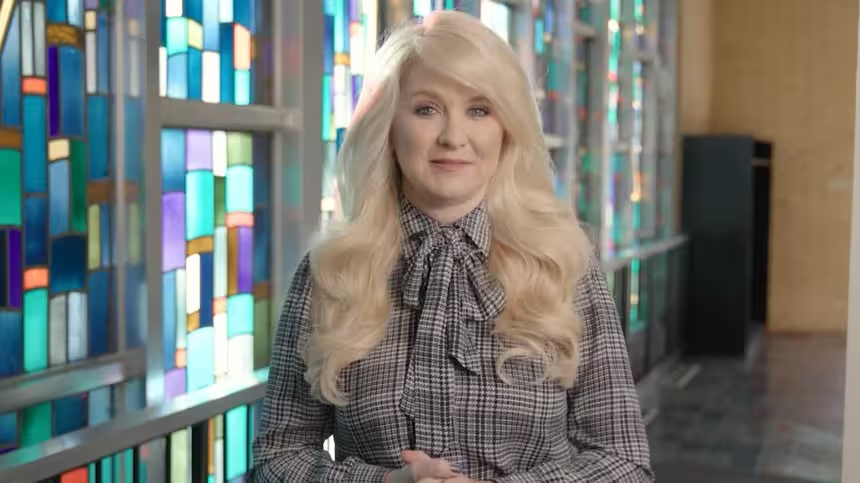
Following the second and final televised debate between Governor JB Pritzker and State Senator Darren Bailey, SIU Debate Professor Todd Graham takes a look at the high and low points of the two meetings.
Problems playing video? | Closed Captioning Feedback
Problems playing video? | Closed Captioning Feedback
InFocus is a local public television program presented by WSIU
Support provided by:

SIU Debate Professor recaps Governors debates
10/20/2022 | 26m 46sVideo has Closed Captions
Following the second and final televised debate between Governor JB Pritzker and State Senator Darren Bailey, SIU Debate Professor Todd Graham takes a look at the high and low points of the two meetings.
Problems playing video? | Closed Captioning Feedback
How to Watch InFocus
InFocus is available to stream on pbs.org and the free PBS App, available on iPhone, Apple TV, Android TV, Android smartphones, Amazon Fire TV, Amazon Fire Tablet, Roku, Samsung Smart TV, and Vizio.
InFocus
Join our award-winning team of reporters as we explore the major issues effecting the region and beyond, and meet the people and organizations hoping to make an impact. The series is produced in partnership with Julie Staley of the Staley Family Foundation and sponsored locally.Providing Support for PBS.org
Learn Moreabout PBS online sponsorship(upbeat music) (energetic music) - Welcome to a special edition of "InFocus" on WSIU.
I'm Jennifer Fuller.
Illinois, Governor J.B. Pritzker and his Republican Challenger, State Senator Darren Bailey, completed their second of two debates this week.
We thought we'd talk about how that debate went and how the debates in general have gone with SIU Professor of Debate, Todd Graham.
Todd, thanks for coming in.
- Right, you're welcome.
- We've talked a lot over the last several years about how debates have gone.
Winners, losers, strategies, those sorts of things.
So, how did these debates go between J.B. Pritzker and Darren Bailey?
- I thought as far as a gubernatorial debate, these were pretty good.
I thought that the debates in general were, the moderators did their very best job.
They seemed very well prepared.
Both debaters seemed fairly well prepared.
I thought they had a good format.
So, overall I would call these successful debates.
I thought they went pretty well.
Not too many hitches.
Not too many sort of things that you would look back and go, "Oh, we need to correct that.
We can't have that."
As we had in many presidential debates this year.
So, pretty good.
- There were a lot of differences in style and substance between the two candidates.
When you look at it from a debating point of view, was there one that stood out as, "This was a clear winner."
Or "This was a clear issue that they should never debate this way again?"
- Well, yeah, there is one thing that I thought that Senator Bailey could have done a little bit differently.
Maybe re-approach, have a new tack to that particular approach.
He was very much Mr. Gloom and Doom, very much in the debates.
"Illinois's in terrible state" "We're worse than we ever have", et cetera.
One of the problems with that is you really need, if you're gonna visualize that, if you're paint that picture, you need a lot more examples, which we'll probably talk about more throughout this.
We need a lot of examples in debates, but I think anytime you have a major strategy, you have to make sure and hit that.
So, Pritzker had a major strategy where we can talk about, and I thought he hit his strategy, and I also did think that Bailey hit his strategy, but just needed a little bit more.
If he's going to be doom and gloom the whole time, then he needs some more examples of how, you know, we got to this doom and gloom and what he can do to bring us out of that.
- That's one of the things that Governor Pritzker actually pointed out about his opponent is that there were a lot of criticisms, but not a lot of solutions provided.
Is that a critical part when you're debating that you not only have to bring up what's wrong, but you have to have a solution for it?
- Oh, the solutions are a hard part.
Listen, anybody can criticize.
That's, anybody can do that.
So, we can stand up and be in a regular debate round.
You would be on the negative or opposition side, you know, or so, and you would just say, "No, I don't believe you.
You're wrong.
I don't think that's right."
You know, and so anybody can criticize the difficult part of any debate of whether it's competitive debate or a governor's debate or presidential debate is the policy solution.
How do you fix these things?
And so that's what I always look for in debate.
But I can tell you a story about that.
In fact, our teams here at SIU would get 15 minutes when we would learn what the topic was at a tournament, 15 minutes to get coaching and to figure out what we're going to do and in that 15 minutes we would have to figure out all these things.
There were some rounds where we were on the government side, on the affirmative side, so we had to have a solution to the problem.
And we're working on it, we're working on it, but the teams are just writing up problems, problems, there's a problem.
Status quo is bad, there's a problem, problem.
And the coaches are working on getting a solution to plan, because we know that if the plan isn't perfect, it doesn't matter how well you criticize the status quo, your plan could very well be worse or might not fix the problem.
So, we've learned in debate that no matter how good you are at criticizing, if you don't have a solution that can improve on that, you still can't win the debate.
So, it's really highly hyper focused.
There was one debate at the University of Utah, it was a semi-final debate.
Our two debaters who were national champions were so upset with me because I did not have a solution, a plan for them.
Clock is a ticking They've got their whole affirmative case ready, their whole case, everything's ready to go, except they're just like, "We don't have a plan."
That's the most important part.
We actually don't know what we're doing, Todd.
And it was two minutes left, and they have to start packing up and walking.
And I'm like, "Okay, we've got it."
The wording is perfect, because you have to also word them perfectly.
You know, we talked about the Safety Act in some of these debates, and the problem is, how is the wording of that particular act and does it need to be fixed?
And that's what Pritzker's talk about.
Well, it's the same with any plan and solution.
So, I was literally working on wording for a plan for the first 13 and a half minutes of that before I gave it to the team.
They walked into the room and started the debate, and I just fresh handed them the solution, which is the most important part.
But it's mostly because we were trying to avoid any of the disadvantages from a bad solution.
Because one thing you can do is criticize, but if you have a solution, you have to make sure that solution doesn't immediately seem worse on its face.
- Let's talk a little bit about the format of the debate, because a lot of times people will criticize moderators who let things get out of control.
If it's a town hall style meeting, perhaps one person is more comfortable than the other.
So, the format of this debate with very strict time guidelines, the ability for the moderators to come back to the person answering the question and saying, "I wanna give you another opportunity to answer this."
Did that work for you?
Did it work for the debate overall?
- Here's what I think it did, and the reason I think it did is because I've seen so many debates, and I was actually at a meeting here at the Civic Center this week where, you know, they wanted me to talk about debates and elections and stuff and so, but the first question I almost always get is, are these really even debates?
Is this a debate?
This is just a question and answer at best, et cetera, et cetera, and so people, the public also very good at criticizing.
So, the same answer I gave a second ago, let's talk about now the, we are good at criticizing these debates because often they don't turn it into a debate.
They maybe are a shouting match or we don't feel like they get very deep.
But I've seen every format of debate from public formats to competitive formats and there are flaws in all of them, Jennifer, there are just flaws in all of 'em.
I've watched 8,000 some debates, after I've watched in the Lincoln Douglas debate, I mean, people always think that the style of debate, this isn't debate.
Well, let's go back.
What is debate then?
I always ask people, "Well, what do you think is debate?
Lincoln Douglas?"
Because most people don't understand what those debates were.
They were the most awful things ever.
They were a 60 minute speech followed by a 90 minute speech, followed by a 30 minute speech.
That was what debate was back then.
So, when people always think the grass is greener, let's have a better style of debate.
I have to remind them all styles of debate have flaws.
I've judged them all.
I've watched them all, but this one, I thought they did a pretty good job.
Things that they did really well, were they, I like, I'm sorry, I like the bell.
I like to have a bell.
It's easier than you trying to talk over someone when they talk too much, et cetera.
So, I like the bell, I like the attempt at follow ups because you can't make these people answer the questions, but you can come close enough to where the audience can tell, oh, they're clearly ducking that question.
And so in that regard, I thought that the moderators did an excellent job.
They had specific questions and they asked follow ups, and that's about all you can do if the candidates don't wanna give specifics, if you keep saying so in their questions, on Tuesday night, forgive me on their questions, they kept saying specifically, "Can you name these two things specifically?
What would you do?"
And we almost still never got some specifics, but that shows us the moderators were trying to do their job and they can't make them answer it, but what they can do is make it obvious that they didn't answer the question.
I thought they did a pretty, pretty nice job overall, other than they didn't keep their calm last night.
There were a couple of moments where I thought the moderator went a little bit too far.
She was clearly upset with Bailey a couple of times.
Her voice had actual, what I sounded to me like anger in it, which I've never heard from a moderator before.
So, it was, to me, I was just like, she clearly was tired of the interrupting, et cetera that was going on.
But you can't, you've got to just, you've got to maintain your calm, et cetera.
And so at what point she seemed a little overly hostile.
So, that's the one thing I would draw back.
Just don't be hostile.
Understand they're not going to answer your question and deal with it appropriately.
- Well, let's get then to the efficacy of these political debates.
If this is the format that we're going to do.
One of the criticisms that you hear from organizers and moderators is that anymore political candidates will not move from their talking points.
You can't get them to get into substantive issues.
Is this an effective way for voters, for the public to see their political candidates and to make an educated decision?
- Yeah, I think it's the only alternative.
So, one of the things in debate that we always teach our debaters is, okay, so what's the alternative?
Okay, so what's the alternative?
So, because oftentimes, like when we talk about solutions, that's why solutions are very important for political debates or any sort of debate.
Because if the alternative is perhaps going to be worse, we need to think about it.
So, what's the alternative to not having these debates?
Well, the alternative is just for sure all you hear is talking points.
All you see are political ads and talking points.
In fact, the most persuasive thing I saw in the Tuesday night debate is something I wasn't quick enough with my pause button on because I never watched commercials and I never listened to anybody in between.
While there weren't commercials, there were, JB Pritzker did have an ad right before the debate.
It was the most persuasive thing I saw, I was poor.
So, their talking points are still quite good and they're managed to get them into debates.
But no, the debates are supposed to get away from those talking points.
And even if they don't, it still is better than just the JB Pritzker commercial we saw, or the Bailey commercial we saw because without these, you get stump speeches, you get no one questioning you ever.
And at least here you're getting questioned and whether or not you answer it and whether or not the public buys it is on you.
But in part of this is on us, Jennifer, we need to focus on debates a little bit more.
We need to understand that right now in our society, debates are being diminished, especially in statewide races, you know, statewide races, there are very few debates, there have been fewer debates even in senatorial debates, et cetera.
And so we need to get the public kind of more energized to realize that even if they're not perfect, this is still better information than not having debates.
So, the alternative is not having debates, which would be even worse.
- Let's get to some of the ins and outs of how the debate actually went.
What about the tone from each of the candidates?
As you've mentioned, Senator Bailey took a very, a gloom and doom tone.
Governor Pritzker tried to be a little more optimistic.
How does tone impact how the debate goes?
- Well, tone has a lot to do with sort of how you look at a candidate.
I've always, when I've coached my teams, I've always said, it depends on how you say that, because I've given them good arguments, foreign rounds, and they go and I watch them make this argument in front of a judge and they make it with the wrong tone, and it comes across mean spirited.
Or like they're trying to say a little kind of quip or a humor.
It comes across mean spirit or it comes across wrong.
So, tone makes a difference.
So, at last night's debate, Bailey was very much gloom and doom.
Now he has two completely opposite tones.
Super interesting watching him.
I haven't seen very many.
One tone is what I'm just gonna call the Trump emulation.
So, it's interrupting, it's petty, it's name calling.
And that's the stuff I can't stand in debates.
And I think most people don't like, and that's what the moderator didn't like.
But the other tone, Bailey has this sort of almost over exaggerated, he calls it a downstate accent, but I've been here 21 years and that's not a downstate accent.
It's a little bit stronger, right?
And so that's fine.
I like it.
I used to have a debater in Louisiana that just could not, I mean, his accent was so thick, he was a great debater.
So, I said, "All right, let's do the opposite.
Let's use that accent.
Let's play it up even more.
When you're debating against Cornell and you're debating against Ivy League schools, I want twice as much accent.
I want a lot of Cajun talk.
I want you talking about going to school in P-rows.
I want all this to show the difference between you and the other.
And I think Bailey has some of that.
Like he's got a little persona that's very like down home sort of, and I do like that, but, it's juxtaposed with this sort of attack, gloom and doom, sort of Trumpism, et cetera.
I like the more home spun down home because he's very good speaker.
He has got a good presence and he seems like somebody, he'd be okay.
Like one of the things that I knew we were going to paint last night is pictures.
Pritzker will try to paint Bailey as a radical and extreme, and in some ways he was successful, although I don't think as much as perhaps in a previous debate on this Tuesday night space or previously, simply because he does have a good personality, it's difficult for you to say something about Bailey.
And then if he comes out with personality number one, which is the downstate home spun sort of thing, that's really enjoyable.
He seems like a decent person that you would want to hang out with.
So, those two things, I think Bailey needed to figure out which one he wanted to sell a little bit more of.
Am I the mean guy, the attack dog?
Am I the gloom and doom, or am I just the down home country folk that you should vote for?
And I think he should have picked the latter.
- You mentioned name calling and that was one of the things that came out almost straight out of the gate with each person, each candidate painting the other as too extreme on one side or the other.
But then there were points when Senator Bailey on issues like abortion rights or marijuana legalization, things like that, where he said, "That's already the law.
There's not much I can do about that."
Does that diffuse some of the attack from the Pritzker campaign?
- Yeah, I think it does.
There's certainly ways to do that, there's not much I can do about that.
So, if he's talked about, I'm talking about abortion, et cetera, he just say, "Listen, even if I wanted to do," which he finally did say in this debate, he said, "Even if I wanted to do an executive order, you can't do that over this particular issue.
So, there's literally nothing I can do."
So, I think he needs a couple of extra like explanations.
So, just say, so as governor, while you know that I am not supportive of some of these things, there's zero I can do, there's zero I will attempt to do so why don't we actually debate the issues that the governor can do, right?
I like that a little bit better.
The problem is, the other half of the issues he's talking about, the governor can't actually do, so they go back and forth between praising things and not praising things and halfway through, I always want the moderator to say, "Now wait a minute, is that something the governor could do?"
Which they did a time or two last night, but you know, there are times that pritzker's touting accomplishments and I'm like, what were those his or were those things?
So yeah, that's part of it.
Can the governor do this?
I think that's a good answer to get out of some of these is, listen, I just simply can't do any of those things and then point to, but I wanna say that Governor Pritzker can't do this either.
That means he didn't do this either.
So, things like that would be helpful.
- What stood out to you from either candidate as something particularly positive or particularly negative that you would've gone to your students and said, "This is something we need to pay attention to?"
- Well, I think Pritzker had better themes.
So, Pritzker had two main themes.
One main theme of Pritzker's was that he wanted to make sure and talk about his own accomplishments.
So, he touted his accomplishments, things that had happened.
He's very good with what I call voting issues.
Most politicians are terrible at voting issues.
These are the same things in competitive debate that we have in political debates, which they're just different voting issues.
But voting issues means what do the people really want you to talk about?
What will they really do?
And I think Pritzker's pretty money when it comes to that.
He seems to know that, you would never have guessed that just saying like, "Oh, I balanced a budget.
Yeah, we're paying some bills."
What?
That does not sound persuasive to me.
Yet it is, it's remarkably persuasive because if you've lived in Illinois for a decade or five years or more than that, you remember what it was like to not pay bills.
You remember going to a dentist, I mean, I've been to dentists and been declined because they said it's the state of Illinois and it takes too long to pay.
You have to go somewhere else for your medical care.
I know and I think everyone I know has that experience.
And so when Pritzker says, "I balanced the budget, we're paying our bills," I thought that was great.
I'm just like, that's awesome.
And it is resonating with voters because voters know what it's like to be able to pay bills or not have to pay bills or these voters remember not getting paid.
These voters remember all of the things, you know, subcontractors, et cetera.
And so, believe it or not, which I never said before this election cycle, a voting issue is actually, yeah, he's making the balance budget paying the bills argument better than anyone I've ever seen made.
So, I thought his theme there was very good.
And his theme to try to tie his opponent Bailey to like radicalism was pretty good.
I think he could have, you know, done a little bit stronger.
Sometimes what you see Jennifer in these debates is they say something in one debate, but not on the next one.
So, what about the people who missed the first debate, if they just watched last night or Tuesday night's debate?
Did they necessarily see all the radicalism?
I don't think they did.
I think that could have got any more detail.
So, that could have got a little bit better.
Bailey, I thought it was the main gloom and doom.
So, when I watched Bailey in Tuesday's debate, what I thought was Donald Trump's inauguration speech, just make it for Illinois because everything was boom doom.
Illinois is the worst it's ever been.
It's terrible, it's worst.
And I think that that can play, right?
That can play.
But what you have to do is have specifics.
So, then when Bailey was asked different specifics throughout the debate, well, what would you change?
How would you make it better?
What has he done that's wrong, et cetera.
He didn't have that and that's kinda the problem with, with the gloom and doom is that while it can work, you have to, the audience has to buy into it.
There's a theory of persuasion called social judgment theory and I teach this a lot.
And basically it says that your audience has a latitude of acceptance.
What can you say that they will accept that idea and a latitude of rejection, what are you gonna say that they're just gonna go, "No, I don't believe that at all."
And the goal of a persuader is to find something that's on the latitude of acceptance, right?
It's right there in the latitude.
I could, they might buy that, et cetera, but without that, and the problem with gloom and doom is the latitude of acceptance for him to say, "We're the worst state we've ever been.
We're in the worst shape we've ever been, we're worse."
And I'm just like, I don't think most people are buying that.
It doesn't fit on the latitude of acceptance for what most people are believing but if he had specifics, if you could say, this part is worse, this part, then it works a little bit better.
So, I think when you haven't met that than what your audience does is if they don't believe you, then they dismiss all of the claims.
And that's what this theory actually says is they will go back and revert back to, well, I think everything's fine then.
So, instead of moving the needle a little, he tried to move the needle a lot and he overshot, which according to this theory that I teach and I actually believe in moves the needle back to where it started in the public's mind.
So, if you try for too much, they just don't believe anything.
- Well, let's get into that a little bit because as we came into this week's debate, there was polling out that showed that Senator Bailey was trailing Governor Pritzker by double digit percentage points close to 20% in some polls.
How much did he need to move the needle in this one event?
Or how much, how far would you have have recommended that he go in order to make up some of that ground?
- Yeah, I thought he, to be honest, I thought he probably did exactly what he was supposed to do.
Because he doesn't think, no one thinks that these debates are probably gonna move that needle a whole lot.
They're gonna move publicly.
So, he needed to make sure and just keep his base, you know, energized, keep them Bailey needed to make sure that he didn't make any horrible mistakes, which he clearly didn't.
He had a decent debate, even without specifics.
It was a fine debate.
But the first question that was asked by both candidates are, "How can you change?"
They gave some polling information, said, "How can you, you know, change these voters' minds?"
And they both ignored that part of the question 'cause frankly, it's impossible to answer.
If I was coaching a debater, I would always, a political debater, I would have them talk a little differently than most.
So, my answer to that would be, I can't.
Listen, this is a debate that's being viewed by this many people and there's only so many watching this.
So, I think there are a few people here watching this that maybe I'll be able to get.
But in general, no, this debate's not going to help me with these people.
What will help me is, and then say if they get out and do this or this, but we should be honest about, you know, the viewership of that debate.
Who's watching it and what difference will it make?
It helps a little, it hurts a little, but not a great difference.
- You mentioned earlier that people need to pay more attention to debates, particularly in statewide congressional, I'm assuming presidential debates.
Here we are right before the midterm election and people are already looking ahead to the next presidential election.
How much should we be paying attention to debates going into those federal elections?
- Well, I always say that the best, whether it's a local, regional, national, et cetera, the debates that you wanna see are, first off you would like to see primary debates, you would like to see debates between candidates of the same party.
And the reason is because we are more and more intractable in the fact that we are going to vote party line.
This is stronger than it's ever been.
You know, a political science polls have said it's stronger than it's ever been.
So, which means if you are not likely to vote for a Democratic if you're Republican, then you really need to watch the Republican primaries because you'd be fine with all of those candidates and it gives you a chance to move around.
If somebody has a terrible debate, you're fine, I'll pick them.
But if in a general election debate, your candidate has a terrible debate, you don't care because the only opponent is the Democrat or the Republican.
And right now in America, we would rather have the, you know, if you're a Democrat, you would rather have the worst Democrat than the best Republican.
And if you're Republican, you would have rather have the worst Republican than the best Democrat.
So, I say start watching debates early on, and then I think that helps a little bit to help you with that.
And then if you're still not sure, of course keep watching general election debates to make sure that you like them, but the public needs to get going again, I think it's part of the problem is there's no punishment anymore for skipping a debate.
Back in the day, Jennifer, you know, 50 years ago if a candidate skipped a debate, it was front page headline, top of the fold news in the newspaper, "Todd Graham is coward."
You know, "Todd Graham refuses to debate" and the public thought that was a bad deal.
Anymore, that headline means nothing.
You know, Eric Schmidt and, you know, and Trudy Busch Valentine in Missouri aren't debating, you know, there's no, because there's no punishment for it.
So, as an audience, that's what I'm asking us to do as the public.
We need to start demanding more debates because if it keeps going on the slippy slope we have, we might only have a couple of debates in the future, you know, maybe presidential general election debates and a couple of senatorial debates, et cetera.
So, gubernatorial debates.
So, we need to do a little bit better.
- Let's get back to this debate between Governor Pritzker and Senator Bailey.
We ask this a lot.
You are a professor of debate.
If you had to grade each of them, what grades would you give and why?
- I, you know, I don't think these would be my worst grades.
So, I would probably give Pritzker somewhere around an A minus to a B plus, and I would probably give Bailey somewhere around a C minus.
I didn't think that because when you're always accusing people of lying, et cetera.
And so it's important to be able to have receipts for these things and to be able to point to their lies.
So, one of the reasons for a lower grade for Bailey is because he said a lot of things about Pritzker's lying, but then I was confused in the debate.
He said, "Okay, what was the lie?"
So, he never actually said like, "Here was the lie, here was this."
And it was true at the lot of his criticism.
So, when they said, "What would you do to change things?"
He never, I wrote down every question's answers.
He never had a policy to change those.
And so he wanted to avoid specifics and I understand in debates we do that, but he would've had a better debate had he gone more specific and had he had more specifics on the Gloom and Doom and on the examples, he would, he'd been a lot better.
- Governor Pritzker, just overall?
- Overall pretty good, pretty good.
I thought he handled the interruptions well.
The interruptions and the pettiness were something I don't really care for in debates.
And so I didn't like that of Bailey.
But you know, the last time I judged debates were presidential debates and so they were even more petty than that.
So, I didn't think it was the worst I'd ever seen, but I don't like that of debates.
Pritzker handled that pretty well.
And so I did like one of the, but he also didn't answer a couple of important questions.
He has some people in key positions in some departments that you know, have been questionable and they were asking why haven't gotten rid of this person?
We also have some equity in how we're distributing our cannabis, you know, funds and licenses, et cetera.
And I frankly didn't think Pritzker's answer to that was good at all about how it is being equitable in minorities.
So, I think he needs to work on the specifics of really what he's doing.
But other than that, he's very calm, he's got a good demeanor and he does know what his accomplishments were and he's very good at talking about them.
- In debates in years past, I would always see candidates who would come from the debate.
They would pull themes that they brought out in those debates and carry them into, in this case, into election day.
Is that a similar recommendation to what you would tell candidates today out of Tuesday night's debate, take this, this, and this and stick with it until November?
- Yeah, that's a brilliant strategy.
That's actually what I've always thought that they should do.
The problem, I think Jennifer with Tuesday's debate is, I'm not sure how much was new.
So, yeah, they can take some stuff from Tuesday's debate, but because there was no gaff from either candidates and most of the issues had already been talked about before, it's not like in the debate you saw Pritzker nail Bailey with being even more extreme than we've seen before, you know?
And so I don't know that this debate will lead to doing that.
- A little less than a minute or so remaining.
I just want your overall thoughts of the two debates and what voters need to remember as they've been watching them.
- I think it was great that we had two debates.
So, I think that's a good start and for voters to remember is you've got your own voting issues so nobody can tell you how to vote but you.
And so what are those voting issues?
What's important to you?
Maybe Pritzker's wrong and it has nothing to do with balancing the budget.
Maybe it is more about crime, which is, you know, something.
So, you decide what it is that are one or two most important issues and that's what you look for in debates.
So, I hope you found those in those debates.
I think that most of the issues were covered, and so I think you should have a pretty good idea for who to vote for.
- Todd Graham is a professor of Debate in SIU School of Communications.
Todd, thanks for coming in.
- Yeah, it's my pleasure.
- You've been watching "InFocus."
We encourage you to stay tuned as we will have another debate here on WSIU between the two major party candidates for US Senate in Illinois.
That's coming a October 27th on WSIU and your public TV and radio stations.
I'm Jennifer Fuller.
Thanks for joining us for "InFocus."
We'll catch you next time.
(energetic music)

- News and Public Affairs

Top journalists deliver compelling original analysis of the hour's headlines.

- News and Public Affairs

FRONTLINE is investigative journalism that questions, explains and changes our world.












Support for PBS provided by:
InFocus is a local public television program presented by WSIU