
Small Businesses / Automation Alley / Grief and Meaning
Season 2 Episode 36 | 26m 45sVideo has Closed Captions
Small Businesses / Roundtable Discussion / Automation Alley / Grief and Meaning
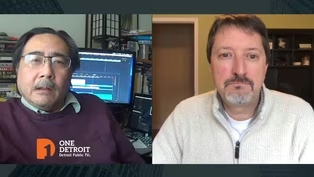
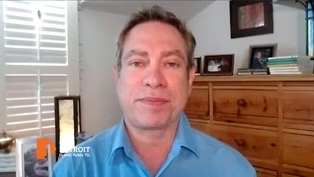
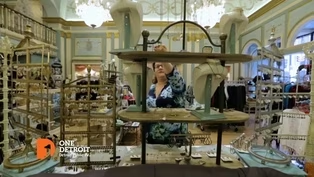
Detroit business owner Rachel Lutz on the struggles of the federal loan process and how the small business community in Detroit is coping. Automation Alley CEO, Tom Kelly, tells Bill Kubota, that the coronavirus crisis just might be the wake-up call needed. David Kessler, world renowned grief expert and author of “Finding Meaning: The Sixth Stage of Grief” talks with Christy McDonald.
Problems playing video? | Closed Captioning Feedback
Problems playing video? | Closed Captioning Feedback
One Detroit is a local public television program presented by Detroit PBS
Small Businesses / Automation Alley / Grief and Meaning
Season 2 Episode 36 | 26m 45sVideo has Closed Captions
Detroit business owner Rachel Lutz on the struggles of the federal loan process and how the small business community in Detroit is coping. Automation Alley CEO, Tom Kelly, tells Bill Kubota, that the coronavirus crisis just might be the wake-up call needed. David Kessler, world renowned grief expert and author of “Finding Meaning: The Sixth Stage of Grief” talks with Christy McDonald.
Problems playing video? | Closed Captioning Feedback
How to Watch One Detroit
One Detroit is available to stream on pbs.org and the free PBS App, available on iPhone, Apple TV, Android TV, Android smartphones, Amazon Fire TV, Amazon Fire Tablet, Roku, Samsung Smart TV, LG TV, and Vizio.
Providing Support for PBS.org
Learn Moreabout PBS online sponsorship- Coming up on One Detroit: Slowly opening up Michigan's economy.
You'll hear from one small business owner on the real struggle to find financial support.
Plus, Stephen Henderson and Nolan Finley on the difficult conversations with life, death, and the new normal.
Then, the future of manufacturing from Automation Alley in Oakland County, and then facing grief in how our world has changed from renowned author, David Kessler.
I'm Christy McDonald, join me, One Detroit is coming up.
- [Narrator] Support for this program provided by W.K.
Kellogg Foundation, a partner with communities where children come first.
The Cynthia and Edsel Ford Fund for Journalism at Detroit Public TV.
- [Female Narrator] From Delta faucets to Behr paint, Masco corporation is proud to deliver products that enhance the way consumers all over the world experience and enjoy their living spaces.
Masco, serving Michigan communities since 1929.
The DTE Foundation is a proud sponsor of Detroit Public TV.
Among the state's largest foundations committed to Michigan focused giving, we support organizations that are doing exceptional work in our state.
Visit DTEFoundation.com to learn more.
- [Male Narrator] Business Leaders for Michigan, dedicated to making Michigan a top 10 state for jobs, personal income, and a healthy economy.
And thank you to these supporters, and viewers like you.
(upbeat music) - Hi there, and welcome to One Detroit.
I'm Christy McDonald coming to you from my home.
While we made it to May, it was over seven weeks ago that the first cases of COVID-19 were reported here in Michigan and wow, how life has changed.
Here at Detroit Public Television and One Detroit, we started doing daily updates and interviews.
We expanded our show to include Monday and Thursday, all to make sure that you have the very latest information in these unprecedented times.
So, coming up on One Detroit, We'll catch up with Nolan and Stephen and have the tough conversation on policies moving forward in the new normal.
Plus, we'll hear what's changing in the world of manufacturing since COVID-19.
And then what we're all experiencing now is some kind of grief.
How do we move through it?
Some help from renowned grief author, David Kessler.
But first, Governor Whitmer unveiled tentative plans this week to start up the economy looking regionally.
- The MI Safe Start will be incremental.
We'll start with workplace types that pose the least amount of risk.
It's really important that we get this right.
So, the first will be additional outdoor enterprises that we feel pose low risk.
We'll also be looking at residential and commercial construction.
- [Christy] She's also facing off with Republicans in the legislature who don't agree with her strategy.
I wanted to see how smaller business were doing seven weeks into this crisis.
So I caught up with Rachel Lutz.
You met her on One Detroit about a year ago when we visited her at the Peacock Room at the Fisher Building.
She owns four retail shops in the city and she talks about the loan process and figuring a path forward.
- It was just heartbreaking to finally make the decision of having to lay off my entire staff, full-time of 12 women, but additional part-time and seasonal help.
It really was devastating on a personal level and as a practical matter, too.
I'm now the only sole employee of running four stores.
And in the process, I've had to be fulfilling a few orders coming in, I've had to apply for all these ransom loans, and in the meantime, I don't just miss my staff operationally, they're my family.
To send the layoff letter I basically I literally stayed up until 5:00 one morning cause I just couldn't hit send.
And I'd promised them I would send it that night.
And I thought, "Well, maybe if I technically do this "before dawn, it still counts."
And finally before I just had no time left, that's when I just sent the layoff letter.
It was awful.
But I did it with the intention of bringing everyone back as soon as we're able to reopen.
Didn't know what the future looked like, but I knew what that moment looked like, and it was pretty bleak.
- So if you stopped then for a minute, and say, "All right, now how am I going to "pause, and now apply you said "for all of these different grants or loans, "and see what you can do to connect the dots."
Can you explain that process for people who don't own a small business and who don't maybe really truly understand what you guys are going through?
- They're lucky not to even be familiar with it because it is a mountain of paperwork.
I think a lot that we're hearing is, well, "You'll be fine, "you're getting the small business bailout" And there really isn't one.
There are several loan programs that you can apply for and some grants, but the PPP for example, we watched 45% of that funding go to 4% of the recipients.
How demoralizing is that as a small business to finally get thrown a life preserver, and then have it yanked away and given to somebody on a yacht.
That's what it felt like.
And the second round of funding is also, it feels just as elusive.
I am hopeful in the second round that we might qualify, but even that is protection for our payroll and rent.
It's a bailout for our landlords in a way.
It doesn't take into account the $100,000 of inventory that I have bought for theater season, wedding season, derby season, prom season, that just evaporated into thin air.
So, the money that even if we do get it, we're restricted on what we can spend it on or it becomes a loan instead of a forgivable loan.
But the questionnaires that we have to answer, How many employees do you have?
Well, do you mean full-time, part-time, seasonal?
How many employees do you expect to bring back?
I have no idea how I'm supposed to answer that question as a retail shop owner that's non-essential.
So all these questions, it's almost like we're expected to have a crystal ball ourselves and we don't.
So these applications are just, thank God i have a bookkeeper and an accountant, and a manager that's helping me through this because the small, small business, especially the ones who are more analog, they're not as web-friendly, I think that those are really a lot of the businesses that are especially going to get left out of this.
- Talk to me a little bit about what other small business owners are doing who maybe don't have the bookkeeper, who maybe don't have even other resources.
What is everyone telling each other in the area right now?
- So one of the amazing privileges of owning a business in the city of Detroit is the spirit of collaboration.
I founded a private Facebook group just to quickly do it as a crisis communications group called City of Detroit Business Owners COVID-19 Rapids Alert Page.
And that's an internal group where we can vent, we can collaborate, we can let each other be aware of all these programs and keep track of all these grants and loans and other resources that are available to help each other, so if anything we're just trying to reach out to those who might not have the resources and share what we have.
Thankfully, we have a short-term, medium-term, and a long-term plan.
We're doing virtual appointments.
We're still very service heavy as we always have been.
We're not gonna be up all in your business in a fitting room any time soon.
And by the time we are, we'll have a plan in place to deal with that and the medium and long-term plans aside from selling through social media and online, is we do want to be a brick-and-mortar again in the neighborhoods that we serve.
That is our number one passion, and the passion of most retail stores in Michigan.
So our medium and long-term plan are really going to depend on what the governor advises and frankly what the health community advises.
I'm not going to be taking my directions from any politician at a city, state, federal level.
I'm going to listen to the medical experts that are out there telling us how to manage this crisis.
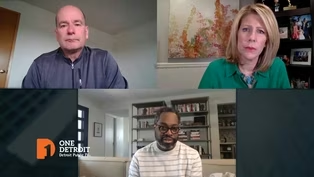
- I caught up with Nolan Finley and Stephen Henderson this week for a conversation on where we are right now as a region and how we all come out of this.
It lasted over a half an hour, we went back and forth, so this is just a small part of our conversation about some of the tough decisions that are being made in our personal experiences.
- So over the last seven weeks, I've never, I think, experienced anything like what we've experienced here.
Not just in the state of Michigan, but especially in the city of Detroit.
The number of people I know personally who have been sick, the number of people I know who have died is staggering.
The relentless nature of the news about people being sick and dying has been unparalleled.
I'm at the point now where I'm almost out of words to describe what we're living through.
There's nothing I can think of that compares.
Nothing I've ever experienced, and there isn't some sort of convenient end that we can say is on it's way.
- Nolan, give us a sense of where you've been this last seven weeks and how this has affected you personally.
- Well, it's not as so much that life has changed, it's basically just come to a halt.
There's this sense that you're on hold, waiting for what next, waiting for the pause button to go off, if you would.
I'm curious to see what this is gonna be like when we do emerge, because we're gonna have to soon.
We can't continue this no matter what the risk.
We can't keep living like this.
Our systems are collapsing, our food delivery system is collapsing, our food production system is, we're gonna have to reemerge at some point.
- When we do come off pause it's not going to be back to what it was and I think that that's probably the most difficult part of all this.
Is not only do we not know where the end is, and if there's another wave coming or that when it is over, it's not going to be the same, Stephen.
- What do you think the difference would be if we develop a vaccine in the next several months?
How do you think that changes?
- I think that drastically changes it, but I think science will tell you that there's no way they're gonna be able to develop a vaccine in the next couple of months.
- It doesn't work that way.
- No, but if we reach toward the end of the year and there's a vaccine, cause I do think these tests and everything are being fast-tracked.
- The vaccine is what we're waiting for, right?
That is the sort of turning point.
That makes it possible for lots of other things to happen.
The idea that that's on it's way inside of 12 months is fantasy if you talk to scientists.
If you talk to actual doctors who are working on this.
- Here's the hard reality.
We can't stay locked down forever or for even much longer or there will be no structured society to return to.
We have to return to some semblance of normal, and we do that by managing risk.
- Well, I'm not quite sure we have any semblance of normal to return to, Stephen?
- So when you say managing risk, that doesn't comport with the nature of this infection.
So college campuses are a great example.
Young people who are in college are, for example, not affected that we know of at this point by the disease.
That's true, but a college campus is not just the students.
The people who teach at those colleges have to be there too.
The people who clean the buildings, the people who run food service, the people who run all the support systems on a college campus are adults and all of them are at risk.
This idea that somehow you can divide people into categories of risk and non-risk doesn't work for a disease that is infecting everybody.
The issue is not- - It's not infecting everybody.
A low percentage of the population's been infected and I think if we minimize the panic over this, first, we can assess how we the steps we have to take responsibly reopen our society.
- It does infect everybody, it can infect everybody.
Everybody.
- But it hasn't.
- But, hold on.
Everybody is a potential carrier of the disease and so as opposed to saying, "Well this person is infected in this way by the disease "and this person is not."
The proper way to manage it is to keep it from spread and that is what has made a difference in states like Michigan over the last couple of weeks and bringing the numbers down.
- But this is not sustainable.
- Well what is sustainable?
The idea of risking other people's lives and deciding who's life is worth risking is atypical policy.
- And that's, you know And that's easy to say for three people who have paychecks still coming in.
You have a lot of people out there with no paychecks coming in.
No way- - It's not easy to say for people who are- - No way to think that the government's going to keep supporting them for COVID.
I mean, we've got to reopen this society.
- Nolan, money losses don't equate to mortal losses.
If you talk about people up North, people in places where there is nowhere near the hospital capacity, getting this disease in large numbers.
The death toll for them as a percentage will be much much higher.
The danger here is off the chart.
And so this idea that this mass of death in places like Detroit and places like New York, in dense places is somehow not getting the concern that it should from some quarters is one of the most frightening and disrespectful things I have ever seen.
- How difficult has this been to talk about this.
- Well, I don't think this is difficult to talk about.
You have different opinions and I think it's important to air them.
I think there's not just one way of one approach here or one way of dealing with this.
I mean, I think it's wrong to say people don't care about the folks who are dying.
Of course people care about the folks who are dying and I don't think there's anybody who hasn't been impacted by this.
I mean, we all have loved ones who have lost their jobs because of this, who've gotten ill because of this, who have died because of this.
This is gonna be a long hard slog coming back from this, but we've got to start figuring this out.
- One of the things we're seeing from the COVID 19 crisis is it was very small mom and pop garages making PPE face shields with their 3D printers that they were using just for hobbies, just for fun.
This is a glimpse into what the future manufacturing's gonna look like.
- [Bill Kubota] I'm with Tom Kelly with Automation Alley in Troy Michigan, right?
- Yeah, hi Bill.
Nice to be with you today.
That's right, Troy Michigan.
- You know we talk in here about what COVID 19 is doing to Automation Alley.
What's going on over there?
- So Automation Alley, Bill is Michigan's industry 4.0 Knowledge Center, so it's all about digitizing for manufacturers, healthcare, agriculture, defense.
So, we started on this journey a couple years ago.
We have 1085 members around the state that are part of our community and quite frankly, the majority of them are manufacturers and they are struggling right now because a lot of the economy is shut down.
And so they're trying to figure out how do we do this?
How do we navigate this new reality?
- Well explain Industry 4.0 to being with.
What is that?
- So it really stands for the fourth industrial revolution.
So think the first was steam and trains.
The second was Henry Ford created the assembly line.
The third was when computers and robotics came onto the scene.
And this fourth revolution is really about the digitization of everything.
The integration of digital with the physical world and it's gonna be a change like none of the other three have been.
So we've been seeing this move along for a long time, but COVID 19 really shocked us into, "Oh my gosh".
People that were prepared for a digital world are prospering, even thriving.
And people that weren't prepared for this digital world are really suffering greatly.
- Give me an example where somebody was more digital ready that we've been seeing right now with COVID.
- A great example that perfectly related to COVID, all of a sudden we needed massive amounts of PPE, Personal Protection Equipment and they said, " Wow,3D printing, "we might have bought this 3D printer to make parts "for our auto supply chain, but guess what?
"We can make parts just as readily for face shields, "for masks, "for other things."
So you saw that they were able to pivot.
Because they had prepared digitally.
- Well what does that say for a lot of the manufacturing done around here in Southeast Michigan?
Are they ready to pivot?
- Sadly, many are not, and I think this is the wake up call where our manufacturing community, and you know it's not about the bigs.
If you look at Ford and GM are doing, they're doing a wonderful job.
They understand Industry 4.0.
What we're really talking about are the small businesses that we all know and love.
They are woefully behind in terms of understanding that the world is digitizing and that's a cultural shift that quite frankly, we have a great deal of difficulty doing, Bill.
And if you look at what's going on in Germany, in South Korea, in China, even in Mexico, they all have national policies around Industry 4.0 around the digitization of everything.
If you've ever read China's 2025 policy, it's basically a road map to being a digital first country.
- Do you see us catching up with China?
Is that what we need to do?
- I would we've never been behind China.
We're still the leader in terms of innovation.
What we decided to give up, which may or may not have been a mistake, was saying, "Listen, the commodity products, "the supply chain for the parts of the car, "let's offshore those all the way to China, "and we'll keep the smart stuff."
And what's happened is China has now become that back office for manufacturing for many many companies in America and all of a sudden we found out, "Wait a minute, the innovation occurs in the plant".
Because that's how you constantly iterate and improve the product so we can't allow China to have all the manufacturing.
And you will see a big push from many manufacturers to re-shore back parts of their production.
They're gonna manufacture in China for Asia, They're gonna manufacture in North America for North America.
That's an opportunity, but only if we understand you have to do it with a digital mindset.
- Well thanks.
We're talking with Tom Kelly with Automation Alley.
Thanks for spending the time.
- Bill, thanks so much for having me.
(music) - Joining me now is well known author and lecturer on grief and death, David Kessler.
He coauthored with Elizabeth Kubler Ross on grief and grieving.
He's helped thousands of people face death, dying, grief, working in hospital systems on the Red Cross disaster team.
His latest book is Finding Meaning The Sixth Stage of Grief.
David, thanks for joining me.
It's good to see you.
- It's good to be with everyone.
- You know, at this time where I think we're all trying to label.
I think what we're feeling, whether it's anxiety, whether it's sadness.
Is it grief that we're feeling?
It is.
So many people have shared that they're just sad at night or they woke up with this heavy feeling.
And I think it's important we name it as grief.
You know, we think of grief as when someone dies and that's certainly the worst grief we have, and yet, at the same time, canceling a wedding, your kids not being able to have their playdates, and this sort of the world we knew a month ago is gone forever and we're grieving a lot.
- As a society though, are we comfortable with the word grief?
It doesn't seem like we are though, sometimes.
- Not at all, and it's important we label it because if we don't we're just pushing these feelings down.
I'm not gonna feel sad because no one died in my life.
I'm not gonna be angry 'cause I have enough food, and we end up being this culture of half felt emotions.
- That almost seems like shame, like grief shame, like my feelings aren't valuable enough to feel them.
- Correct.
We go, "Oh".
We try to tell our kids, " This is virus, "don't be sad that you have to do this".
And not understanding they're sad.
They're sad.
You know people always ask me which is the worst grief.
Is it a death?
Is it a divorce?
What's this collective grief we're feeling?
I say the worst grief is always your grief.
- Do we get a little impatient?
Do we want a time limit on it?
Do we wanna say, ú"David, tell me this is going to be, "tell me my grief will be better in two weeks "and the benchmark of one month".
There's no limit on grieving but I think sometimes we search for it.
- I always say the goal is to grieve with more love than pain.
And we're gonna miss this world we knew.
You know, the world is gonna be different in the future, and so, we're gonna have moments of nostalgia and sadness.
That's gonna be part of our life from now on.
- Is it as simplistic as saying, appreciating more of the little things or appreciating the things that are directly in front of you?
- Or at least naming them as meaningful.
I had a phone call the other day with someone across the country who I like I only have a minute to text with, usually.
We had a twenty minute conversation.
I realized, "Oh, I can Facetime this person anytime".
I should be connecting.
One of the things that's becoming meaningful is we're learning how to do this.
You know, our technology is raising and that's becoming meaningful.
We're becoming a world.
- How do you think this pandemic will change the way we think about grief.
Will change the way we validate the feelings we have and even talking about mental health moving forward because I feel we've been forever changed by this and maybe as a society we're not totally equipped to say, "All right, well let's talk about this".
It's like, "We're fine, let's just keep moving forward".
- Ann, that's so important because every tragedy like this, epidemic, pandemic, war, whatever it may be, we come out of it with some people having post traumatic stress.
Some people come out of it fine.
My goal is to help us come out with as much post traumatic growth as possible.
And while it's important we name the feelings of grief, we also need to name the feelings as we find meaning because meaning is what helps us get closer to that post traumatic growth.
There's meaningful moments occurring.
I studied Victor Frankel's work.
I was so curious about, "How do you appreciate a sunset in a concentration camp?
"How do you find the light in the darkness?"
And even now I live on a block with thirty homes.
I didn't know any of my neighbors.
We're now on a text chain.
Someone's going to the grocery store.
The guy at the end, the elderly man, what can we get him?
Parents are in front of their house playing with their kids.
Like they're having a play date with their own kids.
Those are meaningful moments.
You and I are having a meaningful moment now.
If we name these meaningful moments, that will help us grow through this and not just go through this.
- That's a lot to think about.
I hope you've had a good week and that you are staying healthy.
Here's some of my crew.
They've helped me set up my lights and log down some of my interviews.
We are all adjusting to the new normal.
Remember, you can find us at OneDetroitPBS.org, and that's Tate.
I'm Christy McDonald.
We'll see you next time on One Detroit.
Say bye guys.
- Bye.
- [Female Narrator] You can find more at OneDetroitPBS.org or subscribe to our social media channels and sign up for our One Detroit newsletter.
(music) - [Male Narrator] Support for this program provided by W.K Kellogg Foundation, a partner with communities where children come first.
The Cynthia and Edsel Ford Fund for Journalism at Detroit Public TV - [Female Announcer] From Delta faucets to Behr paint, Masco Corporation is proud to deliver products that enhance the way consumers all over the world experience and enjoy their living spaces.
Masco, serving Michigan communities since 1929.
The DTE Foundation is a proud sponsor of Detroit Public TV.
Among the states largest foundations, committed to Michigan focused giving.
We support organizations that are doing exceptional work in our state.
Visit DTEFoundation.com to learn more.
- [Male Announcer] Business Leaders for Michigan, dedicated to making Michigan a top 10 state for jobs, personal income and a healthy economy and thank you to these supporters and viewers like you (music0
Automation Alley - On the Verge of a Revolution
Video has Closed Captions
Clip: S2 Ep36 | 4m 34s | Automation Alley CEO, Tom Kelly: the coronavirus crisis wake-up call. (4m 34s)
Video has Closed Captions
Clip: S2 Ep36 | 5m 9s | David Kessler on understanding and identifying grief as well as finding meaning (5m 9s)
Video has Closed Captions
Clip: S2 Ep36 | 6m 57s | Christy, Stephen, and Nolan’s discussion on where we are as a region (6m 57s)
Small Businesses Deal with the Pandemic
Video has Closed Captions
Clip: S2 Ep36 | 5m 16s | Detroit business owner Rachel Lutz on the struggles of the federal loan process. (5m 16s)
Providing Support for PBS.org
Learn Moreabout PBS online sponsorship
- News and Public Affairs

Top journalists deliver compelling original analysis of the hour's headlines.

- News and Public Affairs

Today's top journalists discuss Washington's current political events and public affairs.










 New Season
Support for PBS provided by:
One Detroit is a local public television program presented by Detroit PBS