
Smoothies & Rosarito History
Season 15 Episode 6 | 24m 47sVideo has Closed Captions
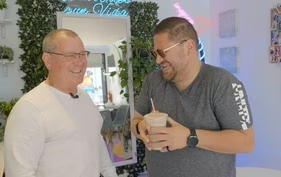
Let’s meet Robert Schmidt, a retired American police officer who now runs a healthy smoothie shop.
Let’s meet Robert Schmidt, a retired American police officer who now runs a healthy smoothie shop in Rosarito. We try his stuff, as he surprises us with the variety of ingredients he has on hand. Then, we visit historian Juvenal Arias, who shares fascinating stories about Rosarito’s past—and his own unique connection to the Rosarito Beach Hotel.
Problems playing video? | Closed Captioning Feedback
Problems playing video? | Closed Captioning Feedback
Crossing South is a local public television program presented by KPBS
Smoothies & Rosarito History
Season 15 Episode 6 | 24m 47sVideo has Closed Captions
Let’s meet Robert Schmidt, a retired American police officer who now runs a healthy smoothie shop in Rosarito. We try his stuff, as he surprises us with the variety of ingredients he has on hand. Then, we visit historian Juvenal Arias, who shares fascinating stories about Rosarito’s past—and his own unique connection to the Rosarito Beach Hotel.
Problems playing video? | Closed Captioning Feedback
Where to Watch Crossing South
Crossing South is available to stream on pbs.org and the PBS app.
Providing Support for PBS.org
Learn Moreabout PBS online sponsorshipJorge Meraz: Hey folks, on this episode of "Crossing South," we meet the man serving up fresh, healthy blends that have the whole neighborhood talking.
And then we sit down with Rosarito's official historian to tell us the backstory of Baja's beach town, and it's coming to you now!
♪♪♪ ♪♪♪ Jorge: Folks, as you can see right now, I'm walking in the middle of Rosarito, not in the touristy area, I'm actually in the middle of a colonial right now, and I'm going to go to a self-proclaimed place which aspires to be the healthiest smoothie in all of Baja.
It's an expat, it's super interesting.
We're gonna meet him right now.
"Crossing South," folks, don't go anywhere.
Jorge: So Robert, nice to meet you, my friend.
Robert Smit: You too!
Jorge: So you purport to--want to be the healthiest smoothie in all of Baja.
First of all, how'd you get to Baja?
Robert: I did 21 years with San Diego PD, and the police department was good, I loved the work, but I realized at about 18 years that I had a private business going at the time, and my private business was doing so well I had to decide to stay on the government check or be an entrepreneur.
And after 21 years, I said, "I've gotta be the entrepreneur.
I can't do this anymore."
Jorge: You went out.
Robert: I went out.
Jorge: Put yourself out there.
Robert: Left the department, retired early, decided I need to downsize my life, sold my home, sold a car, closed my credit cards.
I was gonna live without retirement, you can't collect until 55.
I was younger than 55, and I had to live off my savings, so I thought, "Okay, I know Baja.
I know Rosarito.
I'm not afraid of Mexico."
And I decided to move down here.
I moved in with a friend, rented a place for three months and said, "I can do this."
Jorge: So this is gonna probably blow some of our viewers' minds, right?
Because they're like thinking, "Oh, Mexico, security, and here, a police officer who's seen it all--" and you've been down here 14 years.
What could you tell to someone who's got all the, you know, preconceived ideas, the--you know, bleed-leads media, basically brainwashing them.
Robert: They'll say, "You live in Mexico?"
And I know exactly where they're going with that, because they're worried about what they see, that small snippet of TV they see.
And I say depending on your age, you'll understand what I'm gonna tell you, "Do you remember the '60s and the '70s in the US?
You could leave your door open, you didn't go home--as a kid, you didn't go home until the lights on the street came on?
Mom didn't worry about you, there were no cell phones, you didn't have to chase anybody, you knew where to go to find answers.
That's the way this is.
That's the way I find this is.
For the American, the expat, the Canadians, and even for, what I found, most Mexicans, if you just stay in your lane and you don't do things you shouldn't do--I mean, imagine that, don't do things you shouldn't do-- it's very safe and it's very welcoming.
It's very accommodating.
The culture is so inviting that it's like the '60s and '70s in the US where everyone was open to almost anything.
Jorge: I'm like, the same common sense that keeps you safe in Paris, and London, and Rome keeps you safe in Baja.
Robert: My first three months down here, I had a beat-up truck, you know?
You wanna come down, you don't wanna bring your nice car down here, so you bring a beat up truck.
Well, that's ridiculous.
So I got a beat up truck and I had a flat tire.
Alright, I'm gonna pull over.
I pull over to the side of the road and I'm on the "cuota," and I go to change the tire, and a car pulls over, and I'm a little suspicious.
Car pulled over.
It's not at night, it's the middle of the day.
They wanted to help.
And I said, "Oh, okay, you can help!"
And it's a gentleman and his wife.
The wife goes out, and she's-- Jorge: Mexican?
Robert: Yeah, they're waving their little thing, and I spoke maybe 25% Spanish.
She's waving a red rag to keep cars the other way.
The husband and I are jacking up the truck, and then I noticed another car pulls up behind him, and I'm thinking it must be their family or someone they know.
Nope, it's some random guy in a truck who's got a big jack, and he saw us, and he made a U-turn and came back to help us with a big jack.
Jorge: That's your initial experience, introduction?
Wow.
Robert: Are you kidding me?
Are you kidding me?
I wanted to give them money, and they were almost mad that I was offering them money to just help me change a tire.
That's how it is down here.
It's so different in such a positive way.
I'm not saying Mexico is perfect.
I'm not saying the US is perfect.
Everybody has their problems, but if you can get past the baloney.
Jorge: Yeah, I had a friend from Germany, and he said like, "Jorge, every time I fly into Baja, like, my tension, my stress level--as soon as I land, it just goes down from being in such a strict society."
So, Robert, you relocated, and I guess you got bored, because you opened this little shop here not even in the commercial touristy area, you're servicing the locals here, right?
And some expats that live around.
Robert: Yeah, I had a business partner a year ago--a little over a year ago, and he said, "Hey, let's do something different down here."
And as we talked about it--this was back in February of last year, and by December, he didn't wanna do it.
We opened in August, I bought him out in December, and I've been doing it on my own.
And what I found was, I said, "Let's do something healthy."
He goes, "Well what do you mean?"
I said, "Like a Mexican Jamba Juice," if you remember Jamba Juice in the US.
I said, "But we'll stay true to what we are."
And he said, "Well, I don't know that we'll--" I said, "Just trust me in the process, because I really believe this."
And I told him, I said, "Look, 14 years ago when I moved here," 13 years ago, at the time, "there were three gyms, now there are 14 gyms."
Jorge: Oh, wow!
Robert: Just that simple idea.
Jorge: That's a little market study right there, right?
Robert: That's right, that market study tells you, well, people are getting healthier.
And I said look at, globally, the consumption of alcohol.
Alcohol sales are down by 40% and 50% among young people, that's right, not my age, not your age, but those younger people are deciding they want to do something else, differently.
That was the idea.
Create a healthy environment.
We have four types of milk, we have organic fruits, we have 12 different additives, nine different protein powders for different things that you may want, or don't know you need, with cold-pressed juices that are just super unique.
It's not a hot-cold press, it's real cold press that takes a little bit more time, but you get everything out of that juice.
I was in the military for 11 years as a corpsman, a medic, and I knew a lot about medicine.
I knew a lot about health and the body, so it kind of gave me a heads-up of what to look for.
I had heard of ashwagandha powder and I knew it was a trending thing, so I made sure we carry that.
And one of the first clients goes, "Oh my god, you have ashwagandha?
I can only find that in San Diego, I can't get it down here!"
And then they see the rest of our menu, and they're, "You have this powder, too?
And you have this powder?"
And the idea is to be different.
Not to be better than the juice place on the corner, not to put anyone out of business, to be different, to offer people something that they can't get-- Jorge: Yeah, do your own thing!
Robert: That's right, we have, from what I know, it's the only fat-free frozen yogurt.
It's not ice cream, but it's fat-free frozen yogurt, and we don't add Captain Crunch, we don't add, cookie dough, crushed Oreo cookies on it, no, fresh fruits, fresh nuts, granolas, not your bag granola you buy at the store with sugar 26 calories--26 grams of sugar.
No, I go to the US and I buy whole food, seven grams of sugar in a cup, and that's what we use.
Jorge: At home, I actually am very compatible.
If I showed you my picture of all of my powders, including ashwagandha, like all these different--I'm gonna show you a picture.
Robert: And we have it right there.
It takes seven oranges to make one glass of orange juice, okay?
It's 142 grams of sugar.
"Oh, but it's 'natural sugar.'"
Well, even natural sugar, if you're not exercising, you don't work that off, it turns into carbohydrates and it turns into fat.
So we tell people, "No, no, we can make you an orange juice, but we'd rather make you what we call our 'Glass of Sun,' 'Vaso de Sol.'"
It's two oranges, two green apples, and half a lemon.
The apple sugars will help get rid of the orange sugars in your body faster, and it tastes phenomenal, and so much better.
I tell people, "Okay, let us-- just try the 'Vasa de Sol.'
If you don't like it, I'm gonna make you an orange juice for free."
We've not given any free orange juice away.
Jorge: Well, Robert, are we gonna be able to try your stuff?
Robert: Absolutely!
Jorge: You got something for me?
Robert: Absolutely, we're gonna give you The Arnold.
[imitating Arnold Schwarzenegger] Jorge: The Arnold!
Robert: The Arnold was our first protein smoothie we made, and we did this back in--I first experimented with it in July because I saw that Arnold truly did a video with this smoothie.
Jorge: Oh, really?
Robert: And I think you're gonna like it.
And then, for your partner, we're gonna give him one of our classics, it's our tropical mango.
Jorge: Okay, fantastic.
Robert: And it is--you know, as sweet as it is, it's got less than 10 grams of sugar.
Jorge: You're kidding?
Robert: It's crazy good.
Jorge: Believe it or not, folks, this is totally my wheelhouse!
This could very well be my kitchen on a weekly basis.
I'm a habitual frozen berry smoothie consumer with my own potions and powder mixes, but I'm ready to try his vision of these healthy and high-nutrient concoctions.
Robert: Now, the beauty of the super berry, we're using Splash Diet Berry, which has zero sugar, zero fat.
We're using organic frozen berries, which is natural sugar, no added sugar, and we're using fat-free, sugar-free whipped cream on the top.
That's it, fat-free, sugar-free whipped cream.
[imitating English accent] Jorge: It never tasted better.
My man, if everything is this deliciously--you know-- Robert: Less than less than 70 calories.
Jorge: That's crazy.
You got people hooked down here.
So what kind of patrons are you getting?
Robert: We're about 50/50 Americans to Mexicans.
Jorge: Oh, wow.
Robert: And that's surprising.
I anticipated a little more Americans, but where we're at, we're surrounded by mainly Mexicans, where our store is.
So we're getting more Mexicans.
I think it's 50/50, but I think we're seeing more Mexicans.
Our favorite customer, Señor Bonbon, who is in his late 70s, he comes in three times a week.
He started off with one thing, and now he gets five different things.
Jorge: Oh, fantastic.
Robert: But he feels better.
He said he feels better about his health, he's now walking, he's going to the gym, and it started with him--with me telling him, you know, "You need to drink more water.
You need to drink more cranberry juice.
You're an older gentleman, you need to help your system."
And when he started doing that, he believed me.
And now he comes in here and he'll ask me for, "Okay, I want a wrap, and I want some of your frozen yogurt, and I want a smoothie now," and because he just gets the idea of being healthy.
Jorge: Tropical mango and The Arnold.
Robert: The Arnold has almond milk, has a banana, has--help me out, protein powder, has an egg.
Jorge: Whoa!
Robert: Hold on, when you try that, I want you to try that first.
Tell me what you taste.
We got a little peanut butter in there for you.
Jorge: I love peanut butter.
Robert: Go ahead, give it a try first, and then I'm gonna finish telling you what's in it.
Jorge: Okay.
Robert: Oh, man, this is fantastic.
People will freak out if I tell them before because their mind goes, "Wait a minute, you mean there's a whole egg in there?"
With the shell.
Jorge: No way!
With the shell?
Is that the crunchy thing I'm tasting?
Robert: That probably is, or the oatmeal we put in it.
We put a steel-cut oats in it.
Jorge: Man, I'm feeling fit.
Robert: But imagine that that egg has 1000 mg of natural calcium.
Jorge: Well, he did say his stuff was different.
Okay, let's try the next one, the tropical mango.
This is so refreshing, oh my goodness!
Almost like a pina colada.
Robert: Yeah, so we have one called the verde tropical mango, and we add two cups of spinach, so it looks green, and your first is like, "Oh, it's green?"
This is a pina colada, all it needs is rum!
Jorge: Yeah, that's what this needs!
Robert: All it needs is rum.
[Jorge singing] ♪ All you need is rum!
♪♪ Well, Robert, if you're helping your patrons become healthier with delicious ingredients and delicious smoothies like that, you're doing nothing but good-- Robert: That's the idea!
Jorge: --for the society you live in.
Robert: To not be a business in the community, but be a business as a part of the community.
Jorge: Fantastic, folks, "Crossing South," don't go anywhere.
We're happy to be here with Robert.
There's more coming your way.
Jorge: See, the city of Rosarito has many stories like Robert's, people that have made this town what it is.
We now get to chat with a person that has done his utmost to compile enough of those anecdotes for posterity.
We are at the Rosarito Beach Hotel.
We've been here before, ever since we last did a show here, Don Hugo Torres has passed, and now the next generation has taken over, and they've kind of embraced their history showcasing their museum exhibits more about, you know, the 100 plus years that this hotel has been in operation.
And the person that's gonna guide us as to what the--that showcase, you know, entails is the person that's next to me right now.
How you doing, my friend?
Juvenal Arias: Fine, gracias, thank you for coming.
Jorge: Thank you, what's your name?
Juvenal: My real name is Juvenal Arias.
Jorge: Okay, so people call you Jay?
Juvenal: Jay, yeah.
I'm the official historian of the city.
So I've been writing about the history of Rosarito.
Jorge: Right, not just the hotel?
Juvenal: Not just the hotel.
Jorge: But we're here at the hotel.
Juvenal: Yeah, well, I was born here in the hotel, so I know a little bit about it.
Jorge: Really, literally?
You were born here?
Juvenal: Yeah, uh-huh.
Jorge: Oh, wow, okay!
Juvenal: I was born in Rosarito when it was part of Tijuana, but Tijuana was part of Ensenada, so I was born in three different cities.
Jorge: The municipalities have broken away from each other since then, okay?
Jorge: Mr.
Juvenal has been a faithful custodian of the memories he's made in this city, having seen the progression of the town and getting involved at a very young age in the mix of significant events in the city's history.
He was able to do so by joining the workforce at a very young age, and in doing so, he became a witness to different historical periods in the city of Rosarito.
Jorge: So you're--you went from bellboy, to receptionist, to manager?
Juvenal: Yeah, and then, 1984, then I decided to build my own restaurant.
I had a few restaurants.
I had a small hotel.
Then, I have musical group in the '60s.
Jorge: Rock and roll, right?
Juvenal: What now is all this.
Jorge: Yeah, now it is, but back then, it was-- Juvenal: I work also for the government, for the state, and the local government.
And I started work--and I started being a journalist, so I spent 50 years doing that.
I never charged, I never get any money from it.
Jorge: Okay, but you were doing the work?
Juvenal: Yeah, but that's why I'm the "cronista de Rosarito," because of those 50 years that I spent.
Jorge: Everything that you documented without even knowing it became, like, the chronology and the tale of-- Juvenal: And now, I'm retired, dedicated to history.
I'm the historian for the city.
Jorge: The official Rosarito historian.
Look at all the way your journey has taken you.
Juvenal: Yeah, we're gonna talk about the history of Rosarito, okay?
The history of Rosarito is divided in eight different stages.
The first one is the natives.
The Kumeyaay natives were here in Rosarito, Tijuana, Tecate, and San Diego.
Another stage is the missionaries.
1533, they arrived in Southern Baja California.
They thought it was a California island that they read about it in Spain.
Jorge: Was it Cortez, or who was the one that thought-- Juvenal: Cortez, yeah.
They started building missions along all the peninsula, as well as Upper California, and California was only one, a lone one from Los Cabos up to northern San Francisco.
So the Jesuits first, and then the Franciscans, then the Dominicans.
Jesuits were expelled from Mexico.
They were accused of not well-treating to the natives.
Jorge: Oh, really?
Juvenal: The Franciscans, the Dominicans were here, and they asked the government to divide California.
Franciscans were North-- Jorge: All the way to San Diego, Sacramento.
Juvenal: From San Diego on.
So that first boundary was here in Rosarito.
Jorge: Oh, really?
That's the boundary.
Juvenal: Yeah, as well as the second one, which they move it from Primo Tapia up to here to the creek, the old creek, between Rosarito and Renes, that was the borderline.
Jorge: Oh, wow.
Juvenal: Once-a-year, we celebrate that in horseback riding, and a walking distance from the first one to the second boundary.
So we celebrate that because history is very important for Rosarito, and that part is very important.
So 1773 on, it was Upper California, now it's known as California only, and South, or Baja, or Old California, now is Baja California.
Jorge: 1773?
Juvenal: 1773, the second one is 1788, and it lasted until the war between the United States and Mexico when they established the one that we know in San Diego or San Ysidro.
Jorge: Right, amazing, but the first one, even before the birth of the United States, right?
Juvenal: Yeah.
Jorge: Amazing.
Jorge: Next to the lobby of the Rosarito Beach Hotel, you'll find the collection of artifacts, photos that tell the tale Mr.
Hunal recounted for us.
He also told us about land grants given here for agricultural purposes.
Juvenal: The sons of the people from the army, from the Spanish army, they were given ranches.
Jorge: Okay, by like 17-- Juvenal: It was 1826.
Jorge: Oh, and now we're in the 1820s?
That's when ranches begin?
Juvenal: Yeah, here in Rosarito, it was--to the Machado family was given this ranch.
Jorge: Machado in Rosarito?
Juvenal: Arguello in Tijuana, Ruiz in Ensenada, and Jorba and Tecate.
Jorge: Jorba, I haven't heard that one.
Juvenal: Yeah, there were almost nothing here, so they were awarded big ranches.
Jorge: Right, acres and acres.
Juvenal: So they developed the area.
There were just a few people in Rosarito.
There were 100 people.
Jorge: Oh, my.
Jorge: Rosarito has come a long way from those ranch days.
It's really become prime real estate now for retirees from the states and other places abroad.
Juvenal: Rosarito Beach Hotel, as well as Rosarito Beach Resort, which now is called "Rene's," they were started in 1924.
That's why we're here and showing what it used to be.
Once, this was a casino, like, Aguascalientes casino in Tijuana, but then it became illegal, so they turned this into a regular hotel.
It used to be a landing strip here in front.
Jorge: That's a landing strip on the sand?
Juvenal: Well, it was paved.
Jorge: Oh, really?
Juvenal: Yeah, it doesn't look like, but it was paved.
Jorge: Okay, was that on the beach side?
Juvenal: Between the beach and the building.
This is the bar that is by the end, still those rooms are there.
Jorge: Oh, that's where the current, you know, garden is for the events.
Yeah, wow!
Jorge: You want to know how long this facility has been entertaining guests?
Check out what type of transportation people used to get here in the past.
Jorge: Wow, these cars, what can you tell me?
What year were these?
Juvenal: At the beginning of the 1900s.
Jorge: Oh, man, 1900s?
Well, the license plate is 1902, wow!
Juvenal: It was not easy to get here to Rosarito because there were no paved streets.
Jorge: Right, probably a very bumpy ride.
Man, can I even fit in here?
People were tiny back then!
And then I wonder how different it was.
Look at the gears, the clutch.
Juvenal: Okay, drive carefully, okay?
Jorge: Yeah, look at how low that is!
Like, you have to go like "qua-qua-qua!"
Yeah, they probably didn't have Bill Woodson's book on ergonomics.
Man, look at this!
Jorge: Circling back to when Mr.
Juvenal said he was born in three different cities.
So it was first Ensenada, then Tijuana, and it wasn't too long ago that Rosarito became its own city.
Juvenal: Rosarito was part of Tijuana, and then they worked for 12 years to get to be independent from Tijuana.
So Hugo Torres, the owner of Rosarito Beach Hotel, he started this campaign through 12 years, so Rosarito converted into a known city in 1995.
So it was the fifth city in the state.
The federal government made a decree in which they took away all the private land, and they was trying to re-sell it to the owners.
Jorge: So they expropriated your plot?
And then, "I'll sell it back to you," oh man.
Juvenal: Yeah, so there was a group that said, "No way," and that's how they started to work again on getting Rosarito being an owned city.
Jorge: Its own city.
Juvenal: Yeah, it lasted 12 years, so it's been 30 years now.
Tijuana was getting all the taxes and not giving back enough.
Jorge: Right, which is kind of like the plight of every small city that belongs to a bigger, you know?
Juvenal: That's why Rosarito became an independent city, so they can have--work on their own taxes.
Jorge: And control their own destiny.
Juvenal: Uh-huh, 1995 were 35,000 people here.
Jorge: '95, 35,000?
Juvenal: 35,000 in 1995.
Jorge: And right now?
Juvenal: Now it's 150,000.
Jorge: Wow.
Juvenal: Yeah, a lot of Americans are living here, more than 15,000.
Jorge: Oh, now you know, folks, now you know how many--those of you that are down here, now you know how many you are.
And for those thinking of retiring in Rosarito, which many do, you know what kind of population you're gonna find down here, right?
Yeah, it's a wonderful place to be at.
Juvenal: And more and more Americans or Mexican-Americans are moving to Rosarito, particularly.
Jorge: Yeah, I have friends who--in the States, they said, "I would never even dream of being even close to the--or looking at the water."
You know, from, you know, buying in California, and here, they're living either on the sand, or an unobstructed view of the ocean.
Juvenal: Yeah, they're a few miles from the United States.
Jorge: For sure, which it's a very unique characteristic, right?
Because you could go anywhere, you could go to Vietnam, you could go to, you know, Australia, but there's nowhere where you can be in a foreign land, low cost-of-living, lower property, and be a drive's away from all the conveniences of your home country, right?
Appreciate the journey through the historical phases of Rosarito.
Juvenal: Anytime.
Jorge: So after meeting the entrepreneur raising the bar for wellness in Rosarito and hearing the stories behind the city's past from a man who lived its evolution, we leave inspired by the people shaping this beach town, driven by passion, vision, and pride in their community.
And with Rosarito's story still unfolding, we move on eager to see what new chapters await us the next time we get to cross South.
Robert: With the shell.
Jorge: No way!
With the shell?
♪♪♪ male announcer: Like to know more about the places you've just seen?
Maps, videos, podcasts, and more at crossingsouth.com.
We also do Facebook, Instagram, and YouTube.
Smoothies & Rosarito History Preview
Video has Closed Captions
Preview: S15 Ep6 | 30s | Let’s meet Robert Schmidt, a retired American police officer who now runs a healthy smoothie shop. (30s)
Providing Support for PBS.org
Learn Moreabout PBS online sponsorship












Support for PBS provided by:
Crossing South is a local public television program presented by KPBS