
Snow, Skis and Stories
Season 8 Episode 13 | 26m 48sVideo has Closed Captions
Host Angela Fitzgerald gets a ski lesson at Granite Peak and takes in the panoramic view.
Winter has arrived as host Angela Fitzgerald takes on the slopes of Granite Peak, a popular ski hill on snowy Rib Mountain State Park. She gets a beginner ski lesson and learns what makes this hill so attractive to skiers and snowboarders of all abilities. Then she travels to the top of Rib Mountain to take in the panoramic vistas of Wausau and Marathon County.
Problems playing video? | Closed Captioning Feedback
Problems playing video? | Closed Captioning Feedback
Wisconsin Life is a local public television program presented by PBS Wisconsin
Funding for Wisconsin Life is provided by the Wooden Nickel Fund, Mary and Lowell Peterson, A.C.V. and Mary Elston Family, Leon Price & Lily Postel, Stanley J. Cottrill Fund, UW...
Snow, Skis and Stories
Season 8 Episode 13 | 26m 48sVideo has Closed Captions
Winter has arrived as host Angela Fitzgerald takes on the slopes of Granite Peak, a popular ski hill on snowy Rib Mountain State Park. She gets a beginner ski lesson and learns what makes this hill so attractive to skiers and snowboarders of all abilities. Then she travels to the top of Rib Mountain to take in the panoramic vistas of Wausau and Marathon County.
Problems playing video? | Closed Captioning Feedback
How to Watch Wisconsin Life
Wisconsin Life is available to stream on pbs.org and the free PBS App, available on iPhone, Apple TV, Android TV, Android smartphones, Amazon Fire TV, Amazon Fire Tablet, Roku, Samsung Smart TV, and Vizio.
Providing Support for PBS.org
Learn Moreabout PBS online sponsorship- The following program is a PBS Wisconsin original production.
- Coming up on Wisconsin Life: - Stand by, stand by.
- We set sail with the organizer of an iceboat club.
An artist working to strengthen her community.
- A crew of snowmakers keeping ski slopes fresh, and an animated tale of one man's journey to preserve Indian music.
It's all ahead on Wisconsin Life.
♪ ♪ Funding for Wisconsin Life is provided by Lowell and Mary Peterson, Alliant Energy, Stanley J. Cottrill Fund, American Transmission Company, Focus Fund for Wisconsin Programs, and Friends of PBS Wisconsin.
- Welcome to Wisconsin Life!
I'm Angela Fitzgerald.
We're hitting the slopes at Granite Peak Ski Area in Rib Mountain State Park.
Located in Marathon County, Granite Peak is the tallest ski hill in the state, with more than 400 acres and 75 runs designed for all skill levels.
The ski area first opened in 1937 and was hand-built by workers in the community.
Teams of people cleared trees and crushed boulders to build the foundation of runs that exist today.
Through time, the ski area continued to expand, offering a variety of runs and terrains for guests.
Don't let the mountainside be intimidating.
There's a huge area for beginners.
There are also several black diamond runs for those with more experience.
It's a great place for families or anyone who wants to get out in the snow.
Before I start my lesson, let's travel the state.
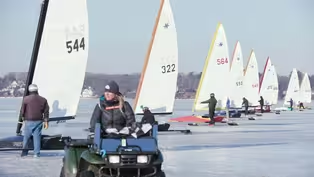
We head to Madison to meet an iceboat club organizer who's keeping things smooth sailing.
♪ ♪ - 2-5-5, 5-3-4, 2-0-5, 3-3-8.
It's the sport that no one knows about.
[laughs] You're on a... basically, looks like a coffin with a cross plank, and some skates, or runners as people call them, and you let the wind blow you across.
[wind rustling] - Go!
- Go, go, go!
[blades thunder and rasp on ice] [ethereal music] [wind sweeping] - Whoa!
- Whoa-ho!
My name is Deb Whitehorse.
If I have to talk about myself, [laughs] I can tell you about iceboating.
I can, you know, bore you for hours about it.
Oh, yeah.
There's my dad.
My dad, David Roston, lived on Lake Monona, and everybody who lived on Monona had a iceboat, and same with Mendota, I'm sure.
My dad always kept a scrapbook.
A lot of ice boaters did.
The sport received a lot of press coverage in the newspapers.
It was front-page news.
Eventually, that changed, and I realized that, "Well, we have to tell our own story now."
I taught myself how to create websites.
iceboat.org went online in November 1998.
I think we've had almost 3 million visitors since then.
Started working race committee for regattas.
Stand by, stand by!
- Announcer: Silver fleet to the line!
- When you start a race, you have to have a rider and a caller, and I have my clipboard.
I think all scorers like to have their own kind of pencil or pen they use.
So then, I have someone stand there and call out the sail numbers... - 255-205-534.
- ...on each lap as they go around.
Generally, they do three laps, sometimes four.
I take a picture of the finish, and I email it or text it to a tabulator, and then results are posted instantly on the Internet.
I'm really happy when I can do a Regatta with no mistakes.
- This is-- - A slide for the...?
- Right here, Jerry.
It's what you bury in the hull here.
- I guess I've known people in our Four Lakes Ice Yacht Club.
You know, they are my second family.
[laughing] People who like to build things.
They are constantly working on their boats like my father did.
- You know, he's got that fancy chalk system.
- Yeah, do you know how that works?
There's a...
There's a trick.
- When you go to Regatta, I've said this, it's like a family reunion.
It's the same thing of getting back together and seeing, you know, "Oh, there's Fred over there."
You know, "Let's go see what he's up to."
I'm with my friends, and we just have so much fun.
♪ ♪ - Next, we go to Milwaukee, where an artist is using her in-home gallery as a way to connect with her community.
Enter Milwaukee's Lindsay Heights neighborhood, and you'll find abandoned houses, vacant lots, and sometimes violence, along with the house at 18th and Wright where Evelyn Patricia Terry grew up.
[door closes] - Some people have told me that they wouldn't come to this area.
Like people who moved to Mequon or someplace, they may not come.
So I didn't mind coming to the neighborhood, I think because I just felt that I'd be okay.
[birds chirping] - The sign on her front door says it all.
- "Be Nice or Leave."
- Evelyn has a point and isn't shy about putting visitors on notice.
- I'm excited about that sign.
[chuckles] I want one on the back door, too.
[laughs] I just don't want anybody coming up to the door and thinking they should come any farther.
[laughs] - And for good reason.
Inside is Evelyn's gallery, brimming with folk and fine art.
♪ ♪ [poignant piano music] - When I was doing these pieces, the abstractions, I was in love with this guy.
He was in love with somebody else.
So I started making these lines across a picture and then scribbling the excitement of being in love.
So it came out of my own personal feelings.
It wasn't like I was copying anybody.
It just showed up one day.
- The same can be said about her foray into art.
An opportunity just showed up one day.
- I was never encouraged to go into art.
- Instead, she was encouraged to go into home economics.
- Then I did, but I couldn't stand home economics.
[solemn music] I cried all the time.
Just on the way to school, I cried.
Trying to go to UW-M, I cried.
It was miserable.
- A recipe for failure or the first ingredient to success, when Evelyn's artwork caught a teacher's eye.
- So she said, "I think you're an artist, and you might think about it."
And I said, "Oh, my mother would kill me."
And I said, "You can get a degree for drawing?"
And she said, "Yes, you can get a degree for drawing."
And I was like, "Where is that?"
- Evelyn's path to drawing and painting began at the University of Wisconsin-Milwaukee.
- I went in; it was like heaven.
Like the world opened up.
I'll always say, "It was like things going off!"
- Evelyn recounts that story at a neighborhood gathering.
- So I had to go home and tell my parents.
My father, he said, "If you do that, "you're going to be a drug addict or something, hanging out on the corner."
And I said, "That's not a prerequisite for art."
[chuckles] My mother, she just kind of gave up and said, "Whatever, it's your life."
- Despite her mother's pessimism, art became Evelyn's escape.
- I could always make art and disappear into a realm that was separate from whatever was happening around me that was horrible.
I could just slip into that and be okay.
- Evelyn's journey became eye-opening in more ways than one.
- When I was going to UW-M, we never learned anything about African-American artists.
I was trying really hard to be great because I thought I was the first African-American artist on the earth.
I mean, that's a big thinking.
A teacher told us one day to go to the library, look up an artist and write about them.
So I was looking through all the art books in the library and it said, Negro Artists in America .
I was like, "What?!?
"There are other artists that are black?
I'm shocked."
- That discovery motivated Evelyn and allowed her to dream of what she could achieve.
- I just remember when I first won that $1,200.
"Wow," I said.
"This can pay off."
[chuckles] And that was exciting.
My mother said to me, "You did it once; you can do it again."
♪ ♪ - Four decades later, Evelyn's artwork includes more than 400 public, private, and corporate collections around the world, including Milwaukee's Mitchell International Airport.
♪ ♪ - The one at the airport is called "Giving Gifts."
And it's about the gifts that each culture brings to share with the world.
Of course, I wanted to be rich, but I knew I wanted to be an artist.
I had no idea if those two things could ever match up.
So the name of this book in a series of books that I'm producing is called America, Guests Who Came to Dinner (and Stayed) .
- In 2014, Evelyn was named Milwaukee Artist of the Year.
- Some came from prisons, but they came and are here.
- Her in-home gallery is a testament to her success in that neighborhood, challenged with a reputation and the zip code 5-3-2-0-6.
- When they write about 5-3-2-0-6, it's written about mostly highlighting negative things that happen here.
♪ ♪ - Despite the crime problems, after spending most of her life in this neighborhood, when you ask Evelyn about her legacy here, she'll give you a modest answer.
- I'll think about it after today and see if there'll be something I need on my tombstone.
[laughs] "Evelyn lived here on 18th Street."
[laughs] - Or maybe it should read... "Be nice or leave!"
♪ ♪ I'm in Marathon County, learning about the highest ski hill in Wisconsin and even getting a lesson.
♪ ♪ Beautiful views, fast runs, and an avalanche of fun.
We're exploring Granite Peak in Rib Mountain State Park.
The best person to show me around is an instructor who's been coming here since she was a teenager: snow school leader, Brenda Zimmermann Thorpe.
I understand you have a rich history here at Granite Peak yourself.
- Oh, I'm so blessed.
So, I joined Granite Peak back in 1988 and started out as a very young person, and have stayed here for a long time.
This area has done so much for me, and it's only my honor to contribute to the legacy serving those in our community and guests that visit the Wausau community.
Granite Peak is exceptional.
We have been blessed with some founding members who had a vision to build this in an area that has over 70 runs.
We have exceptional snowmaking and grooming, and high-speed lifts to help our guests.
- And I understand it's also friendly to other forms of winter sports-- not just skiing.
- Absolutely!
So, Granite Peak is well known for skiing, also is a wonderful place to snowboard, and this year, we have really upscaled our whole park system so you'll see the common standard of small, medium, and large parks.
And Granite Peak also has really, this year, embraced being able to offer adaptive lessons.
We really want to give that opportunity for everyone to try skiing and snowboarding-- to at least give it a chance and have a wonderful, safe experience.
- I love that.
And so, I'm looking forward to my lesson today, getting back into skiing.
- Excellent.
- What should I expect?
- Alright, well, you can expect we are going to have fun.
We'll keep you safe, and we are going to work on speed and direction control.
- Hmm, awesome.
I'm looking forward to it.
- I am too.
Let's get to it.
- Our first step is to grab the rest of my equipment and get my skis adjusted.
And then, it's time for a quick lesson on the hill.
- So, we're going to talk about the fundamentals, things we do with our feet.
Now, as our ski sits right here, you see how it has a balance point is right here, and you're leaning back, that makes your ski come up.
- Ohhh.
- But when your ski is down, and you have shin pressure, that makes your ski come forward.
How'd that feel?
- It felt good.
- Looked amazing, alright!
- It felt better than the first one.
- See?
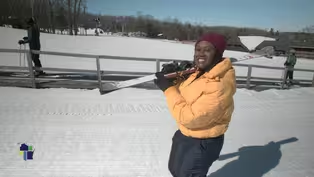
- With some practice, I hit the slopes.
- So, let's start to glide away.
Looking straight ahead to where you want to go.
Stop.
Okay.
Here, we're just going to continue on, and make a few more nice length turns, and finish strong.
Really nice!
Shin pressure!
Dang, nice job, girl!
- Thank you.
- Yeah!
- I appreciate your help.
- My pleasure.
I'm so proud of you and your hard work.
- With a bit more work, I'll be able to enjoy all that these bustling ski hills have to offer.
[high-energy disco music] Well, I'm starting to get the hang of skiing.
Now, let's slide into our next story.
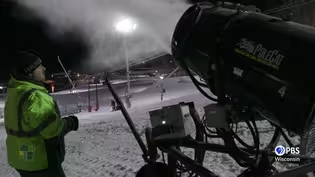
We travel to another Wisconsin ski hill in Kewaskum to catch up with a team keeping the slopes snow-covered and well-groomed.
- Whoo, hi!
[excited squeals] [happy shrieks] - Jason Wood: Chad, go turn power on.
[motor sound, blowing] There was a ring around the moon earlier tonight.
I think that means it's gonna snow.
So, a lot of snow was made last night.
We made piles anywhere from about 7 to 15 feet.
If we have to move that gun, we need to pull that nozzle.
My role is I oversee all of it.
I average probably about 17 to 18 hours a day.
It's got a bad nozzle.
It's typical of almost every time snowmaking.
Something goes down.
Something doesn't go the way it's supposed to.
♪ ♪ The guns freeze up really quickly with the water.
The colder the temperatures get, the faster the problems can happen.
We blew the hose!
I managed to take a good shower.
When the hose blew off, it blew off right in my face.
I'm wet all the way through.
My gloves are drenched inside.
[engine sounds] About an hour later, I got wet from another gun.
One of the valves got stuck open, and it ended up blowing water all over me, as well.
It's part of the game.
It's part of the job and, yes, it's cold.
[engine thrumming] We go through a lot of people.
Most people come out.
They go, "Oh, I wanna make snow," and they get into it, and they realize they just can't handle it.
Every single season, we'll go through five or six people until we find a good crew.
[engine sounds] - I started the year 1975, 46 years and three owners.
[laughs] I like driving equipment.
I never get sick of driving equipment.
When they make snow, I gotta push it around.
- I think the tubing hill at Sunburst is unique because of the way we make our lanes.
[engine humming] - Danny Dorner: To make all the lanes and tubing from scratch, the first time you make 'em is between 10 and 12 hours.
The hardest part is to drive straight for 900 feet when you're going so slow.
It's quite hard.
When both hills are open, there's fifty lanes.
[screeching] When tubing was first opened, we had the Washington County Sheriff's Department sat in the parking lot with their radar gun.
[children screaming] And they clocked them at 30 miles an hour.
[happy screams] Yeah, that's fast.
- I love it.
Tubing is probably my favorite spot to be because everybody's having a great time.
- Like when you stay till 4 o'clock in the morning and then you come the next afternoon and there's lots and lots of people here, then I know that it was worth my time.
[excited screech] - People come out and enjoy it.
It's wintertime.
Enjoy it!
- Oh, my god.
[laughs] That was so fun!
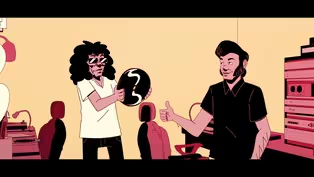
- Our last story is an animated tale of a music lover who splits his time between Madison and New Delhi, working to preserve traditional Indian folk tunes.
[radio on in background] [barbershop sounds] [tuning radio past static and squelch] - Ankur Malhotra: That's me... Ankur Malhotra.
I went to a Catholic school, and I had just failed one of their mandatory "hair checks.
"” So I'm at the neighborhood barbershop getting my hair...
"corrected.
"” ["Hopelessness" by Ashaon Ka Hua Khatma] As my long hair falls in line... my mind tends to drift, absorbing the sounds around me.
[pumping foot petal, clicking razor] This is one of my first recollections of the wonders of music.
This is when I started to really tune in.
♪ ♪ Music was already my life, and even at a young age, I was a freaky tweaker.
["Proverbial Track" by Duniya] If you needed a cassette tape spliced or your tape heads aligned...
I was "the guy."
I was also hooked on vinyl and the music my father was bringing from the States.
This music was always spinning around in my head.
It was the soundtrack to my life.
["Sara Kantigui (Live)" by Madou Sifiki Diabate] Turn of the last century, I ended up at UW-Madison, getting an MBA in Entrepreneurship and working with tech start-ups.
But something was pulling me to music and to my homeland, India.
That's when my longtime friend Ashutosh and I decided to start our own record label.
We had always been fans of the American folk and blues masters.
And then, we started asking ourselves, "Who are these Indian bluesmen?
Who are these Indian folk stars?"
And then, we couldn't come up with their names.
We decided to call our label Amarrass Records.
"Amar"” means eternal and "rass"” means "the essence."
The essence of the music that we are trying to capture would last forever.
India is a country steeped in musical tradition and musical culture... and we knew these masters were out there...
So, what if we go find them?
[changing radio station] So, we packed up our car full of cobbled-together recording equipment and drove hundreds of miles into the desert of Rajasthan, going village to village in search of the musical masters.
["Instrumental Jam #3" by Barmer Boys] We'd also heard about the seventh-generation musician Lakha Khan, player of the Sindhi Sarangi, a 27-string Indian folk fiddle.
So... we went to his home.
[light bulb clicks] And he played us a song.
["Tulsi Kya Karoon" by Lakha Khan] This is one of hundreds of his songs.
But they're all in his head.
And at the time, his two sons hadn't really continued with the family's legacy of playing the Sarangi.
So when Lakha Khan eventually leaves this world... do these songs just disappear?
That notion weighed heavy on him, and you can hear a sadness, a deep melancholy in his voice.
"What will I leave behind?"
[Lakha Khan singing] On that same trip to the desert, we were introduced to a musician named Manga.
And when we heard him sing, we instantly knew this voice needed to be heard.
But it needed a band, and then, the label decided to form one.
This would be the voice of Barmer Boys.
["Bole to Mitho Lage" by Barmer Boys] Barmer Boys put forth a unique fusion of the old and the new, melding traditional songs of celebration, the percussive sound of the dholak, khartal, and morchang, and fusing in contemporary elements like beatboxing and DJing.
[scratching record] ["Bole to (Awaare Remix)"] So, here we are today... in our tiny studio in Delhi, making hand-cut vinyl records.
India is a country of over 1.3 billion people, and we are the only ones making vinyl.
Amarrass Records has worked with over a hundred artists, and we currently manage seven groups that are touring all over the world.
I have always been driven by the realization that these are perhaps some of the last great players of this ancient music.
So, by preserving these songs and these sounds, my hope is that new generations will carry on this music's legacy and perhaps be inspired to create something new.
♪ ♪ - We've met some amazing people from around the state, and I even stayed up on my skis, for the most part.
[laughs] Learn more about Granite Peak or the individuals featured here by visiting WisconsinLife.org.
Share your story with us by emailing Stories@WisconsinLife.org or connect with us on social media.
From the top of Rib Mountain, I'm Angela Fitzgerald.
Happy skiing!
- Funding for Wisconsin Life is provided by Lowell and Mary Peterson, Alliant Energy, Stanley J. Cottrill Fund, American Transmission Company, Focus Fund for Wisconsin Programs, and Friends of PBS Wisconsin.
Video has Closed Captions
Clip: S8 Ep13 | 5m 35s | Amarrass is an animated short following Ankur Malhotra, co-founder of Amarrass Records. (5m 35s)
Video has Closed Captions
Clip: S8 Ep13 | 4m 11s | Deb Whitehorse serves as organizer, historian and family member to the sport of iceboating (4m 11s)
Video has Closed Captions
Clip: S8 Ep13 | 3m 26s | When the temperatures drop and the snow flies, it’s time to get cold and wet in Kewaskum. (3m 26s)
WL Host Angela Fitzgeralds Hits the Slopes at Granite Peak
Video has Closed Captions
Clip: S8 Ep13 | 3m 2s | "Wisconsin Life" Host Angela Fitzgerald makes some linked turns on skis at Granite Peak. (3m 2s)
Providing Support for PBS.org
Learn Moreabout PBS online sponsorship












Support for PBS provided by:
Wisconsin Life is a local public television program presented by PBS Wisconsin
Funding for Wisconsin Life is provided by the Wooden Nickel Fund, Mary and Lowell Peterson, A.C.V. and Mary Elston Family, Leon Price & Lily Postel, Stanley J. Cottrill Fund, UW...