
Snowy Plovers & Kous Kous Moroccan Food
Season 15 Episode 9 | 24m 47sVideo has Closed Captions
Stunning scenery, amazing food, and cross-cultural inspiration all in one day.
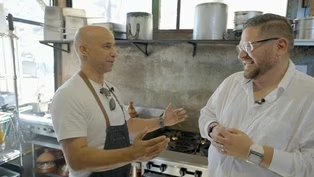
At Punta Banda, we join Pro Esteros volunteers working to protect the endangered Western Snowy Plover. Conservationist John Kinabrew takes us on a guided bird-watching expedition through the peninsula. Afterwards, we meet Chef Moumen Nouri, who brings the vibrant flavors of Morocco to Valle de Guadalupe with his restaurant Kous Kous.
Problems playing video? | Closed Captioning Feedback
Problems playing video? | Closed Captioning Feedback
Crossing South is a local public television program presented by KPBS
Snowy Plovers & Kous Kous Moroccan Food
Season 15 Episode 9 | 24m 47sVideo has Closed Captions
At Punta Banda, we join Pro Esteros volunteers working to protect the endangered Western Snowy Plover. Conservationist John Kinabrew takes us on a guided bird-watching expedition through the peninsula. Afterwards, we meet Chef Moumen Nouri, who brings the vibrant flavors of Morocco to Valle de Guadalupe with his restaurant Kous Kous.
Problems playing video? | Closed Captioning Feedback
Where to Watch Crossing South
Crossing South is available to stream on pbs.org and the PBS app.
Providing Support for PBS.org
Learn Moreabout PBS online sponsorshipJorge Meraz: Hey, folks, on this episode of "Crossing South," we meet a conservationist fighting to protect the tiny snowy plover, then we head to Valle de Guadalupe to meet a Moroccan chef bringing North African flavors to Baja at Kous Kous Restaurant; and it's all coming to you right now.
♪♪♪ ♪♪♪ Jorge: You know, folks, one of the things that is so amazing in Baja is a lot of pristine, untouched places that are beautiful, that are natural, part of nature.
And right now we're in Ensenada--well, south of Ensenada in a place called Punta Banda, which is an amazing location for birdwatcher enthusiasts, and we're gonna be led here on a quasi tour and explain how the activities run in this area by a very well-known conservationist in the region, an enthusiast birdwatcher.
And he's standing right next to me.
His name is John.
How are you doing, John?
John Kinabrew: Hey, good to see you, Jorge.
I'm originally from Louisiana, and these marshes reminded me of home.
Jorge: And did you find this place, like, right off the bat, or how'd you come up to it?
John: I found it on the internet about 15 years before moving here and had never been here before we decided to move here.
One of the things that people are doing more and more is conservation-related activities, and one of those area--one of those activities is birdwatching.
This is a place where a lot of people come birdwatching.
Jorge: So what kind of birds are you getting here, John?
What kind of animals come to this estuary?
John: This particular area, this estuary has its own special bird life.
It's very different from the bird life in the hills.
As you can see, there's numerous brown pelicans.
We have all types of shore birds.
Jorge: Almost like a private club for these birds that nobody knows about.
They seem to be pretty chill, pretty private.
You know, they're in the middle of the marsh, nobody's bothering them.
Do people fish or boat here or--what's going on?
John: Yeah, there's a lot of boating, there's a lot of fishing, and--especially in this area we're in right now, people use this area recreationally quite a bit.
The birds are here there's--because the food is here.
The habitat is not damaged.
They're here for the small organisms that live in the mud.
Jorge: You know, I have a suggestion.
Like, if you guys educated the youth of Ensenada, you know, from college, high school on birdwatching, this could be a destination not just for ATVers, where those kids could maybe contribute to, like, the conservation of the place.
John: Yeah, it's an excellent idea, and it's something that we've formed a--it's called the Alianza de Conservacion the Punta Banda, Conservation Alliance of Punta Banda.
And it's a group of scientists, people from this local community, people from Ensenada.
Some of us were born in the United States who are involved, and that's one of the things that we're trying to do is-- Jorge: "Hey, kids, there's a hobby you don't know about.
It's really cool.
You can get gear, gadgets you like and, you know, log the birds you're watching," right?
John: Exactly, exactly.
Jorge: You know, the estuary is a hidden gem for any birdwatcher enthusiast.
It's pristine, very few people know about it, and you could spend all day unencumbered while at the same time being minutes away from civilization.
And on the other side of this peninsula, that area is the home of a very special protected little bird.
John: The bird that I'm part of the monitoring team for is called the western snowy plover.
It only lives and nests on beaches and dunes.
During the nesting season, which is 5 months of the year, I walk the stretch of the beach that's in front of the houses.
It's about 2 miles.
I walk that stretch once a week looking for eggs in the sand.
And when I find them, I protect them with a cage and a fence so that they--if people are breaking the law by taking motorized vehicles or if their dogs are off leash, they'll protect the nest.
It takes 4 weeks for the eggs to hatch and then once the ha--eggs hatch, then the babies start running around with their parents.
And for about 3 weeks they can't fly, so they're very, very fragile.
Unfortunately, they don't stay in the cage or right near the nest while they're in that first 3 weeks, so that's when they're most vulnerable.
But I keep up the fence and the cage during that period to at least give them a safe zone and to make people extra aware that there are baby--rare baby snowy plovers in the area.
I'm taking you guys up to this nest, which unfortunately, Jorge, was--the last time I monitored it it was already abandoned, but I just wanted to show you what a nest looks like.
On the bright side, we're not disturbing an active nest.
On the sad side, like many of the nests along the developed beaches in the Californias, this one has been abandoned.
But we're trying our best to preserve as many of them and get as many of them to successfully breed as possible.
Jorge: Well, without the cage, it seems like pretty vulnerable, isn't it?
John: They are--the only way that they protect themselves is through camouflage, and it's--there are probably lots of nests that I do not find because it's very hard--now it's easy to see it because you're looking right at the speckled eggs.
But if you are monitoring 2 miles of beach once a week, it's very easy to miss a nest.
This whole year in this 2-mile stretch of beach there have only been four of these nests that have been found, and this is one of two that was abandoned.
And honestly when I first find them that are abandoned, I mean, after spending 120 hours of rather monotonous looking at the sand to find the nest, to find one abandoned is crushing.
So I really wouldn't want you to see me that emotional, a grown man--I know, but anyway-- Jorge: You're passionate, John.
You're passionate.
John: Hey, 120 hours like this, you know, it's either passion or it's mental illness.
Jorge: Of course.
Yeah, a little of column A, a little of column B. No, just kidding.
John is passionate 100%, and you need that.
You need that to be able to do a thankless job like the conservation of this little bird hardly anyone knows about.
John: Well, yeah, I mean, it's important that people have access to places that are beautiful and natural.
Otherwise, if it's locked up and nobody can have access to it and enjoy it and the--eventually they won't know about it, they won't care about it, and then if somebody trashes it they won't care.
Jorge: Well, John, thank you for your work.
You're doing a really good job here.
I know the snowy plover will be thankful and hopefully more people, you know, become aware of conservation causes and how they can take care of their environment.
Thank you very much, John.
John: Thank you, I appreciate it.
Jorge: More "Crossing South" coming your way.
Don't go anywhere.
Jorge: So we now move from the soothing breeze of the Punta Banda Peninsula to a charming corner in Baja's wine country.
Jorge: You know, nestled here middle of Valle, I love when restaurants just become part of the environment.
Instead of encroaching it, em--they embrace all of the landscape and make it part of the restaurant; and we're hearing one right now, a pretty special one, one that recently got actually awarded by Michelin a pretty nice award.
We're gonna talk about that.
And you're never gonna guess the type of food in Valle de Guadalupe here in Baja that we're gonna try right now.
It's actually Moroccan food.
Can you believe it?
Pretty excited, and the man in charge is the person right next to me right now.
How are you doing, my friend?
Moumen Nouri: Good, good to see you.
Jorge: Very nice to meet you.
Moumen: Welcome, welcome to-- Jorge: Can we talk a little bit?
Moumen: Yes, sir, of course.
Jorge: Don't go anywhere.
"Crossing South."
We're gonna have a nice conversation, and we're also gonna eat later, let's go, my friend.
Moumen: Yes, good to have you.
Jorge: Thank you, thank you.
Jorge: This tea is delicious.
What is it?
Moumen: It's Moroccan mint tea.
Very simple.
Just some green tea, fresh mint.
Jorge: And you mentioned that this--in Morocco, this is-- you drink this all day.
Moumen: All day, every day, hot, hot.
Even if it's 110 degrees in Marrakesh, we drinking hot mint tea.
Jorge: So is it true what they say, that when you drink hot beverages on a hot climate it helps your body regulate to the exterior or is that just a myth?
Moumen: That's what we believe.
I haven't done any scientific-- Jorge: We want to believe that.
Moumen: Yes.
Since I was a kid, I hear my mom saying that.
She like don't drink super cold water.
You go and open the fridge, just have some hot mint tea.
It's probably psychological.
Jorge: Well, man, I wouldn't be doing my job if I didn't ask you how the heck did you end up in Valle de Guadalupe all the way from Morocco.
What's the story of your journey?
Moumen: I had this restaurant in San Diego.
Jorge: Oh, really?
Moumen: Yes, in Hillcrest.
Jorge: Same name, Kous Kous?
Moumen: Kous Kous, Kous Kous for 15 years in Hillcrest.
Jorge: So people in San Diego know about you already.
Moumen: Yes, yes, yes, yes, I've been there for a long time, well established.
We doing great.
But I always wanted to open my first restaurant in the US in San Diego and the second one would be here in Valle because when I moved to San Diego in 2003 I had a trip with some friends to Valle and just fell in love with the area.
So the plan was open the first one in San Diego first, then--it's a few years later, then I'll do the second one in Valle de Guadalupe.
And I was so content and happy with this location, the best view.
Jorge: It's like you're in Italian countryside, right?
Moumen: Yes, it's ridiculously beautiful.
I just decided to let go of Kous Kous in San Diego because I wanted to focus all my efforts, all my time on this one.
Jorge: Okay.
Food-wise is it traditional Moroccan food, Moumen, or--is there anything you can tell us about the food you prepare?
Moumen: The main courses is 100% traditional.
I do the tagine, a lot of slow cooking, all the spice blends, the preserved lemons.
All that's--one thing that I'm doing here at Kous Kous is I'm using all local products only.
This is living proof that you can have a Moroccan restaurant using only local products is Kous Kous.
People in--since I opened in San Diego, they come to my restaurant, they ask for hummus.
Now, hummus is not Moroccan.
Jorge: Oh, really?
Moumen: Hummus is more Middle Eastern, and Morocco we're not in the Middle East.
So after a few years of me being so nationalistic about my food, I gave up, gave people hummus, you know.
Another thing that I've added to my menu that is not traditional Moroccan is the rice.
A lot of people around the US when they go eat ethnic food, they expect rice either you eat Lebanese or Turkish or Thai or Chinese, Indian.
Morocco, we don't eat with rice.
Rice is not the staple in Morocco.
Our staple is kous kous once a week or bread.
We eat our tagines, our meats--low-braised meats with this nice delicious sauce.
We eat that with bread.
But the first couple of years I was asked for rice and I saw the disappointment in people's faces, then I added rice.
However, it's a delicious rice that I made.
I took a French recipe of rice pilaf and I Moroccanized it by adding some saffron, some turmeric.
Yes.
Saffron, turmeric, and ginger to that rice.
You're gonna try it and see.
Jorge: Phenomenal, I'm ready for it.
I'm ready for it, my friend.
Thank you.
It's a very interesting story.
Moumen: Appreciate it, thanks a lot.
Jorge: Don't go anywhere, folks.
"Crossing South" coming your way.
We're gonna get to try some of Moumen's amazing cuisine, and what better scene than this.
We're in Valle de Guadalupe.
Don't go anywhere.
More "Crossing South" coming your way.
Jorge: Authentic Moroccan food prepared in Baja is too much of an opportunity to pass up.
So I wanted to go behind the curtain and I wanted to get inside the kitchen and see how the sausage is made and maybe get my hands a little dirty while I'm in there.
Why not?
Jorge: Half?
Moumen: In half, yeah.
Here we go, it's called hummus.
It's the action of dipping a bite-sized piece of bread into and put it--and eating it, basically.
Jorge: Oh, man, I'm gonna have to subdue my normal large portions.
Moumen: Yeah, just grab a large--big chunk, a big chunk.
Use the bread as your fork.
There we go.
You're half Moroccan now.
My mom is yelling at you on TV right now.
Jorge: I'm sorry, mom, I'm sorry.
Moumen: The lamb cooked for 5 hours.
Well, it cooked in the sauce without the honey but with the lamb on the bone.
Then once it's cooked, we take the--we separate the lamb from the sauce and we reduce the sauce and we add some honey to it.
Jorge: The sauce is all the juices that come out of the meat?
Moumen: The lamb with liquid, with water.
Basically that's it, and spices.
Jorge: Got you.
Got you.
This is lamb.
Moumen: This is already cooked lamb.
Well, cooked 90%.
We finish the cooking in the tagine to order.
The tagine is this clay pot where we cook.
Jorge: This is typical of Morocco?
Moumen: Yes.
We cook in burrow, in clay just like indigenous people in Mexico.
Jorge: I was gonna say, like, have you found that similarity.
Moumen: Yeah, yeah, yeah, yeah.
So basically I'm gonna finish cooking this meat and later I'm gonna add some raisins, some almonds, and some sesame seeds.
Jorge: Fantastic.
Moumen: You're gonna have chicken.
We're gonna have honey lamb and fish.
Jorge: Fantastic.
It sounds great already.
And meatballs.
Moumen: And meatballs.
[speaking foreign language] Jorge: Did you learn to cook family cooking or did you school yourself school--you're schooled?
Moumen: School.
Went to chef school in the '80s in Morocco in Marrakesh, but I was not sure if I wanna be a chef or do hospitality.
Then after chef school I went to continue in college and I studied hospitality management.
Throughout my career I worked in--both in the kitchen and restaurant, in hotels, managed restaurants.
I was banquet director here.
So I did a little bit of both to finally learn that I wanna open a restaurant that are gonna allow me both things, you know.
Offer my foods and be outside with the clients and share my culture with people.
Jorge: And share your culture you did, my friend.
I mean, I see--everything that I see seems pretty authentic.
So did you bring some of your decor from your San Diego restaurant down here or is this like other stuff?
Moumen: Yes.
All the Moroccan lamps, first I brought them from Morocco to San Diego, then from San Diego to here.
Just the lamps and some of the furniture.
I'm inside a winery.
Jorge: You're within.
What's the name of the winery?
Moumen: Anatolia.
Jorge: That's Turkish, isn't it?
Moumen: A lot of people think it's Turkish, but the story of Anatolia--the owner, my landlords Claudia and Maru Turrent, they own this boutique winery, but they're naming the winery after Claudia's godmother.
This lady, this--unrelated to the region in Turkey.
Jorge: Right.
Well, unwittingly it adds to the, you know, flavor--Middle Eastern flavor.
Moumen: Yeah, the exotic Middle East, Morocco, Turkey-- Jorge: Kous Kous next to Anatolia, you know.
Jorge: You know, the compatibility is not just in the exotic name.
This region is made for his cuisine.
The environment is completely benign and compatible with the energy of this place.
Jorge: The first one I'm going to try is the saffron rice.
If you remember, he mentioned that rice is not really something typical in Morocco.
So look at how creamy that looks.
It looks amazing.
The texture looks fantastic.
Let's see if the taste, you know, lives up to that.
That rice is really good.
Holy smokes.
The expectation was low, and he hit it out of the park.
Just the rice.
Now this is the kous kous.
This is the name of the restaurant, and look at the ingredients right there.
Look at how delicious that looks.
So this one has caramelized raisins, caramelized onions, I guess, caramelized garbanzo beans, and it's got a little bit of saffron.
It's lightly sweetened.
That caramelization just hit the spot right there.
Oh, man.
Okay, so now we're gonna have--open the tagine, which apparently is both the clay, you know, dish here but also the cooking method.
We're gonna open.
This is the honey lamb tagine.
Imagine that slow braised honey, you know, kind of like au jus sauce, you know, the reduction of the lamb juices with the honey and then what I think are peanuts there, right?
Some raisins as well.
Look at how it glistens, folks.
The sun hitting it, the Guadalupe Valle wind.
That's fantastic.
Oh my God.
That is incredibly good.
Okay, so this one is their chicken saffron.
Look at the color of that.
Look at the texture.
So this chicken apparently has saffron, and it has fermented lemons.
Look at that.
We're gonna get some of that fermented lemon juiciness and we're gonna pour it all over.
Check that out.
Apparently, this is a very Moroccan dish.
So fermented lemon goodness.
This is so flavorful, guys.
There are so many flavors and herbs that I couldn't begin to describe like how many are there.
What a good dish.
Jorge: Moumen, how has the local population or the region itself, like, embraced your--I mean, you're unique here probably, right?
I mean, you're very unique-- Moumen: That was the great surprise.
I was pleasantly surprised.
I was worried to let go of Kous Kous San Diego 'cause it's unknown.
I didn't know what's gonna happen, even if I did some market study and I realized that there is not a lot of ethnic food in Baja.
You know, there's a lot of great food but not enough ethnic food like we see in the US.
So we were packed from day one, and it just haven't stopped since then.
It hasn't stopped since then.
Mexicans are two things: are very open-minded people, very willing to try new things, and well-traveled people.
Jorge: And well traveled.
Moumen: They're middle class.
They all know Morocco.
They all know Turkey.
They've been to India, China, Japan.
They're well-traveled people, so-- and they're thirsty for new stuff.
You open something new, they'll give you that shot.
You just have to be good enough for them to come back.
Jorge: For sure.
Jorge: What Moumen just said is a truth about the Baja-Californian psyche I have observed and talked about on this show for years.
Baja is a wild west for entrepreneurs.
If you have a good idea, you have a population ready to go along with you for the ride.
Jorge: Okay, so now we're going to have the striped sea bass tagine.
Again, the tagine is the plate, the cooking method.
If you would have a table here full of people and everyone was eating, you could either leave it covered or you can just leave it open and people are, you know, sharing the meal with the spoon and everyone's having a little bit of it, right?
Look at how it's marinated.
And always get the sauce.
Like, that's something that he was very adamant about.
Always get the sauces 'cause that's--there's a lot of the flavor in there.
You got your carrots.
You got your herbs.
My expectations are kind of low with this one 'cause I never pictured fish with Moroccan.
I was thinking more of the chicken and the lamb, but, you know, that's how you get surprised when you try stuff.
Let's put--let's make sure there's some of the sauce there, some of the veggies are there.
Wow.
Pleasantly surprised.
Very, very good.
The texture is really well done, lots and lots of flavor.
Okay, so this tagine has your meatballs.
He grew up on meatballs at his house.
So mama surely made these.
Again, a tomato-based sauce, herbs, spices, and he was got a--an egg in there.
Let's make sure we get enough of the sauce.
When you have dishes that are--that have this amount of viscosity, this amount of lubrication, you know that your body is going to react well.
Tell me this doesn't look like something you'd like to try, folks.
It's probably ain't your mama's meatballs.
Say that.
Wonderful.
Jorge: Have you gotten any of your previous customers in San Diego come to your Valle place?
Moumen: Yes.
Jorge: Really?
What did they say?
Moumen: They were sad that I came here, that I--I'm away from them.
But once they showed up and they see why I closed Kous Kous, they understand and they're super happy for me.
Jorge: In Morocco, Moumen is just another Moroccan.
In Baja, he is unique.
And the ethnic flair of his culture, which is evident in the decor and the food at his place, well, it makes local patrons feel a foreign experience that resembles actual traveling.
Jorge: Okay, so we've arrived to that phase of the competition that you know I like so much, the dessert phase.
So this right here is the Moroccan version of the French creme brulee.
Apparently, it's got an orange blossom.
It's got vanilla beans in there.
That's what the custard is made with.
Oh my God, this is exquisite.
Oh my goodness.
It's got less eggs, less sugar than a creme brulee.
So it's not as dense, but it's its own thing.
It is literally its own thing, and it is so good.
Now, these bad boys are dates from Mexicali.
They are stuffed with almonds, and they're covered in chocolate.
You know, these have like some sesame seed, you know, texture.
Great with a cup of coffee.
Jorge: So we're at Kous Kous, and we hope to see you next time, folks.
Take care.
Jorge: After walking Baja's fragile coastline and witnessing the effort to protect one of its smallest inhabitants, then experiencing the bold flavors of a Moroccan chef making his mark in Valle de Guadalupe, we leave reminded how nature and culture shaped this region in unexpected ways.
And with Baja revealing new stories where we least expect them, we continue our journey ready for what comes next the next time we get to cross south.
♪♪♪ ♪♪♪ male announcer: Like to know more about the places you've just seen?
Maps, videos, podcasts, and more at crossingsouth.com.
We also do Facebook, Instagram, and YouTube.
♪♪♪
Snowy Plovers & Kous Kous Moroccan Food Preview
Video has Closed Captions
Preview: S15 Ep9 | 30s | Stunning scenery, amazing food, and cross-cultural inspiration all in one day. (30s)
Providing Support for PBS.org
Learn Moreabout PBS online sponsorship











Support for PBS provided by:
Crossing South is a local public television program presented by KPBS