
Social Codes and Social Media
2/8/2024 | 26m 46sVideo has Closed Captions
North Carolinians discuss social media, code switching, religion and politics.
Eight North Carolinians come together to discuss social media, code switching, social standards in today’s society and religion mixing with politics.
Problems playing video? | Closed Captioning Feedback
Problems playing video? | Closed Captioning Feedback
The NC Listening Project is a local public television program presented by PBS NC
Funding for The NC Listening Project is provided in part by High Point University, Sidney and Rachel Strauss, and Julia Courtney and Scott Oxford.
Social Codes and Social Media
2/8/2024 | 26m 46sVideo has Closed Captions
Eight North Carolinians come together to discuss social media, code switching, social standards in today’s society and religion mixing with politics.
Problems playing video? | Closed Captioning Feedback
How to Watch The NC Listening Project
The NC Listening Project is available to stream on pbs.org and the free PBS App, available on iPhone, Apple TV, Android TV, Android smartphones, Amazon Fire TV, Amazon Fire Tablet, Roku, Samsung Smart TV, and Vizio.
Providing Support for PBS.org
Learn Moreabout PBS online sponsorship- At High Point University, we are focused on preparing students for the world as it is going to be.
- Hi, I'm Cynt Marshall and I am proud to be High Point University's sports executive in residence.
[upbeat music] - [Announcer] Funding provided by Sidney and Rachel Strauss, Julia Courtney, Scott Oxford, and viewers like you.
[soft bright music] - It's not a forum to try to change anyone's position on anything, but to open up an avenue for conversation - And let's just go out on a limb and try something new and different.
- I have very strong opinions about things that I feel are ruining the dynamics of this country.
- I have opinions.
[laughs] - It became really a triggering point for myself whenever, me as a Christian, whenever I heard hear people say "Christian" and they automatically assume that I am a Republican.
- I have to sound like an educated, non-southern white person.
- I can remember many a days going to work and crying.
"Is this the day I'm gonna die?"
[soft bright music] - Here we are once again sitting at the table here at High Point University.
Eight North Carolinians to talk about issues, to talk about the country, talk about the state, talk about things that are important to us and how we better learn to listen to each other.
How you respond to the comment some people make, "Our best days are behind us."
- It depends on each person's perspective and experiences.
And if, when you're talking about that, as a family, as a country, as a group of people.
But if you ask me, I'm not sure about that because- - [David] Well maybe our best days are yet to come.
- Exactly, and I think also you need to be aware of the time you are right now, try to be aware of what is happening, take the best of what is happening, be optimistic, and see how you can improve that.
Or if you are happy with the place you are at.
- Now, I'm more they're still to come.
I mean, I know that there's a lot of hindsight, sort of romanticization of the past and, "Oh, things were so much better back X, Y, or Z," and maybe there were things that were better in the past, but I think we're continuing to progress and evolve as a society, as individuals.
So I am optimistic.
- I think we're better off then without all the technology that is around.
It's just a white noise, constantly.
You can't escape it you realize it and you step out of that, like step away from Facebook, cell phones, get out somewhere where you can really breathe.
I think we can make it better.
I think we can break the cycle of hard times make strong man, strong man make easy times, easy times make weak man, weak man make hard times.
We're somewhere in there.
We could break the cycle where we don't make hard times, but how we approach it, how we interact with each other and make that.
- From the time I came, I think it has become, going back to, yeah, it is, it become a little bit worse because in the past I thought people were more content with whatever they had, they were content.
Now they have more, less contentment.
So I literally went through all the stages of what a normal immigrant would come, $5 an hour working in a factory.
And I saw people were happy with whatever they took from that factory, whatever they could make.
We could have still shared the same from the same plate and be still happy.
But because one person wanted to immediately get the, you know, shortcut to fortune, then rest of the entire industry got crumbled.
So the corporate greed has taken over, I think, with the onset of the social media, that's a major distraction.
We have not even touched on, what now, even those who created it are calling it very harmful, the AI.
Not harmful to the extent, but they do not themselves know where it's going to take us.
- What would you say, Ashley?
- I think about the time whenever I was born and to where I'm at today and so much progress that has happened for, and I'm just looking at the lens of Native people, of my people, of Waccamaw Siouan people.
Growing up, we weren't told a lot about our tribal history.
We weren't taught our language.
Culturally, we knew some things, right?
It's taken a long time, right, for us to build that back.
So growing up, what we've been able to do, in at least the past five years, is revitalize our language back.
We've been able to build back cultural pieces that were taken, artifacts that are being uncovered today that are thousands of years old and taking that and being able to learn from it instead of, or my parents, right?
Me, condemning them, right, for not teaching me things that they did not know.
We are now able to relearn that back and dive deeper into it and be able to gift that back to our parents.
Something that was never taught to them.
And so I think that it's a form of healing that's occurred and that's what I've seen in my generation take place.
- Nisha, what things do you see are worse, what are better?
- We've made life easier by the technology that has been put in place.
Televisions and things like that.
Social media, the ability to connect with people in India.
Better fashion.
[group laughs] The '80s were special.
So aside from that, I think on the same note, there is negative in social media.
We've got a lot of disconnected connected people, pornography at a click of a button.
We were talking earlier about sexuality and stuff like that.
I do not approve of immoral behavior.
In the Bible it says, "Let there be no sexual immorality among you."
There are things that should be corrected or may not be able to be corrected or regulated.
But I think that kind of sums up what I was able to think of.
- Well Lee, tell me about your list and your idea.
Are the best days behind us or are you more hopeful?
- I say as long as we keep pushing the envelope towards acceptance, towards equality, towards inclusivity, eventually we will get there.
And then my three positive changes, you know, we're moving towards banking, finance, technology.
I mean it makes me sad because it makes my negative, the loss of American jobs with the loss of textiles and stuff.
Higher ed in North Carolina is interesting because is the education level in North Carolina equivalent across the board?
My weirdest positive change one is the code switching that I have to do between certain people.
Like there's some people, and we all do it.
You all do it.
Like you don't roll up on your boss like, "Ayo, what's up?"
Unless you're real cool with your boss.
I mean some people really are.
- Say more about code switching.
- It's literally how you interact with other people.
Like I'm sure I interacted with you more formally when I first met you than I do at this moment right now.
You know, being an academic, there are some things you don't expect to come out of my mouth at work because that would be not, it would be not the thing that you would see from a person in my positionality.
I have to sound like an educated, non-southern white person.
- Mm-hmm.
- If I don't present myself that way, because I've already got a couple, you know, I'm already behind the power curve, big Black girl with a bunch of ink, they're already not necessarily gonna listen to me.
So I have to sound like I know exactly what I'm talking about, which I do.
But it also means I have to be three times as good or 10 times as good depending on the situation.
- But does code switching lessen our authenticity?
- It depends.
I'm the same person if I talk to you, like talk to you about my technical work, or if I'm just, you know, hanging out.
- Now with all these changing and worrying and being politically correct, when I'm representing our organization and I have to give a speech, I really have to go through different people to look at it so I don't offend somebody or I don't say a say a word that is deep, that is not representing, or if I have to say Latinx or Hispanic or Latinx.
So it becomes difficult because then I can't really speak from my heart because probably I'm going to mess it up.
So I have to write it and I really have to read it.
And also if it is in English, it is more difficult because it's not my first language.
So it becomes, sometimes I feel I can't be myself.
- Are we trying to be too sensitive?
- I think it's kind of fun to be able to say, "Okay, well how well can you articulate in this environment?"
I make it a fun thing 'Cause in New Jersey, I might slip if I'm having a drink and I might say awesome or coffee, and gosh, that's looked down upon in the south too.
So I mean like, we have our things.
It's just, it's a cultural thing.
And I think that it's social code, it's been done for centuries.
You don't go to a ball gown and behave the same way you would go to maybe a movie theater or a restaurant.
- [Ashley] But what drives a social code?
What do you think drives that?
- Human beings.
We're all trying to, if you look at kids in a classroom, they're all trying to figure each other out.
And I always think that there's something, a lot of 'em are very self-conscious and like, "Am I doing things this way or am I supposed to do it this way?
Or if I say this, how are they gonna react?"
But the kid right next to them is doing exactly the same thing.
- Kids in a classroom is peer pressure, and that's totally different from adults in the workplace versus adults in your free time.
- Is it really?
- I think so.
Unless you hang out with the people that you work with all the time when you're off work.
And that's a whole nother story.
- I think that leads back to social standards.
You know, what are the standards and are you trying to live up to those?
When I was growing up, my mother said, "You know that we're going to church now, are you gonna wear that?"
And I'm like, "Well what's wrong with it?"
And she said that there were standards, the way you look, the way you talk, the way you dress.
And because of that, yes, there are stereotypes that people automatically think something of you and they group thought processes into that.
- I still think that you should be yourself.
And when I do these speeches, I should be able to speak from my heart and do it.
The issue is probably the community is getting too sensitive and I've been criticized, I've been undermined.
I've been also because within our own community, I'm a privileged Colombian who came in on a plane, have papers, my husband is a physician, I live in a nice house, nice neighborhood.
So who is she to represent us or who is she to tell us something?
And in the table, all of us, we can put something that will help collectively.
- How do we balance knowing that there may be conversation, jokes, coarse language at times, because it comes with the territory or we think it does.
And yet, maybe miss the motivation of people.
- You gotta read the room because there might be somebody that's brand new that comes in, they don't know the culture you have and connections with those people in that room with you.
- Whenever you have a relationship with a person, like you mentioned about someone new may come in, you don't have a relationship with that person.
But having a relationship and building that gives you that grace for whenever you do make a mistake or maybe a mishap or your intentions, you can ask for forgiveness or you can say, "Man, I didn't mean to say it like that," you know, or, "I didn't intend that."
It's hard for you to give grace to someone that you don't know personally, but if you build those relationships with people, you're able to do that and forgive them, right?
And you could have more honest conversation.
- Yeah.
- When somebody says, like, treats me a little different 'cause I got a long drawl or I can't say words more than two syllables or I can't spell right, that gives me more determination to show you what I can do.
So you go, "Oh, okay."
Like my accent has nothing to do about who I am and what I can do.
- I mean, the relationships are key because then you give that person the benefit of the doubt.
But then I also think it behooves us to try to use that same approach when we don't know somebody and try, I mean, listen, I am not perfect at this, I'm not perfect at anything, but it's hard.
But to try to assume virtuous intent with what people bring.
- Our better days are ahead of us because part of it is we do, we are talking more about some of these sensitive topics.
We are trying to educate our children that we are raising, we are trying to be sensitive to what we are exposing them to.
But the awareness of some of the issues is going to be what makes us better.
Trying to go towards your faith and try to follow the master or the God that wants you to be better.
But the part that makes me feel worse, that the society's worse, I feel like COVID did a big, huge , disjustice for us because there's so many people that went home.
They were sent home and told to basically barricade themselves.
And you know, that was an emotional instability because some people didn't have support, they didn't know who to talk to, they were scared, they were unknowledgeable about the whole situation.
I can remember many a days going to work and crying, "Is this the day I'm gonna die?"
But I knew I had patients that needed me.
So there's a mental health that needs to be addressed in this country.
- This obviously still impacts you very deeply.
If you had to face something like this, again?
- As a nurse, we were always taught, treat everybody the same, treat them as if they're all contagious.
[laughs] And that was one of the saving graces that, through this whole ordeal, I did not get COVID until this year.
And of course, it put me in the hospital for eight days.
You know, there was a lot of health issues and implications, which was the fear that if I caught it.
So there's always gonna be those fears, but I would still attack it and still, deep down, know that I had the desire to care and serve.
- We've heard a lot of talk about God, creator, master, Christ, our faiths, and yet there are less people going to church today than we've seen in decades.
Why do you think more people are staying home than finding that certitude and solace they used to find in a synagogue or a church or a mosque?
- I was always taught the church isn't the building, the church is in the people and the church is in your heart.
Do I need to physically go over there and worship, no.
Do I need to go over there for a sense of community, yes.
- Mm-hmm.
- And that is the part that people left out.
- I realized probably in a past maybe year or so, it became really kind of a triggering point for myself whenever me, as a Christian, whenever I hear people say, "Christian" that they automatically assume that I am a Republican.
And I picked up on that later on because I was like, "Oh my goodness."
I'm not saying I'm not, but what I'm saying is, is that, that that assumption, that alignment that was happening is that if I go to the church that people are gonna think that I'm also aligned with all these other things because then the pastor started preaching and bringing politics into the church and so the organized religion became, in my mind, like a bit tainted instead of listening and following the, listening to God.
- So I'm curious if you think there could be a connection with the sense of community that continues to appear to diminish and our ability to bridge this divide.
- The social media has still allowed us to be impersonal and not really break down those barriers.
We're copying little pastes that don't really say a lot about us, but they're just generic.
It's fun that we've gotten to know each other and have relationships and the socialness of going to a gathering in church.
- I think, not just social media, but the polarization of people based off of politics in church is a very, very real thing.
And I have been in conversations where people are criticizing certain pastors.
I used to attend one church and criticizing the pastor for not talking about politics on the pulpit.
I think it's important to actually join and get connected, but people are jaded with politics.
- In the reformed Jewish tradition, we don't read the Bible as a literal document.
It's interpreted.
So we don't take it verbatim.
And one of the things I've really appreciated is when they can apply the liturgy to present day things.
I mean, 'cause one of the big tenets in Judaism, is you live a godly life by doing mitzvah or good deeds for others.
That is how you live a holy life.
And I don't see it as politicizing.
I see it as how do we see the world, how do we apply some of the traditional teachings to the world today?
- How do we see it going forward and trying to find a way not to hide from disagreements.
- I think picking and choosing what you say, how you say it, how you frame it, is something that I need to work on personally.
So if I ever get quiet, it's because I'm trying to teach myself a new way of trying to communicate.
- Lee, you ever hide from a disagreement?
- As I've gotten older, yes, only because sometimes it's not worth it.
You've gotta pick and choose your battles.
Younger me, all gas, no breaks.
"What'd you say?
Let's go."
But now, it's like, you know what, it's not worth my job.
It's not worth my relationships, not worth my friendships.
It's not worth possibly my freedom or my life for me to argue with this person in a vehement, vim and vigorous manner, because I don't like what they said.
- I think there's a fear now if we disagree, like, it could cost us our livelihood.
We can't speak up our point without being portrayed as a bigot or a racist or you don't know what you're talking about.
They try to go after your career or your family or whatever it may be.
Like ruin what you've built just because you do disagree.
And that's on both sides.
- On my list of things that are worse, a spirit of meanness at times amongst people.
- If someone goes out to destroy you, Mr. Crabtree, if they're not doing it in person, like if they were in person, they'd be a coward.
But they will fill Facebook and Instagram up with everything they can find, just like they would do it to me or anybody else at this table.
But to face somebody eye to eye, they'll usually back down.
- Whenever there's no accountability, right, for what you say on social media or anywhere, then it's just gonna embolden the next person and the next person to continue saying those things.
- Never did I think in my lifetime somebody would use the word "colored" on the floor of Congress.
But because we have had leadership that has shown that they don't have to speak respectfully and use appropriate terminology, that has now empowered others to speak disrespectfully.
- What is the appropriate terminology for like, because I know I've heard different stories about what is socially acceptable at this point.
- It depends on the person.
I will go with Black or African American.
Some people will say one, some people will say the other.
Colored isn't it.
We ain't been colored since the '50s.
- People do say people of color referring to even me.
- People of color is not the same thing as colored people.
- Okay, so it's a different conversation.
- Yeah.
- Okay.
- How do we move forward in further recognizing where these divisions are and what we individually can do about it?
Can we do anything about it?
And how do we spread that message to other people of saying it's time to try?
- I think that the leadership in the state needs to be a reflection of the people in the state, both in the Senate, representatives, cabinet.
- To get to that also as our community level, we need to have these conversations and also inform those people we want to put in, in these positions, about talking to the community, learning from the community about what is needed, what is happening, and what needs to be done so we can inform those changes.
And then even to bring people to those positions.
- I received a fantastic education through our public school system and I wanna see that continue.
I have my kids in our public schools.
And we have to stick to the important points of exposing our children to facts and ideas and then let them make the decision.
- What else are you thinking, that you wanted to say, that you believe in, that we haven't talked about?
Or you wanna leave us with a thought of what your legacy in this conversation can be?
- At the end of the day, be cool.
Don't be a jerk.
- Fiaz?
- Each individual should take the same lesson and go into the communities and try to gather and exchange this information.
But it is that fear.
The moment you remove the fear, things go very easy.
And there's a lot of fear out there for so many reasons.
- Ashley?
- I think we need to learn more about each other and just be more open to listen to the voices in the community and how things are impacting each other.
- Yeah, no, I really like this opportunity and I think I've said it, that we don't take the time to have these conversations, so thank you for bringing us.
We can learn from each other and listen and have these type of conversations.
- Regardless of our differences of opinion and belief, we still take care of each other because we're human beings and I so enjoyed getting to know all of you and I think you are those kinds of people anyway.
But perhaps if we continue to spread the message that in spite of our differences, we take care of each other.
- And bring back that respect and value life.
Take the time, get to know your neighbors.
- This whole table's so diverse.
Don't be afraid to reach out and learn more from somebody that you might be scared of.
- I think that maybe, perhaps, and if anybody else is on board with the idea, we could keep in touch, but also maybe form an almost counsel.
We could actually help each other help others build a bridge.
- Katherine, Pilar, Jake, Lee, Nisha, Ashley, Fiaz, Anna, I thank you, and keep doing the work you're doing.
- [Announcer] Funding provided by Sidney and Rachel Strauss, Julia Courtney, Scott Oxford, and viewers like you.
- At High Point University, we are focused on preparing students for the world as it is going to be.
- Hi, I'm Cynt Marshall, and I am proud to be High Point University's sports executive in residence.
[upbeat music]
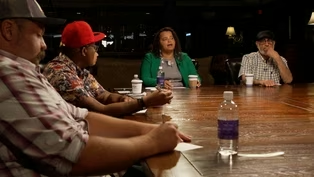
Preview | Social Codes and Social Media
Video has Closed Captions
North Carolinians discuss social media, code switching, religion and politics. (30s)
Providing Support for PBS.org
Learn Moreabout PBS online sponsorship













Support for PBS provided by:
The NC Listening Project is a local public television program presented by PBS NC
Funding for The NC Listening Project is provided in part by High Point University, Sidney and Rachel Strauss, and Julia Courtney and Scott Oxford.