Inside California Education
Soils, Seeds, and Science
Season 5 Episode 2 | 26m 46sVideo has Closed Captions
Visit a Central Valley school where students get a weekly agriculture lesson.
Visit a Central Valley school where students get a weekly agriculture lesson as part of their science studies, discover how graduating seniors in California can earn a State Seal of Biliteracy, visit an outdoor science school in Southern California that introduces inner-city students to nature, and spend a “day in the life” with the Chief of Wellbeing of Los Angeles County schools.
Problems playing video? | Closed Captioning Feedback
Problems playing video? | Closed Captioning Feedback
Inside California Education is a local public television program presented by KVIE
Funding for the Inside California Education series is made possible by the California Lottery, SchoolsFirst Federal Credit Union, Stuart Foundation, ScholarShare 529, and Foundation for the Los Angeles Community Colleges.
Inside California Education
Soils, Seeds, and Science
Season 5 Episode 2 | 26m 46sVideo has Closed Captions
Visit a Central Valley school where students get a weekly agriculture lesson as part of their science studies, discover how graduating seniors in California can earn a State Seal of Biliteracy, visit an outdoor science school in Southern California that introduces inner-city students to nature, and spend a “day in the life” with the Chief of Wellbeing of Los Angeles County schools.
Problems playing video? | Closed Captioning Feedback
How to Watch Inside California Education
Inside California Education is available to stream on pbs.org and the free PBS App, available on iPhone, Apple TV, Android TV, Android smartphones, Amazon Fire TV, Amazon Fire Tablet, Roku, Samsung Smart TV, and Vizio.
Providing Support for PBS.org
Learn Moreabout PBS online sponsorshipNarr: Coming up on Inside California Education: Discover how seventh and eighth-graders at this Central Valley school are learning about all things “ag ” -- from plant and animal science to engineering to planting crops.
Payton: This is probably the best class on campus.
Cause every time we come in here, we're never taught the same thing over and over it's always something new, and I just -- I always cant wait to know what were going to learn next.
[speaking Spanish] Narr: California was the first to offer an official State Seal of Biliteracy to graduating seniors, an award now in place virtually nationwide.
Well visit some Sacramento schools to see how students can start becoming fluent in two languages as early as kindergarten.
Naturalist: If you can hear me say, “snow day!
” All: Snow day!
Narr: This may be the first true outdoors experience for many of these inner-city students.
See how this five-day adventure, called the L.A. County Outdoor Science School, offers a break from modern technology and a hands-on immersion in all that nature can teach.
Kareli: They seem very happy and they're just not worried.
They... they seem to be learning a lot differently than they would be in a classroom.
Alicia: Okay.
We're going to take a deep breath in.
(inhales) And blow it out.
(exhales) Narr: And, spend a day in the life of L.A. County Educations Chief of Wellbeing.
Its a title and a job that covers a lot more than you might expect, including child welfare and attendance, school mental health and counseling, support for homeless and foster youth, even help for school employees.
Alicia: I can say my position was created to support the well-being of everyone.
If our youth are going to be well, we need our adults need to be well also.
Narr: It's all coming up next on Inside California Education.
Annc: Funding for Inside California Education is made possible by: The California lottery has been reliably raising additional money for public education for decades.
More than $41 billion since voters created the lottery in 1984.
And thats the reason why California lottery exists.
Its why we do what we do and work so hard to do it.
Thank you, California - our schools appreciate your support.
Annc: Imagine a credit union where school employees are treated like the heroes you are.
At SchoolFirst Federal Credit Union, everything we do starts with helping school employees and their families live better today and plan for tomorrow.
Learn more at schoolsfirstfcu.org.
Annc: The Stuart Foundation: Improving life outcomes for young people through education.
ScholarShare 529: Californias state-sponsored, tax-advantaged 529 college savings plan designed to help pay for the cost of higher education.
Annc: Additional funding for Inside California Education is made possible by these organizations supporting public education.
♪♪♪ ♪♪♪ Narr: 20 minutes outside of Fresno sits a country school that's bringing learning to life.
Fairmont is a T-K through 8th grade school in the growing and diverse Sanger Unified School District.
What was once a small, rural school is now busting at the seams.
Parents are eager to send their children to Fairmont because they say this school is doing something unique.
Christine: So, our program involves all our students and they, um, come to ag science classes every week.
And so, we do plant science, animal science, we do ag marketing, ag business, ag technology.
We cover the drought.
Christine: I know that there was stuff that you were gonna need.
Narr: Christine Torosian-Klistoff heads Fairmonts Agriculture program.
Its the first program of its kind in California, where all students, from the little ones in T-K to the 7th and 8th graders learn science standards through an ag lens.
Fairmont is building curriculum they hope will be adopted and used in classrooms across California.
Christine: If you're going to teach about plant genetics instead of keeping it small, why not teach about lets say our... our top commodities in the valley, which here in the San Joaquin Valley, you know, almonds, pistachios, and grapes.
Why not teach those things with that ag lens?
So, our idea is to give a blueprint, of the science standards, so that all schools can take it back and use it.
Narr: The hands on science lessons are designed to provide students with an understanding of agriculture and its impact on the San Joaquin Valley, one of the world's top food producing regions.
Jared: Typically, the system is set up to ensure that kids who enter high school have options and opportunities to be successful, exposure to different programs like automation or robotics or agriculture, things of that sort.
We reject that notion that kids have to wait till high school to get access to those options and opportunities.
Narr: On this day, 7th and 8th grade students are rotating through learning stations, designed to teach them how to analyze, evaluate, and problem-solve as a team.
Students are learning how to stitch up a wound using bananas.
They look at bugs through microscopes.
Discover safe ways to fertilize plants.
Get their hands dirty with soil samples, and plant vegetables in their school garden.
Payton: This is probably the best class on campus.
I mostly look forward to, like, learn something new.
Like, all-- like, cause every time we come in here and were never taught the same thing over and over, its always something new and I just, I always cant wait to know what were gonna learn next.
Ty: I would say the ag program at Fairmont has made school better for me because it helps me with, like, when I'm reading and collecting data, it helps me collect data better in class.
Narr: In addition to the weekly Ag Science Lab students are exposed to technology through engineering classes.
Here, students have access to computers where they learn coding.
They work with drones and 3-D printers.
They have a robotics team and even do small welding projects.
Tisha: I think through our program, theyre going to have an amazing foundation and knowledge base about agriculture and the industry.
Um, not just within the means of plant and animal science, but within the means of looking at energy conservation, how to run a business, how to do the marketing, how to do all of that.
Its important for them to understand even as basic as how do we get our food on our plates?
How are we eating every single day?
But for them to be able to be provided with career exposure to different options and opportunities that are available to them within that ag industry.
Um, outside of just you know the basic farmer, I feel like a lot of kids grow up thinking agriculture is about... just about farming, but its not.
Theres so much more science technology and um, engineering that is involved in it.
Narr: Fairmont School is in the process of growing their agricultural program.
Plans include an 8 million dollar two acre complex that will house areas dedicated to plant science and animal science, along with a 4,000 square foot innovation lab that will be used to study water energy and robotics.
Jared: Our ag complex is going to be a blend of tradition and innovation.
And that's a unique combination that really serves this population, that serves this valley.
We started a capital campaign five years ago called Grow the Legacy, and that is all of our community members coming together and saying, this is so important.
We want to help fundraise.
Narr: The AG complex will be available to all 8,000 elementary school students throughout Sanger Unified, and it will be a host site for robotics and other statewide competitions.
It's all designed to help Fairmont in their goal of spreading ag education throughout the Golden State.
Christine: Agriculture is so important to our valley, to our state.
And by educating our youth, all of them, whether its here at Fairmont, if we could start the blueprint here and spread... spread that out for everyone.
It could change education; it could change the way of agriculture.
It is our future.
Annc: All of the classes in Fairmont Elementarys ag program meet well-established standards for STEM learning ‘ Science, Technology, Engineering and Math.
And this is just one of many programs designed to promote learning and careers in agriculture.
Perhaps one of the best known is Future Farmers of America, or FFA, a national organization.
But here in California, the California Foundation for Ag in the Classroom offers teachers and students free access to lesson plans, study guides, and videos, including virtual tours of farms across the state.
All: Thank you, how are you?
How are you?
Narr: Benerisa Perez loves teaching.
(singing in Spanish) Benerisa: Good morning, boys and girls!
All: Good morning!
(speaking Spanish) Narr: And, this kindergarten teacher at Sacramentos Ethel Phillips Elementary derives a special joy from helping these youngsters learn English and become bilingual.
Benerisa: So, my students are getting the same curriculum and... and were seeing the same thing that the English counterparts are.
What I do every day is... is helping them get to the Seal of Biliteracy.
Narr: The idea of the Seal of Biliteracy was created by a group called Californians Together, a coalition of 25 organizations with a shared goal of better educating English learners.
Martha: We really wanted to showcase and to do something positive, to recognize students who achieved biliteracy, by high school graduation.
Narr: In 2011, Governor Jerry Brown signed Assembly Bill 815 into law, officially establishing the State Seal of Biliteracy.
Martha: We were the first state in the country to adopt a state seal of biliteracy, but since then 49 states plus Washington, D.C., have established their own version.
Jorge: Well, I would say that the State Seal of Biliteracy really is a recognition of a richly diverse community that understands the value of being bilingual and biliterate.
Narr: Here in the Sacramento City Unified School District, bilingual options are available starting as early as kindergarten.
Jorge: We're a district in Sac City Unified that values being bilingual and biliterate at a very, very young age.
You can visit classrooms here at Ethel Phillips where you will be hearing our students speaking in a language other than English, um, as early as kindergarten.
Narr: In classes like this, what's called a transitional bilingual curriculum is based on a 90/10 model.
Benerisa: 90% of the time that I spend with the instructional materials, it's in Spanish and 10% is English.
(Benerisa speaking Spanish) Benerisa: Hopefully by high school, you know, theyre- they take those Spanish classes or French or whatever other classes that... that they... they can have.
Narr: Students hone their bilingual skills through high schools like John F. Kennedy in Sacramento.
Zachary: All right.
Now the tricky ones!
(Zahary and students counting in Spanish) Zachary: it takes a long time to become fluent in a language, and it gives them more opportunity, more time to become fluent in a language.
Anais: I hope the seal will amplify what it means to be a Latina and to be bilingual and to be able to communicate with the world And I hope that through the Seal of Biliteracy, Ill be able to have different opportunities in my educational careers.
Martha: We know that bilingualism and biliteracy has academic, cognitive, personal and also economic benefits.
It's important for our students to be prepared to work in this new world, in this global world, uh, where we need to communicate with all of our citizens.
(Zachary reads date in Spanish) (students respond in Spanish) Zachary: It gives students opportunities to work in different communities, um, both national and internationally, um, to connect with other people, to learn about other languages and about other cultures, and kind of help them to be a little more open-minded.
Galileo: I feel like itll really help propel me when I go out looking for jobs, state jobs, federal jobs, private industry, because there is always, like, that extra skill of being able to speak another language.
Youre able to connect with people from a different culture.
Zachary: Right now, at Kennedy High School, we have Spanish, we have Japanese, and we have French.
Luther Burbank High School down the street has Hmong, um, and then also students can get the Seal of Biliteracy by taking a test through Sacramento County with languages that we dont offer.
Narr: Those languages span the globe, from Arabic and Armenian to Hindi, Hmong, Punjabi, Ukrainian, Urdu and Vietnamese.
Jorge: This is a rigorous process where students have to maintain a certain GPA in their English courses, uh, throughout high school, but also have to take a minimum set of courses in a foreign language, in a language other than English.
Zachary: The knowledge that knowing going forward that they can use that on their resume, on their college applications, uh, and... and it-- just in the real world in general, is very rewarding.
Narr: Rewarding indeed, say students like Citlali Perez, whos in her first year of law school at Sacramentos McGeorge School of Law.
Citali: So, in three years, um, Ill... Ill be taking the California bar exam and Id like to actually practice in immigration law.
So, I think knowing Spanish will help me out a lot because Ill... Ill have to speak with, um, clients who most likely do not speak English.
Martha: There is a benchmark that by 2040 three out of four high school seniors receive the State Seal of Biliteracy upon graduation, and so, we are really working hard to expand biliteracy programs.
Jorge: Weve had up to over 500 students who graduate with a Seal of Biliteracy.
And, um, what an honor I think it is for a student to receive a high school diploma with a seal of this type.
Narr: Nationwide, nearly 100,000 students in the high school class of 2018 earned a seal of biliteracy.
Of those, 86% were from just five states — California, North Carolina, Illinois, Virginia, and New Jersey; and more than half were from California.
The best news both the application and the certificate are free to students.
Narr: Still ahead on Inside California Education: Spend a day with L.A. Countys Schools Chief of Wellbeing.
Its a job designed to help both students and school employees in ways that may surprise.
But first, lets head to the high country with these southern California inner-city students.
For many, its a first-ever experience out in nature and a transformational change from the classroom.
♪♪♪ ♪♪♪ (playing guitar and singing) Narr: Singing camp songs, making snowmen and hiking through the wilderness are an important part of childhood for so many.
But for these kids who are growing up in inner city Los Angeles, it's truly the experience of a lifetime.
Kareli: A lot of them have never been away, have never been to the mountains, and for sure have never seen snow fall and have never touched snow.
So, this is a really neat experience for many of our students.
Narr: Nestled high in the San Gabriel Mountains, about 90 minutes outside of Los Angeles, is the small town of Wrightwood, where the L.A. County Outdoor Science School has been hosting inner city students since 1960, providing them with an educational experience they'd likely not get anywhere else.
Shaun: You know, in a classroom, you dont have phenomena much in there.
Its a pretty sterile place and you bring something interesting in for kids to look at, and here theres phenomena everywhere.
Narr: Phenomena like animal prints they don't recognize.
Naturalist: Do you think that's one big claw?
-No.
-No?
Narr: Trees and shrubs that have growing for decades.
Naturalist: So, the sunlight affects the vegetation.
So, we have a lot more trees around here, right?
Narr: And on this particular day, with this particular class, something they didn't expect- snow!
Leonelys: I have not seen snow before.
This is my first time.
I dont really go traveling that much... and I feel very excited cuz its new to me.
Narr: For these students, there's a lot that's new in this five-day outdoor adventure, including being away from home.
That's another lesson they don't learn in the classroom.
Shaun: Theres a lot of social emotional learning that happens for kids.
They learn how to do things that maybe their parents might do for them at home and they have to remember to get their jacket and things like that.
Keiley: Here, its actually really fun because its like a break from the phone and stuff, but in the classroom we would usually just use our computers.
And at my house, I would go on my phone sometimes.
Naturalist: If you can hear me say, “snow day!
” Students: Snow day!
Narr: The other ‘phenomena students experience at the L.A. County Outdoor Science School; a week without technology.
They're not allowed to bring it and they certainly won't find it up in these mountains.
Shaun: I think that its really important for their development to have that exploration of things in the real physical world that they dont get when they are on screens.
It doesnt happen.
-That's very nice.
-Ok... Kareli: They are stress free.
Um, I feel like the classroom sometimes can-- we have an idea of what the classroom setting should look like or act-- how were supposed to act.
They seem very free out here and they seem very happy and theyre just not worried.
They... they seem to be learning a lot differently than they would be in a classroom.
Leonelys: I feel like it's going by really quickly and Id like to spend a bit more time here.
Naturalist: All right, its in the name.
Its in the name.
Student: Rattles?
It rattles?
Naturalist: It rattles!
Why do rattle snakes rattle?
Narr: With eight specialists and a lead teacher, most with degrees in science, every experience, every crunchy step in the snow, every journey up a mountain is an opportunity for kids to learn.
Leonelys: The coolest thing Ive learned or seen is that when I went all the way up the mountain, I saw the beach from there and it was very cool Benjamin: That Blue Jays change color by the sky.
Alexis: What I think about this, in my opinion, is it's amazing.
Christina: What's the most amazing part of it?
Alexis: The weather, the food... and the cabin leaders.
♪♪♪ Narr: While all makes for a memorable experience in the great outdoors, education specialists and this fifth grade teacher say it's a week that changes perspectives, and provides lessons that will last long after they return to their classroom.
Shaun: For these kids, they get this opportunity to be kids in a... in a meaningful way, I think.
They learn that they can handle a new experience and that that's a pretty important life lesson to be able to handle new experiences.
Kareli: Now, when we, you know, open up our science books, everything's going to seem so real to them.
It's just going to be a different experience.
They're going to be different students going back into the classroom next week ♪♪♪ Narr: From the mighty San Gabriel Mountains to the blue Pacific -- the L.A. County Office of Education offers students another hands-on way to explore nature.
Its called the Marine Science Floating Lab.
Students embark on a three-hour cruise through the Long Beach or Los Angeles Harbor, undertaking marine science learning activities like collecting sediment samples from the sea floor; catching, examining, and releasing fish, sea mammals, and invertebrates; and even checking seawater to assess its whether its free from pollution.
♪♪♪ Alicia: Hi, guys.
How are you all doing?
Students: Good.
Alicia: Okay, we're going to get started in a second.
Do you want to start with a deep breath?
Alicia: My name is Alicia Garoupa, and Im honored to serve as Chief of Wellbeing and Support Services for Los Angeles County Office of Education.
Were going to take a deep breath in... (inhales) and blow it out (exhales) The Chief of Wellbeing and Support Services was a position that was created in January of 2022.
Um, I was selected for the position and I am the first person to occupy this role.
So, I think my position was created to really ensure that in education we're centering the needs of those that we serve, which are our students, our families and our educators, and bringing services and supports to where... to where they are, which is to schools.
So, the three prongs to my job really are, um, our community schools initiative, which is basically a way that we're transforming schools to serve as hubs in the community.
My second area of focus is what's called Student Support Services that support things like child welfare and attendance, school mental health and counseling programs, foster youth services, services for our kids who are experiencing homelessness and their families.
And third, um, I oversee our employee assistance service for educators.
That's our EASE program.
>>: Slowly and gently, when you are ready... Alicia: So, we're at John Glenn High School.
Um, and John Glenn is a great example of a partnership between our County Office of Education and the Norwalk Lamarrada Unified School District.
So, the thrift store on campus helps to address an unmet need.
We do have a large number of students on campus who identify as experiencing homelessness.
And they provide a... a drop in space for students and programming that supports counseling, mental health needs, creates a space for, um, youth, um, to drop in as needed.
What I hear from students is that we need to listen to them.
We need to identify alternative approaches, not just a 50 minute, you know, clinical counseling session.
Alicia: All these systems that we create the supports and programs we put in place, they need to meet your needs.
They need to make sense to you.
I can say my position was created to support the well-being of everyone.
If our youth are gonna be well, we need our adults to be well also, um, both because they serve as a model and also because their coping, uh, impacts our youths coping.
So, I think the Employee Assistance Service is an example of how, um, our county office is committed to supporting the well-being of adults.
>>: Inhale that cool air and nurture yourself with it.
Alicia: It is a specialized employee assistance service that provides 24-hour hotline access to, um, counseling and then, um, short-term counseling services for district employees and their family members.
What I like about my job is that I get to engage with students directly.
I get to engage with educators, I get to engage with family members and caregivers and hear directly from them.
And I get to try to build bridges between the decision makers to ensure that we're centering what our students, families and schools say that they need.
In my ideal world, I would work myself out of a job, right?
That there would be such seamles integration services so effectively in place and our kids needs and their families would be met through the work that we're doing here.
Thats it for this edition of Inside California Education.
If youd like more information about the program, log on to our website insidecaled.org.
We have videos from all of our shows, and you can connect with us on social media.
Thanks for joining us.
Well see you next time on Inside California Education.
Christine: When I was putting everything out I was like, I know that there was stuff that you were going to need (counting in Spanish) Banerisa: Good morning boys and girls!
Students: Good morning!
-All right, its in the name.
Its in the name.
-Rattles?
It rattles?
-It rattles!
Why do rattle snakes rattle?
Alicia: And then take a deep breath in... (inhales) and blow it out.
Funding for Inside California Education is made possible by.
The California lottery has been reliably raising additional money for public education for decades.
More than $41 billion since voters created the lottery in 1984.
And thats the reason why California Lottery exists.
Its why we do what we do and work so hard to do it.
Thank you, California.
Our schools appreciate your support.
Imagine a credit union where school employees are treated like the heroes you are.
At SchoolFirst Federal Credit Union, everything we do starts with helping school employees and their families live better today and plan for tomorrow.
Learn more at schoolsfirstfcu.org.
The Stuart Foundation: improving life outcomes for young people through education.
ScholarShare 529: Californias state-sponsored, tax advantaged 529 college savings plan designed to help pay for the cost of higher education.
Additional funding for Inside California Education is made possible by these organizations supporting public education.
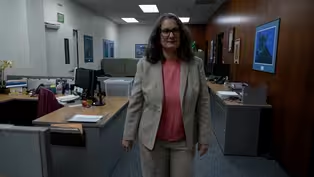
Day in the Life: Chief of Wellbeing
Video has Closed Captions
Clip: S5 Ep2 | 3m 29s | Spend a “day in the life” with the Chief of Wellbeing of Los Angeles County schools. (3m 29s)
Video has Closed Captions
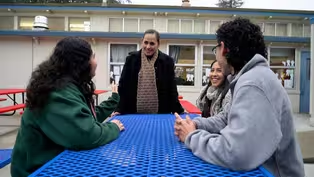
Clip: S5 Ep2 | 6m 21s | Discover how graduating seniors in California can earn a State Seal of Biliteracy. (6m 21s)
Video has Closed Captions
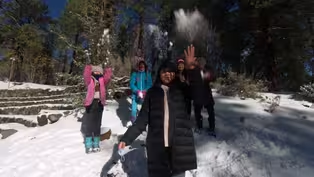
Clip: S5 Ep2 | 5m 26s | Visit an outdoor science school in Southern California. (5m 26s)
Video has Closed Captions
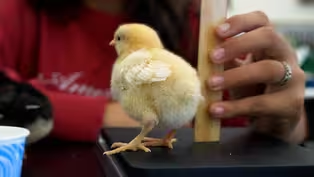
Clip: S5 Ep2 | 6m 12s | Visit a Central Valley school where students get a weekly agriculture lesson. (6m 12s)
Providing Support for PBS.org
Learn Moreabout PBS online sponsorship
- News and Public Affairs

Top journalists deliver compelling original analysis of the hour's headlines.

- News and Public Affairs

FRONTLINE is investigative journalism that questions, explains and changes our world.












Support for PBS provided by:
Inside California Education is a local public television program presented by KVIE
Funding for the Inside California Education series is made possible by the California Lottery, SchoolsFirst Federal Credit Union, Stuart Foundation, ScholarShare 529, and Foundation for the Los Angeles Community Colleges.