Chicago Tonight: Black Voices
Some Neighbors Push Back on New Quantum Computing Development
Clip: 12/4/2024 | 10m 21sVideo has Closed Captions
Advocates are concerned about the potential environmental impact.
The former U.S. Steel South Works site is set to be transformed into the Illinois Quantum and Microelectronics Park. Advocates say things are moving too fast without a clear understanding of the environmental impact the project will bring.
Problems playing video? | Closed Captioning Feedback
Problems playing video? | Closed Captioning Feedback
Chicago Tonight: Black Voices is a local public television program presented by WTTW
Chicago Tonight: Black Voices
Some Neighbors Push Back on New Quantum Computing Development
Clip: 12/4/2024 | 10m 21sVideo has Closed Captions
The former U.S. Steel South Works site is set to be transformed into the Illinois Quantum and Microelectronics Park. Advocates say things are moving too fast without a clear understanding of the environmental impact the project will bring.
Problems playing video? | Closed Captioning Feedback
How to Watch Chicago Tonight: Black Voices
Chicago Tonight: Black Voices is available to stream on pbs.org and the free PBS App, available on iPhone, Apple TV, Android TV, Android smartphones, Amazon Fire TV, Amazon Fire Tablet, Roku, Samsung Smart TV, and Vizio.
Providing Support for PBS.org
Learn Moreabout PBS online sponsorship>> Some South Chicago residents are raising concerns over the development of a new quantum computing campus.
The plan is to transcript transform the former U.S. Steel South works site into the Illinois quantum and Micro Electronics Park officials are calling the campus history altering and hope the developments and their partnership with California-based company Quantum Cyclone to makes Illinois a global quantum leader.
But some neighbors want the process to slow down raising environmental and displacement concerns.
Joining us now are Amalia Nieto, Gomez, executive director of Alliance of the Southeast Hurley Johnson, CEO and director of Illinois Quantum and Microelectronics Park.
And on Zoom and Holcomb community resident and co-founder of Environment, Transportation, Health and Open space of South Shore.
Also known as UFOs and 10th Ward Alderman Peter Chico, thanks to all of you for joining us.
I'm fairly Johnson.
Let's start with you.
Please break it down for us for the non science folks.
What is quantum computing?
Why is it important?
Sure.
Well, thank you for having this evening.
So a quantum computer.
>> Is a new kind of computer, essentially a supercomputer uses the laws of physics and a lot of quantum mechanics to do the calculations differently.
If we believe it will transform a lot of areas of industry, a lot of areas of our society as it replaces classical computing and takes over and does his calculations faster and for understanding quantum computing or technology refers to what is that?
The physics of subatomic particles sorts, right, right.
So quantum computer.
Let's extent of my knowledge.
That's right.
quantum computers operate by controlling states of Adams or states particles of light.
>> Why is Illinois the prime location for this park to develop for this project to go on, right?
Well, so I'm from the University of Illinois.
I'm a scientist and engineer.
>> We're for a long time state of Illinois at you know, more than its share of the national resources in quantum information science.
So we have 4 of the 10 major research centers in country are located here in Illinois.
We have a national Labs Argonne National lab in from National lab.
There are Chicago Northwestern University University Illinois where I am it gives us a head start because we have that the basic science in place.
I'm Molly and the answer Gomez White is a lines of the southeast asking for this process to be slow down.
>> Well, we feel that the process is being rushed through it.
This announcement was just made in July and there are a lot of questions at the community still has whether that questions about the environment and what the environmental impacts are going to be.
What is going to happen with jobs, pipeline, education, pipeline.
And and you know how residents have been in the community for 2, 3 generations are not going to be displaced by this development.
So there's a lot questions that we have.
There's a lot of concerns that we have.
And then we also want to make sure that there are defined community benefits for the community to make sure that this chilly benefits the community because if benefits are to find then this is another round of empty promises we've been had 2 other developments before this one particular community benefits.
Are you advocating So we would like to see a jobs pipeline like the find jobs pipeline and education pipeline that starts at the elementary school level and carries on into high school and that creates job pipelines for local residents.
And we would like to make sure that a longtime residents have built the community are not displaced by this development.
Whether that be from rising property taxes, rising rents, even rising utility bills.
Because we just read that there are our utility bills that could be rising because of data centers.
And the quantum development is going to take on a lot more of the electrical grid.
So how are we going keep people housed that are currently in the community?
>> And Holcomb, what are your environmental and environmental remediation concerns?
>> We've seen a lot of very glossy presentations.
was at the 5 hour Planning Commission meeting last week what those pretty pictures all show is what is in the ground.
And what is in the ground is a toxic brownfield.
And so we have a lot of concerns about the construction process and how that's going to affect residents.
Because when you start digging in a hisa land, all that stuff becomes particulate matter goes airborne and people can breathe it can go into battle a fire the water table that seats like Michigan and then we can drink it.
And we are very afraid of actually being poisoned.
And if that happens, we're not going to know for 10 15 years when we start getting cancers we start getting these other things that could happen because we're breathing and drinking that talks of Brownfield.
They the IDPH virtually waving no further remediation necessary letter in our faces say it's brought up every single meeting and I actually have documentation they did 11/8/2004.
That was a letter that was written to a previous proposed developers.
Mccaffrey was his last name and it was written by the then Chief of Bureau of Land.
name was William Childs.
And he basically said that they only did one sample for 2 acres and so that the stand or 2 samples for half acre to see what was in that round field and what remediation would lead it is feels like me Youve got some concerns than that.
That more of that is necessary testing is has not gotten.
>> As in-depth as as it should be.
I want to I want to bring alderman she Cohen here.
Sorry, and I will come back to you, though.
Alderman, why are you in favor of this project?
>> Well, I think it represents an opportunity for the tent or in the South Chicago community us to a close the stores nearly 30 years ago.
Since then, we've had 450 acres of on develop lakefront property.
When I knock on doors and I talk to folks who kind community in a tent were general, they know that that piece of property could be catalytic to seeing sort of investment in the South Chicago neighborhood and they're excited.
It's time for our community to be a paid attention to its time for the city Chicago in the state of Illinois to pay attention kind community.
And the time has come.
>> Alderman do.
Is there a plan to be sure that residents are included you know, the the future of the campus and the impact it has on on their community and their neighborhood.
>> Absolutely.
I think what I'm most excited about since the announcement in July in division.
I kinda head was.
Creating a pipeline summer schools.
So the IQ and about a month ago he gathered around 20 principles from the 7th and 10th words.
We had Hurley there's new of AI psych one of their call center of exchange.
And we started that conversation started a dialogue about leveraging what's going on and I come up into our schools.
The principal very excited.
And we left that meeting with just a sense urgency and exciting circuits.
>> Harley, The Wall Street Journal says, you know, Chicago will be the Silicon Valley of quantum.
Tell us a little bit about some of the different components that will be incorporated into this park was a Sure.
>> We're very excited about it.
And we think there is a possibility that this becomes kind of Silicon Valley for quantum.
There's going to be a hardware component where companies come and build computing prototypes.
So that early versions of the quantum computers, software side where companies come in and along with university researchers work on software that will be used to run the computers.
that creates really full spectrum all the way from kind of where we are today early prototypes to to really what we think will be serving and users.
The companies and the organizations around Illinois and around the country that can use these devices.
Of course, there's you know, we've heard about the cryogenics, the stuff that's necessary to keep meters cold.
>> Right.
So one of principles that many quantum computers operate on after running very low temperatures are very sensitive need to be kept.
So they need to be kept cold.
So at the center of the park will be really industrial-scale cryogenics plant projects facility that's made to cool the computers down to very low temperatures.
>> Of all you do you see any positives to campus like this coming to the neighborhood?
>> Well, I think the pauses will be measuring whether or not, you know, able to fill the promises that have been made.
And so I think what we what we're saying this to slow it down to do this right and get the details ironed out so that that's what we're saying.
And, you know, you know, even just to to slow it down so that environmental review is done so that we know what is what is in the in the ground because we know there's toxins and we know that there's leaching happening, both from steel workers that have worked there like, you know, we know this on personal level that this happened and some of the stuff, you know, is in the paperwork, we like to slow down until community conversations, actual conversations about what the community's priorities are for a development.
So I think, you know, it can't it has a lot of potential, but like they're also a lot of concerns.
>> Alderman Chico, we've got just about 2030, seconds left.
You know, the site has been earmarked for development several times by different companies.
Why are you confident that this one will go through?
Why is this one different briefly?
>> Because we have the full force of government behind it.
Everybody from the governor's office, the mayor's office, we are fully behind.
might be other projects.
We have the sole source of >> Okay.
All right.
That's where we'll have to leave it.
I know that there's a lot of questions and thoughts among the folks at this table and in
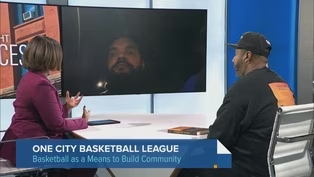
How a Local Basketball League is Working to Reduce Violence
Video has Closed Captions
Former Chicago Bulls star Joakim Noah founded One City Basketball League alongside Cobe Williams, (7m 22s)
Providing Support for PBS.org
Learn Moreabout PBS online sponsorship
- News and Public Affairs

Top journalists deliver compelling original analysis of the hour's headlines.

- News and Public Affairs

FRONTLINE is investigative journalism that questions, explains and changes our world.












Support for PBS provided by:
Chicago Tonight: Black Voices is a local public television program presented by WTTW