
Some of Our Best Friends - Part 2
3/10/1969 | 1h 1m 6sVideo has Closed Captions
Black and Jewish communities gather to have a candid conversations about antsemitism.
In a candid conversation about racism, antisemitism and views about one another, eleven men and women representing Black and Jewish communities gather for this rare dialogue first broadcast in 1969. Capturing the issues of that time period from education and housing to oppressed groups, this frank discussion gets passionate, at times combative, and yet insightful all at once.
Problems playing video? | Closed Captioning Feedback
Problems playing video? | Closed Captioning Feedback
The WNET Group Archives is a local public television program presented by THIRTEEN PBS
Some of Our Best Friends - Part 2
3/10/1969 | 1h 1m 6sVideo has Closed Captions
In a candid conversation about racism, antisemitism and views about one another, eleven men and women representing Black and Jewish communities gather for this rare dialogue first broadcast in 1969. Capturing the issues of that time period from education and housing to oppressed groups, this frank discussion gets passionate, at times combative, and yet insightful all at once.
Problems playing video? | Closed Captioning Feedback
How to Watch The WNET Group Archives
The WNET Group Archives is available to stream on pbs.org and the free PBS App, available on iPhone, Apple TV, Android TV, Android smartphones, Amazon Fire TV, Amazon Fire Tablet, Roku, Samsung Smart TV, and Vizio.
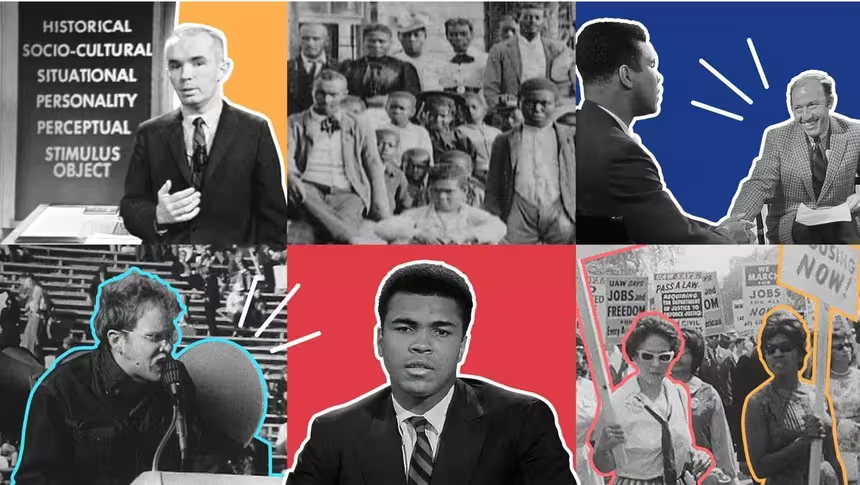
Welcome to the Legacy Archive Project!
Resurfacing a treasure trove of 50 archival documentary films, and series focused on the Black experience, indigenous rights, antisemitism, and rare interviews with civil rights leaders like Dr. Martin Luther King, Jr., James Baldwin, Muhammad Ali, Malcolm X, and much more.Providing Support for PBS.org
Learn Moreabout PBS online sponsorship- Way senses that here's the possibility, because the second point is, for people to really communicate, meaningfully and understandably, there has to be a quality of confidence in the relationship.
You know what I mean?
I think there's a lack of relationship, and the most perhaps we can accuse you, of in this situation is insensitivity.
Ah, wait- - Wait, insensitivity, like, wait, wait, wait, you know racism.
Ralph Ellison wrote a beautiful book called the "Invisible Man."
Right, and I accuse you all of racism.
- [Murray] Yeah.
- Of not recognizing the visibility, what the teachers do with those Yiddish remarks.
They don't speak Yiddish-- - [Murray] Did they really?
- What the teachers do in talking about those kids sitting in those 35 seat, as though they weren't there as though they didn't know what a Schweitzer was because their mama knows what a Schweitzer was 'cause she does they work for 'em, right?
- [Murray] To have a right to make that criticism and to make that attack upon this Jew.
I'm not denying that.
I make that attack from my pulpit.
- I hear Black saying, "Look, we're choosing the time, and we're choosing the dimensions, and we have the right to do that and we're choosing the weapons, so to speak."
And I hear the Jewish group saying, "But you know, we've always had the opportunity to be a part of that with you."
You know, and I came out very clearly in what you said, I think, Murray, and now you're saying we don't have that right.
- Here an example in SCLC NAACP, CORE, I was deeply involved in them.
Now, not right now, but about, I'd say, three years, four years ago.
Stay out, I was told to stay out.
I was initially perhaps perturbed, because I wanted to share this.
I, from my point of view, feel that my destiny as a Jew and as American is inextricably connected with the destiny of what happens to the Negro in this country.
I can't separate it.
- I think that the rabbi of through the course of this discussion several hours probably appreciates that better than anyone else in the group who is, you know, any better than any of the other non-Blacks except for maybe this guy who already came with, keen appreciation of it.
And my man over here, you're on cloud nine.
I mean, I have to say that you're not as far as I'm concerned in here in this room and I'm not even sure if you're trying to get here.
- [Milton] I'd like to provide you with a little answer.
- Oh lemme- - Just a moment, just a moment.
I wrote this on Thursday evening when I first received a call for the program - [Loriman] That's exactly what I mean- - No, just a moment, just a moment.
- [Loriman] You didn't know I was gonna be here, did you?
- No, I knew human beings were gonna be here.
- [Murray] You can't do that.
- And I addressed myself to something that I feel the rabbi should have addressed himself too.
And that is that we are addressing ourselves to something that should be non-existent in America.
[rumbling] And that is that there should not be, any racial antagonistic differences between us.
In 1969, I'd like to read and I ask your tolerance, please listen.
- No, I won't listen.
- Well, excuse - You only said, I wrote this last Thursday- - Excuse you - 'Cause you didn't know I was gonna be here- - Excuse yourself.
- Or anybody else here except yourself.
- I'll address this to everybody else, exclude yourself.
- All right, count me out too, baby.
- [Milton] "And there was left one man and one woman on earth.
And the two were not as one.
For the man was kin to the color of night, and the woman akin to the sun.
And the woman shrank from the man and cried.
And the man just stood and stared and they heard a voice speak to each of them.
"It is so because I cared.
You see, my whole world was destroyed in fire every man, every woman by hate, but I saved you two, each one of a kind and hoped that you two would mate.
If you only hate you will both expire, and there shall be nothing left.
All that I loved will be ended in fire, and the whole world will be bereft.
Just one thing shall make my whole world whole again.
Such a love as I give you two and I'll make you blind to each other's skin and create my world anew."
- [Dick] That has all the wrong answers.
- I won't comment on the poetry but- - [Milton] Poet always has wrong answers.
- Yeah, but it seems to me that I couldn't agree with that in a million years because to be blind of his skin is to- - [Lou] Not the answer- - Insult him.
- [Milton] You wanna be blind to- - I don't want him to be blind or deaf to my Jewishness, or as I express it.
I don't wanna be blind to his blackness.
He's gonna write to it, and it's great.
- Just how I want him to be respectful and understanding of mine.
This thing is crazy.
- As a poet uses the words blind to skin, he means, if I may interpret, to be tolerant and compassionate.
- And would you think we were getting close to beginning to zero in on the target?
- Mm-hm - Like you know, I'd like to ask you a question.
Did it ever occur you're an American-Jewish Congress?
- Is that it.
- I'm just wondering, did it ever occur to you too, or has it been any discussion about supporting these cats, in their idea of getting self-determination for their schools?
- Yes, the answer is yes.
The answer is that when the school strike was on, we called on the school teachers go back to work.
We're the only Jewish organization to do so.
We passed a resolution and announced it publicly in support of decentralization as a measure of, as a way and a technique and an instrument of improving and increasing the participation of parents in the education of their children.
And we weren't the only Jewish organization to do that.
[group chatter] The reformed rabbis have done it and so on.
- And I think, I wanna carry it one step further.
Here, really is that when we hit smack into the economic arena, and I'm gonna stereotype and generalize a bit in here, that the Jewish ally who was with me for integration of the a restaurant, I wonder if he's gonna be there with me, if in my attempt to get economic control of my community, he has to attack some Jews at that level.
And when we attempt to get, you know, teachers that are relevant to our kids be able to understand it's not because the teacher is a Jew, but because the teacher comes from a different environment.
Would you be with me if it meant economic harm to those Jewish teachers at that point?
And that's what I'm not.
- If it meant that a thousand teachers in New York or any number you wanna mention.
A thousand Jewish teachers, or a thousand teachers, 80% of whom say if the ratio of persists are Jews.
If it meant that a thousand teachers were fired because upon investigation and due process and legitimate study, they were found to be lousy teachers- [Woman mumbles] Wait a minute, who could not relate to their children in the class, I would say fire 'em.
- [Woman] Certainly.
- Absolutely.
And I think that there are ways, and we have proposed ways of establishing some kind of measurement so that the teacher doesn't get his tenure after three years and automatically continues for the rest of his life.
That's no good.
I'm with that entirely, but what I'm against, I'm against replacing this teacher because he's white and putting a black in there.
If so factor, without any indication other than the fact that one is white and one is Black, that the Black is better for the Black child.
That's what I'm against.
I'll fight you on that.
Not on the first, is that clear?
- Are you gonna go back to your?...
- [Lou] I, I'm very honestly-- - The issue that I saw that does connect the two for me was your statement bringing up that you're gonna trust his organization, but, that you don't know on the basis of your history with other people, other experiences, whether it would have, whether there's any reality to trusting Dick.
[clearing throat] And that's the issue.
- And, and I- - You were trying to point there.
- Sure.
- Because, I think- - The issue is honest.
- As many Jews.
- [Paul] Maybe, maybe.
- Going with you at this founding inspiration.
- [Paul] Maybe, you're asking at this point, maybe you're asking too much.
See, 'cause I think everybody came here.
Certainly, I came here at least with certain set notions in my head about who the people were gonna be here.
And I was prepared without having met them.
Not to, it wasn't a question of liking or disliking, but I certainly had some fixed ideas.
- You were Thursday night home.
- I had a fixed idea right now.
[chuckles] And I think everybody had a fixed idea, right?
Now the question is.
the need that became very apparent very quickly.
At least for me, was to junk as fast as, as I could most of the notions about the people who were here.
- Mm-hm.
- And I certainly had to junk the notion I had of hatchet 'cause my- - I did too.
- Well every everything I got.
- I told them.
- The only thing I knew about hatchet was what I read in the, New York times or in the, in trying to see in terminable insane arguments that go on in the pages of the New York review of books, which review each other.
Ah- - [John] It's called the New York review of Vietnam.
- Yeah.
[chuckles] Or the New York review of Vietnam.
So, so too, you know, I have a picture and they tell me when, when Willis said to me gonna have a rabbi, I had a vision in my mind, that's gonna be one of them, organ toning cats, you know.
Guy who talks like he's standing next to an open grave all the time, you know?
[laughing] And you know, here, I think of him.
See, there's the NAACP, that's the God Tom in the operation.
'Cause that's, you know, out where I live the NAACP doesn't, it's not such a hot thing.
Now it takes a while then to get rid of, of these kinds of attitudes and begin to understand and to listen more carefully to what's being said.
And so, I'm not certain that we can get any more out of a scene like this than a willingness to take the next step, which is to make the demands on each other and keep testing until we do achieve this mutual.
- [Dick] And I don't know how you heard what I was saying.
- John, can I ask you this question?
In terms of what I said before, how far I'm going to go or willing to go.
As honest as I can be at this time, as I conceive it, are you willing to at least go any distance with me or because I hedge at one point, are you saying, okay, the hell with you.
- You at this stage of the game, you're not my preoccupation.
You see, I'm not preoccupied with you.
I'm preoccupied with black people and doing for black people.
- You see.
- Perhaps at some distant future, we may come together again as, me as a man and you as a man.
But at this stage of the game, I am a black man in search of my identity in order to recover the humanity that your folk meaning whites stripped me off.
Now in the process, I can care less about you.
In this kind of search you're out of it.
And I admit this.
- I don't think it's possible to put me out of it.
- [John] I admit this.
- I don't think it's possible to put me out of it.
And you truly gain your humanity.
- [John] Oh yes I can.
- I don't think so.
- [John] Because I'm going to do to you, perhaps.
What- - You accuse us, you accuse us of using [indistinct]- - Alison In invisible man said that, "You-" - Just as I need you for law [group chattering] - But in so dude, we have lost our humanity and the charge that we have lost our humanity by depriving you just like the Nazis lost their humanity by, by murdering Jews.
That's, that's a correct charge.
You are saying now, you've lost your humanity, I'm gonna lose mine.
And after I've lost mine, as much as you've lost yours, then we can be together.
And I think that's very destructive and nihilistic.
[clears throat] 'Cause I think that, I think that the process is the product.
The process is the product and we've got to, we've got to make that process decent.
We are gonna be decent.
- The reason I'm ignoring you is because you are making my point.
- Jaren said, he was going to get and seek his humanity.
- [Lou] Well, we're saying is part of his humanity is gone?
- [Charlotte] But listen, we got to go back.
- He can't do it, he can't go and say others are not.
- We've got to find ourselves.
- 'Cause like whites- - We've got to go all the way back, - But you gotta find [indistinct] And start from when we were in Africa, and when some of us is- - [Lou] Right.
- Some of us were princesses and prince and Kings and Queens and what have you.
- [Lou] No one is disagreeing with that - And those societies so that we can start to find out- - Okay.
- Where we belong right now.
- Okay.
- We've got to find out who we are, where we going.
We've got to find ourselves.
- Right.
- You cannot be involved in finding me.
You are white, you are was whatever you wanna call it.
You are white, you cannot be involved in finding me Charlotte Robinson, a black woman.
No, never.
- [Charles] All right now Murray, and... - But he's a human too.
- He's human but, I'm not saying he's not a human.
- And you are human.
- Nobody.
- And we share, if we don't share negritude or Jewishness, we share some measure of humanity.
Otherwise.
- I would say, we're not saying, you know, throw you out, you aren't human or anything like that.
I say, well, give us a chance, we want to find out who we are.
You're not black, so you can't be included in that part of the we.
- [Bertrand] Right, that's just one point that I'm not very clear on, and that is Murray and Dick and their vehement rejection of, you know, what was said by Charlotte, you know, and what John said, in terms of blacks getting themselves together and you're seeming rejection of you- - [Dick] Not being a part of that.
- I didn't understand.
- No [indistinct].
- I'm saying including in blacks, getting themselves together is the confrontation and the real confrontation with whites.
I don't think it can be excluded.
- [Loriman] I don't understand that.
I really don't understand that.
I get in this feeling again, this, you know, like this attitude, attitude that's being expressed here.
I hear all the time that niggas are, you know, the Jewish burden in this country, you know, and that, you all, [chuckles] you all watch out for us, you know, and make sure that we get it ready and get it right.
Otherwise we might go off someplace, and come up with something weird and strange, you know.
- [Murray] Weird you get that here, did you?
- I get, I am getting it here, right?
- John, John, John, and Charlotte, you know, talked about a need for black people to develop their own identity.
And while we're doing that, we have to do that, while we're doing that, we really can't be dealing with you or anybody else, you know.
I mean like- - [Dick] But that's not real, we have to [indistinct] - I mean, that's not real, years in desert all by yourself to do it.
Why isn't it real?
- [Dick] Because- - You left Egypt and went out and developed the whole thing, right?
- [Dick] Because it was in a desert and there was nobody else around us except the sand.
But the Orbis, you are surrounded in this country by whites, by Catholics, by all kinds of people by institutions.
- [Loriman] You know.
- [Charles] Who might have think this is, another one of those times, when we're not gonna finish in the next 30 seconds.
[group chattering] - We gotta finish in 30 seconds?
- Okay.
- We have gone an hour past break time and I've been waiting for the thing when I thought it would end in 30 seconds.
So let's take 15.
[groans] - Believe it.
- Oh, boy.
[group chattering] [low thud] [chuckles] [group chattering] - I'm not believing in the New York times.
- I gotta think, I think most, most of us here resent, you know, the fact that you guys believe that in defining ourselves, that you should be involved in the definition of us as black people, as black people.
And, you were saying, Dick was saying, I think that, unless we deal with you as human beings, in our definition of black people, we're not going be human.
If we negate you humanist or something like that.
[clacking] - What we're saying is, what I'm saying is, that in this day and age, I think we need each other.
- Why do we need- - More, more than we did before, right?
Because, I think the Jews need the blacks and I think the blacks need the Jews.
I don't think you need us to help define your own identity, although I think our experience as a people and as an identifiable ethnic group can be valuable to you.
Why do Jews need blacks?
Jews need blacks because, blacks are part of the human race.
Okay, and Jews, and the way blacks are treated, the way blacks are treated is an indication of how humans treat other humans and how humans treat Jew- - Okay, so then Jews need Arabs?
- Yes, they sure do.
And Jews need every- - And that.
- Then the reason, the way you put it in that fashion is the reason that we need him, is so that I, so we can carry out our mission.
We've got to save somebody.
Say it, I'm gonna save you.
[chuckling] - No, no- - No.
We've got to save ourselves.
- We've gotta save ourselves.
- We gotta save our things ourselves.
[group chattering] - Why couldn't we save ourselves by first saving ourselves?
- That's part of it, why can't we, fairly well?
- No, no, no, no.
- Wait a minute.
Not in my, we haven't saved ourselves in my judgment.
My judgment, doesn't mean that to be saved means to belong to the club to be saved means to have a big house, to be saved means to be financially secure.
I don't accept that notion of, of being saved.
If I say to the Jews, if I wanna say to the Jews be saved Jews.
- Yeah.
- Then I would have to say a totally different kind of thing.
Be saved Jews means, don't think that the god damn house is so important.
Don't be so hung up about, you know, belonging to the Hill Crest country club or living in the golden theater, - Or living with- - Every rabbi in the United States, and every Jewish organization in the United States and every Jewish, philanthropic and fraternal institution in the United States would say to itself, our problem as Americans is to try to discover how affected we have been by the American notions of racism.
Then we would be saving ourselves and incidentally, maybe, maybe we might help them.
Maybe.
- The trouble with that is it's too contemplative.
- I'm making this?
- You're indicating, Paul is not going to be available from the Jewish community.
Jewish community right now at any rate is not gonna join in a revolution.
- Right.
- Okay.
- Okay, so when I'm saying, then let's, let's, let's stop kidding ourselves.
- Yeah, I'm being honest.
- About, you know, how we're gonna help the blacks.
- All right, rabbi.
- We're not gonna help the blacks.
- There's a, because you are assuming that the only way you can help the blacks is by revolution.
- And I tell you what, then, then.
- I'm assuming that.
- Well- - I hear you didn't join revolution.
What the hell we need you for?
- I think the difference is right there.
I'm glad you said it because I think that what you have done, I think you've put your finger on a- - The whole topic.
- On a very.
- Don't join it but watch it.
- Four hours ago.
- A very important - [indistinct] Hurt yourself, - A very important difference between the Jewish community as a corporate body, if anybody can speak for it and the black, the black power or the black, the black movement, the movement that is the, the Jews, the Jewish community believes rightly or wrongly that the system can be improved, reformed.
The difference is that those, those whites and those Jews feel that the system can be improved by revolution, by reform and improvement.
Those people find themselves, and I find myself frightened by the idea of revolution.
- You know, it's like, like I got some real strong feelings that one of the things that's happening here, and it's been happening since the civil rights movement, where a great number of Jews came into that movement.
And the very things you talk about that are Jewish ideals, but not Jewish practices, as I see it.
'Cause I can just show you Jewish communities, that went yes on 14 because they said property values were more important than human beings, et cetera.
And the idealism of the Jewish youth, not being able to vent itself in the Jewish community, turned to the black movement, the civil rights movement for integration into it.
Now, black people have come to the conclusion after that movement and so did the lives, that America ain't about, ain't about never has, and in the foreseeable future, isn't about to absorb any group of color.
She absorbed you because you white, even though you are a Jew didn't to a larger, to a much larger extent than she could absorb the Indian whole as the original cat here, the Puerto Ricans, the black, the Filipino, you name me a group of color.
America never took them in and they've built their institutions around that racism.
That's what we call institutionalized racism.
And really what we as blacks are doing, is kinda knowing at that idealism that, you know, you see in your religion, you say, and you see in your, supposed way of life.
And in very fact you have been co-opted.
The majority of the Jewish community as I see it in this country.
And that's the big difference I seen between an American Jews, Israeli Jew is that, you have been co-opted, you are just another hunky at this point, but underneath you still have those kind of dreams.
Now you're caught in between your material over here and your dream over there.
And you're kind of saying to the black, hey man, you know like, hey, can't we find another way where I can accommodate both.
Me and Paul get along very we good, because I think we understand full well that there's gonna have to be some basic changes made in the economic system of this country.
And more important, more important, and which I think hits smack Deb in the middle of Jewish ideology, there's gonna have to be a basic change of how human beings are viewed in this country.
Because there's one thing the black community will tell you, and we know that dollar bills in this country right now are more important than people.
Property is more important than people now, you know, that runs smack babe in contradiction to what you would like to believe, right?
But in fact, you're caught in the trap of that materialistic jazz.
And we wanna find a way and, and this is simply what we mean by black revolution.
I hope we can do it peacefully.
We wanna find a way where, we can have the benefits of the technological society.
[coughs] Like my tooth was just hurting.
Darn it, I don't want no witch doctor, I want that stuff right there.
It knocked it out.
When I came east, I flew on a jet.
[coughs] I flew on a jet that got me here and three hours and something.
I don't want a covered wagon, but I also want my Friday and Saturday night.
And I wanna be able to relate to him as our brother and not as a dollar bill or our commodity.
She's my sister and we want to have our primary relationship and groove.
At the same time, we can have our economy and that's, you know, economical advantages.
- And that's the challenge right now to Jew to, the Judaism itself I think.
- I think that's true.
- And, and we are annoying the hell out of you.
- I'll say this, you know, every one of us at a different point are gonna say this far no further.
I don't think the Jewish community is with you, when you say this far, no further.
I agree with you, you know, we're not.
[coughs] At that point with you.
- How do we begin to extricate ourselves from this kind of dilemma?
It's by first controlling a very basic institution in society, named the educational.
This is the reason we've singled that one out, but that's not the only institution we are interested in.
We're interested in the totality of the black community.
- John.
I, I hope by this time, I don't think it was necessary to have this meeting tonight, to understand it.
'Cause I think you already did understand that, when there are stores in Harlem, it's not the little Jewish storekeeper who's gouging, the black man in Harlem.
It may be chase Manhattan bank.
That's owning, that owns a property, and owns a lot of condemned property too.
It's not the Jew by and large who exploits.
And I, I think that kind of defensive posture might be necessary to be said again and again, because apparently it isn't understood.
- [Lou] No, like how come you never had this conversation with him before this scene here in war Washington.
And aint you two guys live in New York?
You know, he's been a central figure in a hell of a contrary varsity.
You're a, the assistant director of an agency that's been directly involved in.
- How come you never- - How come that you never- - Questioned?
- I have a question.
[group chatter] - He's not even talking to Mark Rudd.
- Yeah, but no Well, oh yeah, but I can't do anything about the Mark Rudd thing here.
It takes a television program, you know, to take you down to Washington and him down to Washington.
And for the first time you having comment, I listen to you guys talking to each other.
I think to myself, what a thing this is, what's the matter with you?
You couldn't pick up the phone and say to him, "Hey hatchet, I read in a paper about that, that you put out about Jews."
Why don't we sit down and talk about that?
- That's what I said, I'd learned.
- I should have [indistinct] Okay, I learned that.
[group chatter] I learned that from John tonight and I'm very grateful.
- I wanna know, wait, I wanna know.
- Is he who did it.
- I wanna know.
- Look at the trouble we, I getting you this.
- [Richard] I'm not a black man.
We are not blacks.
You cannot expect the Jew to be a black.
- I didn't the Jew to be a black.
I asked the Jew to try to understand that, baby, you getting it worse than me.
- We are trying to understand.
And we are trying to help.
- Maybe you missed my point, maybe you've missed the point, - In the blacks community to be piece of these Jews.
[group chattering] - What is this?
- It's the tenacity of the feelings or the pervasiveness of the feelings.
The surfacing of the feelings is due to this.
When Les Campbell read the poem on WBAI, and Rose Shapiro got up and clacked with her false teeth, she's comes out along with a rabbi whose name I can't recall.
I think it was Eisen drive, and some other prominent Jewish figures and says, "Without reservation, Les Campbell is racist, anti-Semitic et cetera and Les Campbell must be fired from his position for reading that poem."
When she says this, "This is not lost on the black community."
- John, can I add, can I explain why, why Jews took offense at that?
Granted that the poem was a- - Some.
- Some, yeah, granted that the, the poem was an express, a valid expression of the way this girl felt.
But excuse me, Campbell was her teacher.
He read the poem was, one of his and the way he read it on the program, and his comments before and after indicated that he approved of that.
He approved of a sentiment by a child that said, "I wish you do with the yamaka on your head, I wish you were dead."
Now that can you understand?
I ask you to try to understand, what that means to a Jewish teacher or, to a Jewish parent or to 3 million Jews or whatever number there are in New York.
When, when the teacher, who was supposed to be training the mind of this child, apparently encourages and approves of that kind of sentiment.
Now, can you understand, really?
I wanna get closer to you.
Can you understand what it feels like having known that 6 million of your kin, were killed in this generation over there?
And somebody writes a poem.
I don't blame the child, the child feels that way.
I blame the teacher for not saying, "Here's the poem, this child read."
She feels this way.
It's terrible, we've gotta do something to train this child not to hate.
Isn't that important to you, to train children, not to hate.
- Yeah, why don't you go talk to this guy?
Why are you talking to the television audience about this guy?
Why don't you go talk to him directly?
It, no, what, you see?
It seems to me that just in this kind of thing, that's happening here, it seems to me that if this is the way the New York City School, the dire, the debate about the New York city school system has been carried on.
It's no wonder the god damn school system has grown up in that fashion.
You people aren't talking to each other, you're talking for the benefit of the press, and you're talking for the benefit of the television and you're talking for the benefit of the ads and the newspapers.
You're talking for everybody except yourselves.
That's probably true to some extent of the blacks as well It is, as it's true of you.
- Now spend what, almost 10 hours together here?
And we have looked at a lot of incidents that have happened in the communities from which we come, and some of our thoughts and feelings.
And now if we can focus it in on, and what is the net result of spending time, this way for us and our feelings and reactions about each other and what other kinds of issues would have to be looked at and dealt with before relationships moved further, which is really the issue.
- I have learned that, I think a lot, I feel that I relate to John, who was just a name before tonight to me and who I think Paul you're right.
I think I should have call him and tried to meet with him in New York instead of a news release attacking him.
[dull sound] And this session in the pit has taught me anything.
It has taught me that I should have done that, and then I hope the- [chuckles] Next time he writes an article.
[chuckles] That I ought to, that I ought to call him, or perhaps now that he knows me, he might not write it in the, in the very same way.
I don't, I think, I try to get extra quote to Lou.
I don't think, I understand Lou very well.
And I, I don't know why.
I think Lou is a revolutionist and wants to just tear everything down.
And that simply isn't my personal way of looking at it.
- Boring.
- I get you were trying to adopt a kind of a real tough guy attitude, a real hard line position, because you think it's the right way to act.
I don't think, and this is very presumptuous of me.
I don't think you really, feel it.
I think that at least as it comes across to me, I think somehow you've gotten caught up in this dialogue here tonight, almost in a kind of a, trying to outdo the other guy kind of business.
I think some of the Jewish participants have too, particularly with Paul, because Paul is a superior person.
- Okay, then the queen over here .
- Has somebody called it with the earrings.
I don't know, I'm a very poor judge of women.
I think you're very angry at me and I think you're angry at, at a lot of people.
I think you're angry.
You're probably very angry at a lot of black people too.
You strike me as a person of deep, deep feelings who gets mad, and hits and strikes out, and revives probably a time.
I would guess that you have a terrible temper.
[laughing] - Yeah, all colored women are that way.
- Ah, no, I've only lost my temper once in my entire life.
Just once.
- That proves what a lousy judge of human nature.
[laughing] - What is for a long time, you know, I came from the school where, you didn't say anything, you accepted, whatever was told you, by the adult blacks, and by especially by the white community.
And I never questioned it.
I never said a word.
And when I got in a position of coming out on my own, you know, some of the thoughts that I'd, you know, put in the back of my mind, 'cause I didn't want to confuse myself 'cause I had to make it through school and I had to keep everybody happy.
So I could, I decided now that I'm taking care of myself, I can express these views and I'd like to, you know, find out exactly what my other brothers and sisters feel, what the white people that I come in contact feel and I'm angry, true.
I'm angry at anyone who stops me and the black people and the non-white people from having peace.
Peace and freedom to me are synonymous.
You know, let me have my freedom and my peace.
If you don't, I'm going to be very angry.
If you cross me, look out, 'cause I'll get you.
Now, that's just the way I feel about it.
And regardless of who it is, if you're black and you cross me and you're against my freedom and you know, you're running around how, but I'm a big Negro liberal, you know, you go with the rest of the people.
- [John] I can't do this kind of thing, Charlie, 'cause perhaps I should have confessed in advance, and then maybe I wouldn't been here.
That I'm not very groupy.
Some people have misread me.
I find it very, very difficult to function in a group environment.
In fact, I don't get along too well with adults.
Many of whom are negro.
I come alive, mostly in relationship to black children, usually in a classroom setting.
Now this is just, you know, me.
So I can't go around like this, and say how I relate to a particular individual except to say that on a one to one basis, I am more likely to get my point of view across to that person.
So that person better understands me as a black person.
If I'm talking to a white or if I am speaking, you know, I can speak to a group of people.
[coughs] But this is because.
I have been trained in that kind of thing.
See, I go back to a, through a long tradition of ministers, great great grandfather was lynched because he dared to preach.
See, this is part of the environment in which I grew up.
[sighs] So I can't do this kind of thing, except to say that it's not all in vain, what we have done, because if that be the case, then I don't think I would've sat here this long.
I'm not being patronizing.
- I don't think I've developed any kind of emotional or philosophical or other kinds of feelings toward anyone, in a group that didn't have when the group started.
I mean, during the course of this thing ... - Where were they when they, when you started?
- When they started?
Yeah, I'm glad I participate in this thing though, because when it comes, you know, the white, the Jewish participants, I realized a little while ago that I have all, I have not really gotten involved in an involved kind of conversation with the type of people that most of this group represents.
That is the white members.
I know Jewish radicals.
I feel very comfortable with this cat, both, you know, and style and, and you know, lifestyle and the way he comes on and, and what, what he says.
He goes, you know, the only whites I really deal with, talk to get involved with are radicals, otherwise I don't talk to 'em unless I have to, you know.
It just doesn't seem to be anything to talk about.
So, I didn't really have an appreciation, for the bag that the Jewish community as a whole was in.
I'm not certainly, I think it was Dick here, you know, who said something about me as an individual, not being that he didn't believe me.
I think is what he was saying.
- Yeah.
- That I'm not really where I've been.
I'm not really at where the way I've been coming on tonight.
And that I sort of find rather amusing an interesting observation.
And I just wanted to ask him, why he feels that I'm not.
- You know, it.
[clears throat] It's hard to say.
I think because you strike me as being too smart for that.
I think you know, too much to shut other people out, and it doesn't come across to me, that you really mean it when you say, or when you indicate to me that you wanna shut me out.
Because I think, you know, better than to shut me out.
And I just had that impression from what you were saying, that you weren't as you were coming on, and that you know, better.
- How do you know I'm too smart to, you know, maybe it might be a dumb thing.
It might be really stupid and really dumb and really way out and all that, to wanna isolate myself and deal with myself.
As a black man, you know, maybe really stupid and way out in the wrong thing for the black community to it.
But, but that's what I wanna do.
That's the way I think it's got to be done.
I can't figure out any other way of doing it.
And I get annoyed.
I really am getting annoyed, I do get annoyed.
I mean, getting annoyed all night long whenever, whenever you guys come up with that kind of thing.
- It's very- - We were.
[coughs] And now I didn't, I didn't think I ever implied that at all.
I didn't think Dick had just until right now.
- Well, it's difficult to talk about, how you relate to other people, particularly someone that strange to me as you are.
'Cause I don't have any contact with black radicals or without sounding patronizing.
And if that sounded patronizing, I didn't mean to didn't mean it.
- Would you, would, you have said that about me too, not too smart for that radical bag.
Assume that, that's what you're talking about in his case.
- No, no, not that you are too smart for the radical bag, but that, it seems to me that, there is a value in bringing people together, and not cutting them out.
I don't think you cut 'em out, I think he does.
Or at least he seemed to, you don't.
He does, and it seemed to me that that's so lacking sense, and lacking value and self-defeating, that I don't believe that he means.
- You and John have not responded in kind to this situation this experience.
And I'm just wondering if this is gonna be true of all of you.
And I'm asking myself, why?
Is it, I mean, just because you can't get along in a group, doesn't mean you can't respond to a human being.
[clears throat] - The rabbi's point is something that concerns me too.
And that is, if your reaction, John and yours were typical, then that tells if it's typical, it's important.
And if you're not representative, then it doesn't really matter.
But what it means is what it tells the rabbis.
I understand what it tells me is that the possibility of, of working together is apparently dismissed by you not only intellectually 'cause you don't think that we've got it or we'll go all the way, but emotionally psychologically, because you are unable.
If your reaction and yours, John, were typical you are unable to relate to us.
- You know, you're making it a Jewish black confrontation here.
I don't agree with you or agree with you.
I think it takes a special kind that [indistinct].
I mean, I'm using the word, I think in its right sense at this point, if there's one thing I learned tonight, or I think I feel is that to get to know somebody and to get them to know them totally, it will take a hell of a lot more than what we have done now.
And that perhaps the one thing that I realize is that gap that I knew existed is much greater and must need much more work than I have, or a lot of people have been willing to give.
So to pass off and to say, "I judge thee and thee and so forth," is to me something that I don't think one can do.
I don't think one can do, and I think one does damage.
- One of my problems is, you know, I just don't feel comfortable enough in this group to open up to it again.
I've opened up to it before and told you how I felt about black kids in education and how I'd even go against my own value system.
- [Man] I understood that.
- The starvation point and what I have gotten back, is some intellectualizing.
You know, when we throw out the subject of anti Negro feelings in the Jewish community you know, we can't really explore that subject and that hurts me very much here.
- [Man] Yes, we can explore.
- Well, we haven't, you see and all I'm saying is that I don't wanna explore in that one.
And the wall, you know, is kind of going up to where, you know I'm not just ready to open up to this group.
I feel no sense of community, you know very frankly, within the total group.
I think you can emotionally and intellectually understand the Mediterranean sea at the back of the Jew in Israel and I could.
You see, I could sit there and look at that sea and relate very much to it, but I don't think you have accepted the fact that we are against our Mediterranean sea too.
- I do, I could.
- And we feel just as emotional about it, and we are just as desperate.
- All right, Brenton.
- And, you know, I haven't heard...
It's always questioning us about what we are going to do.
You know, like you tell me that you think that I'm gonna somehow tear the system down or you know, I don't think I have to tear the system down.
You know, I think you're gonna tear yourself down.
And we can just hold out long enough.
You know, we can just survive long enough, most of the work is gonna be done, you know and as far as going along with you, I don't think it really mean that going along with us, you understand, you know, you haven't asked me to go along with the American Jewish Congress.
You know, you don't understand what we were talking about.
There's some things we blacks have to do as blacks.
There's some things you Jews have to do as Jews.
That doesn't mean we can't get together on other levels.
You've tried to twist it around when we say that certain things, black people right now have to do with black people, we have to get our manhood and womanhood in a society that is continuing through like, you know, the school system to still rob us of that, to still try to make us feel like, we are not as good as Caucasians.
You know, that's still the emphasis within the schools.
That's the genocide we were talking about.
You know, that made me come out of school.
So damn mad that if you called me black, I'd fight you, three or four years ago.
And every one of us in this room, and I had a advantage on him because I was lighter than him, you see?
And you had us hating ourselves, hating our color, straightening our hair, the whole bit.
And what we're saying is we haven't seen that change within the school system and our kids still, and they have to go outside of that system.
So, I don't know, you see you open up from your gut and how you emotionally feel and you get intellectualizing and questions like, you know, "How are you gonna do it?"
I don't know how we're gonna do it, except that I know we're gonna do it.
Now, that's not rational.
That doesn't fit within the framework of categorized America today.
But you see, you know, I see America as a totally different thing than you see [indistinct].
- He thinks I don't understand [indistinct].
- I see America as a place that has never allowed me.
Sure, It has accommodated you.
It has given you a niche, but I don't see it as that.
I see it just as Langston used, that I am the rock on which America stumped her toe with Jamestown long ago.
Hell no, I don't get excited at the constitution, where he talks about his law and order.
Hell it took article one, it made me three fifths of a man.
And now it doles out my rights in those rights.
You know, don't you know when nothing is any more de humanizing, you're talking about sensitivity and antisemitism.
How would you like to have been sitting up for the last 10 years and hearing Congress debate how much of a man you're gonna be this year?
And you have to go through that kind of, and that's all it is.
You know, and then they turn around and talk about the glorious American dream and you'll hear congressmen and senators filibustering filibustering your manhood.
And all they're saying is they're giving a license to white people.
And I know those bills weren't for me, those bills were, you know to set the bounds of your conduct towards me, you know.
And you see, I just have to do this because, you know the humanness ain't going out of us, baby, but we are retreating behind a wall.
We're tired of throwing our gut out and back on it, throwing our dreams out, wham back on it.
You see, every time we throw out a dream, you're talking about killers of a dream.
Now that's all we've been talking about dreams.
There are no real concrete, factual way.
We couldn't sit down here on a piece of paper and give you one real concrete way we gonna achieve them, except that we're gonna achieve them.
And you're gonna have to take us on that faith.
[participant coughing] And we're gonna achieve them 'cause we want to achieve them.
- I have a... - You know, I just, so.
- What is your reaction.
- I'd like to hear something back from you.
- I'm very much moved by what he said and stirred by it, you know because I think you have opened up now as you did a while ago and you have a... [group chattering] - [Richard] I felt you were communicating.
- You have made me feel uncomfortable because I'm white and I am part of the structure and part of this system that has dehumanized you and a small part of it perhaps not as big as you think, a small part of it, a part and an even smaller part of that small part is my organization, his organization, others that are trying to do what we can about it.
And I can understand, or I'm moved by what you say and I try to empathize or sympathize or feel that and I can't entirely, because I haven't lived it.
It wouldn't be honest of me to say, "I know just what you mean, man.
I'm with you all the way."
I can't say that.
I'm trying to be honest with you by saying that I can't feel that I can be stirred and moved and touched by what you just said.
And I am, but I can't honestly say, "I'm going here all the way 'cause I'm with you.
My skin is black."
It's not black, It's white, and I have... What I'm saying is I'm trying to tell it straight.
I'm trying not to be a nice guy and have you like me and say, "I'm with you all way."
I'm trying to tell you as honestly as I can, how limited I am in helping you or in trying to help you.
I wanna help you.
I wanna help you more, I think more than more than you realize in ways that I don't know how to open up.
And I want to, and I'm touched by it and I wanna go, but I can only go as far as I'm able to go.
That's all I wanna say.
- One thing I wanna say, please, please, don't think of it as helping me.
Start looking back in and seeing what's happening to you and fight for you.
I wanna say one more thing, on the whole subject of antisemitism.
You know, if I learned anything sitting in this group, I certainly don't fit that role.
You know, in fact as far as Caucasians are concerned and that's where I put a Jew with this point, in this country, a Jew is that I pick.
I'm almost like I don't like white people, except my list is growing.
[laughing] Do you follow me?
- Yeah.
- As a blanket statement, no I don't trust, you know, that's the dual thing that you got on John about earlier but if you watch us, that's the way we operate.
Right in the middle of a sentence, I can switch from you individual to you group, you see and no, white people as a whole, I don't trust.
But my list of whites who I work side by side with is growing.
And I mean, that's about as far as it can go.
And I will attack a black who tries to kill my dream.
And I don't care if you call me anti-black.
I will attack a Jew who tries to kill my dream and I'll just carry the little cross of antisemitism or any other group.
But right now, man you gotta understand we up against that seat.
And some black cats have strapped up [indistinct] and have made some very serious commitments.
And there are some whites who understand that, that's the same box they're in.
And in fact, your job is gonna be harder than mine, because his brothers say, we starting from ground zero.
In fact, in some cases minus zero, and we have nothing to lose.
Your problem is going to be, how are you gonna get your freedom when you have vested interest in the very system, that's stifling your freedom?
- That is a problem.
And all I say to you.
- I understand that.
- When we try to help with a work side by side or whatever way you wanna use it don't hurt because I say, "Help," work with or whatever way, try to understand just as we must understand the depth of your despair and desperation and everything else as you've said it try to understand too that we want to help.
- Dick, Would you just try to read back what you think he was saying to you about the word help?
Because I'm not sure that you understood that.
- I understood him to take offense at my use of the word help.
- [Charles] Mm-hmm, why?
- Because I interpreted him to have understood...
He interpreted my use of the word help as kind of condescension.
- [Lou] No, isn't it that- - Wait a minute.
- [Lou] You are saying it's his problem and not yours.
You're saying it's your problem.
- And that he's gotta do it himself.
- [Richard] The rabbi was saying on target.
- What did you say?
- [Bertrand] Ever think, every time you... - [Lou] Let the rabbi repeat that.
What do you say on target?
- [Murray] You are inferring, as I understood it which I wouldn't go along with, it's his problem.
You're gonna help him solve this problem.
He's saying, "No, it's your problem."
- [Richard] Maybe something else.
- Well, I think that's a phony intellectual formulation.
I really do.
It's his problem, it's his problem- - [Murray] And your problem.
- Yes sure.
- [Lou] But suppose, would you accept this?
There is no way my problem can be solved by you and I working on my problem.
I am a symptom and only a symptom of the bigger problem.
You see, you're not gonna free America by concentrating on Harlem and Watts.
South side Chicago is mine, okay?
If we deal with that outside place, we are only a symptom.
Get rid of the germ and the syphilis bump will go away.
Don't treat the bump, man, because then the germ will have a chance of getting in the spinal column and killing the body.
You feel we're coming to wipe you out.
But we are being programmed to be the American noxy to do you in.
- [Loriman] Or cast out soul or whatever, you know?
- [Dick] No, I don't feel that.
I don't feel that, but I do feel this.
Do you think that can happen?
Do you think we can be program manipulated?
- [Dick] No, I don't think you can be manipulated.
You manipulate yourself.
I do think that if you get desperate enough and mad enough and wild enough that some of you may decide, "They're in the way, let's not bother.
Let's not bother being careful."
I think that the possibility exists that I think you've said it tonight in so many words, that that may be the case.
- [Lou] Certainly blacks have been attacking the economic system within their community, very violently and it happens to be a lot of them cats caught in that box with Jews.
Oh yes, that's already started [indistinct].
- We are at a point where we ought make a decision of whether we stop or go on.
It's just two o'clock.
One possibility would be to take a few minutes if anybody else wanted to have their final say.
Another would be to let it roll and see where we go with it.
- I'd like to say just one thing.
It's probably interesting that we started out talking about antisemitism in the black community and ended up talking about, the whole society as a whole.
And it's not a separate issue.
I didn't think it's an isolated issue.
And there are gonna come times when blacks and Jews are gonna rub each other.
I hope this is shown that it's not the antisemitism Christ killer type of thing is gonna be a... Those rubs are gonna take place.
You know, I would just be tragic if we got sucked into a battle, whether it's Time Magazine or whoever it may be is making that appear, that it's an antisemitic thing in sense that blacks are out to get Jews.
It is just, you know a transfer of power that needs to take place.
There are gonna come those rubs between blacks and Jews and blacks and everybody else.
Even blacks and Negros, that rub is gonna take place.
And that certainly doesn't mean we're anti-black.
[chuckling] You see, and I just wanna make that clear and you know, I understand, you know your paranoia at times, but because I have a little button I wear, sometimes it says, 'Even paranoids have real enemies."
So, you know, kind of keep your guard up.
- [Dick] Right.
- But in this case, I'll just tell you from what I've seen no planned or concerted or even the beginnings of a plan to smash Jews, because they are Jews.
You follow me?
- [Murray] Yeah, but- - We don't have the time.
- [Murray] Sure, but the outcome is.
- Some Jews may get rubbed.
Some blacks will get rubbed in that.
We're not gonna call you anti Negro When we get rubbed.
- [Charlotte] They're going to be all different groups of... Well, people from ethnic backgrounds are going to get rubbed.
We, as a black group of people, don't have time to jump on the Jews per se.
We're out to say what we can of this country and ourselves first.
[patting] - We didn't break a record to.
[group chattering] - What's the longest marathon?
- Depends on which you chose.
- I like my sleep too well, to even keep track.
[group chuckling] [rustling] [sighing] - We done?
- We're done.
- Everybody's good health before they do.
[indistinct] [scrapping] [footsteps pattering] [indistinct] [indistinct] [papers rustling] [indistinct] - Need a ride?
[group chattering] [papers rustling] [footsteps pattering] [dramatic music] - [Narrator] This is NET, the public television network.
[dramatic music] [instrumental music]














Support for PBS provided by:
The WNET Group Archives is a local public television program presented by THIRTEEN PBS