Jay's Chicago
Song and Dance
Season 2022 Episode 2 | 24m 23sVideo has Closed Captions
A 102-year-old former nightclub performer, Bob Fosse’s childhood dance partner, and more.
Jay is entranced by a 102-year-old former nightclub performer, gets to know Bob Fosse’s childhood dance partner, and hears the inspiring story of local blues pianist Erwin Helfer's COVID-era recovery from serious depression with the help of friends. And Chicago guitar virtuoso Joel Paterson takes on the Beatles.
Problems playing video? | Closed Captioning Feedback
Problems playing video? | Closed Captioning Feedback
Jay's Chicago is a local public television program presented by WTTW
Jay's Chicago
Song and Dance
Season 2022 Episode 2 | 24m 23sVideo has Closed Captions
Jay is entranced by a 102-year-old former nightclub performer, gets to know Bob Fosse’s childhood dance partner, and hears the inspiring story of local blues pianist Erwin Helfer's COVID-era recovery from serious depression with the help of friends. And Chicago guitar virtuoso Joel Paterson takes on the Beatles.
Problems playing video? | Closed Captioning Feedback
How to Watch Jay's Chicago
Jay's Chicago is available to stream on pbs.org and the free PBS App, available on iPhone, Apple TV, Android TV, Android smartphones, Amazon Fire TV, Amazon Fire Tablet, Roku, Samsung Smart TV, and Vizio.
Providing Support for PBS.org
Learn Moreabout PBS online sponsorship(upbeat music) - My mom has always been a great dancer, with nonstop energy and personality on the dance floor.
Her specialty was the jitterbug.
My dad was pretty good too and always eager to show off his beautiful and vivacious dance partner.
They never competed, they never performed, they just loved to dance.
In the next half hour, four stories of talented and passionate Chicago dancers and musicians.
There's the longtime nightclub performer still playing when we met her at 102, a Chicago man who was Bob Fosse's dance partner as a kid and now teaches their old routines to younger tap dancers, a beloved musician's story of deep depression and recovery in the time of COVID, and a virtuoso Chicago guitarist takes on The Beatles.
Stick around, that's right now on Jay's Chicago.
(upbeat whistling music) (upbeat whistling music) (upbeat whistling music) Hi, I'm Jay Shefsky.
One day, a few years ago, I got a call from a viewer who said, I know a 102 year old woman who spent her career playing piano in Chicago and she still plays.
Well that got my attention.
Her name was Dorothy Olson Pauletti and the day I spent with Dorothy was pure pleasure.
- [Dorothy] The first job I'd applied for and they liked the piano playing, but they said I was too young.
I had to be 18.
- [Jay] And so what did you do?
- Well, I lied about my age.
(laughing) (upbeat piano music) - [Jay] It was 1934 when 17 year old Dorothy Olson Pauletti arrived in Chicago (upbeat piano music) and we're visiting her 85 years later.
(upbeat piano music) - I am 102 years old.
(laughing) - [Jay] For nearly eight decades, Dorothy has been a busy working pianist in Chicago, playing in hotels, nightclubs, restaurants, and on radio.
(upbeat piano music) Dorothy Olson Pauletti grew up in Bloomington, Illinois.
Let me see this one.
Dorothy's first job was at age nine.
- [Dorothy] This is back in Bloomington now.
- [Jay] A local furniture store started selling pianos.
- So I was in the window playing the piano so I helped them sell pianos.
- [Jay] Well, and this is you here.
She was a prodigy at the age of nine.
- Oh.
Prodigy?
- That's what it says right there.
(laughing) (upbeat piano music) When 17 year old Dorothy arrived in Chicago, she stayed with relatives and found work right away.
- I started auditioning at hotel lounges and that worked out very well, so, and I found out that agents were interested in me.
I don't know why.
- [Jay] Because you had talent.
- Well, no, because they would get 10% of my salary, that's why.
- [Jay] Dorothy was always a solo act and she became a regular at places like the Hotel North Park, the Drake, LaSalle, Pick Congress, and her favorite, The Empire Room at the Palmer House.
- Every job I've had has been nothing but fun because the idea of an entertainer is to entertain and to get people involved.
I had them singing, I had him playing duets with me, and almost everybody would have a favorite song.
Some of the songs go way back but so do I.
(upbeat piano music) ♪ And you and I keep wondering why ♪ - [Jay] Dorothy married, had two kids, and she kept right on playing.
- I've been listening to my mother ever since I was in the womb.
She was a working mom.
She was, and she'd get dressed in the formals and she'd make our dinner and she'd go off to work and we'd have a babysitter.
No matter what time she got home from working, she would get up and make breakfast for us and get us off to school.
- [Jay] And those formals?
Dorothy made them and all her clothes herself.
(upbeat piano music) Dorothy says it was very common for customers to want to buy the piano player a drink.
- When people wanted to buy me a drink, I would say, well, no, this is my job.
Do you drink on your job?
And then none of them ever did, or they said they didn't.
(laughing) (upbeat piano music) - [Jay] Dorothy played pop, classical, jazz, and humorous songs like 'The Drinking Man's Diet'.
♪ For breakfast, there's corn flakes and vodka, ♪ ♪ But corn flakes have carbohydrates ♪ ♪ So I don't eat those fattening cornflakes ♪ ♪ I eat the vodka straight ♪ ♪ Drink, drink ♪ Dorothy Olson Pauletti's last paying gigs were in her mid nineties, though clearly she's still got the chops.
♪ If pounds you would burn off, then turn on your Smirnoff ♪ ♪ And drink, ♪ ♪ Drink, ♪ ♪ Drink!
♪ (laughing and clapping) Soon after that story first aired, the Palmer House invited Dorothy to return to the Empire Room.
(staff cheering) She was welcomed by cheering staff.
- Oh.
- [Jay] Then she and her family were treated to lunch in the Empire Room and serenaded by Chicago musicians.
(upbeat piano music) And then, at 102, Dorothy Olson Pauletti played the Empire Room one last time.
(upbeat piano music) (audience clapping) (upbeat music) (upbeat music) You've probably heard of the legendary director and choreographer Bob Fosse, and you may know that he created Cabaret, All That Jazz, Pippin, Pajama Game, and so many more Hollywood and Broadway hits.
What you may not know is that he grew up and got his start in Chicago, and the person who knows that part of his life the best is his first dance partner Charlie Grass.
- You ready?
- Yes.
- Okay.
(dramatic music) - [Jay] Two dancers work on a new routine.
(tap shoes clicking) Nothing unusual about that, except that this is in fact a very old routine.
(tap shoes clicking) They're recreating a dance that this man performed nearly 80 years ago.
(tap shoes clicking) His name is Charlie Grass.
He's 91.
- I can't tell jokes all the time.
- [Jay] And you may have heard of his childhood dance partner Bob Fosse.
♪ Bye ♪ ♪ bye ♪ ♪ Mein leiber Herr ♪ Yes, that Bob Fosse.
(tap shoes tapping) A talented dancer who went on to have a monumental impact as a choreographer and director.
(upbeat music) (clapping) From age 12 to 17, Bob Fosse and Charlie Grass performed as the Riff Brothers.
They met at age seven at a North Side Chicago dance school.
The owner put the boys on stage together when they were 11.
Brother acts were all the rage.
(upbeat music) The Berry Brothers, The Step Brothers, and especially the Nicholas Brothers.
- So guess what?
It was Bob and Charles Riff, brothers.
(upbeat jazz music) We started making money when we were 12 in '39.
I mean, we'd like to practice together and work hard.
We'd go to the theaters and watch the same movie over maybe two or three times, pick up ideas.
- This is the one where you said we could use our shoulder a little more.
- [Jay] Jenai Cutcher and Heather Brown initially learned the dance from this 75 year old dance notation.
Jenai runs the Chicago Dance History Project.
That's how she got to know Charlie and his old Riff Brothers notation.
- Because I'm a tap dancer, I could understand what I was reading, and so I asked Charlie, you know, can I learn this?
Can I teach it to myself from paper?
Would that be okay?
- [Jay] But notation only records the steps.
They needed Charlie for things like style and upper body movement, and Charlie had no trouble remembering those details.
- We did the act for about five years, you know, the same steps and all that so it does stay with you.
- [Jay] One thing that makes recreating it more challenging is that tap dance has changed in the last 80 years.
Jenai says that these days upper body movement is not a big priority.
- We prioritize sound and energy more so wherever your arms go and however they need to go in order to make the sounds you want to make, that's perfectly acceptable.
- Today's tap is more down to earth, and the feet are the instruments where years ago it was more style.
- [Jay] Charlie says it's the difference between Bill Robinson or Fred Astaire (tap shoes clicking) and Gregory Hines.
The end of the Riff Brothers came when Bob Fosse graduated from high school in 1945, a semester ahead of Charlie Grass.
Bob was itching to leave Chicago, and he encouraged Charlie to skip that last semester and join him on the road.
Charlie says he has no regrets.
- [Charlie] It was a hard life, a gypsy life living out of suitcases, and that I was sort of a home guy, family guy.
- [Jay] But Charlie Grass still had his own long and busy dance career.
Ballet soloist, choreographer, and especially as a beloved teacher.
(tap shoes clicking) Charlie married, had six kids, and beginning in his forties, when the dance work dried up, he worked as a pipe fitter like his dad until he retired.
Bob Fosse died of a heart attack in 1987 at age 60.
- [Charlie] I guess Bob's waiting for me up there.
Finish the routine.
I personally think that the happiest part of his life is with me.
Those 10 years from seven to 17 as teenagers growing up together, but I'm proud of him, and I was a little bit of the Riff Brothers went with him.
(upbeat music) (upbeat music) (upbeat music) - [Jay] There are many ways the COVID-19 pandemic turned our lives upside down.
This next story is about the emotional devastation and recovery experienced by one beloved Chicago musician, Erwin Helfer.
(drum roll) Back in early March 2020, just before COVID shut the world down, a group of musicians recorded the 16th CD of a legendary Chicago pianist but they had no idea the 84 year old musician's life was about to fall apart.
- Okay.
- [Jay] And that within two months he would be in a hospital psych unit.
(slow blues piano music) (slow blues piano music) (slow blues piano music) - [Erwin] My name is Erwin Helfer.
I play a roots kind of piano, blues, some boogie, and standards.
(upbeat piano music) - [Jay] Erwin Helfer is also quite modest.
He's got a Lifetime Achievement Award from the Chicago Jazz Institute, a Chicago street named in his honor, and he was among the first to bring blues musicians from the South Side to North Side clubs and white audiences.
- You want to sit on this note?
- [Jay] He fell in love with the music when he was just 16.
(singing) - I was a teenager and I could drive so I drive down to the South Side and my dad would take me to hear Little Brother Montgomery or I'd go hear Blind John Davis on West Madison Street.
- [Jay] Over the years, he became a trusted friend and fellow player to many blues musicians who came before him, like Mama Yancey, the widow of pioneering boogie-woogie pianist Jimmy Yancey, and a noted blues singer in her own right.
- [Erwin] A miracle was a great deal to these people.
- [Jay] Nearly a year after that pre COVID recording session, Erwin Helfer was ready to talk about his trip to hell and how he got back.
When the shutdown began, how were things for you then?
- They were all right for awhile, but later on, it was not getting all right, because I couldn't teach, which is what I love doing the most, I couldn't play which I love doing, and I couldn't even walk into the bank and I didn't know it, but I started going into a deep state of depression.
- [Jay] Erwin says he became consumed by fear and delusions like obsessively worrying that his house would burn down.
- What I was doing was accepting unreality for reality.
- [Jay] Some people close to him were getting worried.
One was the owner of Erwin's record label and a longtime friend.
- I was calling him every day and just week after week, things seem to be going in a bad direction.
(slow blues piano music) People were worried about him harming himself and not being able to take care of himself.
- [Jay] So in early May, his friends intervened.
- [Erwin] They drove me to Rush Hospital where I stayed for six weeks.
- [Jay] Drug therapy he says didn't work.
Group therapy was okay but didn't bring back his will to live.
Erwin and his friends credit his recovery to a treatment with a bad reputation, electroconvulsive therapy.
(slow blues music with sax) ECT or shock therapy as many call it conjures terrible images.
But doctors they trusted recommended it, and after nine treatments Erwin and his friends could tell he was back.
- [Erwin] I knew I was getting much better when the nurse came up to me and she said, when was your last bowel movement?
And I said, we just met, aren't you being personal?
(laughing) And that's when I knew.
- [Jay] And when Erwin came home, he found that his friends had thoroughly cleaned his house and his good friend, blues singer Catherine Davis had moved in to help, and now about eight months later, he says the deep despair has not returned, and what he feels most is gratitude.
(piano chord) - The friends I have, what they've done for me, being able to get up in the morning and face a new day.
- [Jay] He was feeling better, but he wasn't playing music, no gigs during those early pandemic days, of course, but he wasn't even playing at home.
He says he was okay with that.
Some speculate it could be a side effect of the ECT.
Erwin doesn't think so.
We interviewed Erwin in a room with a piano just in case, and he decided to give it a try.
(barrelhouse piano music) - [Erwin] Some people have told me I was very brave for telling the story and I don't think I was brave at all.
I think I owed it to people.
(piano music) There were probably a lot of single, older depressed people who are living by themselves, and I just wanted to say, it's possible to do something about it.
(piano music) (upbeat music) (upbeat music) - There is hardly a musician anywhere who hasn't covered the Beatles, but when I heard that Chicago's master of classic guitar styles, Joel Paterson was devoting an entire album to The Beatles, I knew I had to pay him a visit.
(upbeat drum music) - [Joel] I loved The Beatles when I was a kid.
(guitar chords) Before I even played guitar, I was obsessed with The Beatles.
My mom had all The Beatles records.
("If I Fell" Beatles instrumental) ("If I Fell" Beatles instrumental) - [Jay] Chicago based guitar virtuoso Joel Paterson has just released an album of Beatles covers, and if this rooftop performance brings to mind one from 50 years earlier, that's intentional.
♪ Don't let me down ♪ (upbeat music) In 1969, the Beatles played five songs on the roof of Apple Records in London, until the police made them turn down the volume.
("And I Love Her" Beatles instrumental) The performance on this rooftop will become a music video for the record.
- These songs have just always been in my head, but I never really played them before because I got into all these other styles.
(Beatles instrumental) - [Jay] Joel Paterson is renowned for his mastery of classic American guitar styles.
It started when he was about 13.
- My mom had kind of a cool record collection and she had a Lightnin' Hopkins record, who was a blues man, (guitar instrumental) and something hit me that I had to learn how to do that.
Pretty much taught myself how to play (playing guitar blues) blues in E from that record and then the 1920s blues guys like Blind Blake and (playing guitar blues) so.
There's great guitar playing on any kind of old style.
One, two, three, four.
And that's what this record really is.
It's a lot of different styles.
("All My Loving" Beatles instrumental) - [Jay] 'All My Loving" comes out rockabilly.
(guitar instrumental) - [Joel] The Beatles loved Sun Records and they loved Elvis, so I kind of made "All My Loving" sound like a Sun Session's song.
Did a fingerstyle kind of like Chet Atkins and Scotty Moore.
("All My Loving" guitar instrumental) - [Jay] There are songs on this album with an old time Nashville sound, sixties soul, honky-tonk, even ska, and several inspired by guitar great Les Paul.
(guitar instrumental) (band instrumental) Joel plays all guitars on the album.
His version of "Honey Pie" includes 15 guitar tracks.
The album is called, "Let It Be Guitar" and the album cover is a remarkably precise homage to The Beatles first American release.
- [Joel] I got the idea of instead of four Beatles to do the same pose with four of me and I wanted some guitars in the thing, 'cause it's called "Let It Be Guitar."
("Michelle" Beatles instrumental) - [Jay] The building on top of which Joel and his band are playing has an impressive Chicago music pedigree.
It was once the factory where Hammond organs were manufactured.
Today, it's home to Smashed Plastic, Chicago's first vinyl record pressing plant in more than 30 years.
(Beatles band instrumental) Like many devoted guitar geeks, Joel Patterson knows every lick from every recording from all the great guitarists you've never heard of.
- I was just playing Blind Blake, but then I realized Scotty Moore, just because it's doing the same thing.
- [Jay] And there are nods to many of them on this album.
(playing guitar blues) - It's the same thing, and he was trying to play like Chet Atkins.
("Michelle" Beatles band instrumental) Most of the best guitar players in the world are country session musicians, you know.
They could play anything.
Definitely record labels want to separate things into genres, but as musicians, we just like music.
("Michelle" band instrumental) - [Jay] And on "Let It Be Guitar" Joel Patterson applies all that to The Beatles.
(Beatles instrumental) (upbeat music) (upbeat music) You can watch any of these stories again, along with 15 years of other stories on our website, wttw.com/jayschicago and while you're there, tell us what you thought of the show.
I'm Jay Shefsky, thanks for watching.
(upbeat whistling music) (upbeat whistling music) (upbeat whistling music)
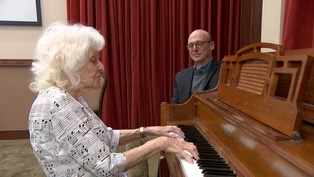
At 102, She Still Has the Chops
Video has Closed Captions
Clip: S2022 Ep2 | 5m 27s | Dorothy Olson Pauletti spent decades performing in Chicago. At 102, she’s still got it. (5m 27s)

Bob Fosse's Childhood Dance Partner
Video has Closed Captions
Clip: S2022 Ep2 | 4m 58s | As a kid, Bob Fosse danced in the Riff Brothers. Meet his partner, Charlie Grass. (4m 58s)

Chicago Guitar Virtuoso Takes on the Beatles
Video has Closed Captions
Clip: S2022 Ep2 | 4m 27s | Chicago guitar master Joel Paterson gives a unique spin to the Beatles. (4m 27s)

Video has Closed Captions
Clip: S2022 Ep2 | 5m 52s | Pianist Erwin Helfer wants you to know about the weeks spent in an inpatient psych unit. (5m 52s)
Providing Support for PBS.org
Learn Moreabout PBS online sponsorship













Support for PBS provided by:
Jay's Chicago is a local public television program presented by WTTW