State of Affairs with Steve Adubato
Soraia Mendes; Kim Guadagno; Christina Renna
Season 9 Episode 31 | 26m 55sVideo has Closed Captions
Soraia Mendes; Kim Guadagno; Christina Renna
Soraia Mendes, Principal of The Newark School of Architecture and Interior Design, discusses how vocational education is preparing students to fill workforce gaps. Kim Guadagno, Former Lt. Governor, talks about the challenges following a political campaign. Christina Renna, President & CEO of the Chamber of Commerce Southern NJ, explores the biggest challenges facing South Jersey
Problems playing video? | Closed Captioning Feedback
Problems playing video? | Closed Captioning Feedback
State of Affairs with Steve Adubato is a local public television program presented by NJ PBS
State of Affairs with Steve Adubato
Soraia Mendes; Kim Guadagno; Christina Renna
Season 9 Episode 31 | 26m 55sVideo has Closed Captions
Soraia Mendes, Principal of The Newark School of Architecture and Interior Design, discusses how vocational education is preparing students to fill workforce gaps. Kim Guadagno, Former Lt. Governor, talks about the challenges following a political campaign. Christina Renna, President & CEO of the Chamber of Commerce Southern NJ, explores the biggest challenges facing South Jersey
Problems playing video? | Closed Captioning Feedback
Where to Watch State of Affairs with Steve Adubato
State of Affairs with Steve Adubato is available to stream on pbs.org and the PBS app.
Providing Support for PBS.org
Learn Moreabout PBS online sponsorship- [Narrator] Funding for this edition of State of Affairs with Steve Adubato has been provided by South Jersey Industries.
The parent company of South Jersey Gas, and Elizabethtown gas.
The Turrell Fund, a foundation serving children.
PSEG Foundation.
Congress Hall.
A Cape Resorts property.
Rutgers University Newark.
New Jersey Sharing Network.
Englewood Health.
The New Jersey Economic Development Authority.
And by New Jersey Board of Public Utilities.
Providing New Jersey residents tools to save money on energy costs.
That’s what NJBPU does.
Promotional support provided by NJBIZ.
Providing business news for New Jersey for more than 30 years, online, in print, and in person.
And by BestofNJ.com.
All New Jersey in one place.
[INSPRATIONAL MUSIC] - Hi everyone, Steve Adubato.
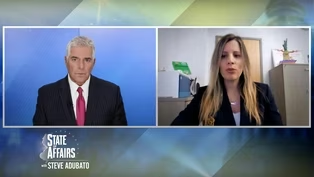
We kick off the program talking with Soraia Mendes, Principal of the Newark School of Architecture and Interior Design.
This is part of our series, "Newark Student Leaders of Tomorrow."
Soraia, great to have you with us.
- Thank you, Steve.
It's a pleasure to be here.
Thank you for the invite.
- You got it.
Tell everyone what the school is.
- Well, the Newark School of Architecture and Interior Design is a brand new school that opened up this September, and a school of opportunities for the students in Newark, where we offer students two programs of study, architecture and interior design, where we partner with Pratt Institute in New York and the Survey of Trades, where our students could learn a specific trade, such as electricity, HVAC, or plumbing.
And we are their partner with unions and companies in the community as well.
- Soraia, let me ask you this.
The students who go through the school, graduate from the school, talk about their prospects for employment, careers that they otherwise would not have had.
- So, like I mentioned before, this is a school of opportunity.
So we drive by or walk, we always see houses being built, renovated, buildings being built and renovated, and there is a big need for architects.
There's a big need for electricians, plumbers, HVAC experts.
And then we need people to sell these or rent these, so we need real estate agents, so this school meets those needs.
There's a big need in our community, and we are providing the students the opportunity to develop these skills and be the next generation of millionaires, 'cause that's what it's all about.
The trade is a future that can't be replaced by AI, and what we're offering our students here is very unique.
- Where is the school in its operation?
This is the first year of operation?
- That is correct.
So we opened up in September, and we have grade nine only.
And next year, we'll have grade nine and 10, so every year that goes by, we'll take another group of cohort of students grade.
- So I'm curious about this.
How do students, do they self-select and say, "I'm interested in architecture and design," at that age, at 13, 14, how would they know?
- So, they work with their counselors in the elementary, middle schools obviously.
And then we also, we teach students through the high school fairs what our school has to offer and the various opportunities and skills, even if they decide to pursue a different career, and different pathways.
These are skills that everyone will need, because at some point everyone will own or rent a house and these skills, you will need to apply them eventually in the future.
But Newark has, they applied through Newark Enrolls.
- Your background is fascinating.
Where'd you grow up?
- So I grew up in Portugal and in the US.
So I attended school here in Wilson Avenue in Newark, and then I moved back to Portugal, and I did high school there at the University college in Coimbra, and I taught there for a year.
My major is in English and German.
Taught there for a year, English and German in a high school, close to a town where I attended my college.
And then I came back to the US and began teaching here in Newark.
- You know, first of all, thank you to you and all of the other educators, particularly in our urban communities, who face a whole range of challenges.
Teaching is hard anywhere, just let's say urban communities for a variety of reasons, may be a bit more challenging.
That being said, why education for you, why?
- So, it's a passion.
You know, it's a passion that I've always had since I was little.
I remember growing up and asking my parents for Christmas that I wanted a blackboard with chalk, and I would just keep writing and teaching my little Barbies.
So it was a passion that I had since I was little.
And, you know, I was very fortunate that I had the opportunity to fulfill my dream and then, teaching students, connecting with students was a passion of mine.
But then, I started to want to also connect with the adults and coach them and share best practices that I've learned throughout the years through other great leaders.
So then, I got my master's in administration to begin to work with also adults and provide support.
- I'm curious about this.
This series is part of a series we've been doing in the cooperation with the superintendent in North Public schools, Roger Leon.
But he and I often have conversations about leadership, and you just mentioned that you were mentored by leaders.
The series is called "Newark Student Leaders of Tomorrow."
What do you see, Soraia, in these students, our potential leaders of tomorrow?
And with all the challenges they face, why are you still so optimistic about them and for them, please?
- I believe that every student is a genius, you know, and we educators need awaken that genius that is within them and make them realize that they have talents.
Not everyone has the same talents, but everyone has the talents that just lives within them, and that we, educators, need to help awaken that talent and that skill and make students realize that they are that genius, and they are leaders in our society.
So we should be coaching them and helping them, guide them, in their path towards that leader that one day they will become.
- Well said and we're happy and thrilled that you're doing what you're doing.
Soraia Mendez, Principal of the Newark School of Architecture and Design in its first year.
We'll follow the progress of the school as we move forward.
Thank you, Soraia.
I appreciate it.
- Thank you for the invite again.
- You got it.
We'll talk again in the future.
Stay with us, we'll be right back.
(grand music) - [Announcer] To see more State of Affairs with Steve Adubato programs, find us online and follow us on social media.
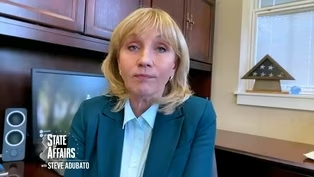
- We are honored to be joined by our good friend and former Lieutenant Governor of the great state of New Jersey, Kim Guadagno, who is also the President and CEO of Mercy Center.
Check out our sister series "Lessons in Leadership" and also on "One-on-One," Kim talked with Mary Gamba and I about Mercy Center and the important work they're doing.
But Kim, I wanna talk to you for a few minutes.
First of all, thank you for joining us as always.
- Of course.
Thanks for having me, you know that.
- We're taping this right before Thanksgiving.
There's a transition period going on, new governor taking over, Mikie Sherrill, on the 20th of January.
This will be seen somewhere along those lines, but also maybe after.
What is the hardest part about getting ready to be Governor or Lieutenant Governor?
Because you were involved in the transition with Governor Christie when he was elected and you were elected back in 2013?
- 2009 and 2013.
But who's counting?
- Go ahead, the first time around.
- So it was like drinking from a fire hose, you know, the first time around, nobody expects us to win, and the first time around I remind everybody, we didn't get 50% of the vote.
So, I mean, we were prepared.
The governor had somebody in mind to be the head of the transition team who had government experience.
So you didn't wanna go too far out over your skis, but you had to be prepared.
I mean, even when I ran for governor and lost, I still had somebody sitting over somewhere.
So you knew what you were gonna say the next morning in the event, in my case, the unlikely event that you would, and so she's, I think Mikie Sherrill, Governor-elect Sherrill is drinking from a fire hose, which is what she should be doing.
You know, at the end, they were very close together.
At least that's what the polls were sharing.
It was a shellacking as they say.
But right now, I would guess that she's getting her team together, talking to as many people as possible, and talking to them about who they should have on each of the respective transition teams.
So for example, I heard during the campaign, I heard her talk about the Business Action Center.
That's something that we started in the Secretary of State's office, which I was at the time.
Maybe she wants to beef that up.
So I'd be a big fan of making sure that happened and helping businesses out by streamlining government in some way or another.
But she's got a lot of problems coming out.
- Kim, that's where I wanna go.
So here's what I keep thinking about.
So those of us involved in public media, and the state owns the New Jersey public media license, if you will, someone's gonna operate it.
There'll be a new operator on July 1st, 2026.
For those of us involved in public media, it's the highest priority, except if you're the Governor, it's not the highest priority.
So my question is, how the heck do you prioritize while you're drinking out of a fire hose, as you said?
- Everything coming at you?
- Yeah, go ahead.
Go ahead.
- Because you made promises.
You made promises, you have to, you know, she said she was going to sign an executive order doing something about electric bills.
She has to do that.
It was a very clear promise- - Why does she have to do that?
- Because it was a very clear promise, and I think she's working very hard.
I would guess that she's working.
I don't have any direct contact with the Governor-elect, but I would guess that she's working very hard to make sure that happens.
And by the time this views, hopefully it has happened in some way.
She has affordability is a huge issue.
How is she gonna address the affordability issue?
How is she gonna address what's going on in Washington right now?
Those are three big things in my mind anyway, not necessarily in that order that she's gonna have to address head-on with a group of people that are... Look, she's got a lot of smart people around her.
- She does.
- She's got access to a lot of smart people.
And I believe she's the type of leader who will pull in those people and ask them for the sake of their state to do the right thing.
And people do, at this point, they do.
They want her to be successful.
- Is it fair to say, Kim, that the art of leading a campaign and the art of leading a government dramatically different?
- Oh, night and day, apples and oranges.
Not even, you are the absolute boss in a campaign.
Like what you say goes, you're the candidate, you're it.
- As Governor or Lieutenant Governor?
- You may be the first, you know, you may be the most powerful governor in this country, but you still have to deal with the legislature.
Christie still had to deal with the other party owning the legislature because it really is a give and take.
And that's where, even if you're a Democrat, then Democrats with a Democrat legislature, even with a super majority, you're still not gonna agree on everything as Governor-elect.
She's still gonna have to sit down and, you know, make some hard decisions, make some tough appointments, make some deals- - Compromises.
- Yeah, compromises is the word, I would say better than deals.
- Hold on, Kim, let me ask you this.
You were the first woman who was Lieutenant Governor.
You were the first Lieutenant Governor.
- First Lieutenant Governor.
- Okay.
She's the first Democrat, first woman Democrat, Christie women, the first woman who was a Republican Governor.
We've had two.
Do you believe Kim, on any meaningful level that leading as Governor for a woman in that role versus a man is in any way significantly different?
- Well I do, I do.
But you have to remember Mikie Sherrill's background, and after the election, you couldn't forget that she was a helicopter pilot.
That's not the point.
She graduated from the Naval Academy.
That's where she learned how to lead men and women, you know, didn't matter what their gender was.
That was... My son graduated from the Air Force Academy.
I saw what he was when he walked in and it couldn't have been that much different than what she was when she walked in versus what she was when she walked out.
And then she had a very successful career in the Navy where she was a leader of people.
Usually they say leader of men, but a leader of men and women.
And so this is nothing new to her.
The last problem I think the Governor-elect has is her ability to lead.
I think she has much bigger problems of just leading the state and the condition that it's in now.
- Kim Guadagano, who's heading up the Mercy Center as President and CEO, but also formerly Lieutenant Governor, the first Lieutenant Governor of the great state of New Jersey.
And her insight and perspective on what it takes to make this transition from campaign to governing is one thing, what the new Governor and her administration will be facing is another in prioritizing.
And Kim, I cannot thank you enough, as always, for providing perspective, thank you.
- Thanks Steve, Thanks.
- You got it.
Stay with us, we'll be right back.
(grand music) - [Announcer] To see more State of Affairs with Steve Adubato programs, find us online and follow us on social media.
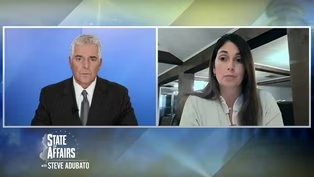
- We have her back, Christina Renna, who's President and CEO of the Chamber of Commerce, Southern New Jersey.
Christina, good to see you again.
- Well, always good to see you, Steve.
Thank you.
- You got it.
We're taping this right before Thanksgiving, 2025.
Wishing everyone a wonderful Thanksgiving.
Actually taping on Veterans Day.
Thank you to all of our vets for their service.
But let's talk new governor, new agenda, top two or three items as it particularly relates to the business community of South Jersey, please.
- You know, Governor-Elect Sherrill is going to be what we believe at the South Jersey Chamber to be a supportive one of business, economic development, job growth in the region.
She seems to really understand some of the challenges that face South Jersey as well as a lot of the interesting opportunities, which, at the end of the day, really equates to the fact that New Jersey is pretty built out.
So if you wanna grow as a business owner in New Jersey, you're gonna be doing it in South Jersey.
I think she recognizes that and is eager to work with us and members of the community and making sure that we can continue to grow business in the state.
- But to push that a little bit further into the weeds, transit an issue, housing an issue, affordable, accessible housing.
Connect the two, please, transit, housing, Christina.
- So what, and this is not a South Jersey issue, this is not a New Jersey issue, this is a national issue, and that is the housing crisis that we're seeing.
And in South Jersey, we have a real shortage of housing options, especially as it relates to workforce housing and affordable housing.
Of course, they're the two main issues that we are seeing.
So in South Jersey, we have a lot of open space.
As I said, we have a lot of buildable land, no homes nearby, no apartment complexes, nowhere affordable or really any entities at all to house residents that want to maybe move to where a new business decides to call it home.
So that's the housing issue, and then you put that in conjunction, as you correctly stated with our transportation infrastructure shortage here in South Jersey.
And I hate to be dramatic in saying this, but I do think it is an accurate statement when you say that South Jersey, the deeper you get in the footprint, the more of a transit desert it becomes, and that's something that our current president and CEO of New Jersey Transit, Kris Kolluri, completely understands.
But as you said, we have a new administration coming in.
- Sorry for interrupting.
- We need some new things.
- Christine, I'm sorry for interrupting.
There'll also be a new head.
Kris Kolluri is leaving.
There'll be a new head of New Jersey Transit.
So help us on this.
I'm sorry again for interrupting, Christina- - No, no, no, you're fine.
- There's a $5 million federal investment in transit.
I'm reading off of our prompter here.
But where are the feds?
What's the fed's role?
What's the state role vis-a-vis New Jersey Transit and the Department of Transportation?
Who's got what responsibility, Christina?
- So with the $5 million that you're specifically speaking to, that was a Governor Murphy federal gift essentially, and that comes from COVID money, so it is a one-time allocation.
New Jersey transit, and as well as the South Jersey Transportation Authority are going to have to oversee these micro-transit lines.
That's where they come into the picture.
But this is just a one-time $5 million infusion, gifted to us by Governor Murphy from federal COVID dollars.
The lines will be overseen by those two agencies.
- But the need is much greater than that $5 million or micro-transit initiative.
Help folks understand, for those of us up in the North.
I don't wanna over complicate things, but I've often thought about this, and we have some new partners in South Jersey, South Jersey industry.
You happen to know the CEO there, I think, right?
- I know a guy.
- Yeah, yeah.
Mike Renna, the CEO But also, we're partners with Stockton University now and Cape Resorts with Curtis Bashaw.
And I keep thinking to myself, it feels at times, Christina, like there are two states.
- Yep.
- And I don't wanna oversimplify it, but for those of us who live in North Jersey, South Jersey, to me, is almost like New Brunswick and Trenton.
But it's much further south and east and west.
Help folks get a picture of what the heck South Jersey is and what the people of South Jersey face.
- South Jersey is deceivingly geographically expansive and diverse.
If you were traveling from Burlington County down to Congress Hall in Cape May, that is almost a two-hour drive, because we don't have the highway structures that we need to get to and from point A to point B.
- You go across the state?
Is that across the state?
- That is, that would be, no, that would be north to south.
Burlington County to Cape May would be north to south.
And we have some highways, but then at some point, it becomes all back roads to Cape May, because we don't have highway infrastructure there to support us.
We certainly don't have light rail in any way, shape, or form.
We have one light rail line from 30th Street Station in Philadelphia to Atlantic City with a multitude of stops in between that are in no way, shape, or form, tourist destinations or places anywhere anyone would actually wanna travel to.
We have limited bus routes.
We do have buses, but they're not consistent, and they are sparse.
So the $5 million allocation in micro-transit is going to plug those bus gaps, but it's only for one year.
- Wow, let's shift gears- - Sure.
- from transportation to childcare, no natural segue.
And we've been involved in a public awareness initiative, "Start Strong NJ," the graphic will come up, focusing on affordable, accessible quality childcare.
- Yeah.
- We've been talking more and more about the connection between childcare and the economy, childcare and women disproportionately and some men, parents being able to work.
Help us understand your chamber's agenda vis-a-vis childcare and economic development, please.
- Oh, Steve, you hit the nail on the head.
I mean, you said all the things that are very real and livable.
Every day, working families, these are the challenges they face.
And it's even more so in South Jersey where we have a much lesser population than we do in the rest of the state.
You know, when you're an employer, there's a few things you need.
First of all, you need employees.
And these days, sometimes that's hard to come by.
But then once you have really quality employees, what do good employers wanna do?
They wanna make those employees happy.
Where does happiness start?
Knowing that their children are taken care of, right?
And so, supporting childcare initiatives in the workplace is something that we are passionate about, and it's something that we have been consistently supportive of.
But we also need to consistently continue that conversation and say, "Not every business's solutions to childcare, "problems that their employees are having, "are gonna be the same as the others."
And so, we need to be creative when we look at solutions in order to be, you know, basically dynamic for what our employees need and the industry in which those employees are serving.
- Yeah, and to Christina's point, let's stop considering and talking about childcare as daycare.
It's much more than that with a direct economic impact.
Last question before I let you go.
Number one energy issue in South Jersey.
I've heard some of the wind stuff, which apparently will be changing off the shore.
You know where I'm going.
Where the heck do we need to go?
Murphy Energy policy vis-a-vis wind?
Big bet on that, didn't turn out.
What do we need to do?
- We need diversification, right?
There is no easy answer.
So there is no solution that you're gonna come up with, Steve, I'm gonna come up with, any thought leaders or policymakers.
It's not an easy fix.
It's a supply and demand issue that everyone is facing.
What we need in Governor-Elect Sherrill, is a really strategic energy portfolio, a concept that really includes diversification.
So, one criticism of Governor Murphy would be that he put too many eggs in that wind energy basket.
Our chamber was supportive of wind energy.
We obviously love renewable energy.
What we would like to see, and what we think helps the businesses of South Jersey, is a dynamic energy plan where everything plays a role.
And the more diversity we have in energy, natural gas, RNG, nuclear, renewables and solar, renewables and wind, whatever it is, hydrogen, whatever it is, that is going to create diversity, so your consumers have their selection, always good, and all that diversity is gonna help bring prices down.
And so, we are hopeful that Governor-Elect Sherrill has seen some of the issues that the Murphy administration faced as it relates to his energy policies, and adapts.
And, you know, she campaigned a lot on energy, so we're all in wait-and-see mode at this point right before Thanksgiving.
And I think 2026 is gonna be a big telltale sign of where this is headed.
- Again, we're taping right before Thanksgiving.
It'll be seen after, and we'll also have an in-depth interview with the governor, Governor Sherrill on these issues.
Christina, wish you and the team at the chamber all the best, thanks so much.
- I appreciate you Steve.
Thank you.
- We appreciate you.
I'm Steve Adubato.
That's Christina Renna.
We'll see you next time.
- [Narrator] State of Affairs with Steve Adubato is a production of the Caucus Educational Corporation.
Funding has been provided by South Jersey Industries.
The Turrell Fund, a foundation serving children.
PSEG Foundation.
Congress Hall.
Rutgers University Newark.
New Jersey Sharing Network.
Englewood Health.
The New Jersey Economic Development Authority.
And by New Jersey Board of Public Utilities.
Promotional support provided by NJBIZ.
And by BestofNJ.com.
- How long you been waiting?
- About a half hour.
- Brutal.
This keeps up, I'm gonna miss my pickleball game.
- I've been waiting eight years for a kidney.
What can you do?
(gentle music) - [Narrator] Over 100,000 people in the US are waiting for a life-saving transplant.
But you can do your part in an instant.
Register as an organ donor today at NJSN.org.
The biggest obstacles facing the South Jersey community
Video has Closed Captions
Clip: S9 Ep31 | 11m 31s | Analyzing the biggest obstacles facing the South Jersey community (11m 31s)
How vocational education is preparing students to fill gaps
Video has Closed Captions
Clip: S9 Ep31 | 7m 41s | How vocational education is preparing students to fill gaps (7m 41s)
Kim Guadagno talks about going from politics to leadership
Video has Closed Captions
Clip: S9 Ep31 | 8m 20s | Kim Guadagno talks about going from politics to leadership (8m 20s)
Providing Support for PBS.org
Learn Moreabout PBS online sponsorship New Episode
- News and Public Affairs

Top journalists deliver compelling original analysis of the hour's headlines.
 New Episode
- News and Public Affairs

Today's top journalists discuss Washington's current political events and public affairs.
 New Episode
 New Episode
 New Episode
 New Episode
 New Episode
 New Episode
 New Episode
 New Episode
 New Episode
Support for PBS provided by:
State of Affairs with Steve Adubato is a local public television program presented by NJ PBS