Signature Dish
Southern Comforts
Season 1 Episode 7 | 27m 29sVideo has Closed Captions
Duck jambalaya; smoky brisket and bone marrow mac & cheese; BBQ spare ribs
Seth visits the South on the flavor train, enjoying wood-smoked barbeque, Louisiana spices and culinary innovation applied to classic meals. He tastes duck jambalaya at Dauphine’s in downtown D.C., smoky brisket and bone marrow mac & cheese at Pennyroyal Station in Mt. Rainier, MD and BBQ spare ribs at Ruthie’s All Day in Arlington, VA.
Problems playing video? | Closed Captioning Feedback
Problems playing video? | Closed Captioning Feedback
Signature Dish is a local public television program presented by WETA
Signature Dish
Southern Comforts
Season 1 Episode 7 | 27m 29sVideo has Closed Captions
Seth visits the South on the flavor train, enjoying wood-smoked barbeque, Louisiana spices and culinary innovation applied to classic meals. He tastes duck jambalaya at Dauphine’s in downtown D.C., smoky brisket and bone marrow mac & cheese at Pennyroyal Station in Mt. Rainier, MD and BBQ spare ribs at Ruthie’s All Day in Arlington, VA.
Problems playing video? | Closed Captioning Feedback
How to Watch Signature Dish
Signature Dish is available to stream on pbs.org and the free PBS App, available on iPhone, Apple TV, Android TV, Android smartphones, Amazon Fire TV, Amazon Fire Tablet, Roku, Samsung Smart TV, and Vizio.
Providing Support for PBS.org
Learn Moreabout PBS online sponsorshipANNOUNCER: And now, Signature Dish, a WETA original series.
SETH: Today, on Signature Dish, we're headed down south.
KRISTEN: Dig in.
SETH: After sinking our teeth into some hearty Carolina style barbecue.
You're not skimping on the seasoning, here.
MATT: No, no, no, no, no.
Flavor, baby.
SETH: We'll meet a chef who is bringing a taste of the Big Easy to DC.
KRISTEN: And the big thing about jambalaya, is you never take the lid off.
SETH: What happens if you take the lid off?
KRISTEN: You ruin the entire dish.
(laughing) SETH: And enjoy a new spin on a down home classic.
And there are so many good flavors, I almost forgot the cheese was coming.
JESSE: Oh, you can't have mac and cheese without the cheese, right?
SETH: Hmm, that's just dynamite.
JESSE: It's like, waiting to know that.
ERIN: And you're waiting for that, right?
SETH: I'm Seth Tillman, WETA producer and DC native, and I love good food.
That's why I'm traveling to restaurants across the DMV.
At each stop, looking for the one thing you just gotta try.
That Signature Dish.
My Southern food sojourn begins in Arlington, Virginia.
Just off Glebe Road, in the Arlington Heights neighborhood, is Ruthie's All-Day, where Chef Matt Hill is all in on Southern hospitality.
MATT: I'm originally from North Carolina, kind of an agricultural family.
Everything that came to the table was, was being grown by us, or raised by us, uh, from the time I was very young.
My grandma Ruthie, the matriarch of the family on my father's side, she always prepared all the foods that we were eating on the table on Sunday, with such love.
Me and my brother would, uh, would race into the house to try to, to try to get the, the cracklings or the fat back.
And you know, try to get the first taste of her food every, every weekend.
And so, that's kinda what we wanted to and aspire to, to be at Ruthie's every week.
SETH: While Ruthie's serves up breakfast, lunch and dinner, seven days a week, their barbecue has become the star of the show.
MATT: We've got several different smokers here, at the restaurant.
We've got a JR, a 700 Oyler, where we can cook about 1000 pounds of meat at one time.
And it's all 100% wood burning.
Same thing out, with an offset that we have, from permanent pits outside.
We do a lot of the shorter cooks on that, ribs, chicken, things like that.
Wood fire cooking has a lot of nuance to it.
Every piece of wood is different.
You really have to feel when you're cooking.
It's really the only way to get these beautiful flavors, you know.
Nice bath of smoke throughout the night.
You can't get it any other way.
SETH: In Matt's home, in the Carolinas, they love all things pork.
And that's why I'm meeting up with him to try his signature dish, barbecued spareribs.
Chef.
MATT: Hey, Seth!
SETH: Good to see you.
MATT: How are you?
SETH: I'm doing pretty well.
MATT: It's, uh... SETH: And, uh, wow, that is a sizable rack of ribs, right there.
What are, uh, what are we looking at?
MATT: So, we've got actually two variations of ribs here.
So, you've got your spareribs, which are down here, with all that belly meat, with a ton of like, you know, nice fat, marbling.
And then, you've got back here, in the loin meat, you've got the, uh, the, the baby backs.
SETH: All right.
MATT: So, these guys here, they're a little bit more lean.
The, it, uh, if you think about it, like a pork chop versus pork belly.
SETH: Yeah, yeah.
MATT: What's gonna have the most moisture.
SETH: It probably explains why some of the ribs I've had over the years, may be a little more dried out.
MATT: Absolutely.
They're quicker to cook.
Um, these guys here, take a little bit longer, the spares.
But I think the, the end result is what's really gonna pay off.
First, I'll trim it up here.
My grandfather said, "We use everything on the pig, but the oink."
Okay.
So, all the trimmings, they go into stocks, broths... SETH: Yeah.
MATT: Beans.
So, we've got, right here, we've got these chine and this cartilage here.
All right.
That's what you call a rib tip.
SETH: You want a nice aerodynamic shape for the smoker too, right?
MATT: Yeah, you want aerodynamic, you know.
You don't want these little thin bits 'cause they're gonna burn up real quick, right?
The way we season it here, which is kind of what makes our signature dish, we use a little bit of Chinese five spice.
We're always layering flavors... SETH: Got it.
MATT: So we don't get the palate fatigue.
'Cause a lot of times, you're just using salt, pepper, paprika.
So, we like to vary each cut with a little bit different flavor and kinda, you know, push you around with the flavors.
SETH: All right.
MATT: All right.
SETH: Feel free to push me around.
I like... (laughing).
SETH: And so, what is the, what is the five spice you add to the... MATT: So, five spice, okay, that's got Szechuan peppercorn, ginger, white pepper, a little bit of cinnamon.
You could smell the aromatics coming off of, right there.
SETH: Oh, yeah, all right.
For sure.
MATT: All right.
And then, we'll season it with just, you know, this is what we call TCB, we're taking care of business.
All right, this is the house blend of, uh, salt, pepper, garlic, you know, a nice dry rub.
SETH: You're not skimping on the seasoning here.
MATT: No, no, no, no, no.
Flavor, baby.
All right, now, that we've got them all seasoned up, I've got a few out in the smoker.
We've had it going for a couple hours.
Let's go take a look.
SETH: Sounds great, let's check it out.
MATT: All right.
SETH: Of course, we do this on a day when it's over 90 degrees, right, Chef?
MATT: Yes, Seth.
Well, you know, beautiful day like this, (laughs) summer's all about barbecuing and with the family.
Let's see what we got going on.
SETH: Oh, wow.
MATT: So... SETH: Look at that beautiful crust, right there.
MATT: Yes.
It's nice bark.
Some of the, uh, the ribs are starting to get exposed here.
So we're, uh, we, we wanna touch them for feel.
We kinda see if they're, uh, if they're jiggling, how they bend.
And we're gonna add the, uh, the glaze to them too.
And that's really gonna, you know, kick it up.
So, some of the flavors we've got in this glaze here, we're using, uh, gochujang.
My wife's Korean, so, we like to use, you know, some of her side of the family's recipes, as well, and some of her influence.
We've got some dried and smoked chilis.
It's also got a little, uh, caramelized brown sugar in it.
Ginger, shallots.
So, lots, lots of different flavors going on.
We'll just glaze them up then.
SETH: If you put this glaze, on right, right at the get-go, after a few hours in the smoker, this thing would just be burnt to a crisp, right?
MATT: Yeah, we've got sugars in there and, and, it, it would just completely, just over caramelize.
So, we wanna do that when it's almost ready to come out of the smoker.
But you do wanna have it set in that smoker a little bit, kinda tighten up the glaze and get real sticky and delicious.
SETH: Sticky sounds good.
So, what are the last steps here?
MATT: Well, I'm gonna put them back on the smoker.
Let that glaze kinda set and finish cooking and then, wrap them up.
SETH: Sounds great.
Can't wait to try it with you, back at the table.
MATT: Excellent.
Looking forward to it.
SETH: Thanks, Chef.
MATT: Thanks, Seth.
What do I love most about Southern cooking?
I love just the feeling of warmth you get when you eat it.
And you know, it reminds me of my childhood.
I wanna bring that to everybody, and how good I felt when I was eating that food when I was young.
And I think it was something people really craved.
A little homespun hospitality, warmth.
And I think that the hospitality that we try to engage here, is, is shown in the food, and then with the staff, and everything about Ruthie's.
SETH: Chef, this spread, this looks so good.
These spareribs look so hearty and delicious.
I'm just gonna dig in.
MATT: Do it, do it, man.
Let's eat.
SETH: All right.
I don't know how I'm gonna eat this without making a mess.
So, I'm just gonna go for it, so.
MATT: It's barbecue.
SETH: It's barbecue.
MATT: You gotta be a little messy.
SETH: Oh, my gosh, Chef.
That's just awesome.
Even picking up some of those spices that you put on, it's not just salt and pepper.
MATT: Yeah, we wanna make every bite unique, you know.
So, everything that you're gonna get, when you come in, every dish is gonna be something different.
SETH: Mm-hmm.
MATT: And, you know, hopefully delicious.
SETH: And I like it's, um, it's a good hearty bite to it, too.
MATT: Oh, yeah, yeah, yeah.
Not falling off the bone.
A common misconception is the meat should be falling off the bone.
You want them to be tender and, and moist and delicious, but not where at the pulling off the bone and everything's coming off.
SETH: You wanna see where you sunk your teeth into.
MATT: Absolutely.
SETH: I gotta go for another one.
Hmm, wow.
That's amazing.
And all these sides too, is it... MATT: It's, it's part of the meat and three concept.
You get to come in, you, you pick your protein and then, pick whatever sides.
We got fresh vegetables, salads, leafy greens.
SETH: And that's kind of a Southern thing, the meat and three.
MATT: Absolutely.
It dates back to when people went from the farms, to the mills.
They still needed a home cooked meal for lunch and dinner.
And they went into these places, the cafeteria style restaurants, where you could get, you know, great home cooked meals with, you know, ribs and, um, mac and cheese and collard greens.
And we take some interesting takes on it.
The pinto beans have pork shoulder, uh, chili powder, cumin.
The, the collard greens, we do with smoked tomatoes and soy sauce.
They're actually vegan.
Most collard greens have everything but the kitchen sink.
SETH: A little pork and then, yeah, yeah.
And I do have to try one of these sides, here.
MATT: Oh, yeah, for sure.
SETH: I'm gonna go for the, go for this mac and cheese.
MATT: You gotta, you got to.
SETH: All right.
MATT: Ruthie wouldn't have it, any other way.
It's, uh, sort of a casserole style mac and cheese.
So, a little bit different, delicious, all the same.
SETH: Now, that is great.
And Chef, you've got this, uh, this big old restaurant, you know, huge menu, you're open, you know, all day long.
Do people sort of consider you a barbecue joint, a restaurant?
MATT: What we try to strive for is be a really hospitable place to go, you know.
Breakfast, lunch and dinner, you can come in.
I mean, you might not want ribs every day, but you can get them once a week.
(laughing) SETH: I can eat these in more than once a week, yeah.
MATT: There you go.
SETH: You know, that is great.
The sides, I feel like I'm in a pretty upscale cafeteria, right here.
(laughing) Thank you so much for taking me out to the smoker, on a hot day.
MATT: Yeah, you bet.
SETH: I'm glad we can cool down and get some cold beer to wash it all down.
MATT: Good day for barbecue, Seth.
SETH: Sure was.
Hey, cheers.
Appreciate it.
MATT: Salud.
♪ ♪ SETH: I'm next off to downtown DC.
On the ground floor of the ultra-modern Midtown Center building, is Dauphine's, where Chef Kristen Essig is serving up Crescent City inspired cuisine.
KRISTEN: I'm originally from Florida, but I moved to New Orleans in 1999.
I was very fortunate to meet Chef Emeril Lagasse, when I was in culinary school.
And he invited me to join the team at Emeril's, which is his flagship restaurant on Tchoupitoulas Street.
I did not know how to pronounce Tchoupitoulas... (laughs) When I got to New Orleans.
I spent my first year with Chef Emeril.
And then, moved on to work with a chef named Anne Kearney, who was my chef and mentor at a restaurant called Peristyle.
I think one of the things that's so special about New Orleans and Louisiana, is that the food is very personal.
It is very much a part of who your family is.
And, and what you're growing, and how you're contributing to the table.
The cultures that really influence New Orleans cuisine are vast, right.
So, we have Africa.
We have the Caribbean.
We have Central and South America.
We have France and Spain.
We have Cajuns that are originally from, you know, up north in Canada.
I think the thing that's really important to know about New Orleans cuisine is that, it is cuisine that takes place in New Orleans.
I'm a very local focused person.
So, as an example, I didn't cook scallops and lobster in Louisiana.
We didn't have them coming out of the Gulf of Mexico.
We are sharing our vision of what Dauphine's can be, through the lens of Mid-Atlantic product, but using some inspiration from the city of New Orleans.
SETH: Chef.
KRISTEN: Hi, welcome.
SETH: Nice to meet you.
Thank you.
And oh, I see some beautiful ingredients here, and, uh, a big ole bowl of rice.
What are we gonna be preparing today?
KRISTEN: So, we're preparing our duck jambalaya, which is our signature dish.
And we're basing it really, off of this rice.
The rice is really, really special.
It comes out of Youngsville, Louisiana.
It's a farm called Prairie Ronde.
They do a great job of making sure that this beautiful heritage grain makes it way, all the way up here, to DC.
SETH: And what kind of makes it a different rice than what I'd be able to, you know, pick up over at the grocery store?
KRISTEN: Well, there's, there's a sense of place, right.
I mean, I also just like the way that it feels.
But the thing about this rice, is that it's really aromatic in a soft and subtle way.
It's got just the right amount of starch on the outside of it.
It's a beautiful rice.
SETH: So, it's gonna hold up against all these other ingredients here, as well.
KRISTEN: It will, but it also won't overpower the dish.
This all marries together.
SETH: So Chef, besides the rice here, what are some of the other ingredients that are gonna flavor this dish?
KRISTEN: The jambalaya that we do here at Dauphine's is based on trinity, which most jambalayas are, but we do deeply caramelize our onions.
Other than the trinity, we have our braised duck meat.
And so, if you wanna follow me over to the stove, we can sort of, get started.
SETH: All right, sounds good to me.
Here, you go.
KRISTEN: Oh, thank you.
SETH: And Chef, I like the, uh, I like the the crawfish on top of the pot there.
KRISTEN: It's totally not a lobster, it's really a crawfish.
(laughing) SETH: I knew that.
It's New Orleans.
So, and this is where you're gonna be serving the dish in.
KRISTEN: It is.
It's a tiny Dutch oven.
So, the way we're gonna get started is we'll remove the lid.
We'll add some rendered duck fat that comes from the duck skin.
About two to three tablespoons.
Then, we're gonna do about a cup of rice.
SETH: All right.
KRISTEN: Standard ratio here, is about one to one and a half in liquid.
SETH: Nice.
KRISTEN: So, we'll add our rice.
We're gonna add salt, pepper, some of our house made Creole.
And then, this is our Worcestershire powder.
So, one thing that's really important is that we wanna try to keep all of the rice in the bottom of the pan, and not stuck on the sides.
SETH: All right.
KRISTEN: So, they don't get over cooked or crunchy.
There's nothing worse than crunchy jambalaya.
SETH: And sautéing it, it will get coated with all that nice duck fat.
KRISTEN: Mm-hmm.
It'll make sure that when we go to separate and fluff the rice that, that fat coats each grain.
SETH: Awesome.
KRISTEN: So, it doesn't get wet or soggy.
So, you wanna cook this just it gets a little bit more fragrant.
We're gonna add a lot of vegetables to this.
So, this is our trinity mix.
Next, we're gonna grab our roasted garlic puree.
We're also gonna go ahead and add our braised duck meat.
SETH: You already got a lot of duck going into this dish.
KRISTEN: Lots of duck.
(laughing) All right.
And then, what we're gonna do next is add our green onion and our parsley.
I'm a big fan of parsley.
We're gonna add a little bit of stock.
SETH: Let me guess, we get a little bit of, uh, duck in this, as well.
KRISTEN: There may be a little duck in here, yeah.
It's an all duck stock.
It does have a little bit of red wine and tomato, just to help deepen the color.
SETH: So much darker than like, a chicken stock.
KRISTEN: Mm-hmm.
SETH: Yeah.
KRISTEN: All right.
So, the big thing here, now, is that what I'm gonna do, is I'm gonna grab one of these spoons and I'm just gonna taste the broth.
'Cause you really wanna make sure that you're not under seasoning.
I think it actually needs a little bit more Creole.
We're gonna add this sachet, right before we put on the lid.
It has a little bit of fresh bay leaf and thyme.
SETH: Oh, so you got some nice aromatics going in, as well.
KRISTEN: Yes.
And then, we're gonna put our lid on.
Pull it back to simmer.
We're gonna let it cook.
And the big thing about jambalaya is you never take the lid off.
You have to trust the process.
SETH: What happens if you take the lid off?
KRISTEN: You ruin the entire dish.
SETH: We definitely don't want that.
KRISTEN: So, while this is cooking down, we're gonna pull together the rest of the components of the dish.
So, that's gonna include grilling off our duck and jalapeño sausage.
The cabbage is a mix of house fermented sauerkraut.
We pull it together with just a little bit of duck stock and some butter.
For our duck breast, we're going to pull them from the refrigerator and then, we'll hang them in the combi oven to bake.
So, after they've roasted, we're gonna let them rest just a little bit.
And then, each duck breast will be split in half and divided amongst the plates.
We'll garnish our finished rice.
And we'll take it all out to the table and enjoy it there.
Thank you so much for coming to Dauphine's.
I hope you're excited to try it.
SETH: Well, I mean, just the aroma coming off this plate, the duck looks incredible.
KRISTEN: Thank you.
It's almost done.
So, there's a step that we do in the kitchen normally, but I wanted to share this last little bit with you.
So, this is, um, some of Charles Poirier's cane syrup.
And this is how we actually finish the duck.
So, what I want you to do is take one of these little spoons, and you're just gonna put a little cane syrup on there.
SETH: And what's this gonna add to the dish?
KRISTEN: And this is just gonna add a little bit of sweetness, a little bit of depth and nuance.
And then, you wanna eat the cane syrup off your spoon.
It's the best part.
SETH: Hmm.
KRISTEN: It's so delicious.
It's like nothing else in the world.
SETH: Just the smokiness of it, um... KRISTEN: Mm-hmm, yeah.
SETH: That's gonna be pretty good.
KRISTEN: It's beautiful.
SETH: All right.
And this is where all the magic's happened, right?
KRISTEN: This is where mo- I mean, there's a little magic everywhere, but this is where most of the magic is.
And we're just gonna give it a stir, so we wanna make sure that we work that duck liver mousse that we topped it off with, and get those duck skin cracklings in there.
SETH: Oh, wow.
That's great.
KRISTEN: And then really, I'm just gonna put a little bit on your plate.
There may be some leftovers.
(laughing) SETH: I know some people who are gonna enjoy those.
KRISTEN: Good.
Dig in.
SETH: Mmm.
KRISTEN: Hmm.
SETH: That is delicious.
KRISTEN: It's not bad, huh?
SETH: That is just delicious.
And you know, I mean, I think the few times I've had, you know, jambalaya even in New Orleans, much more like tomato-ey, maybe a little sweet.
KRISTEN: Mm-hmm.
SETH: That has got that nice savory flavor.
KRISTEN: It is very savory.
SETH: And the, the, the richness of the duck, as well.
KRISTEN: And then, once you sort of pull the, the sauerkraut and the roasted cabbage in, as well.
So, it's again, it's just about marrying all these flavors.
Gotta try that duck though, 'cause that's like the best part with that cane syrup on top.
This is aged for about two weeks.
SETH: Wow.
I gotta say, I mean, I've had duck, but I'm not sure I've had two week aged duck before.
KRISTEN: It's beautiful.
I mean, it does still have a little bit of that gaminess that I think that duck is known for.
But it sort of balances it out, just a little bit.
It gives it a little more roundness.
SETH: All right.
I gotta try a little bit of this sausage as well... KRISTEN: Yes.
SETH: Since, you know, there's, I know there's a little duck in everything.
And duck... KRISTEN: There's, uh, there's, uh, there's a lot of duck in that sausage.
And there's also, a little bit of jalapeños.
So, it'll give you a little bit of kick.
SETH: Hmm, wow.
And that's really wonderful that the whole animal is being used.
I mean, nothing's going to waste.
KRISTEN: Not a single thing, not a single thing.
And we actually render more duck fat than we can use.
So, we cook lots of other things in it, as well.
SETH: Well, everything is better when cooked in a little duck fat.
KRISTEN: Yes, it is.
SETH: And Chef, you know, just to someone who's, you know, I've been to New Orleans a few times in my life, and always loved the food there, I'm glad that you have brought a little taste of New Orleans here, into DC.
KRISTEN: Well, I mean that's exactly what we're trying to accomplish, you know.
We're trying to really inspire people to go and see the real thing.
This is, uh, the Mid-Atlantic version and we're exceptionally proud of what we do.
But really, you can never beat a trip to New Orleans.
SETH: I normally wouldn't wanna end on a note, of encouraging people to leave DC.
This is a DC food show.
But in this case, I'm sold.
KRISTEN: Go.
SETH: This is delicious.
And that I cannot wait to come back and definitely bring, maybe even more than two people to share it with 'cause this is a lot... KRISTEN: I mean, it definitely can be split between a few.
SETH: Of good food.
KRISTEN: Thank you.
SETH: Thank you, Chef.
Cheers.
KRISTEN: Let me know about your trip.
♪ ♪ SETH: My last stop takes me to Mount Rainier.
Just over the DC line in a historic building, you'll find Pennyroyal Station.
A modern Southern restaurant started by Chef Jesse Miller, and a pair of restaurant industry veterans.
JESSE: I'm originally from Baltimore.
I went to college to study art.
And in order to pay for college, I worked in kitchens.
By the time, I graduated, I kinda fell in love and had a passion for that life.
But it is still an art.
It starts with your own idea, your own passion, your own creation.
And then, eventually it's for someone else to enjoy, and hopefully, they do.
SETH: Jesse's artistic talents are on display, both on the plate and on the walls of Pennyroyal, which feature two of his large scale paintings.
The artistry is right at home in Mount Rainier, part of Prince George's County's Gateway Arts District.
ERIN: Coming from DC, I started looking at Mount Rainier for a place to call home, just because it was so unique.
So, the artists are, uh, they're all over.
GARRICK: Mm-hmm.
ERIN: There's music.
GARRICK: Lots of music.
ERIN: There was just a lot of energy, vibrant energy, here.
GARRICK: It's a great, great community over here.
We're right on the DC line.
So, you know, you get the big city feel, but you also get like, people who are invested in the community.
Our background, we love people, we love to entertain.
We want you to have a good time and, you know, enjoy yourself.
JESSE: The focus is Southern inspired comfort food.
I really think people are drawn to comfort food because the title kinda says it.
It makes you feel good.
It, it makes you feel good 'cause it brings you back to your childhood.
ERIN: Comfort and Southern go hand in hand.
There's a connection with Southern comfort food... GARRICK: Mm-hmm.
ERIN: And people.
There's, there's a story behind it.
There's like, their grandmother used to cook this.
JESSE: What's happening with Southern food, right now, and really all over the country is, it's pretty exciting.
They're not keeping themselves trapped to a box.
It's like, how can we elevate that food?
I just was recently in Louisiana.
There's a heavy Vietnamese culture down there, like, they're using a lot of Vietnamese ingredients.
And then, why wouldn't you?
If they work well and it all pairs well, like, you should be using it.
So, it's a little different.
It's, it's more fun.
SETH: Chef, nice to meet you.
JESSE: Nice to meet you, as well.
SETH: Thank you so much for having me at Pennyroyal.
And what is it that you're making?
JESSE: So, today, we're making our signature dish, our smoked brisket and bone marrow mac and cheese.
SETH: Oh, that sounds mighty good.
You know, I make a lot of mac and cheese for my kids, straight out of the box.
I'm guessing, this might just be a little bit of a cut above.
JESSE: Just a little bit above, but you know, not, not hating on the box mac and cheese though, though.
SETH: That's delicious too.
So, how do you, how do you begin here?
JESSE: So, before you got here, today, we've popped in our bone marrow at a nice high temp, about 450 for about a half an hour.
I'll just grab the bones.
All right.
So, here you go.
You can see all the fat starting to pull out from them.
All right, so first, we're gonna take our bones and scrape out the marrow.
A little hot, but I'm kinda used to it, by now.
Uh, we'll just take it.
SETH: Oh, that stuff comes right out.
JESSE: Yeah.
It's working.
And we're just gonna scrape that clean.
You get every bit, for now.
Oh, we could see too, we've already got a good amount of fat sitting at the bottom of the pan.
SETH: And this isn't just, um, about the fat too.
I mean, that bone marrow is gonna give it a real, just kinda richness that you wouldn't get from any other flavor.
JESSE: Exactly.
Because it's from the bone, you get some extra like, darker, deeper flavor.
There we go.
We're just gonna take this guy.
Get it in here.
So, this is gonna become the base of our roux.
And we will add a bit of butter in, as well, uh, just because why not.
We are, you know, making Southern food here, right.
SETH: If we're making it rich, why not add a little more butter.
JESSE: Yeah.
It never hurts.
SETH: So, for this roux, I mean, this isn't a gumbo.
You're not looking for something, you know, super dark here.
JESSE: No.
You could, but this is really not necessary for this.
So we're just gonna get this melted, we're gonna grab our flour.
And this is always like, you're kinda eyeballing it, because every bone's different, right.
SETH: You're looking for probably a one to one ratio there.
JESSE: Just, just about, yeah.
See now, we've got that nice and bubbly.
We're just adding our milk and cream into the roux.
SETH: We've got the marrow, we've got the butter.
Why not add some cream to it?
JESSE: Why not, oh, I know, right.
Okay.
So, while this is going, we're gonna add a couple of our spices.
So, we have some ancho chili powder, put a dash in there.
This is more of a chili mac, so this is why we're adding the ancho chili powder.
That, and you start to feel thick enough from the roux.
Add a little garlic powder in.
So now, we're at the point, where we wanna add our brisket in.
SETH: And this is brisket that you guys are smoking here, at Pennyroyal.
JESSE: Yes, we smoke it in-house for about six hours.
SETH: Wow.
Already so much flavor in this.
And you have to keep stirring too, right.
I mean, if you stop, this thing's gonna start to burn in the bottom.
JESSE: Yeah, yeah.
That bottom will scorch really quick, so we're gonna make sure we keep working it.
All right.
So now, we're gonna add our mac.
Let this warm first, into the sauce.
Oh, yeah.
There we go.
(laughs) SETH: That is just thick, that is creamy.
JESSE: Now, everyone's favorite part, of course, the white cheddar.
SETH: There are so many good flavors in here, I kind of forgot that the cheese was coming too.
JESSE: Well, you can't have mac and cheese without the cheese, right?
SETH: That is definitely true.
Those noodles are just getting buried in those flavors in there.
I love it.
JESSE: Oh, yeah.
Let that heat up a little bit.
And we're ready to roll.
While this finishes heating through, we're gonna start our plating process.
We're gonna put a little bit of mac down to hold our bone marrow bone.
Then, we're gonna put some mac on top of that.
Once we've plate the mac, we're gonna add a little of our house made garlic and chili oil, some fried shallots, parsley, and then we're ready to enjoy it.
SETH: Thank you guys, so much for welcoming me to Pennyroyal today.
This mac and cheese looks like none I've ever had before.
I cannot wait to try it.
That's just dynamite, Jesse.
JESSE: That's, all right.
Good.
ERIN: And we're waiting for that, right?
JESSE: Just like, waiting to, I was like... (laughing) SETH: That is so good.
That marrow really does add such a richness to it, too.
JESSE: I know.
SETH: It gives it a nice deep flavor.
Like I said, it's almost like you didn't need the cheese, but it certainly worked.
JESSE: It tightens it all up, yeah.
SETH: And even those little, um, crunchy bits that you put on top with the, with the shallots and the chili oil, two things I might not associate with, uh, a good old mac and cheese, but it really works.
JESSE: Yeah.
The, the shallots add a little texture and the chili oil, you know, traditionally, a more Asian ingredient, but it really brings it together.
We don't wanna trap ourselves to just inside the box.
Like, in Southern food, it's really started to make that turn.
If it works, it works.
Don't be scared of it.
SETH: And the presentation too.
I love the marrow bone in here.
And this plate, this table, the salad, this whole space, everything just feels so artistically, you know, put together.
ERIN: I think that goes back to also, reflects Jesse's personality.
And to also, the assets he has with, with him being an artist.
Everything kinda comes together, obviously on the plate.
And when you walk through kind of the streets of Mount Rainier, these are all old buildings.
And it's taking that old with the new, and you just set it up for like, a beautiful, vibrant space that works perfectly together.
GARRICK: Yeah.
This is definitely an area, Mount Rainier, that we really want to come in, and you know, it's all about community here.
You know, and we just know that they were kinda missing that connection like, a gathering spot.
SETH: I mean, if you're gonna build a gathering spot, you know, what better way than just nice, hearty, comfort food like this.
JESSE: Yeah.
I mean, Southern style comfort food, that really brings people together, right.
GARRICK: Jesse is definitely the man, you know.
He takes our staples and put a little twist on it.
And who doesn't love a twist, right?
SETH: Well, I love a twist.
And, uh, this has ruined me for box mac and cheese.
Chef, appreciate it.
JESSE: Still nothing wrong with box mac and cheese still.
SETH: Yeah, but it ain't this.
Thank you guys, so much.
Appreciate it.
GARRICK: Thank you for coming here.
JESSE: Thank you for being here.
♪ ♪ ♪ ♪ ANNOUNCER: To find out more about great food in the Washington Metro Area, visit weta.org/signaturedish.
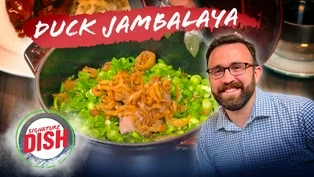
Here's Why Dauphine’s Duck Jambalaya Is So Amazing
Video has Closed Captions
Clip: S1 Ep7 | 7m 13s | Dauphine's Chef Kristin Essig shares her New Orleans-inspired Duck Jambalaya. (7m 13s)
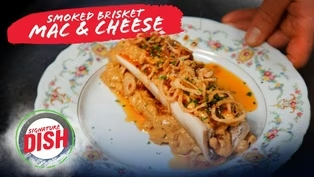
Pennyroyal Station's Mac and Cheese Has a Delicious Twist
Video has Closed Captions
Clip: S1 Ep7 | 6m | Seth heads to Pennyroyal Station for a unique take on a Southern-style mac and cheese. (6m)
Preview: S1 Ep7 | 30s | Duck jambalaya; smoky brisket and bone marrow mac & cheese; BBQ spare ribs (30s)
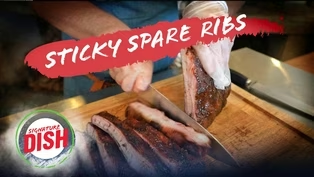
The Secret Sauce to Sticky Spare Ribs at Ruthie's All Day
Video has Closed Captions
Clip: S1 Ep7 | 6m 32s | Seth visits Ruthie's All Day to learn the secrets behind their Sticky Spare Ribs. (6m 32s)
Providing Support for PBS.org
Learn Moreabout PBS online sponsorship

- Food
Christopher Kimball’s Milk Street Television
Transform home cooking with the editors of Christopher Kimball’s Milk Street Magazine.









Support for PBS provided by:
Signature Dish is a local public television program presented by WETA