Here and Now
Speaker Robin Vos on a 2026 Agenda for Wisconsin Republicans
Clip: Season 2400 Episode 2426 | 8m 16sVideo has Closed Captions
Robin Vos on what policies the Republican caucus is prioritizing going into 2026.
Speaker Robin Vos, R-Rochester, discusses outcomes of the 2025 legislative session in the Wisconsin Assembly and what policies the Republican caucus is prioritizing going into the 2026 elections.
Problems playing video? | Closed Captioning Feedback
Problems playing video? | Closed Captioning Feedback
Here and Now is a local public television program presented by PBS Wisconsin
Here and Now
Speaker Robin Vos on a 2026 Agenda for Wisconsin Republicans
Clip: Season 2400 Episode 2426 | 8m 16sVideo has Closed Captions
Speaker Robin Vos, R-Rochester, discusses outcomes of the 2025 legislative session in the Wisconsin Assembly and what policies the Republican caucus is prioritizing going into the 2026 elections.
Problems playing video? | Closed Captioning Feedback
How to Watch Here and Now
Here and Now is available to stream on pbs.org and the free PBS App, available on iPhone, Apple TV, Android TV, Android smartphones, Amazon Fire TV, Amazon Fire Tablet, Roku, Samsung Smart TV, and Vizio.
Providing Support for PBS.org
Learn Moreabout PBS online sponsorship>> Speaker Vos, thanks for your time again.
>> Thanks for having me on, Zac.
>> So, walk me through, what do you think were the biggest accomplishments of the Assembly Republicans this year?
>> Well, first of all, we all know that the biggest thing that people are talking about as we go through the holidays, but really for the whole year has been affordability.
To me, it's really five different areas, but the ones we've been focusing most on, health care, utility costs, the cost of property taxes, and how do you stay in your home, and then ultimately making sure that we have more money in your pocket to pay all your bills.
So, when I think about what we've done, number one, we had a good bipartisan budget, it seems like forever ago, but really we addressed a lot of those things.
More money for health care, more money for schools, more money to try to make sure that we keep it in your pocket by having that exemption for seniors to be able to have the first $48,000 tax free.
And also making sure we have no sales tax on electricity, and ultimately a small tax cut.
So, I think overall pretty good.
>> One of the things you mentioned there, we talked about property taxes, Governor Evers' 400-year veto.
>> Yeah.
>> First hit the property tax bills now.
Some of this seems like it's gonna be a messaging war of who takes the blame for this, because Democrats are saying, well, Republicans could have funded it in the budget, and obviously Governor Evers fought for other priorities in the budget.
So, do you think taxpayers know where this comes from?
>> Well, number one, we had a bipartisan budget where we all got what we wanted, right?
Governor Evers and the advocates who came to the testify at our Joint Finance hearing said, "Put more money in special ed."
So, we had the largest increase in funding for special ed in literally 30 years.
So, exactly what they wanted.
But Governor Evers also used his creative veto to make sure he had this 400-year guaranteed property tax increase.
Well, he got his wish.
My own property tax is 24% higher, and I think if you ask most Wisconsinites, that is not sustainable or affordable.
But under Governor Evers' plan, that's the foreseeable future.
So, if we wanna care about making sure people can stay in their homes and afford to live in Wisconsin, we've gotta have better controls on property taxes than we currently do.
So, one of our ideas is to come back this spring, we'll have a constitutional amendment to address the 400-year veto.
So, you cannot have a governor increasing spending like that forever without at least the willing discussion and debate in the legislature.
>> One of the more recent headlines out of the Assembly had to do with expanding health care for women through Medicaid.
That's got a lot of support in the Senate.
There are Republican co-sponsors.
Walk me through your process for your caucus of when there are Republicans that support it, but it doesn't come to the floor.
>> Sure, so, we have a rule that by and large things get to the floor as long as they have 50 Republican votes.
We work really hard to get there.
The vast majority of things do.
Sometimes it takes a little longer to find out what changes have to be made or how do we address the issues that people have concerns with.
One of the concerns that I have is putting more people onto welfare is not something that is sustainable for taxpayers in the long run.
We have done a very good job over the course of the past decade as other states have seen increases in their welfare spending.
We've kept ours flat.
We found other ways to address health care challenges.
Remember in the budget we had a bipartisan agreement on a hospital assessment that actually brings in almost a billion dollars into Wisconsin to help lower health care costs.
I would much rather focus on lowering health care costs for everyone as opposed to putting a few more people onto welfare that all of us are gonna pay for.
>> And there are Democrats saying, well, it's you personally.
"It was Speaker of Vos alone that stopped this from happening."
Is there truth to that?
Is it simply you opposed it?
And so, you convinced others not to support it?
Or is it really there wasn't enough support in the caucus?
>> Well, I have opposed it because I've always said we're not gonna expand welfare as long as Republicans have a seat at the table, because we already have one of the most robust social safety net programs in the country.
If someone decides to have a child, right now about half of the births in Wisconsin are unwed mothers, and they're on Medicaid.
We're already taking care of them and their babies for the entire nine months of the pregnancy, and now up to three months afterward.
Some people wanna go a year afterward.
It just seems like at some point the taxpayers have to say, it's your responsibility to care for the child that you decided to have.
We've already done our part.
Now, it's up to you to go and get your own insurance, so that you can make sure that that child is well cared for, and so are you as the mother all the way until hopefully they get outta the house.
>> Over the last year, we've seen the Wisconsin Supreme Court strip a lot of legislative oversight of the rulemaking process away.
There was talks of trying to find some sort of compromise to reinstate some oversight, any progress, any hope that something might happen next year >> Or remember we created a Speaker's Task Force on the rulemaking process headed up by Brent Jacobson from Wausau, a very bright and talented freshman.
I know he is working with others to see if there are ways we can bring it back together.
But it's really an example of how the Supreme Court has really gone rogue.
We have had 50 or more years of the administrative rule processes under liberal Supreme Courts, under conservative Supreme Courts, under liberal governors and Republican governors.
It's really been a consensus to say, we want co-equal branches of government only under this radical, liberal Supreme Court have they taken away the ability for us to just have a check on the executive.
And as I've said to my Democratic colleagues, someday there's gonna be a Democrat legislature, God forbid, but there will be and a Republican governor, and you are gonna forget how much power you gave away and you're gonna regret it.
So, hopefully we can find that bipartisan consensus to say co-equal should be good for everybody.
>> There has been some success over the last few years of actually working with Governor Evers to pass some bigger, >> Yeah.
>> Bills.
Do you think there's room for one more?
[chuckles] >> I'm always open to compromise and finding an answer.
I mean, we're working together on this idea of SNAP benefits right now.
We believe that, you know, kind of like what's happened in almost a dozen other states around the country, it's crazy to have taxpayers paying for junk food when you're on food stamps.
We think we should be able to restrict those to healthier options.
He'd like to have more money going into helping administer the program under the Big Beautiful Bill.
There were some changes in how we administered it.
We like the work requirements in the bill.
So, if we can do that in a way that reduces fraud, hopefully that's an area we can find consensus.
My hope is we can do that in the spring, but you're right, there are other areas that we are more than willing to sit at the table and find that consensus, but we're not gonna give up our principles.
And I respect the fact he doesn't want to either.
>> So, a lot of other people have already shifted to looking at the election next year.
What's the recruitment process look like when you've got a lot of competitive seats out there?
>> Yeah, I mean, it's really no different than it's been for the past 30 or 40 years.
We've always had a competitive map in Wisconsin.
We've been successful 'cause we recruit good candidates who are locally based, and they focus on the issues that matter to Wisconsinites.
As I look at what's happening in the governor's race, I watch the Democrats go farther and farther to the left.
Their entire campaign is focused on one person, not the average mom or dad in Wausau or Rhinelander or Eau Claire, but they're focused on Donald Trump.
And I think most people are sick and tired of having an argument about one person.
They wanna see results.
So, I think our candidates are gonna talk about affordability.
How do we make things better for the average family?
We're gonna bring up a bill this spring that focuses on putting more money back into the pockets of Wisconsinites.
We're gonna focus on property taxes because they're way too high.
And ultimately we're gonna try to make sure we have good programs that can build a social safety net, but in a way that encourages people to get off of it and doesn't become a hammock.
>> Do you plan on running again?
>> I haven't gone through that process.
My wife and I talked about it already, so I'll make a decision sometime like I normally do in January, February.
>> Do you plan on getting involved in the governor's primary at all on the Republican side?
>> No, we have two good candidates at this point.
There certainly could be more that enter in.
I feel like either one of the two candidates that we already have are exceptionally good leaders.
They both have to focus on what matters to Wisconsinites and that is affordability, cost of housing, making sure that we have reasonable taxes and ultimately deliver services that people need.
The Democrats are kind of running to the far left, the candidates that they have, a bunch of people who've run before and lost.
I don't know if that's the most successful way for them to win, but I guess only time will tell.
>> When it comes to next fall, do you think that the average voter will be focused more on what's happening in Washington and the federal impacts, or do you think they will be focused on what the state legislature can do for them?
>> Well, it's one of the rare times where the only race on the ballot are state races, besides our Congressional seats which are up every two years.
A lot of times you'll have a Congressional race, a Senate race and a gubernatorial at the same time.
So, federal issues really overwhelm us.
This time around we get to talk about more of Wisconsin issues, and I think we have done a really good job of addressing issues that people in Wisconsin care about.
We had a bipartisan housing package.
We are gonna be bringing up some issues dealing with utility costs in the spring, which I know are a big hassle for people.
We're gonna focus on property taxes.
We've dealt with crime in many ways.
So, I think we've done a good job, but there's always more work to do.
>> All right, Speaker Vos, thanks for your time.
>> Thanks.
Appreciate your time, Zac.

Advocates Push Regulation on Drug Prices, Medication Access
Video has Closed Captions
Clip: S2400 Ep2426 | 54s | A rally at the Wisconsin State Capitol urged lawmakers to pass Cole's Act. (54s)
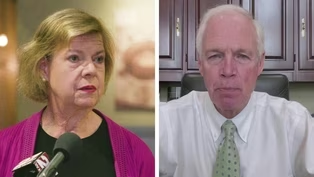
Baldwin, Johnson React to Killing by ICE Agent in Minnesota
Video has Closed Captions
Clip: S2400 Ep2426 | 1m 2s | Tammy Baldwin and Ron Johnson on an ICE agent who shot and killed a woman in Minneapolis. (1m 2s)
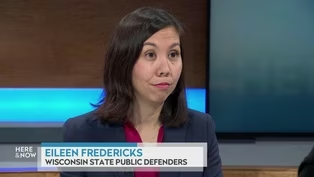
Eileen Fredericks on Staff and Security in Youth Corrections
Video has Closed Captions
Clip: S2400 Ep2426 | 9m 24s | Eileen Fredericks on concerns in youth prisons after an incident in Racine County. (9m 24s)
Here & Now opening for January 9, 2026
Video has Closed Captions
Clip: S2400 Ep2426 | 56s | The introduction to the January 9, 2026 episode of Here & Now. (56s)
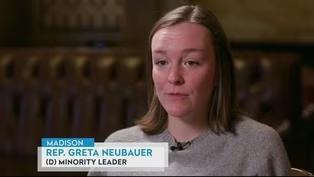
Rep. Greta Neubauer on a 2026 Agenda for Wisconsin Democrats
Video has Closed Captions
Clip: S2400 Ep2426 | 8m 54s | Greta Neubauer on what policies the Democratic caucus is prioritizing going into 2026. (8m 54s)

Wisconsin THC Businesses Prepare for End to Federal Loophole
Video has Closed Captions
Clip: S2400 Ep2426 | 5m 48s | Businesses that sell legal THC products are considering next steps as federal law changes. (5m 48s)
Providing Support for PBS.org
Learn Moreabout PBS online sponsorship
- News and Public Affairs

Top journalists deliver compelling original analysis of the hour's headlines.

- News and Public Affairs

FRONTLINE is investigative journalism that questions, explains and changes our world.












Support for PBS provided by:
Here and Now is a local public television program presented by PBS Wisconsin