
Special Session Debrief
Season 6 Episode 10 | 27m 1sVideo has Closed Captions
Lawmakers deal with new political maps, vaccine mandates, and a controversial name change.
Following a raucous committee hearing, Utah lawmakers finalize political boundaries for the next decade. Plus, with more children able to get vaccinated, local leaders push back on federal mandates. Dr. Chris Karpowitz, Rebecca Chavez-Houck, and Spencer Stokes join host Jason Perry.
Problems playing video? | Closed Captioning Feedback
Problems playing video? | Closed Captioning Feedback
The Hinckley Report is a local public television program presented by PBS Utah
Funding for The Hinckley Report is made possible in part by Cleone Peterson Eccles Endowment Fund, AARP Utah, and Merit Medical.
Special Session Debrief
Season 6 Episode 10 | 27m 1sVideo has Closed Captions
Following a raucous committee hearing, Utah lawmakers finalize political boundaries for the next decade. Plus, with more children able to get vaccinated, local leaders push back on federal mandates. Dr. Chris Karpowitz, Rebecca Chavez-Houck, and Spencer Stokes join host Jason Perry.
Problems playing video? | Closed Captioning Feedback
How to Watch The Hinckley Report
The Hinckley Report is available to stream on pbs.org and the free PBS App, available on iPhone, Apple TV, Android TV, Android smartphones, Amazon Fire TV, Amazon Fire Tablet, Roku, Samsung Smart TV, and Vizio.
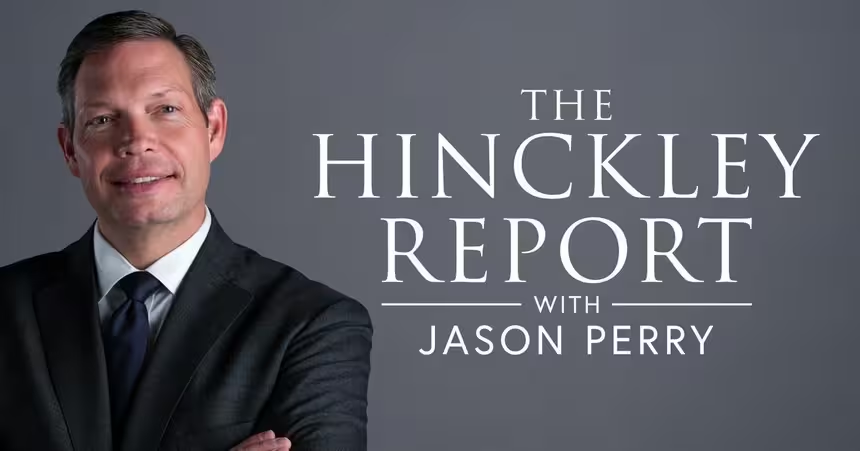
The Hinckley Report
Hosted by Jason Perry, each week’s guests feature Utah’s top journalists, lawmakers and policy experts.Providing Support for PBS.org
Learn Moreabout PBS online sponsorship♪♪♪ male announcer: Funding for the Hinckley Report is made possible in part by the Cleone Peterson Eccles Endowment Fund.
Jason Perry: Tonight on "The Hinckley Report," lawmakers meet in a special session to debate a wide range of issues that will significantly impact state politics and local businesses, citizens react to a raucous committee hearing as legislators finalize political boundaries for the next decade, and as parents with young children line up to get the vaccine, leaders push back on federal mandates.
♪♪♪ CC BY ABERDEEN CAPTIONING 1-800-688-6621 WWW.ABERCAP.COM Jason: Good evening and welcome to "The Hinckley Report."
I'm Jason Perry, Director of the Hinckley Institute of Politics.
Covering the week, we have Dr. Chris Karpowitz, co-director of the Center for the Study of Elections and Democracy at Brigham Young University.
Rebecca Chavez-Houck, former Democratic member of the Utah House of Representatives.
And Spencer Stokes, president of Stoke Strategies.
So glad to have you all with us this evening.
This has been a big week in politics, particularly for us with our legislature.
They just met in special session, nine items on the call that they were able to discuss, and a couple of them got a little bit heated.
I want to talk about a couple of those in particular, because the implications are significant throughout the state.
Spencer, let's start with you, because one of the biggest items is really adopting the maps for the redistricting process we've just been through.
You are closely associated with the the independent redistricting commission through the proposition that created it.
Talk a little about that the origin of that, and did you get what you thought you would get when this got put forward?
Spencer Stokes: Well, I've been watching this process for 30 years.
I started out in my career in a county clerk's office drawing census blocks on physical maps, and over those years, my view of this has changed pretty dramatically, and that is I think one of the things we need to focus on as Americans, as Utahns, is rebuilding the trust in our institutions.
And I think the independent redistricting commission, which I was not involved with the initiative, but I was hired to defend the commission, and it felt like a natural fit for me, because I believe that perception is reality in politics, and if you can do things that will set up a greater participation, a greater faith in the system, that's positive.
I've told my client I probably should have written a letter to them after we got the commission put in place that they could open the day that the legislature took this up, and it would've said congratulations, you've got the commission.
You're not going to get anything else.
So I feel like the commission, they did a lot of great work, it was bipartisan, it was appointed by legislative leaders both on the Democrat side and the Republican side and the governor, and I do believe you had prominent citizens on that commission who listened, and they should've taken their maps.
Jason: Huh, well, I want to talk about a couple of those points, but Representative, to the part that Spencer was just talking about, about sort of the faith in the system.
I mean, that's what--that's an interesting conversation we're having here is, you know, people voted for this initiative, you know, a majority of Utahns voted for it.
Did they get what they hoped for out of it?
Did this independent redistricting commission have an impact?
We know there wasn't a map they submitted that was selected, but do you believe it had an impact on the process itself?
Rebecca Chavez-Houck: Well, I believe that, you know, every a lot in public policy is incremental.
A lot of change, especially when it's difficult related in this political sphere is incremental, and I would echo what Spencer said related to the work of the commission.
If you look at other redistricting commissions throughout the United States, some of them have dealt with a lot of vitriol or challenges, lawsuits, in-fighting, things happen, and for our inaugural commission, for them to have gotten as far as they did to come to consensus on maps save one commissioner who theatrically and strategically decided to step away from the fray, you have as Spencer mentioned bipartisan unaffiliate, Democratic, Republican, that came to consensus on their maps, and so in contrast to what I've seen across the country, I think that the experiment of our redistricting commission here in Utah for this first step to show the legislature and to show the public that a convened community commission can do good work, can listen to the people, and come up with maps that complied with their standards, which were in many cases more rigorous than those that were laid out for the legislature, they were able to do it fairly, and they were able to do it in a way that really did respect both urban and rural interests.
Jason: Chris, I want to talk about the urban and rural interests, because this is what really at the heart of what people were concerned about was what do you do with Salt Lake City?
So talk about what these maps did and why it got divided the way it did.
Chris Karpowitz: Yeah, well, Salt Lake City is divided in this--in the map that the legislature eventually accepted, which was not any of the redistricting commission's maps.
And so that's important to understand, and unlike in past years, Salt Lake City was divided four ways.
I mean, we could hold the next "Hinckley Report" taping somewhere around 39th South with each of us sitting in a different congressional district, and that's unusual.
We haven't seen that level of division within Salt Lake--of Salt Lake City before.
And I think that made clear the legislature's goal here, which appeared to be to preserve partisan interests above other values that were important in this process and that the redistricting commission took seriously.
So we could think about the value of representativeness or different communities, different interests represented, we could also think about the value of competitiveness, and the maps that were ultimately approved will not be competitive or will be less competitive than some of the other possibilities that we saw.
And so I think that has in the long run--that can frustrate Utahns who were looking at the process and wanting a greater voice, wanting greater political competition within the state.
Spencer: A decade ago the argument was if, you know, we are one media market, and so in order for any congressman to get any kind of media coverage, you need to have some kind of representation in the urban center, but I will argue the other side of the rural-urban divide, because I grew up in in rural Utah, and what you now have are four people who care most about where the votes come from, and you've probably seen the last rural congressman ever to be elected in the state under these current maps, because Rob Bishop from Box Elder County was elected, but with the population being in the urban areas, the chances of someone coming from a Washington County or a San Juan County or Cache County being elected to Congress is zero, because property doesn't vote.
We got away from property owners having a right to vote many, many, many years ago.
So the population base is in urban areas, and what do political candidates care most about?
Being reelected, and so what are they going to focus on?
They're going to focus on areas where the people are.
So really, I believe you don't have a rural voice anymore.
You have four urban voices, so the argument from the urban area is that, hey, we don't have anybody that represents us.
All four represent them.
It's really the rural people that got shafted in this.
Jason: So, it's so interesting-- go ahead Chris.
Chris: No, I think that's a really important point, that I mean, Utah faces a challenge, which is that 80% of our population resides within the Wasatch Front, so in relatively urban areas.
So if you want a specifically rural voice, you have to think differently, and to some extent in any of these maps, Salt Lake City, you know, is going to be divided at least to some extent.
It's just now dividing it four ways means exactly as Spencer was saying that we have rural and urban in every district and more voters in the urban areas than in the rural areas in many of these places, and so just as hunters hunt where the ducks are, politicians go where the votes are, and those votes are in urban areas.
Jason: Representative, do you subscribe to this idea that has been put forward that you need to have both those interest in a district, 'cause this was like a hallmark of the discussion was it's important if there's no real rural voice, we have to make sure that they're getting it in some way through this.
Do you to buy into this particularly?
Rebecca: There's a couple of arguments that are presented their, number one, that you know we have the federal lands issue and having attention to federal issues needs to be looked at through that lens.
An argument I would make is when you look at criminal justice funding, when you look at transportation funding, when you look at education funding, that's all federal funding, and so why are we not look at it-- looking at that as to how it plays itself out within rural districts versus urban districts.
They're very distinctive needs, very distinctive interests, very distinctive applications of how that funding comes and is used in these different types of sectors, rural versus urban.
And then the other argument I would like to make is the fact that for it being so important, they've never enshrined it in statute, they never enshrined it even in their guidelines.
Now, the reason this is they did have to defend it legally, but if it's so important, why was it not put in as a standard either in statute or guideline?
They keep--you know, that is their paramount, that is their vanguard.
Jason: Spencer, to a couple of these points, I think it's interesting, we talk a lot about these congressional districts which most people are focusing on, but it's interesting 'cause you talked with these elected officials, and they cared about that, but mostly what they cared about was their own district, right?
Spencer: No question, I--look, politicians care about one thing, and that's getting reelected.
And that has a deep-seated internal desire that you're never going to get away from, and anybody would take that approach.
I want to make sure that my seat is one I can win, but all the focus because it's been such a national issue is really focused on the congressional maps, and this this will be an election coming up where one or two members of Congress could make a difference in the balance of power in the House.
Jason: So, Chris, that's a very interesting point, because we have our districts here.
They didn't change, they're largely draft in a way that Republican's going to win.
Are you seeing what happened here in Utah occurring throughout the rest of the country?
I mean, I know you follow these things all closely.
This next election cycle, are some of these states up for grabs again, the House in particular?
Chris: Yeah, I mean, the issue of gerrymandering has-- is coming up all over the United States right now, and that's true in Utah, and it's true in other states as well.
I don't think our maps here in Utah score quite as poorly in terms of gerrymandering as some other maps, but they don't score well in terms of competitiveness.
And the other thing that I think is a worry, just to go back to something Spencer said right off the bat, which is how will voters here in Utah ultimately respond to this?
Which is the voters asked for an independent redistricting commission, and the legislature instead of adopting any of those maps chose to do its own thing and propose its own maps.
And it has the right to do that, but over time, one question is whether this particular set of choices about maps increases cynicism in the public and decreases trust, because they see that the procedure that they set up through this independent redistricting commission was not followed in the end.
And so I think there are some worries about that, and I think, again, nationally we see these same kinds of debates going on in states across the nation.
Jason: So, some interesting points, which makes me you need to ask, Spencer, so what's next?
I mean, we got these parts about what the voters feel like happened, where they feel like they got what they wanted or not, but there are movements already as soon as these maps were passed from groups that are going after it.
Spencer: Well, you know, you can never predict what the outcry is going to look like from the general public.
I mean, when the Grandma law was passed a number of years ago, there was such an outcry in the public, and they came back into session and changed it.
When the tax restructuring was passed, there was such an outcry in the public they came back and changed it.
How will the public react to this?
We don't know.
I fall on the side of doing everything we can after this very raucous past presidential election to do things that will build the faith and trust in our system.
Now, I will be the first to tell you that gerrymandering is not unique to a Republican state.
This happens all over the country, and depending on who's in control and who's in power is where how you feel about gerrymandering.
If you're in a Republican state, the Democrats feel deeply that you're gerrymandering.
If you're in a Democrat state, the Republicans feel deeply about gerrymandering.
And you can see where seats have been crafted all over the country, and I think the edge this year in redistricting goes to Republicans nationally, because they're in control of of more of that process.
But I think as policymakers, as leaders, we should try to do everything we can in a day and age where people are so cynical.
I'm wearing my trust me I'm a politician cufflinks today for this discussion because we need to do everything we can to try to embolden and empower citizens and bring to pass a time where people trust their government again.
Rebecca: If I could just add-- Chris: That's a really important point.
Rebecca: I just want to point out that we have such a growing number of unaffiliated voters in this state, and I think that speaks a lot to, you know, dismay at the parties, dismay at the process that exists right now where you've got unaffiliated voters being the second largest voting block in the state.
Their voice continues to be quashed.
Jason: Great point, Chris, go ahead.
Chris: These are really important points because, you know, we typically talk about democracy being the people choosing their leaders, and I think there's a worry when the elected officials choose their own voters, and if voters don't feel like they have confidence in the process that went into that, and so you know, Spencer talked about the legislature altering things that the voters have done through initiatives over the past several election cycles, and I do think it's important to pay attention to choices that will increase confidence in our system of government generally in the the fairness and the reliability of our elections.
Those are sort of core pillars of American democracy, and they're not things that we should play around with.
We should be working to to shore them up, because they're under attack by some forces nationally.
That's not talking about anyone specifically here in Utah, but just nationally there are people who are trying to sow discord and sow distrust of what's happening in our elections, and so the more we can have bipartisan agreement about core elements of the Democratic process, the better off we'll be as a state.
Jason: Great points, a couple other issues that occupied a pretty good amount of controversial discussion during this legislative session.
Representative, the next one was Dixie State University.
We have a new name for them, and this was a--this was not an easy one going in, in fact, the votes were not completely certain even as they were meeting.
Rebecca: But what I would like to do is compliment the legislature for actually following the guidance of a committee that was convened together by the community.
That was what was done down in Dixie, you had a convening of individuals who represent the area, the interests of the institution that gathered and made these recommendations as to the name change, and the legislature heard them and took their deliberations to heart.
I think that the new name will aptly suit the institution, and it also speaks to a changing dynamic that exists in terms of what society expects, and I think it will suit the alumni in the students well, the name change, but I did want to call that-- Jason: Utah Tech University is the new name.
Spencer: Utah Tech University, I will tell you that I heard a lot of vitriol about from folks in Washington County about this, and I think that the big factor, the difference in, you know, Dixie National Forest and Dixie Electric or any of the other Dixie names is that the named Dixie on the University campus, they embraced everything that was wrong with the name of Dixie over the years.
All you have to do is go and look at the photos in their yearbooks, the Confederate, the rebel flag, you know, the rebel mascot, the slave auctions, the minstrel shows, the black face, up until 1980 there were people dressing in blackface, that is in my mind is a big difference between that institution and other people who have the name of Dixie.
I wish It would all go, but I do think that there is a difference.
And I'm trying to tell myself that the people who fought against the name change were well-meaning to preserve the history of that area.
I'm having a difficult time believing that, I have a difficult time embracing that, because there were so many things that were done that were wrong, and I am thrilled the name has been changed.
It was close in the state Senate, and I think there was that people were on pins and needles.
And I have to applaud the university president there.
This was not an easy challenge for him, but he did something that's going to make that institution better generationally, better for the state, better long term.
I think you heard this discussion of Brad Lastson, who was doing residency interviews, and that very morning one of the universities he was interviewing with, or one of the hospital systems he was interviewing with asked about the name Dixie on his resume, and he had to explain it.
Now, wasn't it great that he could be proud to explain that his father was at the forefront of changing that name versus my father is fighting to keep that tradition alive.
He had a much different narrative.
They don't build monuments to people who embrace hate and racism, they build monuments to people who changed that, and I'll tell ya, I believe president--I call him President Biff.
Jason: Biff Williams, yes.
Spencer: President Williams has done something that a monument should be erected to him because he took on a really ugly issue in that community and made it happen.
Jason: Chris, I want to get to one more issue that came up, that was discussed heavily with our inner special legislative session, and it really goes to the vaccine mandate that came out from President Biden, but it's a continuing conversation that's happened in the state.
Our legislature--this is through Senators Cullimore-- a bill that adds a new exemption.
So if businesses decide they want to mandate a vaccine, you already have a couple of the exemptions, you have health, and you have deeply-held religious belief, and they expanded this to a personal belief.
Talk about how they're posturing this particular issue as they see a mandate from the federal government which, by the way, has been stayed at least for now by the fifth circuit.
Chris: I think it remains to be seen what will happen with that federal mandate and the extent to which it will survive legal challenge.
It seems to me that the state legislature is expanding the notion of what sorts of exemptions should be allowed from a mandate like that in ways that we haven't seen before.
In the past, vaccines have not been politicized, and they've been seen as a key to public health, and so it's uncertain to me sort of what a personal belief exemption means and how that differs from or is distinct from a religious exemption.
And in a time when our case counts here in Utah are still very high, uncomfortably high as we head into the winter, it strikes me that the legislature seems much more concerned about about these sorts of symbolic moves largely to counter the Biden administration than really dealing with the public health crisis on the ground as it stands in Utah right now.
And so I think there's a tension there.
We talked about different values with respect to redistricting, with respect to vaccines certainly personal choice and individual freedom is a value, but there are other very important values, life itself and health being two of the most important.
And so how we balance those as citizens and as elected leaders is incredibly important.
And it seems to me the legislature is repeatedly weighing in on the side of individual liberty, but that might be giving short shrift to some of the other values that are really critical for us to get this situation under control.
I know we're all tired of the pandemic and ready for it to end, but that's going to require us to work together, and it's going to require reaching out to people who haven't yet been vaccinated and finding ways to get them vaccinated or to help them to see the advantages of vaccination or other steps that they could take to help us get this under control.
Jason: So, Representative, couple parts of this bill was-- it was this, adding this new personal belief exemption which existed for other categories, particularly when it comes to like universities for example, but the other things we're put in-- Rebecca: You know, I'm concerned about the precedence for small businesses.
My husband and I own a small business, so now are we going to be challenged by employees that now say, well, it's a personal belief, I don't wanna wear my safety glasses, or I don't want to do this, that, and the other in terms of keeping myself when I'm out in the--safe when I'm out in the field and my co-workers and the people with whom I work.
So, you know, it's--yes, you can confine it, but I worry about precedence when we start expanding these personal exemptions into the realm of public safety, very disconcerting.
Jason: But also, Spencer, some other pieces like there's like some provisions that cannot retaliate against employees who do avail themselves of one of these exemptions.
Spencer: Look, we're all adults.
If an adult--I don't believe the federal government should be mandating this, but we all are adults.
My more troubling issue is the fact that this has been turned into such a partisan, you know, issue, and it doesn't contribute to the civil dialogue that we're trying to have as a society.
I mean, we've seen this through common core, CRT, vaccinations that we--and now we're entering into something I never thought we'd be discussing again in this country, and that's book burning and banning books, because what has happened is those on the far right have figured out--and the governor's race in Virginia played out in this with R--if we can make it ugly, and we can make the civil dialogue and discourse ugly enough, we can turn it into an election issue.
So my bigger issue is trying to be civil about understanding both sides.
I don't believe the federal government should be mandating this, and there--but there are consequences.
We see them every day.
We all know people who have passed away from covid because they have not been vaccinated.
So you know, it's--to continue.
Jason: To continue is right, very good conversation this evening on some very interesting and important issues, thank you.
And thank you for watching "The Hinckley Report."
This show is also available as a podcast on PBSUtah.org/SlashHinckleyReport or wherever you get your podcasts.
Thank you for being with us, we'll see you next week.
♪♪♪

- News and Public Affairs

Top journalists deliver compelling original analysis of the hour's headlines.

- News and Public Affairs

FRONTLINE is investigative journalism that questions, explains and changes our world.












Support for PBS provided by:
The Hinckley Report is a local public television program presented by PBS Utah
Funding for The Hinckley Report is made possible in part by Cleone Peterson Eccles Endowment Fund, AARP Utah, and Merit Medical.