
Special Session Lawmakers in Springfield
9/2/2021 | 26m 46sVideo has Closed Captions
Special Session Lawmakers in Springfield
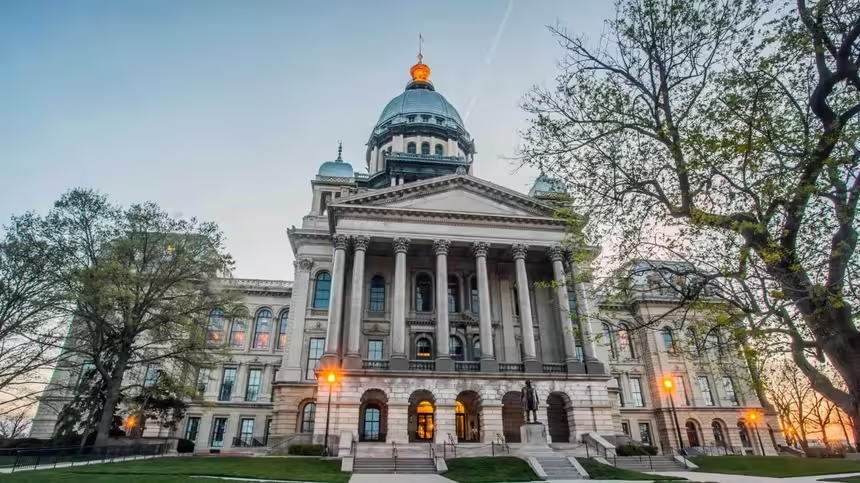
Host Hannah Meisel (NPR Illinois) and guests Dave McKinney (WBEZ) and Jerry Nowicki (Capitol News Illinois) take a look at the special session lawmakers held in Springfield this past week.
Problems playing video? | Closed Captioning Feedback
Problems playing video? | Closed Captioning Feedback
CapitolView is a local public television program presented by WSIU
CapitolView is a production of WSIU Public Broadcasting.
Special Session Lawmakers in Springfield
9/2/2021 | 26m 46sVideo has Closed Captions
Host Hannah Meisel (NPR Illinois) and guests Dave McKinney (WBEZ) and Jerry Nowicki (Capitol News Illinois) take a look at the special session lawmakers held in Springfield this past week.
Problems playing video? | Closed Captioning Feedback
How to Watch CapitolView
CapitolView is available to stream on pbs.org and the free PBS App, available on iPhone, Apple TV, Android TV, Android smartphones, Amazon Fire TV, Amazon Fire Tablet, Roku, Samsung Smart TV, and Vizio.
CapitolView
CapitolView is a weekly discussion of politics and government inside the Capitol, and around the state, with the Statehouse press corps. CapitolView is a production of WSIU Public Broadcasting.Providing Support for PBS.org
Learn Moreabout PBS online sponsorship(bright upbeat music) - Welcome to Capitol View, where we discuss the latest in state, government and politics.
I'm Hanna Meisel of NPR, Illinois.
Dave McKinney joins us this week.
He's a Chicago Public Radio Station WBEZ.
Thanks for being here Dave.
- Hey Hannah.
- And also here is Jerry Nowicki of Capitol News, Illinois.
Glad you're here, Jerry.
- Happy to be here.
- Well, lawmakers were back in Springfield for one day of special session this week, and it was quite something to behold.
In terms of what they had to do, lawmakers fulfilled their stated goal to be back in town, which is it passed a revised version of legislative maps that were more in accordance with new US census data that was released in mid August.
But Jerry explain for viewers, why should Democrats have to essentially redo the maps passed in the spring?
What was found between the Census Bureau releasing that new information and lawmakers being back in Springfield on Tuesday?
- Yeah, so the long story short is at the end of May, they passed the maps based on American Community Survey data, which obviously isn't the full census.
It's just survey data in there.
The census data became available August 12th because of the pandemic and a number of other reasons.
And once that data became available, it showed that there was probably some population variants that wouldn't be allowed under Supreme court precedent.
I think there you're basically allowed a 10% variance between the biggest and smallest district.
And some analysis said it could be around 30 in the house at least, and it wouldn't have flown.
There's a lawsuit going on right now by Republican leaders in the general assembly and the Mexican American legal defense and educational fund sort of challenging, it was initially challenging the fact that it was used with community survey data, but they had to come back and fix those population variances and right now it's pretty tight, they're all pretty close, I think maybe less than a percent, even in most cases.
And that's kinda what they had to do and now the court case is kind of pivoting as well as to they're considering the new maps in that case, more likely than the old ones.
- Right, there was a status hearing this week on both of the lawsuits that were, currently seeing the ones that were filed, but by GOP leaders and also on behalf of five Latino voters by right MALDEF, which by the way, has had the most success in redistricting cases in the decades past.
But Dave, I mean, we're gonna see this case evolve, but it's really important to point out.
We're in unprecedented territory, the fact that Democrats did go ahead and use ACS data and then have to kind of come back.
They always said that they would come back and tweak the maps, but based on census data, but I don't think anyone was expecting such large variance.
But what's at stake here?
Are the Democrats map something nice and is it possible that they're gonna lose control altogether?
- Well, I would have to say that's a legal long shot, but you know again, anything can happen once you get into federal court.
And as you say, this is a pretty unprecedented period.
I mean, these census results that just got released in August.
I mean, they were expected many months earlier and the fact that the pandemic delayed them and the Trump administration delayed them, they created this really strange opportunity for Illinois and other states.
And what set us apart is this constitutional requirement that these new political boundaries be drawn after the decennial census and in our case by June 30th.
And if that date isn't met, then it gets thrown into a bipartisan commission which is equally composed with Democrats and Republicans and you get a deadlock situation.
And that comes down to basically pulling a lot out of a hat.
And so for Republicans, the best they could get here is a 50-50 chance at being able to redraw the boundaries.
I think what's key for Democrats is that they don't, there's not specific language in the constitution that says what kind of data they have to use.
So, I mean, that's gonna be probably part of their argument and whether it holds or not, we'll see.
But I think that that's there's a lot at stake here.
The Republicans would love to be able to carve up some of these districts, the suburban ones especially, in a way that would take in, greater parts of some of these downstate areas possibly and boost their numbers.
But even with the way Illinois even if that were to happen, I mean, the shift in Illinois, demographics kind of make me wonder, even if Republicans got to draw the map, whether it would be a map that they could win under.
- Sure, I mean, that's a good point.
The census data showed that like almost over other areas in the country, Illinois is becoming more diverse and of course, we're having a major demographic shift from rural areas to more urban, suburban, ex-urban areas and that's good news for Democrats.
But Jerry, I mean, the maps that were passed this week, assuming that they do go forward and the court does not step in, what do they mean?
I mean, we saw, I think it was ultimately 14 Republicans in the house get redistricted in together in seven districts.
So, I mean, what does that mean for the caucus?
What does that mean for a candidate recruitment, going forward, what would this map mean for both parties?
- Yeah, I mean, it certainly looks like it means a democratic super majority, and I think you're right, Dave, there's probably no way you could draw these maps for a Republican majority, but you could certainly cut into the sort of veto proof threshold that Democrats would have possibly under these maps.
So, for recruitment, I don't know.
I think GOP is out there trying to get more people to run.
They say, "The more people we have on a ballot, the better chance we have of cutting into democratic majorities, no matter what the maps look like."
So you gotta have people on the ballot, I think that by all accounts, the GOP is trying to do that.
But one of the other things I know about this maps are that MALDEF argued in their court case yesterday was that they believe they've lost maybe one or two, one each in the house and Senate, majority voter, majority Latino voter age population districts.
So they said the populations for the Latino community has grown about 310,000 in the last decade.
And they're losing a seat because of it, a couple of seats because of it.
So that's sort of the legal pivot they've done with the latest map data that's been released.
They're arguing, I think they use the word that they've been punished or something like that.
- Right, Dave, I mean, Latino power, (mumbles) not just in Illinois, but everywhere around the country.
That's the group along with Asian-Americans that was expected to grow and then, have their political power then be mashed commensurate in redistricting, at least in Illinois and other blue states.
But their argument that, "Hey, the census data is, actually not being born out in what we're seeing in the maps, and if your stated purpose was to..." Governor Pritzker and Democrats were in charge, they repeatedly said that they wanted a map that reflects the diversity of the state.
So I mean, it's the other interesting thing here is that we've had Republicans kind of lineup defacto behind the arguments of Latinos and more broadly community advocacy organizations, but on the floor on Tuesday evening, we saw Democrats, especially progressive Democrats, push back on that and say, "Hey, this is not genuine argument when you are only citing them with in this convenient marriage when we are all on the same team, when we all have something gained from redistricting."
- Well, yeah, I mean, for Republicans, they're mostly a white male party.
I mean, there are women in that in some of these house and Senate seats and the Republican party of course.
But there are no minorities and so there is an indisputable irony, I guess, to have the Republican party in court, arguing this diversity issue because they themselves as a party or not, they have not had a lot of success in drawing diverse candidates into their fowl.
I think, this particular census, this particular remap may not be the one for Latinos in Illinois, and they may have to wait another 10 years.
But I think that in both the house and the Senate, the redistricting committees were chaired by Latinos, Lisa Hernandez in the house, and Senator O'Mara Keno in the Senate.
And there, there was an opportunity if, either of these lawmakers saw grave and justices for Latino districts and Latino constituencies, they were in a position of authority both of them to speak up and potentially do something about it.
So, I think, if these numbers continue to grow in the next 10 years, I think that will have to lead to more representation for Latinos in the general assembly.
- Sure, and the other thing that I don't want to get lost here is that, there was an internal struggle.
Obviously the parties tried to keep it behind closed doors and not have it bubble up to the surface as any sort of distraction.
But there was an internal tension between the Latino caucus who wanted their power to grow and match the new census data and the black caucus who has, especially under former Speaker Mike Madiga, that caucus grew and grew and their political power grew.
And they didn't wanna see any of their power, their political voice be diluted by the new MES either.
But what was argued this week by groups who represented African-American voters and they said, "The new maps don't serve us well either."'
And so, what kinds of, if the maps do go forward then Dave, what kinds of internal intro party strife might we see?
- Well, my guess is that if we're talking about super majorities in both chambers moving forward, potentially for the next five election cycles.
I think a lot of that probably will wind up going to the waste side because by and large, the ability to, you know, steer policy, steer projects, all of those things are gonna be there for Democrats regardless.
And I think, minority groups are such an important constituency for the democratic party.
They're not gonna be left out on policy and in a way, basically for lack of a better word, pork, gets spread around.
So, I think, there's always gonna be underlying tension about who has more seats, more power, but at the end of the day, they're all going to probably get back under the same tent and function as a party.
- Yeah, that's a good point.
I mean, we saw earlier this year, the black caucus pushed through a whole host of progressive reforms in the criminal justice space, health care, education, economic opportunity.
And so they've changed the conversation going forward.
So it's not like their voice is gonna disappear.
They're hugely important constituency.
A lot of presence in leadership, obviously.
Chris Welch, the first black house speaker, yields a lot of influence.
But Jerry, I kind of hate to ask it this and this way, because I do feel like it's sometimes unfair to voters and kind of short changes them.
But I'm going to ask it kind of anyway, do voters really care about, I mean, like who is really plugged in by and large, are people, is this going to be something that is going to motivate people that you think to the polls?
- Yeah I think the the constituencies who view a program like this, they'll probably, they'll probably have followed a little more closely than the general public as a whole I think, I am not sure the percentage that knows who their state Senator is, but it might just be that the next time they get to the polls, they think you know, "Where's Senator so-and-so or where's this house rep that I've been voting for for 10 years or whoever and they might just be in a different district.
So as a motivator there will be some people certainly.
I don't know if this is one of those issues that changes anything by any major amount of percentage points, but I think there certainly, it sounds certainly some people's radars.
- Sure.
And the other thing that happened Tuesday or didn't happen at, depending on your perspective is major movement on this large energy and climate package that's been stalled in Springfield all summer.
Parties came back to the table and ultimately were not able to agree to a final, final deal, but we did see the Senate Democrats decide to get what they had in a package and pass it over to the house with a pretty overwhelming majority that also cross party lines.
So Dave, I guess tell us a little bit about what was in the package that the Senate Democrats passed and what's the strategy here?
- Well, I mean, the strategy is a little bit fuddling because you think with Democrats maintaining this absolute control over the house, the Senate, the governor's mansion, that they would all figure out how to get onto the same page somehow on such an important piece of legislation.
But really at the core of all of this and what, what caused the wheels to come off in spring and led to this inertia during the summer, well the fact that you had these kind of feuding democratic constituencies in labor and in the environmentalist who couldn't quite agree on what the terms of this energy bill should look like.
The environmentalist, of course, one of the front and center make global warming climate change, the big thing, they want to shut down the fossil fuel producers.
And that was really a kind of a pivot point in all of these discussions here this week, and then overlaying the whole thing is this really important issue to labor.
And that is the fate of Exelon's nuclear fleet in Illinois.
And what becomes of that.
After the Senate did what it did and passed this, package that doesn't appear to be, to the governor's liking or to the houses liking.
Exelon came out with a statement, reiterating that September 13th is their date.
Set in stone it seems that they're gonna start the process with Byron to close this nuclear plant down.
And in doing so if that happens, I mean, it really kind of undercuts the whole green energy efforts in the state of Illinois because there's not carbon pollution that's created by these nuclear plants.
And so there's just, there are, it's like the big gambling packages that we've seen in the past where you have all these kinds of, disparate constituencies that can't agree on things.
And it gets so big that eventually it's just really hard for them to take flight.
And we're seeing that here, the most interesting part of this whole thing though, I think is how Governor Pritzker and Senate president Harmon seem to be kind of singing from different hymn books about what this thing auto entail?
And as I mentioned, the pivot point earlier was this coal-fired plant that we've talked about before in the show and Marissa called the Prairie state energy campus.
It's a large scale polluter, but it powers dozens of communities, including in Illinois here in the Chicago, in Naperville, Wanetcat Batavia, lots of suburban communities in Chicago rely on this plant and Pritzker wants the plant closed, but he also wants there to be provisions that leading up to a closure in 2045, that there'd be, a constant scaling back of the emissions, the carbon emissions.
And it just, none of the pieces are fitting together here in a way that economically makes sense for this plant that, that the Senate Democrats can, they're in behind.
So I don't know where this is headed.
I don't have a good feeling that these guys are gonna make much progress on this until, it might be early September, closer to that September 13th deadline when they take another stab at this.
- Right, and lawmakers left town without there being any sort of clear plan on when they're gonna come back.
And as we film this in September 13th, that is 11 days away.
And that drop dead deadline is very real from what I have been talking with, excellent folks about...
But Jerry, the Democrats, no, I'm sorry.
Governor Pritzker has sided with environmental groups saying that the their goal is to make meaningful steps on climate change what they want, what they wanted to see for months is this de-carbonization piece which in their minds is a step down year over year of the amount of carbon, these coal fired power plants.
And to some extent, natural gas fired power plants are able to emit into the atmosphere.
But I asked Senate President Don Harmon very late at night, early in the morning, Wednesday after they did punt that over to the house.
In your mind, can that exist, co-exist with also hard closure dates, the same thing.
The other thing that Governor Pritzker and the environmental groups want.
And he said, no, it just, to me it doesn't make any economic sense.
Why would anyone agree to that?
And so with that very hard line in the sand, I feel like more exact than he's ever been.
Do you see in (mumbles) do you see Governor Pritzker, caving to that fire sure in a meaningful way?
They'll tell you that they've moved a lot, but according to labor, they've not they're missing the forest through the trees.
- Yeah.
So Harmon said, I'm open to any hybrid if the governor's gets to a point where the stakeholders can accept it.
So the thing is like the hard closure date is for 2045 and environments, don't the environmentalist, the governor don't want that plan open past that time.
But in order to spend the money to get those caps down is what makes it not an economical.
I think Harmon said $4 billion investment.
They'd have to make just to meet a cap, the certain caps.
And then they're guaranteed to go offline in 2045.
So who's going to spend that money if it's not a long-term investment?
So, you know, that's the challenge here and that's the sort of thing, there's been reported progress or whatever, but there's really not been progress because who knows if you can even get there or what other creative solutions lawmakers can come to.
But you know that the Democrats had said, as long as they get to the Senate Democrats, I should say, and put in the plan, as long as you get to you're capturing at least 95% of the plants, and then another offset for carbon emissions through other renewable energy credits or whatever.
They could stay open past 20:45 and then, but this would have declined caps.
But the governor dismissed that as out of hand as well.
So they tried one, they tried the other, so now it's up to the governor to find a solution that maybe can get this across the finish line.
- Yeah, and Dave, is there any sense that the governor, I mean, I doubt he would ever admit this, but is there any sense that there is a regret from the Pritzker camp to have committed so hard to the closure dates?
But really, I mean, if you think about it, the more important thing, at least in my mind, if they're gonna go for this de-carbonization is to get in place the stepped down the year over year, you can't pollute more than you did last year.
And in the future, I mean, 2045 is a long way away.
I know it's headlines that are we saying, "Well this plant can pollute forever and ever in perpetuity."
But again, 2045 is a long way away.
Technology could advance.
Hopefully we'll advance the point where we can see more carbon capture.
So Dave, do you think that there's any chance the governor will go back on what he's been saying all summer when he weighs the what's really important here for decarbonization.
- Well I mean I thin, everybody is for taping this show and tune in the news this morning, and you see these massive floods in Pennsylvania and in New York state from hurricane Ida that are unlike anything that anybody has ever experienced there.
And that is a flavor of what global warming is doing.
So I don't think that, the governor's office sort of looks to things like this to say, "Well, we are gonna draw a hard line in the sand on this Prairie state issue."
It's a winning issue to them And so that's why they've aligned themselves, so heavily with environmentalist.
And I think, the issue with decarbonization, the four billion dollar figure that Harmon mentioned as you said earlier.
I mean, there is saying, "It's not real, till it's real."
And that's what I would say with this technology.
Because if you remember, it wasn't that long ago, that there was an effort called future Chan in central Illinois, where it all involved kind of the same, a similar principle, but different bearing the carbon in the ground.
And it never, could take flight because the technology wasn't there.
And so I think we're in the same situation here, because it was just that easy to get rid of carbon from coal, we would have done it already.
And I just think that that's, it's a pipe dream in a way to sort of think that long-term that that's a real genuine answer to deal with, a pollutant that we know is always gonna gonna pollutant atmosphere.
- Oh, right.
I clean college, forgotten about that whole campaign.
Obviously that's kind of disappeared from the, vernacular because it was born out, but that's just not, not really a thing, although we did have, I think Rodney Davis earlier this summer kind of promote that same language on clean coal.
But we are almost out of time, and I know Jerry, any closing thoughts about the urgency here from, especially the house to get back to Springfield to work something out?
- Yeah, I think the house is, has that urgency as well.
And I think one of the lead negotiators said, "They're hopeful to be back."
Certainly before veto session and maybe in a few days.
- Okay.
All right, well, I'd like to think of my guests, Steve McKinney, Jerry Nowicki, I'm Hanna Meisel.
Thanks for joining us.
We'll see you again next time.
(bright upbeat music)

- News and Public Affairs

Top journalists deliver compelling original analysis of the hour's headlines.

- News and Public Affairs

FRONTLINE is investigative journalism that questions, explains and changes our world.












Support for PBS provided by:
CapitolView is a local public television program presented by WSIU
CapitolView is a production of WSIU Public Broadcasting.