Jeffrey's Southern Ghosts
Specter in the Maze
5/14/2026 | 24m 7sVideo has Closed Captions
Kathryn Tucker Windham’s tale of an eerie glowing orb in the state's first capital.
Adaptation of Kathryn Tucker Windham's tale of an eerie glowing orb in a Civil War-era garden in Alabama's first state capital. Is this floating orb an omen of what's to come for Old Cahaba?
Problems playing video? | Closed Captioning Feedback
Problems playing video? | Closed Captioning Feedback
Jeffrey's Southern Ghosts is a local public television program presented by APT
Jeffrey's Southern Ghosts
Specter in the Maze
5/14/2026 | 24m 7sVideo has Closed Captions
Adaptation of Kathryn Tucker Windham's tale of an eerie glowing orb in a Civil War-era garden in Alabama's first state capital. Is this floating orb an omen of what's to come for Old Cahaba?
Problems playing video? | Closed Captioning Feedback
Where to Watch Jeffrey's Southern Ghosts
Jeffrey's Southern Ghosts is available to stream on pbs.org and the PBS app.
Providing Support for PBS.org
Learn Moreabout PBS online sponsorship(soft ambient music) (static hissing) - He ran toward it to catch it in his hands, and before he could touch it, it vanished right before their eyes, (ominous music) and then it was back again, taunting them, and almost saying, "You don't know what I am and you can't catch me."
- [Narrator] Imagine you're walking with a date in the night air of a small Alabama town, and something stops you in your tracks, a floating ball of pure light.
It doesn't threaten you.
It doesn't seem to care about you at all.
All it does is twirl through the air in graceful arcs that almost make you think it's dancing.
You reach out slowly to grab it, but just as quickly as it appeared, it dashes away, a bright missile casting shadows across the trees until it disappears (light whooshing) into the night.
Many years later, the town will vanish.
You'll look back on that mysterious orb and wonder, was it an omen?
(bell clanging) And how does an entire town disappear into the wilderness?
- [Jonathan] Something has been left behind that we can feel.
- [William] The antebellum Pompeii, it's all just immediately under your feet.
- [Todd] The ghosts, the spirits, the bumps in the night, well, that's the history of the place.
- A strange, glowing ball that appears from nowhere that no one can catch and no one can explain, and they say it's the Pegues' Ghost, still here at Cahaba.
(ominous music) - [Narrator] Her name was Kathryn Tucker Windham.
- You do not have to believe in ghosts to enjoy a good ghost tale.
- [Narrator] A folklorist and storyteller.
For nearly 50 years, she traveled the South, collecting tales of mystery and the supernatural.
- But a good ghost story would stretch your imagination and make you wonder, could that really be true?
- [Narrator] But she was not alone.
An unearthly presence followed her.
She named the spirit, Jeffrey.
This is what they discovered.
(dramatic ominous music) (title thudding) - This is a fine line of old cedar trees here at Cahaba, and I like to think that they are the descendants of the trees that grew on this very property when the C.C.
Pegues Family lived here.
Beautiful place, this deserted field now.
There was a fine house there, but everyone who came to the Pegues' place wanted to be sure to have a walk in the mystic maze.
One moonlight night, a strange thing happened in that maze.
(soft piano music) - [Storyteller] "The Specter in the Maze at Cahaba."
"Antebellum Cahaba was a pleasant place to live.
There seemed to be no limit to the round of entertainment and visiting in the Dallas County town.
Fine carriages awaited the arrival of each boat at the Cahaba Landing to convey passengers to the homes where they would be guests.
Down Vine Street, Cahaba's principal business section, they drove past its paved walks shaded by ancient water oaks, mulberry, and Chinaberry trees, past the newspaper offices, the churches, the stores, and the telegraph office.
There was Salt Marsh Hall, scene of masked balls, enactments of romantic scenes from Byron and Moore, fanciful tableau and political orations fiery with talk of secession.
It was the Confederate officer, Colonel C.C.
Pegues, who owned the property at which the ghostly phenomenon bearing his name manifested itself.
There were grander and costlier homes in Cahaba than the one occupied by Colonel Pegues and his family, but none could surpass it in hospitality.
The house had been a jail during the years when Cahaba had been the capital of Alabama, a background that provided the Pegues Family much amusement.
After Colonel Pegues purchased the property, he planned and supervised its renovation so expertly that it bore no resemblance to the place of incarceration it had once been.
The most distinctive feature of the premises was the labyrinth or maze of thick cedars.
No place in Cahaba was more popular with couples out for a stroll than was this evergreen labyrinth and leisurely walks through the Pegues' maze became a part of the ritual of courtship in Cahaba."
- We know nothing about that maze.
I really can't go into any further detail about that.
I'm Jonathan Matthews and my official title is assistant site director here at Old Cahawba Archeological Park.
Christopher Claudius Pegues, he owned the entire city block, probably three acres.
There might have been room for a mystical maze of cedar trees, and you know, if any place is gonna have it, it would be Cahaba.
- [Narrator] Mrs.
Windham likely first learned of the specter in the maze from the memoirs of Anna Gayle Fry, who recalled the story from her girlhood in Cahaba, but by the time Mrs.
Windham and Jeffrey came through here in the 1960s, there was no maze to be found and the Pegues House had vanished.
Moreover, the once thriving town of Cahaba, the first capital of Alabama, had been reduced to a handful of lonely ruins.
Today, Old Cahawba is an archeological park where a small but dedicated group of staff, students, and volunteers investigate the endless mysteries of one of the South's great ghost towns.
In this field, they're investigating an old legend.
Are the ruins of the Pegues House really buried beneath this tree?
- My name is Dr.
William Henry.
I am the site director at Old Cahawba Archeological Park.
We had two competing theories about where the jail, which was later converted into Colonel Pegues' home, was located.
The sort of local folklore was that it was around the big tree that's behind me.
- [Narrator] Dr.
Henry is an archeologist, though his job sometimes requires him to act like a park ranger.
He and his colleagues are scientists, first and foremost.
Legends and folklore like the story of the ghost in the mystic maze can clue them in on where to start, but what thereafter is empirical evidence collected via scientific methods like ground-penetrating radar.
- Ground-penetrating radar is kind of what it sounds like.
It's a radar that's directed into the ground, and based on how that signal interacts with whatever is subsurface is how we're able to sort of determine, is there something there?
- [Narrator] If they can show that this is where the Pegues House stood, then according to legend, the field behind it is the site of the cedar maze, and maybe where the omen of Cahaba's end first appeared.
(film screeching) (soft ominous music) - Old Cahawba being the the most famous ghost town in the state of Alabama, it brings in tourists and tourism dollars.
It brings people to the area who are curious and interested, and they wanna learn.
Telling the ghost stories, you're also telling the history, and this is a great place to tell those stories, 'cause there's so many here.
- [Narrator] While the staff at Old Cahawba search for scientific proof, volunteers work to preserve its tradition of storytelling.
- My name is Todd Prater and I'm a volunteer.
I just love the place, because I'm a big history fanatic.
And during the Haunted History tours, I have the honor and privilege of telling a couple of the stories.
Years ago, I had an experience that made me believe that there's something on the other side, something that that is more than just this physical world.
One of the things a lot of people don't realize, especially non-believers, ghost stories are our history.
It is part of our history.
The ghosts, the spirits, the bumps in the night, all are attached to a story that happened in that place or in that field, or wherever you are.
- [Narrator] While believers claim that Cahaba is home to many ghosts.
(animal calling) - (chuckles) Uh-oh, that's one of them ghost stories I ain't told yet.
(laughs) - [Narrator] The town's disappearance poses an equally eerie mystery.
Why did Alabama's first state capital vanish into the tangled wilderness from which it emerged?
- I mean, Cahaba is kind of a microcosm for the rise and fall of the South in general.
(soft music) - [Narrator] Cahaba was founded during a time of great expectations.
In 1814, the Treaty of Fort Jackson forced Native Creek people to give up more than 20 million acres of land, most of it in present-day Alabama.
Word went out across the country, Alabama was open to white settlement.
Out of the ensuing frenzy, new towns emerged, planned communities backed by extravagant promises from investors.
When Alabama became a state in 1819, several towns, each representing the interests of a different region, vied to be chosen as the new state capital.
Governor William Wyatt Bibb eventually prevailed, and his choice would be to build a new town located at the confluence of the Alabama and Cahaba rivers, and reportedly, the site of a long-abandoned Native American village.
- You'll see newspaper advertisements across the country about the city of Cahaba.
Land was being auctioned off, people had dollar signs in their eyes.
- [Narrator] Not everyone arrived willingly.
The actual work of building and maintaining the town was carried out by enslaved men and women brought in from all corners of the South.
In time, they would be the last to claim this place as their own before it faded into the pages of history.
- The enslaved community at Cahaba was our silent majority.
Some 60% of the town was African American.
The brick was made by the African American population, the roads were cleared by the African American population.
I don't believe the town could run without that population of Cahaba.
- [Narrator] In July of 1820, mere months after Cahaba's founding, Governor Bibb was thrown from his horse and died.
With Cahaba's champion out of the picture, regional rivals plotted to steal the capital away, amplifying exaggerated stories of disease and flooding at the State House, even claiming that legislators once had to enter the building's second floor by boat.
In December, 1825, Cahaba's enemies finally won.
The legislature chose Tuscaloosa as the new capital site by a single vote where it would remain for 20 years before moving again to Montgomery.
For all the grand dreams and expectations that had accompanied its founding, Cahaba in its early days was little more than a frontier community.
With the capital gone, the residents that remained looked toward an uncertain future.
(static hissing) (film scratching) (VCR clunking) (people chattering softly) - 1650?
- 1650.
Mm-hmm, hold off to the side, push it a little bit, one rotation.
- Yeah.
- Cut it short.
- Pretty much.
Cahaba's has been described in some publications as the Antebellum Pompeii, but it's all just immediately under your feet.
From an archeologist perspective, this is a playground.
(soft ominous music) Archeology, the historical documentation, folklore, all of it comes together.
In the case here, for example, the Specter in the Maze is classified as a folklore.
On their own, none of those things are able to give a 100% answer, right?
But when they're combined together, we can make a verdict on, like, what is the reality here for the people who lived here?
What was their life like?
What were they doing?
What were they eating?
Where did they live?
What did they call themselves?
There are so many other questions that we haven't even thought of, and that people 50 years, 100 years from now might think of.
- Right, right.
I think three transects, it'll affect.
- Yeah.
I'm gonna spend my career here.
I plan to die in my office.
(chuckles) - [Narrator] After the capital departed, Cahaba entered a period of decline, but not desolation.
- Cahaba remained the county seat of Dallas County through 1865, so we were not this desolate, abandoned city after the capital left.
- [Narrator] By the 1850s, Cahaba had entered its golden age, brought about by new wells that spurred growth in the town and nearby plantations.
To build it all, more and more enslaved labor was brought into the region.
While the white citizens of Cahaba enjoyed a world of fancy dinners and idle play, the town's silent majority was forced to stand by while others enjoyed the fruit of their stolen labor.
In 1861, a war came that would dramatically alter the fortunes of both populations.
Colonel Pegues assembled a company of young men to fight for the Confederacy, a unit known as the Cahaba Rifles.
His family and servants stayed behind tending his gardens, and perhaps, a mystic maze.
- [Storyteller] "So it was that one soft moonlight night in the spring of 1862, a young confederate soldier and his sweetheart were promenading in the Pegues' garden.
He had only a few days leave and there was much he wanted to say to the beautiful girl beside him.
Their stroll led them naturally to the maze of cedars."
- People liked to walk through the maze, especially in the evenings under a full moon.
Young couples especially enjoyed it.
They had intentionally planted the trees in such a way that it created this maze so that people would come and wander through and and enjoy them.
And of course, I guess that was part of the fun, was getting a dead end and then turning around and having to go back.
Of course, it kind of reminds me of "The Shining," but that's a whole nother story.
- [Storyteller] "They had entered one of the circular walks leading to the center of the labyrinth when a large, glowing, white ball darted toward them.
(light whooshing) It appeared to be floating in the air a few feet above the ground as though controlled by some powerful but invisible force.
The ball played a taunting game with them, swerving from one side of the walk to the other, and then hovering directly in front of the couple, almost daring them to catch it.
Then it would recede and disappear in the thick cedars, reappearing seconds later, right beside the startled pair.
The soldier being accustomed to having solid and logical explanations for all happenings was at a loss to explain the antics of the luminous ball or to account for its origin, but he decided that it was an illusion caused by the reflections of the moonlight on some object hidden from their view.
'Don't be frightened,' he said, putting his arm gently and protectively around the girl's waist.
'It's just some trick the moonlight is playing.
Let's walk back toward the house.
I'm sure the thing won't appear again,' but it did.
They had retraced their steps only a short distance through the maze when the bright sphere appeared in front of them and began performing all sorts of gyrations.
This time, motivated by both curiosity and exasperation, the soldier jumped toward the object and tried to catch it, but just as he seemed to have it in his grasp, the ball twirled away (light whooshing) and disappeared completely.
After its initial appearance, the dancing ball of light was seen by several other persons.
Their stories of its erratic behavior differed only in small details from the accounts given by the couple who first saw it.
The phenomenon became known as the Pegues Ghost, and stories of its antics were told throughout the countryside."
- [Todd] I believe that they saw something and other people saw something, and people continue to see something.
I don't know what it is, I don't know why it is, but I am open to believe that there are more things in this world than we can understand as humans.
(static hissing) - [Interviewer] Have you ever experienced a ghost?
- Here in Cahaba?
Yeah.
(chuckles) We have gotten, oh God, I gotta tell you the first one.
(ominous music) A friend of mine was here, total nonbeliever, total skeptic.
We had a paranormal group that was helping us.
One of the folks scanned a infrared camera over him, and while he was standing there, over his shoulder, the perfect outline of a head and shoulders appeared on the infrared.
(figure hissing softly) And you know, he looked, because they said, "There's somebody standing over your shoulder."
And he went, "No, there's not," but in the picture, you could see a perfect outline of a human figure (figure hissing) standing behind him, and then it just disappeared.
(wind whooshing) - [Narrator] Colonel Pegues didn't live to hear the legends of his namesake ghost.
He was mortally wounded in battle the same year, hundreds of miles away.
(guns popping faintly) Indeed, the first reported appearance of Pegues' Ghost preceded a series of disasters for Cahaba.
A third of the men who made up the Cahaba Rifles died in battle.
Roughly another third returned wounded or disabled.
Immediately after the war, a steamboat carrying Union soldiers who'd been imprisoned at Cahaba exploded, (explosion blasting) killing more than a thousand men, to this day, the deadliest maritime disaster in US history, and the bad luck didn't stop there.
- The war ended in April of '65, but in March of '65, the river crested the banks and the downtown area inundated with water.
It is the metaphorical nail in the coffin for Cahaba.
- [Narrator] The following year, the county seat was relocated to Selma, marking the second time Cahaba lost a seat of government.
The town's buildings soon abandoned, were looted for their bricks until nothing remained, but amid it all, something new emerged.
In her memoirs, Anna Gayle Fry recalled how after the war, emancipated Black workers fled her father's plantation for a nearby Union camp.
Her father went to the camp to convince them to return.
There he spotted an old woman who'd been an enslaved servant with his family since his childhood and whom he believed to be devoted to him.
He commanded her to come, but she walked away with a glib remark, the first time in his life a Black person had refused an order from him.
And so white Cahaba was made to understand, if only for a moment, how fragile the myths underpinning their old way of life had been all along while the no longer silent majority inherited what was left.
- At Cahaba, the emancipated African Americans were taking their first footsteps into freedom.
They were organizing themselves into political parties.
They were holding rallies at the steps of the old courthouse.
They were educating themselves.
They were buying up land lot by lot, block by block, turning it into a more agricultural village.
- [Narrator] But the community remained small, and as was the fate of many rural villages, continued to shrink over the coming decades as families either left for opportunities elsewhere or slowly faded away.
The Pegues House was dismantled, and the mystic maze, if it ever existed, disappeared into legend.
By the 20th century, there was little left of Cahaba - Folklore says there were still 100 buildings down here, but those buildings were in ruins.
You had a small contingent of folks still living down here.
Population was no longer in the thousands by that point, probably in the hundreds, if that.
- [[Narrator] Not 50 years after that strange orb was first reported to appear, the wilderness reclaimed Cahaba with only ruins and ghosts to speak of its glory days.
(low wind rumbling) - 90% confident that we found it.
- And it's right where we thought it was?
- It's plain as day, like, I was hoping that you guys weren't ready to start yet so could steal you and show you.
(soft ominous music) - [Narrator] The ground-penetrating radar turned up something around the big tree.
- So we're looking at 20 centimeters deep, 25 centimeters, (buttons clicking) 30 centimeters.
- And there, we start to see the corner of the building.
- [Narrator] By piecing together multiple underground snapshots, a picture starts to come together.
- They're still working back there to go through and really confirm the results.
What we have found is approximately a 20-foot by 40-foot building with brick foundations that are approximately two to three feet thick.
We would probably end up killing the tree to excavate that wall, which means we would not, because I rather like the tree.
- [Narrator] Folklore, history, and science have come together to produce a new discovery, but Old Cahawba contains many stories and many more potential discoveries, too many, in fact, for one lifetime.
- Jonathan and I were recently just talking about how long it would take us to GPR this entire field, and it would be weeks, nonstop, weeks just to do this one field here.
We don't want to answer all the questions.
There's some mysteries that we wanna leave for the next generation.
- [Storyteller] "Gone with the old Pegues home, the flowering shrubs, the fountains, and the maze, a few clumps of old-fashioned yellow jonquils and some scattered piles of broken brick are all that remained to mark the scene where the strangely bright Pegues' Ghost caused such excitement more than a century ago, but stories of the glowing ball are still told, and occasionally, a fisherman returning home late at night from an outing on the river or hunter trying to follow the bane of his hound will report seeing a white fireball near where the circles of cedars once provided background for a supernatural display."
- So even to this day, there have been reports that that ball of light still haunts the area where the maze once was.
Now, what it is, well, who knows?
- I will say I'm a skeptic.
I don't put much weight into ghost stories.
They're wanting to tell a different type of story, and a ghost story is just sort of the best medium.
- So the scientist in me says these are just stories, but I'd love to see that orb, if possible.
- A strange, glowing ball (ominous music) that appears from nowhere and that no one can catch and no one can explain.
And they say it is the Pegues' Ghost still here at Cahaba.
(ominous music continues) (ominous music continues) (ominous music continues)
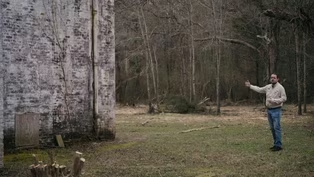
Adaptation of Kathryn Tucker Windham's tale of an eerie glowing orb in a Civil War-era Old Cahawba. (30s)
Providing Support for PBS.org
Learn Moreabout PBS online sponsorship













Support for PBS provided by:
Jeffrey's Southern Ghosts is a local public television program presented by APT