Traverse Talks with Sueann Ramella
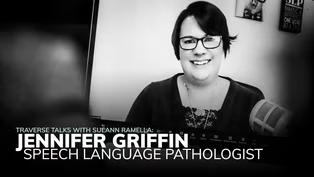
Speech Language Pathologist Jennifer Griffin
12/21/2021 | 35m 33sVideo has Closed Captions
Speech Language Pathologist Jennifer Griffin On Dyslexia And Playing To Its Strengths.
Jennifer Griffin talks about dyslexia and signs that you or your child may be suffering from it. Jennifer also talks about techniques used at her clinic to improve the neurological connections and synopsis speeds to help kids conform to educational and societal standards. If you believe your child or yourself suffers from dyslexia, Jennifer encourages people to talk to their primary care doctor.
Problems playing video? | Closed Captioning Feedback
Problems playing video? | Closed Captioning Feedback
Traverse Talks with Sueann Ramella is a local public television program presented by NWPB
Traverse Talks with Sueann Ramella
Speech Language Pathologist Jennifer Griffin
12/21/2021 | 35m 33sVideo has Closed Captions
Jennifer Griffin talks about dyslexia and signs that you or your child may be suffering from it. Jennifer also talks about techniques used at her clinic to improve the neurological connections and synopsis speeds to help kids conform to educational and societal standards. If you believe your child or yourself suffers from dyslexia, Jennifer encourages people to talk to their primary care doctor.
Problems playing video? | Closed Captioning Feedback
How to Watch Traverse Talks with Sueann Ramella
Traverse Talks with Sueann Ramella is available to stream on pbs.org and the free PBS App, available on iPhone, Apple TV, Android TV, Android smartphones, Amazon Fire TV, Amazon Fire Tablet, Roku, Samsung Smart TV, and Vizio.
Providing Support for PBS.org
Learn Moreabout PBS online sponsorship(gentle music) - It's estimated that about 20% of the population has some level of dyslexia and it's not just seeing B's and D's backwards or mixing up the six and the nine.
If you struggled in school or can't spell well, maybe you feel insecure about your spelling, or maybe you had a hard time rhyming words, you could have dyslexia.
Jennifer Griffin is a speech language pathologist, dyslexia childhood education expert and she talks about the programs for children and what adults who may have been coping all their lives with dyslexia can do.
(gentle music) What is dyslexia?
- So dyslexia is a neurologically-based language disorder.
And one of the primary features of it is difficulty with phonological awareness or phonological processing.
- Phonological, so speech and words and-- - Yes, sounds.
Being able to put those sounds together into words, being able to take the sounds apart through reading, decoding, being able to manipulate those sounds.
Some common activities that would target that are rhyming.
- Ah, so they would not be able to hear the rhyme.
- Yes, exactly.
So rhyming can be difficult.
Being able to blend, like if you have the word snake, right?
Being able to put the S and A and K sound together to make the word snake.
- Instead, they would do what?
- It depends.
We get all sorts of creative, (laughs) creative things.
Oftentimes in very young children that are learning to speak, they often will not say the N sound.
So it'll be like sake.
- Ah.
- But that sort of difficulty, so phonological-based.
But that has to exist apart from any intellectual difficulty or disability.
- Okay, so you have, I'm gonna say like a grid chart of if this, then that.
- Yes.
- If not this, then not that.
- Right.
And the other component is, in a classroom setting, if they have been given intervention that most kids would respond to and there is not the response you would expect for a child with dyslexia, then that's one of those, then it's likely something more.
- Okay, because some of the... You know, my child had a stutter and issues blending.
I don't think he's dyslexic.
But when I'm reading about other signs, they seem like they can correspond with ADD or ADHD.
Because in the classroom, they're getting distracted and they can't focus.
- Absolutely.
And I think that that is what makes isolating it very difficult is because there are so many other contributing factors and then you have to consider normal development and normal growth and each child has their own trajectory in that.
So they're not all gonna look the same.
So is it just a little bit different developmental approach for this child or is there something that's inhibiting that development?
- And isn't just eyesight issues, right?
Or hearing issues?
This is-- - Oh, right.
No, it is actually not eyesight or hearing acuity, as we would say.
They can see, they can hear.
Oftentimes, it comes down to what the brain does with that information, how the brain processes the visual information and the auditory information.
- Ah, the brain is such a fascinating thing.
(laughs) - Right.
And because it's a neurologically-based difficulty, and as you said, the brain is an amazing thing, but it's complicated thing as well.
So it can be very difficult to isolate and sort out what the real difficulty is or where the breakdown is occurring.
- So then Jennifer, how do you diagnose, like do they read cards or they draw or-- - Yes, a little bit of both.
So our approach to assessing is, for me as a speech language pathologist, I look at their language abilities.
I look at their language abilities with words.
So I mentioned earlier, like the phonological awareness, can they read a nonsense word that isn't a real word?
Because oftentimes with the kids we work with, they have amazing compensatory strategies and they rely a lot on their memory.
So instead of reading words, they memorize words.
So we have to take that context away from them to truly get an idea of, is their brain able to attach the letters with the sounds and vice versa for reading and spelling?
So I look at that, but then I look at their ability to read words and sentences, spelling the same way.
But we also look at, so language can be broken down into speaking, like we're doing, and listening, which is what we're doing, that's one aspect of language.
But language has also been the literacy, the reading and the writing.
So we like to look at all four of those mediums, if you will, to get a profile and identify where the breakdown is occurring.
If it's occurring in the literacy side, the reading and writing side, that gives us information that it's likely something specific like dyslexia.
And sometimes what we see in our profile is that their auditory oral abilities, so listening and speaking, are quite high.
So we would then expect that the reading and writing would be comparable.
So if there's a discrepancy, that gives us good information about what the profile of that specific child looks like.
- The history of dyslexia, how did it come about?
- When we started correlating symbols to sounds.
- Of course.
- Right?
Throughout history, it has had various names.
Word blindness was one of the first.
But there are documents from when schools first became schools and education was, you know, the very infancy of education many, many years ago.
There are accounts of kids who struggled.
- This makes me wonder what are some other diagnoses out there about the way people process that we haven't really given a name to yet.
- Right, exactly.
And or with more information, like there's constant evolution of the name of things, right?
And new information changes that and specifies it and we reorganize the subgroups and reclassify.
So I don't foresee that changing anytime soon.
- No, we're constantly learning.
And I'm just curious, how did you become a speech pathologist or involved with dyslexia in the first place?
- So I became involved and interested in speech language pathology 'cause I actually had a very good friend who had a daughter who was receiving intensive speech therapy.
And at the time, we were both working at a job, and both of us knew it wasn't our forever job and we're just discussing like, "What do you wanna be when you grow up?"
"Oh, wait, we are grown up, ha-ha-ha."
(both laughs) And just talking with my friend, she was like, "Oh, my gosh.
You should be an SLP."
And I looked into it and I was like, "Oh my gosh, yes, I should.
That is where I need to be."
As far as specific to dyslexia and reading difficulties, my coworker who's occupational therapist, there was a need that we identified.
And we were having difficulty trying to determine the best way to serve from individuals we were seeing.
And one day, she was like, "We need to do something about this.
Like we need to fix this.
This is not okay."
And I was just like, "Oh, my gosh.
You're right, we do."
And that was kind of the beginning of us going down this path that we're on right now.
- And was this under Pullman Regional Hospital where you created this website and community outreach?
- Yes, yes.
- Oh, wow.
So the two of you really took it on your own shoulders?
- Right, yes.
And our director, Carrie Cohen, has been amazingly supportive of us on this, working with us, helping us get the marketing with the website.
And the initial podcast that we did is a series of podcasts through Pullman Regional Hospital.
We have a foundation at the hospital and they offer staff scholarships for furthering education for our staff members and my colleague, Francis, and I applied and were granted the scholarship, which allowed us to go to the training that we did so that we can provide treatment for people with dyslexia and or literacy difficulties.
- Now, where Pullman is around the Palouse, is pretty rural comparatively speaking.
So do you have many clients?
- Yes.
- How many people, you know, I mean, if it's so rural and you have a handful or more of clients, how many people in the United States or the world have dyslexia?
- That can be difficult, right?
'Cause many people are underidentified.
You know, trying to identify a subset of a population, there's all those inherent difficulties with getting an accurate number.
But it's estimated that about 20% of the population has-- - 20%?
- 20%.
Has some level of severity with dyslexia from maybe mild difficulties to very severe.
(upbeat music) - Did you know that you can find us on Spotify?
Just look up Traverse Talks and we're the first result.
Happy listening.
(upbeat music) - Okay, so when I was young, dyslexia was just getting out, like we heard the word, and in my perception as a younger person, it was always just seeing the B and the D backwards or the six and the nine confused.
But you're telling me there's different spectrums and levels of it.
- Very much that.
- And 20% of the population has some form, but that's a guess.
- Right.
- Okay, I know you work with children a lot, but I'm so curious for those who are adults, you know, young adults who've gone their whole lives just thinking dyslexia was reading numbers backwards.
I guess my question is, what are some signs that an adult may be have lived with or got used to that is a sign they have dyslexia?
- For an adult, the easiest way is, are you a proficient speller?
- Really?
- Yes.
Like that's one, if an adult contacts us, asking questions, that is one of the first questions I asked, "How well do you think you spell?"
One of the other questions I ask is, "What did you think of school?
Did you like school?
Where you, you know?
Did you enjoy school?"
And then the other thing is, "Do you have family members, parents, grandparents," and with the adults, sometimes even children, "that had difficulty in school or really didn't like school?"
- Oh, my goodness, so there could be whole generations of families who've just passed down like, "Oh, reading was always hard for me," and "Oh, we're just bad spellers," and accept it this way, but really there's help, and there's a reason.
- Yes.
- Oh, wow.
- Yes, absolutely.
And I will say working the families, 'cause we work mostly with children, we absolutely would work with adults and we would love to, but our caseload currently is primarily children.
A lot of the parents are reflecting on what we say about their children and the work we're doing and they're like, "Oh my gosh, that's me."
And so they are becoming more aware of how closely they fit the profile.
And again, because of that hereditary component to it, it doesn't have to be hereditary, but there's a large percentage of kids that have it.
They have parents, grandparents, aunts, uncles.
So it's, yeah.
- Well, I certainly hope someone's listening and they are like, "Oh, I'm a terrible speller and I hated school," that maybe they'd consider getting themselves diagnosed.
- Right.
- Yeah.
Because it seems like there's a lot of help.
We've learned how the mind processes things so they could learn the tools.
Is that what you do with your patients is give them tools or do they do rote memorization of symbols?
- A combination of both.
What we try to do is we take a multisensory approach.
So we have cards with letters on it and they're raised and they're bumpy so that they can feel.
- Ah.
- Right?
So that there's the touch.
The occupational therapist I work with, Francis, she is amazing.
She'll have kids get up and write a letter with their whole body, right?
To get that gross motor involvement in, or like your hand is a marker and you have to do like an A.
- You spell in the air.
- Right, and as we're doing that, we're incorporating the sound that that letter A makes.
It can make ah or it can say ey.
- So Jennifer, as they're doing these physical activities, they're using a different part of their brain?
Is that what's happening to connect with the sound?
- Yes, absolutely.
And so it's like it's a whole body, a whole system approach.
- This seems kind of new to me.
This almost sounds like one of the alternative schools we hear about where the children are in the woods and they use rocks and sticks to do math and spell letters.
- Right, and the other thing that the program we use has, we use three-dimensional objects.
So like an apple literally represents the a sound.
We have a banana that represents the b sound.
Or a taco that represents the t sound.
So we'll put the banana and the apple and the taco on the table and they have to read the word, b, a, t, bat.
- Wow.
- Then we add the letters to that.
So their brain can connect and process that visual three-dimensional representation with the two-dimensional letter with the sound all put together into a word.
- The brain is, again, fascinating.
And it makes me think that those who have dyslexia are not impaired as much as just enhanced in different ways.
I mean, are there any benefits to having dyslexia?
- Absolutely, this is actually like, my favorite part of the conversation.
So yeah, our approach bridges the gap between traditional literacy education to how presenting the information to these kids and adults, but these kids, in a way that their brain works.
So we take those strengths that these kids have because their brain works differently and we capitalize on that to try to help them understand a language system that to them is quite frankly very difficult to understand.
- Oh, my gosh, but English is just difficult.
Period.
- Yes.
- I mean, you have so many rules and then exceptions to rules and then we have the different font styles.
- Right, and then like just the different sounds, the different letter combinations that make all those different sounds.
So most of us just kind of pick up on that intuitively, these people do not.
- Right.
- And that's okay.
- I wonder if they had their own language, how it would be?
- Right?
- Mm-hmm.
- So their strengths are amazing.
And there are researchers and authors, Mr. and Mrs. Eide, they have what they call a dyslexic advantage is kind of a term that they use to like let's step away from the limitations.
We're very aware of the limitations, but let's not focus on those.
Let's not concentrate on those.
Let's concentrate on what makes the anatomical and physiological structure and processing of the brain of people with dyslexia.
Let's take that and let's capitalize on it.
Let's nurture it and see what great things happen.
- And what did they find?
- So people with dyslexia are tend to be global thinkers.
They're problem solvers, right?
As they say, the big picture thinker.
They can think outside the box, those kind of cliche terms.
So oftentimes people with dyslexia can find solutions and see solutions to problems that most of us don't even knower as a problem.
Like, "Oh wait, there's a problem."
And they're like, "Yes, there is a problem, and this is how we can solve it."
- Wow.
- Right?
And they tend to be mechanically and graphically inclined.
So a lot of engineers, the STEM areas, are very popular with people with dyslexia.
They also tend to be very intuitive and sensitive to people's feelings.
So they have exceptional interpersonal skills.
- They'd be good therapists.
- Right?
And again, their ability to visualize three-dimensional shapes and figures, the Lego structures that some of my kids I work with show me that they build, and their ability to put puzzles together.
So just those visualization skills, they tend to be amazing.
- This is opening up my mind to how we have tracked our education system very much.
I still think that we're pretty industrialized education system when we have left behind all these people who think slightly differently and what a different society we may have and accomplishments we may do if we acknowledge this.
But Jennifer, on the same time, how do you do so much individualized education on this scale?
- And that's the million dollar question as they say.
But yes, absolutely, our education system is based on literacy because it's efficient, right?
For the majority of people, giving information to be read and then I provide my knowledge to you in writing, that exchange of information for learning is quite efficient.
Unfortunately, it is not efficient for about 20% of the population.
So yes, how do we address that system that is not working for 20% of the population.
- Hmm, and here I'm thinking, then you would have all these brilliant engineers and interpersonal skilled people.
- Right.
- Right?
- And if you're curious, you should Google, you know, the famous or well-known people with dyslexia.
The list is astonishingly impressive.
- Can you name some of the top on your head?
- Richard Branson.
- Oh, really?
- Mm-hmm.
Henry Winkler.
(Sueann laughs) - Good actor.
- Yeah, right.
And there are several athletes, I believe would be Goldberg.
And historically, people speculate that even Albert Einstein.
- Well, he didn't do well in school apparently.
- Right, and so like you think about all of those historical figures that weren't in school because they were told they were stupid or they didn't try hard enough or they were troublemakers.
- You know, Jennifer, that leads to a question about labels, because I guess speaking of my generation again, you didn't want to be labeled dyslexic 'cause it made you different and there still was a stigma, and I think there might still be that you're stupid.
So how do you work with children to, you know, do they know that they have dyslexia and then what do you say to them about it?
- Whether they know or not, that's kind of a conversation that us, clinicians, we have with the parents and we take what the parents would like that approach to be into consideration.
But if the parents are on board, we absolutely tell them.
Because again we want to reinforce all the advantages that come with this label or diagnosis, right?
It doesn't have to be a limitation.
And the kids, they find it empowering to know that it's their brain.
It's not a choice, right?
They're not choosing to be lazy.
They're not chewed by.
It's just the way their brain works.
With the kids we worked with, they found that to be very empowering and to have something to call it, right?
And that kind of like, they give it a name and that takes the power.
- Mm-hmm.
- Right?
And we do, we say, when we work with them on a daily basis, "It's not you.
It's your brain.
Literally, your brain is getting tricked."
You know, with whether you spell cat with a C and kite with a K, like it's tricking your brain.
So let's straighten those wires out in your brain.
- I really liked that because it takes it away from the identity of the person.
- Absolutely.
- And it's more like, "Well, my hand is just a little different.
I'm left-handed, right-handed.
This is just the way my biology is and I'm learning how to work with it."
- Exactly.
- Gosh, imagine, Jennifer, if we did that for many things in the society.
- Absolutely, absolutely.
(Sueann laughs) - The person's not lazy, they just think differently.
Hmm.
- Right.
- Can you give us a story or an example of working with a client and what the initial diagnosis was like and the progress that happened toward the end?
- Yes, I can actually.
I might get a little emotional.
- Oh.
- This is where, for both Francis and I, this is where it touches our feelers as when we have parents like nearly in tears telling us like, "My fourth grader who has hated reading and has hated books like her entire life not only is putting books in her backpack to go to school independently.
She is worried that she is not gonna have enough books to be able to do her free reading time."
So like those moments, like those seemingly insignificant moments from the outside, but on the inside to that family who has had, you know, this little girl who's liked homework, like three hours a night for first grade, second grade homework, crying in tears and frustration to, you know, a sixth grader who got a 99% on a spelling test of the capitals of South America.
(both laughs) I'm not sure I could do.
So those little moments.
- Unlocking that door to their greatness.
- Right, or simply, you know, having a parent coming, telling us, you know, "My child said, 'You know what?
I'm not stupid.'"
- Oh.
- Right?
- Oh, yes.
- So those are the moments.
Those are the moments that get you.
- I kinda mourn for those in the past before human knowledge got to the point where we can acknowledge the differences in the ways that our brain thinks and then realize that these human beings have such great potential and are smart, they're just not aligned to the way that your society wants it to be.
And I feel like, yeah, I'm just having a moment thinking about all those in the past who thought their whole life that they were stupid and all it was was just a little different.
- And different is, we need different.
And Francis and I, we're constantly reminding the kids we work with that there are real problems in the world that can have and are having dire consequences.
And who knows?
Maybe you're the one that has the solution.
Maybe you can play a role, a meaningful, tangible role in the solution.
But they would never, it would be more difficult for them to overcome their barriers as it currently is.
- Do you see a future where public education in the United States is more equipped to handle dyslexia?
- I would love to see it, yes.
- Okay, let's be hopeful.
- Right?
(upbeat music) - Never miss out on local video about your community by subscribing to NWPB's YouTube channel.
Simply type Northwest Public Broadcasting in the search bar on YouTube and hit the subscribe button.
(upbeat music) - Speaking about education, what would you tell teachers or advice that you could give them on how to work with students with dyslexia or what happens in a public school system if you have dyslexia?
- That is a very good question.
And again, coming back to the labeling, right?
Like oftentimes, access to services is based on a label.
But there are so many different labels of reading delay or reading disorder, a specific learning impairment, a specific language impairment, dyslexia, how all of those are defined and classified and sorted out varies across organization, across specialties.
So even to get a label can be challenging.
But is it the right label for the right institution that you're trying to access services through?
And it creates a whole conundrum on its own.
And recently, the Washington State Legislation has passed some guidelines about early screening for dyslexia and reading impairment in young children.
But how each school approaches that from my understanding can be different, right?
Based on how that school wants to approach those guidelines.
- So we have within the United States, 50 different states, within that different counties in different schools boards.
- Right, different school districts, different schools within one school district.
- This sounds like a maze for parents to go through in order to help their kid.
- Absolutely.
- Oh.
- So what can be done?
- Right, that is a work in progress.
The one thing I can tell the parents is you have to be a very strong advocate for yourself and your child.
That's the best piece of advice that I can give to parents.
Be the strongest advocate for your child that you can be.
- And it starts with, "My kid may need some help.
What do you have available?"
- Right, it starts with talking to the classroom teacher, you know, school counselors, the principal, the special education teacher in the school.
Outside the school, talk to your primary care physician.
- Oh.
- Right?
That's how they come to us because we're, you know, an outpatient clinic.
Talk to your primary care physician really.
And the other thing is talk to anyone that will listen.
I don't know how many referrals we have gotten because one of our patients goes to a cosmetologist and as they're getting their hair cut they're just talking, it's like, "Oh, my kid is having a hard time in school reading."
And they're like, "Oh, hey, I know someone."
So just talk to people.
There are online Facebook groups.
- Oh, my goodness.
- Anywhere, you know.
Like at the park.
I've had parents that, "Oh, yeah.
I was at such and such park and talking to so-and-so.
And they were like, "Oh, my kid.
"Oh my gosh, they're having such a hard time."
And this and this and they're like, "Oh, hey, have you heard about?"
which is part of the reason why we have the website and we did that initial podcast was just to let people know that like we're here and these are the services we can provide.
- Yeah, what would you tell teachers?
Or what advice do you have for them on how to work with a student with dyslexia?
- The first thing I would say is educate yourself.
Make sure that what you think is dyslexia is actually dyslexia 'cause there's a lot of myths and misinformation out there, not just about dyslexia, about many things, but educate yourself.
Make sure that you understand that it is a neurological issue.
It's a whole system, whole brain difficulty and advantage, and use that information to play to the child's advantage.
That'd be the first thing.
The other thing I would tell them is a lot of the kids we work with have sensory processing difficulties if you will.
Their fidget.
I have my squishy ball right here.
You know, twirling in their chairs, those sorts of things.
Some kids, and often the kids we work with with dyslexia, they need that input to help their brain process the information.
- Wait, so they need to move?
- Right, 'cause we were talking earlier about it's a whole body.
Like we get them up, we get them writing with their hands and their feet and they're touching and they're feeling and they're hands on learners.
- Okay, wait, Jennifer.
This does not sound like a calm classroom to me.
- Yeah, right.
But it doesn't have to be that because they have recess, right?
They have those moments where they can be big, but it might not be appropriate for this child to be sitting at their desk with both of their feet on the floor with their elbows.
So you can make some accommodations that are not distractive or disruptive, right?
Like this ball, I've been playing with it for the past half an hour.
(both laughs) And you know, hopefully you don't hear it.
So those sorts of things.
Or you can get little cushions for their chairs so that they can wiggle back and forth.
- Jennifer, this is, again, a moment we're past thinking about what is appropriate for educating a child.
And you're telling me that these ideas are not good for a subset of the population.
So it's possible that a lot of the troubled students in class have neurological differences and they're not doing well in our standard way of teaching.
I mean, I know people would be like, "Duh, of course."
(both chuckles) That's what we've been saying for a while, but like I can just see a person, like let's say my mom or my dad be like, "No, we did just fine sitting in class and not moving.
And we did okay."
- Right, and absolutely, absolutely.
My counter to that is, is it acceptable to have our children just do okay?
Or if we give that child a desk that they can stand at and that child can then become exceptional, like what's our standard?
- Jennifer, I really like what you just said.
And then I wanna ask, when do you stop individualizing this type of education?
- Never.
- Yeah.
(Sueann laughs) - Because-- - Because their brain will always be different.
Like there is no cure for it, right?
Like we can tweak the neurologic connections and the synopsis and the speed of those, like that's malleable to an extent.
But their brain is not gonna change to the extent it needs to change for them to be able to conform to the educational and societal standards that we have set forth.
- Well, this sounds awfully expensive.
(both laughs) - I hate saying it was.
- Actually, it probably wouldn't be.
I wonder though, if we were to align the way our tax dollars flow, if we paid enough people, we'd have helpers like you at school.
- There are some astonishing statistics available out in the verse that discuss the correlation between people with, maybe not specifically dyslexia, but literacy difficulties and juvenile delinquency, incarceration as adulthood, you know, the meeting governmental support in adulthood, so it could be expensive, but it could maybe not be.
- I think what you may be alluding to is the myopic approach to the long-term approach of saving money and value for societies, putting the investment in first in the children.
And then in the long run, society is healthier and you've saved money.
- Right.
Perhaps a more practical response to your question is when does it end?
There can come a point where we have given them the skills and the knowledge about how their brain works and enough foundational work to the inner workings of the English language that they can be successful in a general education classroom with maybe minor accommodations, you know, maybe more time on tests, because while we can improve their processing speed, they still might not ever be able to read as quickly as their classmates.
So those sorts of things were they can function at a level that's appropriate for them in a classroom or outside of a classroom.
But I feel slightly unsatisfied with that answer.
- Oh, I think it's a good answer.
Because to me, what I'm learning from you, and just thinking about education is there's this idea that we need to conform and we get upset at those who don't do it because they're inconveniencing the system of teaching.
Let's just say I firmly believe that most teachers want to be there for the children, so this is just me, you know, spitballing, but let's say a teacher who's just like so inconvenienced by having a student with special needs and not given the tools to help that student, it could be very frustrating for everybody.
But what I'm hearing is truly educating children means meeting them where they are and helping them with the tools that their biology has given them in order to succeed into adulthood.
And I guess then the next question is what does it mean to be a successful adult.
(Sueann laughs) One who can get a job and pay for their own meals or care for others?
- Yeah, so... - Right?
Like that's a whole (laughs).
- A whole other conversation.
(both laughs) Well, Jennifer, that was really insightful conversation.
Thank you so much for your time.
- Well, thank you for having me.
I appreciate it.
- Yeah, I hope it helps a lot of people.
- I do, too.
You have to start by just raising awareness that it's a real issue.
- And it's not a terrible thing.
- No.
- You just need tools.
- Yes.
And it's not going away.
- Yeah, right.
Especially if it's hereditary.
- Right?
(upbeat music) - Jennifer Griffin, speech language pathologist, dyslexia childhood education expert at Pullman Regional Hospital.
It's so great to have these resources in rural areas.
And there's so much more to learn and understand about ourselves and others.
One of Traverse Talks producers was very interested in this subject and went in to get tested for dyslexia.
And when you have a name of an issue, you gain understanding about it and about yourself.
Thanks for listening to Traverse Talks.
I'm Sueann Ramella.
(upbeat music)
Jennifer Griffin - Conversation Highlights
Video has Closed Captions
Conversation highlights with speech language pathologist Jennifer Griffin. (3m 50s)
Providing Support for PBS.org
Learn Moreabout PBS online sponsorship













Support for PBS provided by:
Traverse Talks with Sueann Ramella is a local public television program presented by NWPB