Northwest Profiles
SpIFF: Bringing Independent Film to Spokane
Clip: Season 38 Episode 4 | 6m 5sVideo has Closed Captions
SpIFF brings independent and international films to Spokane, connecting filmmakers and audiences.
The Spokane International Film Festival brings independent and international films to the Inland Northwest. Through a volunteer-driven process, SpIFF curates powerful stories, highlights Northwest filmmakers, and creates an intimate festival where audiences can meet the creators behind the work.
Problems playing video? | Closed Captioning Feedback
Problems playing video? | Closed Captioning Feedback
Northwest Profiles is a local public television program presented by KSPS PBS
Funding for Northwest Profiles is provided by Idaho Central Credit Union, with additional funding from the Friends of KSPS.
Support provided by:

Northwest Profiles
SpIFF: Bringing Independent Film to Spokane
Clip: Season 38 Episode 4 | 6m 5sVideo has Closed Captions
The Spokane International Film Festival brings independent and international films to the Inland Northwest. Through a volunteer-driven process, SpIFF curates powerful stories, highlights Northwest filmmakers, and creates an intimate festival where audiences can meet the creators behind the work.
Problems playing video? | Closed Captioning Feedback
How to Watch Northwest Profiles
Northwest Profiles is available to stream on pbs.org and the free PBS App, available on iPhone, Apple TV, Android TV, Android smartphones, Amazon Fire TV, Amazon Fire Tablet, Roku, Samsung Smart TV, and Vizio.
Providing Support for PBS.org
Learn Moreabout PBS online sponsorshipIm Pete Porter and I teach film and digital media at Eastern Washington University.
I'm also the director of the film program and the chair of Fine and Performing Arts.
I've been involved with Smith since 2006.
Our mission really is to bring films to Spokane in the Inland Northwest that will not come here if they are not shown by SpiFF.
We had this year, I believe, a little over 300 submissions, and we were programing 63 films.
So that's usually about where we are.
We're usually accepting some somewhere between 10 and 20%.
Most of those are short films.
And so this year we have two special event features.
And then we have eight features that we have found through the submission process.
Or asking filmmakers if we can show their films.
We have a whole army of volunteers actually.
They look into open submissions.
Basically, we just put a call for submissions that goes out onto the service that we use, and then all of the volunteers do kind of what we call screening or first tier programing, and they give it a green or a red or yellow.
And then one of the more senior programmers looks and says, this should not be a red or this should not be a yellow.
And we kind of do shuffle some from time to time.
There was one film this year that had been given a red, and someone was like, this is really good.
So sometimes it's a question of taste or a question of interest.
If I were the only programmer, there would not be very many horror films in the lineup because usually I get five minutes in and I'm like, this is not for me.
I would say probably something like 7 or 8 years ago, where we created a new category that was northwest films, and ever since then that just kind of puts people on the radar.
Oh, they're going to really pay attention to northwest films.
And so we've had the best in the northwest, and we've had Pacific Northwest filmmakers as well.
You can't program everything all the time.
So you have to make some choices.
My name is Tom Dineen, and I studied film in college and afterwards worked in TV shows, some feature films, all of those shot here in the Spokane area and have basically just been working in the film TV industry off and on.
And with the Spokane International Film Festival this year, I took on the role as the director.
We do receive a lot of submissions from local film makers.
This year, we actually have two films that we're going to be screening, one from a filmmaker named Caden Butera, who way back when we started the 50 hour Slam, it was one of the first places where he was entering films, and now he's going to be our opening film.
Recollection.
At our opening night on March 7th.
I need you to tell me, what do you remember?
And then we have another local filmmaker with a feature film that will be screening on Saturday night.
If God actually exists then I'm out.
Later everybody!
But there are a lot of challenges for putting on an international film festival.
One of those keys is it's an international film festival, so we have to collect these films and preparing them to screen in the various venues, organizing when the events are going to be and where they're going to be.
And then on top of that, we need to organize the venues.
We need to figure out a marketing plan, how to engage in the public.
And then, of course, the most important thing the party planning.
Kind of guiding the board along as we prepare for the event itself.
We're an all volunteer board helping in specific areas.
Somehow, as an international, person moving to Spokane, it was really a good fit for me to to be part of spiff one day.
So my role is to put some, all the the marketing materials, the ad in the Inlander as an example and the postcards announcement, any, any ancillary material that we need for marketing as well as, collaborating with top designers in the area to create, posters for the movie that we're going to show to be provided with a script, a mini trailer and some, a marketing, material.
That is very basic.
But it's a fun challenge just because there's not really a lot of restrictions other than time.
I would say that we're a really intimate film festival where you can meet the filmmakers.
If you come to the best of the northwest, you'll get to see the variety of films that are being made here, and also, again, to meet the filmmakers who made them and discuss their work and say, what are you doing next?
We're kind of in an age of social media, but you can also reverse that in a way like media social, kind of like film festival like a media social, like it's not just about the media, it's also about the social piece.
So coming in, meeting other film festival goers, talking about the films, but also meeting the film festival curators and creators.
No one has a closer view of what's going on in the industry than the people who are making independent and international films.
What I love most about spiff, I see it as a very valuable cultural event for our community.
It's like performance art.
I'm just waiting for the cameras to pop out.
Actually, when I think about spiff today, I think that, okay, of course it's Spokane International Film Festival, but it's also Spokane Independent Film Festival.
It's also a Spokane Indigenous film Festival, and it's also Spokane Inland Northwest Film Festival.
Video has Closed Captions
Preview: S38 Ep4 | 30s | Habitat for Humanity, Painter Christina Deubel, Spokane Int'l Film Festival, Wooden drum maker. (30s)
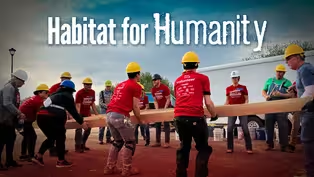
Video has Closed Captions
Clip: S38 Ep4 | 6m 37s | Habitat for Humanity partners with people to help them build a place to call home. (6m 37s)
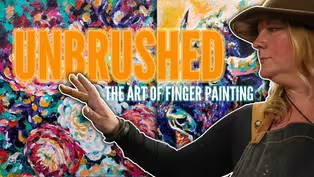
Unbrushed - The Art of Finger Painting
Video has Closed Captions
Clip: S38 Ep4 | 4m 55s | Christina Deubel, a finger painting fine artist from Spokane, Washington, specializing in wildlife. (4m 55s)
Providing Support for PBS.org
Learn Moreabout PBS online sponsorship











Support for PBS provided by:
Northwest Profiles is a local public television program presented by KSPS PBS
Funding for Northwest Profiles is provided by Idaho Central Credit Union, with additional funding from the Friends of KSPS.