
Your Vote Your Voice
Spokane County Prosecutor Debate
10/19/2026 | 28m 19sVideo has Closed Captions
Hear from the candidates vying to be Spokane County's next top attorney.
Hear from the candidates vying to be Spokane County's next top attorney. Current prosecutor, Republican Preston McCollam, and Independent Danny Tarkenton, a former county deputy prosecutor, face off on the KSPS PBS debate stage. They take questions from journalist Nick Gibson of The Spokesman-Review and Valerie Osier of RANGE Media at KSPS on October 13.
Problems playing video? | Closed Captioning Feedback
Problems playing video? | Closed Captioning Feedback
Your Vote Your Voice is a local public television program presented by KSPS PBS
Your Vote Your Voice
Spokane County Prosecutor Debate
10/19/2026 | 28m 19sVideo has Closed Captions
Hear from the candidates vying to be Spokane County's next top attorney. Current prosecutor, Republican Preston McCollam, and Independent Danny Tarkenton, a former county deputy prosecutor, face off on the KSPS PBS debate stage. They take questions from journalist Nick Gibson of The Spokesman-Review and Valerie Osier of RANGE Media at KSPS on October 13.
Problems playing video? | Closed Captioning Feedback
Where to Watch Your Vote Your Voice
Your Vote Your Voice is available to stream on pbs.org and the PBS app.
Providing Support for PBS.org
Learn Moreabout PBS online sponsorshipThis is a KSPS PBS Vote 2026 Special featuring candidates running for the office of Spokane County Prosecutor We are pleased to bring you this debate featuring the candidates running for Spokane County Prosecuting Attorney.
Republican Preston McCollam currently holds the seat.
He was appointed after Larry Haskell retired in 2025.
He faces independent Danny Tarkenton, a former county deputy prosecutor.
Let's go ahead and meet those candidates.
Preston McCollam, we will begin with you.
Tell us about yourself in 30 seconds.
- Sure.
My name is Preston McCollam.
I've been a deputy prosecuting attorney or a prosecutor for about 13 years now.
I passed the bar in 2013.
I immediately stepped into public service as a deputy prosecutor, and I bring experience from serving in nearly every unit within the Prosecuting Attorney's Office.
Prior to that, obviously, I went to college, went to undergrad.
I was a wildland fire firefighter for five seasons through college, working for the US Forest Service.
And then I'm a proud husband and father, and live in this community with my wife and four children.
- All right.
Danny, on to you.
- Yes, I'm Danny Tarkenton.
I have an educational background in philosophy as well as psychology, a minor in developmental psychology.
I'm also completing my master's in forensic psychology full-time this December, and I'm a veteran that has served in Iraq in 2016 on top, of course, my law degree.
So I am passionate about finding better ways to be efficient and effective when it comes to helping out our community.
So I'm dedicated to public service and I'll continue my dedication, thank you.
- All right.
Thanks to you both.
The candidates will answer questions tonight from two Spokane journalists, Nick Gibson from the Spokesman Review, and we have Valerie Osier from Range Media.
Thank you both for joining us.
- Thank you.
- Let's go ahead and talk about the debate rules before we begin.
The panel can ask the same question to both candidates or can direct the question to just one candidate.
The panelists may request a follow-up to the answer.
Candidates will have one minute for answers, and are allowed two rebuttals for the entire debate.
Rebuttal length is limited to 30 seconds.
Now a coin flip determined that Preston will take the first question, and that will come from Valerie.
- The Prosecutor's Office stated mission is to protect the public by providing competent and ethical prosecution, superior victim services, and seeking justice in every case.
Do you think the office is currently doing a good job of fulfilling that mission?
And what, if anything, would you change?
- I absolutely do think that the office is doing a good job of fulfilling that mission.
That is a very important mission that we have a whole host of dedicated public servants that work in that.
We have 11 victim/witness advocates in that unit that provide victim services.
It's certainly not enough for the volume that we have or for the needs of the community, but we have incredibly caring people that provide those services to our crime victims.
At any given time, if anybody's been following government offices, and especially prosecuting attorney's offices, you know that we're down in staffing.
And so at any point, we're down 20% to 30% of criminal attorneys, and that's not unique to Spokane, but what I can say is that of the individuals that are in that office, they're incredibly dedicated, they're incredibly passionate about providing services and enforcing the law.
And we have an amazing group of attorneys that come in, day in and day out, and work very hard for this community.
So yes, we are doing a good job of fulfilling that.
Can we do better?
Can we utilize more resources?
Absolutely.
And so that's something that I've been fighting and advocating for every day in this position.
- And Danny, same question.
and what, if anything, would you change?
- I think that our office is trying to fulfill that mission.
I think that prosecutors deeply want to be able to fulfill this when it comes to public safety, ethics.
But again, it's all about kind of the work environment.
So our deputy prosecutors are extension of the elected.
So that's why it's really important, we want to elect officials who support providing ethical prosecution, to apply the facts to cases, and to reassess those cases as necessary once material facts come about.
It is about resources, it is about funding, of course.
And while my opponent does mention that it's not unique to Spokane when it comes to the funding, but it also very much is whether or not do you want to work somewhere.
Some people like to ask themselves, I'm okay with the funding as long as I enjoy where I work.
I'm okay with the funding as long as I enjoy where I work.
And we can't seem to find the personnel to fill these spots, regardless of whether or not there is less pay or more pay, because my opponent did increase the pay, because my opponent did increase the pay, but yet we still can't seem to fulfill the staffing.
So my hope is that we can get to that point.
- Rebuttal, go ahead.
- Yes.
And again, that answer comes from a position of, frankly, a lack of knowledge.
We have individuals in this position that, again, We have individuals in this position that, again, they're striving day in and day out to provide a quality service to this community.
And in terms of pay and staffing, as my opponent said, the deputies are an extension of the prosecuting attorney.
And that's incredibly important because the prosecuting attorney has to understand because the prosecuting attorney has to understand what the needs of the office are, and the prosecuting attorney has to understand what your people are going through in order to understand how to advocate for them.
And that's something that I can do, and have been doing very effectively.
- All right, time's up.
Nick, you have next question.
- Thank you, so part of this leadership role is managing a budget and large staff as the county faces hard financial times.
Ahead of 2027, the commission will need to close an expected deficit of between 20 to 30 million.
How would you go about deciding where in the office to make cuts if given that directive?
And Danny, we'll start with you.
- Sure, well, it starts by having to open up those referrals to restorative courts and diversion.
So pretty much anytime somebody is incarcerated, it costs about $80,000 to incarcerate them.
But if we actually utilize these restorative courts again, then the likelihood of them not coming back decreases as low as 14%, but by doing that also, it doesn't cost as much for them to be there.
So WISP data has shown us that it costs about $6,000 to have somebody complete a drug program, whereas somebody who's incarcerated every single day for 30 days is about $7,600.
So by opening up these restorative courts and diversion referrals again, we could actually reduce some of that funding.
Again, I'm all about being efficient and effective when it comes to prosecution.
So if there are ways that we can be more efficient about that, such as assessing our misdemeanor courts, then we can now reduce some of that, and it reduces the load for the felonies, and then again, overall in time, it will save us money.
- [Nick] Preston.
- So the office is already operating at a incredible efficiency rate.
And again, that statement that incarcerating somebody costs $80,000, again, that's a misunderstanding of where those funds come from and who pays for them.
If somebody is sent to prison, then that's paid for at the state level, not at the county level, and it won't impact the county budget.
What we have presently in our jail are individuals who are violent offenders, by and large.
Of the about 500 local folks sitting in our jail right now, 97 of them are there under sentence.
So they've been sentenced in a municipal district court, or they're serving a local sentence on a felony.
But of those numbers, we have 300 of them are class A and class B felonies.
And a good portion of those, about 50 plus, are child sex offenses, rape offenses, those are class A sex offenses, individuals who are a danger to the community.
And about 30 of them are there for homicide.
So again, the costs that are occurring here are not due to a lack of efficiency.
It's simply a cost of protecting the community from violent offenders.
- [Dana] All right, Danny, you have a rebuttal.
- Yeah, so actually a lot of that data is a lot of people that are in that county jail, not only does it cost about $58 million a year to operate our county jail, it does cost about $80,000 per person, but also a lot of what's taking up the jails right now, at least the county jail, are pretrials, so people that are waiting to be seen for trial.
So I understand what my opponent is trying to say here, but again, it is about being efficient, because if you can reduce the recidivism rate, then there are going to be less likely for people to commit crimes again and overall reduce the volume.
It'll save us money.
- All right.
Valerie, you have the next question.
- Ms.
Tarkenton, you've said that trial experience is not necessary to be considered for the role.
While Mr.
McCollam, you've pointed to your time in the office during your campaign.
What experience do you believe is necessary to be a good county prosecutor, and why is that you and not your opponent?
- Yeah, so experience that is required to be a good elected prosecutor, again, it is a leadership role.
So while I understand the need to do a trial, in which case I've said it's three days, but what you really need to be in this role is to be a leader.
You need to have leadership qualities and experience, which I do have an extensive amount, not only just from my time in military service, but also when I was working as a training NCO.
It is about having that independent judgment to be able to lead that office.
It's also about having the passion to be loyal to the Constitution as well as your people.
So again, you don't need trial experience to be loyal to the Constitution or loyal to your people.
What you do need to have is to be able to have those values to wield your experience responsibly, which is what I have.
And if I felt that my opponent had those qualities, I wouldn't be here.
So right, trial's great, but the whole purpose of being the elected is to find the recruiting and retention to be able to have people be able to do those trials.
It's about leading as much as managing.
- [Valerie] Same question for you, Preston.
- So selecting a county prosecutor is, in fact, selecting a county prosecutor, not an HR role.
You're not selecting a recruitment and retention coordinator.
What you're selecting and the people are choosing is an individual who's capable of actually accomplishing the duties of the job.
And the duties of the job are laid out in RCW 3627.
That's the chapter on prosecuting attorney.
And that is to, at a minimum, your prosecuting attorney should be able to enforce the law.
In order to enforce the law, you have to know what it is.
It's easy to say that you can be loyal to the Constitution, but at the end of the day, the Constitution is the law of the land, and we are a nation of laws or we're not a nation at all.
So what a prosecuting attorney does is we enforce the law while protecting the constitutional rights of our citizens, making sure that we're not violating their constitutional rights during the investigation or arrest process, during the court process.
You have to be familiar with the state constitution.
You have to make sure that the individual's rights to privacy are not being violated as well.
And so I'm the only person on this stage that has demonstrated an ability to do that and the experience and skillset to do that.
- All right.
Nick, I think you have the next question.
- Preston, we'll start with you with this one.
The state Supreme Court ruled five years ago in the Blake decision that Washington's drug possession laws were unconstitutional.
This brought about a change in state law to where possession and use of illicit substances is now considered a gross misdemeanor.
Do you believe that current state laws around drug possession and usage are sufficient?
Why or why not?
- I do not believe they're sufficient.
I think that we've seen in the state of Washington what experimenting with that particular law has done.
Unfortunately, that ruling came coextensively with fentanyl coming onto the scene in vast quantities.
And the lethality rate of fentanyl is such that it surpasses any other type of drug that we've known before now.
The addictive cycle of that is not something that you can cure within 30 days, or 60 days, or 90 days.
You need a nine to 12-month program, or a 12 to 18-month program.
And unfortunately what was done, whether inadvertent or intentional, is that we have effectively removed rock bottom for individuals who otherwise could have gotten treatment, either in a prison system or through the Department of Corrections.
We've also removed any supervision of those individuals and removed their ability to potentially get clean.
And so it is a huge problem.
I do think that's an area where reform needs to come, especially in light of fentanyl.
It is different than methamphetamine, it is different than heroin, and we need to respond accordingly.
- Ms.
Tarkenton, what are your thoughts on state policies around drug usage and the role prosecution would play in that?
- Right, so somebody shouldn't have to hit rock bottom or be arrested in order to get the support they need to overcome their addiction.
These are people trying to recover, or they are struggling with addiction or substance abuse.
And again, that's where my experience is relevant to this because I actually understand that journey that somebody needs to take in order to get clean.
But I assure you, every time somebody is incarcerated, it is both cognitively and economically destabilizing.
So every time we do that, in hopes to get them help because they hit rock bottom, according to my opponent, we're actually making it worse.
We are increasing the likelihood of them returning to the system, and again, more destabilized, in which case then at that point, then they revert back to the drugs.
So again, we need more than just somebody who can do trials in order to do on this role because this is policy-forward, and we need a prosecutor who actually understands the needs of their people so we're not just putting people in cages.
Valerie, I believe you have the next question.
- This one will go to Mr.
McCollam first.
You and your predecessor have been criticized for never prosecuting police officers who kill civilians on duty.
You recently ruled eight SPD officers were justified in the fatal shooting of Joshua Musselman.
After that ruling, text messages between several of those officers were brought to light in a lawsuit in which they admitted that they hadn't established probable cause, hope they, quote, "Hit him at least once each, LOL," unquote, and strategized what they would say in their reports.
Do you stand by your original ruling and do you feel like you enforced the law here?
And is there anything either of you would change about the process for investigating and prosecuting fatal police shootings?
- So I will sharpen something that you said.
There were not eight involved SPD officers, there were only four in that particular case.
In terms of that case, I'm not gonna comment about the specifics of it.
In light of new information that was brought to my attention, I submitted that back to the Spokane Independent Regional Investigative Team to do additional follow up.
And so that matter should be considered active and ongoing at this point.
In terms of reviewing these types of cases, I hear this spouted a lot of, "We've had all these shootings and you didn't charge somebody," but it's very much like walking up to a doctor, a medical doctor, and saying, "Hey, you did 50 surgeries and nobody died.
I think somebody should have died by now," right?
If law enforcement is doing their job correctly, then they should be acting under the strictures of the law.
And what we do when we review a case is we take the actions of those officers and we apply them to the law.
It's no different than what you ask a jury to do, except we're doing it in a very tedious fashion.
And so in each circumstance, when you're applying the law to the facts, and if their conduct fits the facts, then there is a result that will come out, and I will be transparent in those results.
- All right, thank you.
Time's up.
- All right, thank you.
Time's up.
Valerie, did you want to ask the same question or are you moving on?
- Yes.
I can ask the same question.
Is there anything you would change about the process for investigating and prosecuting fatal police shootings?
And for Preston, I had asked if he stood by the original ruling, which you didn't rule on it.
- Okay, yeah, well, I'm really happy that my opponent has decided to reconsider this after it's been publicized during his candidacy, his campaign for it anyway.
But that's where my degree, again, that's where my expertise comes in, is that we need to have an Office of Independent Investigation, Office of Independent Prosecution.
And that is because, with my forensic psychology background, is that it is impossible for people not to be biased.
And the closer you are in proximity, the harder it is to be able to objectify the issues here.
So that's why we've already tried to implement it, four times, I believe, and we're trying to get the Office of Independent Investigation over here on the east side of the state.
Like I said, this is a perfect example of why it is the prosecutor's office should not be prosecuting or saying if these are justified at all.
It's for exact reasons like this.
Just to use the analogy of a surgeon in killing people and an officer shooting people is an interesting choice that I would have not have picked as my answer.
So I think we should implement those offices immediately.
- [Dana] Okay.
Preston, you said you have a rebuttal.
- Yes, again, the duty of a prosecutor is to enforce the law within the jurisdiction in which you're responsible for, and you're to do it without fear or favor.
And it's no different than looking at a murder case, looking at a rape case, and applying the law to the facts, and being transparent in that decision.
And there's far more transparency in these officer-involved shooting reviews.
These are the first two that I have done, and I am committed to making sure that the public is aware of why I've made the decision that I've made.
I've released these directly to the public and directly to the media at the time that I've made the decision, and that is a commitment moving forward.
- All right.
Preston, that is your final rebuttal.
And now we're off to Nick for the next question.
- There is a months-long effort underway to bring about an overhaul of our regional criminal justice system, led by a group known as the Safe and Healthy Spokane Task Force.
One aspect of their planning would be a new jail facility.
County officials say the current one lacks resources, space, and is aging very poorly.
What would an ideal facility look like to you, if elected prosecutor, and would you support a regional sales tax initiative to help fund that facility?
And Ms.
Tarkenton, we'll start with you on this one.
- Yeah, well, an ideal facility should be able to offer resources to help rehabilitate people that are incarcerated.
So the goal is not to jail people, the goal is to help them rehabilitate because harm has been done to the community.
That's the whole goal.
So education, workshops, shadowing, of course, we have medical care, but we're supposed to have adequate medical care, be able to have their treatment.
Again, you shouldn't have to be arrested in order to get treatment.
So yeah, jails should be focusing on rehabilitation, not incarceration.
We shouldn't be putting people in boxes.
When it comes to the tax, no, I don't.
I think we need to assess whether or not we can be more efficient and effective when it comes to that.
As I mentioned before, it's $80,000 per person that's inside that county, it's $58 million.
But if we can reduce the recidivism within Spokane County, then people are less likely to recommit, and therefore we can help reduce some of that so we can use that, the money we do have, to repair the jail we have until we can ensure we don't need two jails, because we don't.
- All right.
- Mr.
McCollam.
- So it's abundantly clear to everybody across nearly every discipline within our community that we absolutely need a different approach and a different facility in order to facilitate the needs of our community.
Our jail has effectively aged out and it's beyond capacity.
And the individuals that are in there are not receiving amenities that we should see in a community of this size.
And that does include things like treatment, rehabilitative options, but a jail also serves a function.
It's not just to put somebody in a box.
It's to protect the community from dangerous offenders, or violent offenders, especially in a pretrial situation.
The county jail should not be the place where people are serving their entire sentences on a felony.
The idea is that you have a place that allows them to be housed in a humane way.
You have a place that allows them to engage in any programming that could potentially get them out of that situation.
But right now, and the example that I've used, is that we're trying to provide a hospital level of care out of an ambulance in a backfield, it's wholly inadequate.
And our systems, our jail system, our medical system, our behavioral health systems, are grossly overtaxed at this point.
- All right.
Valerie, you have the next question.
- As for the courts, the Spokane County Public Defender's Office is in the midst of a lawsuit against the county over caseload standards, and there's complaints that public defenders make between roughly $5,000 and $10,000 less than their prosecutorial counterparts.
Is there anything you would seek to change about the relationship between the two offices?
- So I can't comment on pending litigation presently, but in terms of the pay issue, the public defenders have typically always been matched to whatever the prosecution pay has been.
So when I've advocated for a pay increase for deputy prosecutors, that applies to public defenders as well.
The pay discrepancy between the Public Defender's Office is a function of their bargaining agreement.
So counsel for defense is a non-repped office, also public defenders under Spokane County umbrella, and they should be making the exact same rate of pay as deputy prosecutors and they just track evenly there.
In terms of the relationship between public defense and the county, again, public defense is a constitutional right.
We need to make sure that we're providing individuals with the ability to a constitutional defense, and that's something that we absolutely have to do.
Unfortunately, this caseload standard discussion has essentially foisted on the municipalities and the counties a massive unfunded mandate.
There's been no additional funding in order to address this issue at the county level.
about the relationship between the two offices?
- Well, as a prosecutor who worked there and worked with public defenders, it's really great to actually have a working relationship because public defenders want the same thing as prosecutors, that is to resolve the harm that has been done against the community while protecting each other's rights, while thinking about both the harmed and the harmer in that situation.
So I think we should stop seeing each other less as professions or case numbers, but really we should really start be seeing people as a community and people.
So I don't know if, I guess to be elected, I would encourage that.
Like I said, I think that both offices want to go in that direction, we're just not encouraged to go in that direction.
When it comes to, again, yeah, PDs are unionized, sure.
And PDs do a lot of work.
Public defenders do a lot for our community, and they do a great service for that.
So again, I'm really happy for them.
Everybody should be able to have competent counsel.
So when they are overburdened to where they feel like they can't do that, I'm happy for them that we're able to get that volume of cases down so they can do that.
- All right.
This next question will be our final question.
Nick, go ahead.
- Thank you both for being here today.
Recent reporting by Range Media found artificial intelligence may have been used to create materials for each of your campaigns.
Please define your personal beliefs on when it is okay to use AI to communicate as an elected official, and what your position would be on its usage within the Prosecutor's Office if elected.
And Danny, we will start with you.
- Okay, yeah, well, AI can be really great for spell check, make sure you're writing in active voice.
Yeah, it's really great for that.
But when it comes to using it in that office, absolutely not because of confidentiality.
So I do know that Lexis and Westlaw, they have AI integration into it, but even again, the hallucinations are still highly probable, so you'd still have to go and verify this anyway, to where why would you even want to use the AI services if you can't even rely on it?
So I don't encourage AI in that office to protect confidentiality as well as to make sure that things are accurate and again, efficient and effective.
But otherwise it can be great for spell check, and yeah, help concise your thoughts, so that's it.
- Go ahead.
- Just to clarify, the hallucinations, would you mind sharing with the public what you're referring to there?
- Yeah, so hallucinations, is it okay to affect my time?
- Nope.
Keep going.
- Okay, so hallucinations.
So sometimes AI can make up cases, or make up facts, or make up statistics.
And so that's why you don't want to rely on AI as the ultimate authority and source in any situation.
You always want to verify that and search for that yourself.
So again, when it comes to being a prosecutor, you don't want to waste time having to verify when really we do have the tools and skills and training to be able to look at these cases with Lexis or Westlaw or Bloomberg.
So again, hallucinating, yeah.
- And Mr.
McCollam, if you would finish up for us.
- So I think AI is an amazing tool that could be used in many circumstances.
I think it should only be used in the Prosecutor's Office setting for purposes like grammar revisions, or helping condense thoughts, or get concise, listing, and things like that.
So as soon as I was appointed into this role in September of 2025, I adopted an AI policy for the office.
I also required mandatory training for all the attorneys within the office, because we were seeing with, especially with a lot of the younger, more inexperienced attorneys in the bar, they were utilizing, because they didn't have the knowledge, they weren't able to catch some of the hallucinations that were popping up in briefing.
And so I invited the Washington State Bar Association to come to the office, present a training, and talk about, essentially, the perils of using AI, or generative AI to create legal work.
I don't think it has a place in creating legal work.
You need attorneys making decisions based on their experience and based on the context that they have from what they know.
- All right, time is up now.
But it is time for closing statements.
So Preston, we will start with you.
- Again, thank you for having me here.
If I were to tell the public one thing, I'd be honored to have your vote as ballots are released in the next couple of weeks.
And what I would submit to you is that you have a track record of who I am and what I have done.
I have not had this office for 10 years.
I was appointed into this role based on the vote of the county commissioners.
And I would submit to you that over the last 12 months, I have honored that public trust that was provided to me.
I've worked very hard to build an incredible team of people that love coming to work every day, that love serving one another, and ultimately they love serving this community.
I have dedicated my life to public service, in one form or another.
And what I bring to this office is a passion for this community, a passion for the law, but also the experience to follow up on what is necessary, and the experience to be able to protect crime victims from the worst amongst us in our community.
Because at the end of the day, a law enforcement agency like a prosecutor's office has to know what the law is, and I do.
- All right.
Danny.
- Right, well, I don't have Preston's experience, and that's right.
I don't have experience in rapidly-declining felony domestic violence cases.
I don't have experience in having to, again, review once or twice of whether or not a police shooting was justified until after it was made to light.
So I don't have that kind of experience, and that's not experience that I want.
But what I do have experience is is being loyal to the Constitution, first and foremost, and as somebody that was raised here, loyalty to every single person in Spokane County.
There's experience, but there's also values.
And if you do not have the values to wield that experience responsibly, then we are going to experience more of what we've been experiencing in the last 10 years.
My opponent, sure, he wasn't a head in 10 years, but he did contribute to the problem, and now he claims he wants to fix it.
Whereas I am here because Spokane County willed it.
Spokane County wants me to be here.
They want the change, they want to break the cycle.
And they know that I can do it because I have very diverse experience.
So I hope you vote for me November 3rd.
- All right.
Thanks so much.
That'll do it for the debate for Spokane County Prosecutor.
Our thanks to the candidates, Preston McCollam and Danny Tarkenton, as well as our journalists, Nick Gibson and Valerie Osier.
Stay tuned for the Washington State legislative debate, coming up next, This and other KSPS debates are always available for viewing at ksps.org, or on the PBS app, and on the KSPS PBS YouTube channel.
and on the KSPS PBS YouTube channel.
Thank you for watching.
(no audio)
 New
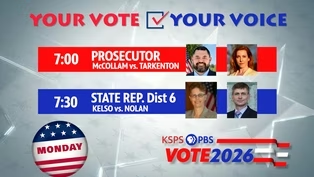
Prosecutor and District 6 Debates
Video has Closed Captions
Spokane County Prosecutor and WA State Legislature District 6 candidates debate at KSPS PBS. (30s)
Providing Support for PBS.org
Learn Moreabout PBS online sponsorship New Episode
- News and Public Affairs

Top journalists deliver compelling original analysis of the hour's headlines.
 New Episode
- News and Public Affairs

Today's top journalists discuss Washington's current political events and public affairs.
 New Episode
 New Episode
 New Episode
 New Episode
 New Episode



 New Episode
 New Episode


Support for PBS provided by:
Your Vote Your Voice is a local public television program presented by KSPS PBS