LA64
St. Martin Parish
4/1/2026 | 26m 46sVideo has Closed Captions
St. Martin Parish sits at the heart of Louisiana’s Cajun Country, with music, food, and heritage!
St. Martin Parish sits at the heart of Louisiana’s Cajun Country, where music, food, and heritage shape everyday life. The episode visits St. Martinville at the Acadian Memorial and beneath the Evangeline Oak and explores Breaux Bridge, the Crawfish Capital of the World, where Cajun and Zydeco fill local dance halls. Along the way, Karen paddles Lake Martin’s cypress-lined waters and meets artisan
Problems playing video? | Closed Captioning Feedback
Problems playing video? | Closed Captioning Feedback
LA64 is a local public television program presented by LPB
LA64
St. Martin Parish
4/1/2026 | 26m 46sVideo has Closed Captions
St. Martin Parish sits at the heart of Louisiana’s Cajun Country, where music, food, and heritage shape everyday life. The episode visits St. Martinville at the Acadian Memorial and beneath the Evangeline Oak and explores Breaux Bridge, the Crawfish Capital of the World, where Cajun and Zydeco fill local dance halls. Along the way, Karen paddles Lake Martin’s cypress-lined waters and meets artisan
Problems playing video? | Closed Captioning Feedback
Where to Watch LA64
LA64 is available to stream on pbs.org and the PBS app.
Providing Support for PBS.org
Learn Moreabout PBS online sponsorshipSupport for LR 64 is provided by.
Office of the Lieutenant Governor Billy Nungesser.
Keep Louisiana Beautiful and the Louisiana Office of Tourism.
In this episode of LA 64, hit the road with me to explore Saint Martin Parish, where the past dances the two steps to zydeco and waltzes in Cajun dance halls, where paddle trails are scenic roads through the Ottawa Air Basin and Cajun roots live on in modern day makers, culture keepers and cuisine.
Join me in the heart of Acadiana, where locals say Cajun began.
I'm Karen LeBlanc, a travel journalist and Louisiana native.
Join me on LA 60 for a journey through all 64 parishes, exploring Louisiana's less traveled path and.
Head.
Saint Martin Parish sits in south central Louisiana, right in the heart of Acadiana, Louisiana's Cajun country.
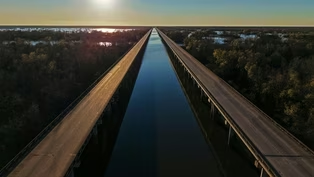
It stretches along the edge of the a chapel, a basin, the nation's largest river swamp.
Our road trip starts in Saint Martinville and heads north to Boroughbridge.
Crossing into Saint Martin Parish.
The sign greets me plain and proud.
Home of Louisiana's 57th governor, Jeff Landry.
Saint Martinville is known as the Petite Paris of Louisiana.
It's home to a concentration of Acadian settlers who arrived in the 1700s after their exile from Nova Scotia.
Present day ancestors, myself included, can connect with their roots at the Acadian Memorial and Museum.
A talking mural greets me, telling the story of the Acadian Expulsion by the British in the mid 1700s from Nova Scotia.
Joseph Broussard, also known as Beausoleil, led a group of Acadian families to Louisiana in 1765, where they settled in what is now present day Saint Martin Parish.
The opposite wall lists the names of Acadian exiles who lived in the region, etched in bronze.
So I'm a little and my ancestors are on this wall.
Many of the blocks came in the beginning, with, Beausoleil.
Broussard.
There were more than 3000 Acadians that found homes here in Louisiana.
The majority of those settled in the Saint Martinville area.
In honor of my ancestors.
I am going to do a rubbing of the very first LeBlanc listed on the wall.
Andre LeBlanc.
We head next door to the Saint Martinville Cultural Heritage Center, which houses the Museum of the Acadian Memorial and the African American Museum.
Right at the entrance.
We thought that it was very important to have the same text panels that showed the diaspora of the Acadians and the diaspora of the African, so that we can show our similarities of being moved or forced from our homeland to a new place here in Louisiana.
Well, let's go take a walk.
Before I leave, we head out to the courtyard where an eternal flame burns, honoring the Acadians and a replica of the deportation cross at Grand Prix in Nova Scotia stands, marking the location where Acadian families were gathered and deported by the British in 1755.
And I notice that the Loblaw yes, family sealed them.
One of the other main features out in the courtyard is that families were able to put their shields here for people to remember their family and the things about their particular family.
The Evangeline Oak stands as the fabled tree from Henry Wadsworth Longfellow epic poem, a symbol of love and loss rooted in Acadian exile.
In the story, Evangeline waits beneath its branches, hoping to reunite with her beloved Gabrielle.
Longfellow never set foot in Louisiana, but his tale of two lovers torn apart by the Great Expulsion gave this town its muse and one of its most enduring legends.
I stroll along Newmarket Street, pausing to check out these steep old boxes called Acadian Stations.
Think of them like Catholic stations of the cross.
Each one tells a chapter in the Acadian journey, all connected to Saint Martin de Tours Catholic Church, the spiritual and cultural anchor of this community.
One of the reasons why they were deported was for their faith, and so they brought that with them.
And it became, the primary glue, if you will, that held the family and the culture together.
All of the festivals, all of the celebrations throughout the year, all revolved around the feast of the church.
Acadian exiles founded the church in 1765.
It started as a simple wooden basilica and enlarged over time, retaining its original altars, including this tabernacle tucked into a grotto.
You'll see this altar in many, country French churches in France.
This simple, wooden altar with the tabernacle.
And around this was built the grotto of Our Lady of Lourdes.
You can see here.
The one who designed this actually used chicken wire stuffed with mucilage, which is the mud and clay from the bayou Tash, and plastered it on top.
Just off to the side of the church, in a quiet graveyard, stands a statue of Evangeline.
It was a gift from actress Dolores del Rio, who played the role in the 1929 film shot in Saint Martinville.
She even posed for the statue herself.
Why it's worth heroine put Saint Martinville on the map for visitors in the early 19th century and inspired the namesake of Louisiana's first state park.
Welcome to Longfellow Evangeline State Historic Site.
Well, Ranger Joe, thank you so much for meeting me.
And I appreciate the attire.
What do we dress as?
Sure.
So I'm dressed as an Acadian woman in the 19th century.
The interpretive center chronicles plantation life and Acadian and Creole culture.
It provides context to tour the rest of the property.
In addition to our interpretive center exhibits.
Here we have an 1815 Creole plantation home that was built for the Olivier family.
They can walk out and see the plantation.
We also have, two reproduction cabins on site.
Before I say goodbye to Saint Martinville, I met up with Mayor Jason Willis.
His family has called this place home for six generations.
I wanted to know, what is it about this city that keeps people rooted here for generations?
And we have one of the most beautiful bayous.
You know, we have beautiful trees, you know, most beautiful oak trees.
And down south Louisiana.
You know, we have the best food.
I'll put our food up against anybody, you know.
You know, we have different culture here.
You know, it's just quiet.
It's like, we want our place to be, like a be a real community where people come to reside, you know, and then coming to work other places.
Just because this is family oriented is safe.
Next, I head to Breaux Bridge, the crawfish capital of the world.
Crossing the bayou into a historic district that proudly proclaims its title.
Locally owned shops, still old buildings and public art surprises you, even on utility boxes.
Since 1959, the Crawfish Festival has drawn over 30,000 people each May.
For the food and the music, only authentic Cajun and zydeco bands take the stage.
If you come to the bridge, be ready to dance.
And if you can't, maybe take a lesson first.
Hi there Reginal.
Hi Kara.
I am so excited for my authentic zydeco dance lesson today.
But I got to tell you, I have a confession.
The last time I took a dance class was as a member of my high school dance team, and that was kind of like, that donut that that what I know how to do is.
Oh, you're.
You are in for a challenge.
Well, even when you just did that, let me know that you're ready because you still have the rhythm and the move.
Reginal Hamilton learned the zydeco two step as a kid, dancing alongside his moms and his aunts.
These days, he is a sought after instructor, and lucky for me, he's agreed to teach me the basics.
It's a four count step with three positions open, closed and free.
The lead starts on the left foot and the follower that's me starts on the right.
Hey, look at us.
Open!
Hey, do.
I'm feeling pretty good about mastering my moves.
Until Reginald throws in a turn and I try to twirl.
Falling out a step.
Yeah, that move is going to take some practice.
After our lesson, we sit down to talk about the origins of zydeco music, which started as Lala traditional Creole house party music.
The music itself was tank of change.
And, as it evolved, because of the, sound and the rhythm make came more upbeat.
Became called zydeco, which means snappy snap sound, pappy sound.
So then evolved into zydeco.
What gives zydeco its signature sound?
It's a blend of your island African sound, mixed with blues.
Some country, Western French.
It's kind of like a gumbo.
By Saturday morning, I was ready for the dance floor and brunch.
Good morning.
From Buck and Johnny's world famous zydeco breakfast.
Locals line up early for this Saturday morning event.
Doors open at eight, and when the coffee mug says, long d'affaires, you know you are destined to get up out of your seat and dance, which is what I'm going to attempt to do.
And I stress the words attempt in the whole.
Gorilla day and the zydeco band take the stage and people of all ages band out on the dance floor.
I spot reginal in the crowd and we put that dance lesson to the test.
Saturday night I danced up the dance floor at La Policia Cajun Dance Hall and Breaux Bridge, one of the last in Acadiana and the oldest in the state.
Lawrence Patton, his wife Judith, and their daughter Nicole run the family owned dance hall founded by Lawrence's parents in 1955.
Its nickname is the Little Cathedral of Cajun Music because countless Cajun music legends have played on its stage a lot.
Yeah, it's a French name, a Cajun name, and it's the translation for the Dutch.
And really, what it was, is after night of dancing, people shuffling their feet, you know, and stuff and accumulate.
There's nothing unique about the building, you know, it's the people.
It's the people.
The people that makes that make the atmosphere that made us what we are.
You know, I mean, you get to embrace the the music in the culture and.
Le Boucher opens its doors on Saturday night.
And for a small cover charge, collected with a smile by Judith at the door, you can waltz the night away to live Cajun music.
On the other side of the Levee and Breaux Bridge.
On any given Sunday, you'll find another Cajun dance party at Cypress Cove Landing, Jordan Thibodeaux, a Cajun musician, co-owns the venue and electrifies the stage with his fiddle playing and dancing.
I caught his last Sunday family friendly dance party of the season.
In late November, he performed with his band de la.
I'll do a bicultural dance.
It's going to be French music.
Every Sunday.
We have hundreds of people show up from everywhere.
I mean, all of our local people, as the intent behind it.
But we've now gotten to the point where we've got tourists coming in from all over the country, all over the world.
And, doing that, we do houseboat rentals.
People come and stay in those.
We do.
Got it.
Alligator hunts.
Jordan is a Cajun culture ambassador for Louisiana.
He travels the world promoting the language, heritage and traditions.
When you're on stage here, what is your soul saying to the people out there through your music and your storytelling?
Oh, I guess it depends on the song.
I mean, all of my songs, stories about my real life, you know?
So, I mean, they all mean something to me.
I feel like I grew up with a whole generation before us that was kind of doing everything they could to Americanize, you know?
And I watched a lot of my peers do that, and I never felt the need to do that.
I was always just more proud of who we are.
I thought it was awesome, you know?
And the more I've traveled and the more I've learned, like the uniqueness that we have in South Louisiana, the more I celebrate it.
And to me, all of our big dances, that's all it is.
It's just a big celebration of who we are.
When you play with what you shape.
Next, a change of pace.
As I head out to kayak on Lake Martin with my pack and paddle guide, Michael Van Eaton.
Lake Martin sits at the heart of the Cypress Island Nature Preserve, a protected swamp and hardwood forest that's among the largest in the Vermilion watershed.
We paddle along the swampy edges populated with cypress and tupelo trees.
Michael, I just paddled up to this huge bald cypress tree.
Any idea how old this is?
I've been told the tree is a little over 500 years old.
This is the largest tree trunk out here on Lake Martin that I know of.
We spot an alligator sunning on a log.
It's a rare sighting on this cold day in January.
Lake Martin is a popular spot for photographers and birdwatchers.
There's something very mystical about the scenery, and it's so peaceful, yet so close to urban life.
I launched my kayak from the Breaux Bridge boat launch, where swamp tours also depart, and I passed a few while out on the lake.
Lake Martin lies within the Falluja basin, North America's largest river swamp, spanning 1.4 million acres.
Bayou Tash runs parallel to the western edge of the Atchafalaya Basin.
The bayou was once the main course of the Mississippi River, and it flows through Saint Martinville and Breaux Bridge, offering another way to experience the beauty of the basin.
The Tesh project created paddle launches, providing easy access to the bayou, which is a national paddle trail.
It's quite a prestigious title, and it enabled us as a project to get funding to build this paddle trail and put these docks in the Bayou Touch Paddle Trail.
National Paddle Trail, spans around 100 and 32 miles.
There are paddle trail docks and 15 communities along the bayou, with the furthest south one being in Patterson, the furthest north one being in Port Barre, where the bayou starts off the Bayou Catawba and Port Barre and, it's it's an amazing journey down the trash.
As just about anyone living in Saint Martin Parish for the best place to eat.
And they'll point you to Postgres and Breaux Bridge for their plate lunches.
The pig pen at the base of this sign hints at its origins as a slaughterhouse along bayou tests in the 1960s.
Today, post operates as a meat company, grocery store, and restaurant.
Locals say when you come to posh, it come to order the crawfish and Fay served over rice dressing and topped with fried shrimp.
It's for those in the no way to eat it so that is what I will order.
What locals didn't tell me is yeah, gotta come hungry.
We're going to portions.
On any given day, you'll find owner Floyd Posey behind the counter and in the kitchen.
For 50.
Years and counting.
He took over the store from his dad in 1976.
I'm here every day.
Checking on him.
You know, I had some people that helped me cook.
Not that I got old, but, you know, just make sure everything is done right.
And he plans to retire Floyd.
On not too long ago.
When I travel, I'm always on the lookout for locally made products.
Shopping local is really a way to connect with a sense of place.
Louisiana has a program called Certified Louisiana that supports artisans and growers, people that make products right here in Louisiana.
I'm taking you behind the scenes here in Breaux Bridge to the workshop of woodworker Eric Cuvier, who turns Sinker cypress into gorgeous furniture.
Eric Julian owns live Edgewood Works and salvages sinker Cypress straight from his hunting land deep in the Vallejo Basin Outback.
Stacks of water soaked cypress pulled from the swamp bottom, air dry and wait their turn at the mill.
That's the beauty of Sinclair Cypress, and that's what makes it beautiful.
Is the cypress an oil that's in it.
The minerals, or seeped in mostly to the outside edges.
And when you when you cut it, you can see it.
I mean, you can see the greens, the blues, the blacks.
Erik builds his tables from his own designs, carrying on a legacy with every cut and curve.
Each one is a piece of history, a bit of heritage crafted for future generations to hold onto and gather around.
If I don't get them out, no one is going to get them out.
They'll be lost forever.
Watch live Cajun music in Louisiana, and chances are that triangle keeping the Beat was crafted by Brandy obey in her Breaux Bridge workshop.
The talented welder carries a torch for the Tea Fair or Cajun Triangle.
So I start out.
With, I use cold rolled steel, new steel.
When I started making them, I was, you know, set my intention to make a good sounding instrument.
So long ago, before amplification and before drums were a common thing in Cajun music.
You had a fiddle, an accordion, and maybe a guitar.
So the T-bar would help keep rhythm so it would ring out over the accordion because an accordion is allowed.
Instruments.
Brandy shows me how to play the T fair, which requires more technique than that generic triangle I played in elementary school music class.
The sound comes from the grip and release.
Saint Martin Parish is fertile ground for Louisiana made products by artisans and culture keepers.
Gerry Hale is a fourth generation cotton planter who invited me to his home, where he hosts tours teaching people all about the history and heritage of Acadian Brown cotton, a Cajun textile.
The seed has been handed down in an Acadian family for over 200 years.
The seed was slowly dwindling down because no one was planning it.
His wife, Mary Alice, transforms the fabric into handcrafted textile goods.
Each piece stitched with a story and tradition.
So the Acadians made two types of textiles.
They made a solid so it would be a solid white or a solid brown.
And then they made a stripe.
And how many heritage patterns were you able to discover?
So we have access to close to a thousand different patterns.
While exploring Saint Martin Parish, I wanted accommodations that rooted me and the region's story, so I mixed it up.
I split my nights between historic homes, bayou cabins, and the wild beauty of Lake Falls Point State Park in the Atchafalaya Basin.
The state park is 18 miles southeast of Saint Martinville, set in isolated nature along Lake 40 Point Lake, but with all your creature comforts, I hiked the well-marked trails, some crossing over quiet waterways, and followed a path to the scenic overlook.
Staying in the state park gave me a deeper connection to the wild beauty of the Alaia basin.
Good morning from May.
So, Madeline, here in Breaux Bridge, this is a charming 1840s French Creole cottage bed and breakfast that I'm staying at while I film throughout Saint Martin Parish.
And every morning I wake up to a home cooked breakfast by the owner.
She is Madeleine's snack.
Go morning, sleep well.
I did.
The bed was a dream.
Total bliss.
Oh very nice.
Madeleine Cenac specializes in historic interior design.
She bought the cottage, which had sat vacant on farmland since 1925, and moved it to Breaux Bridge, and she created a quiet nature retreat with gardens and several restored buildings.
The interior walls are filled with either, a modern modernist mixture which we call blues ij or brick between the posts.
And then it's plastered on top.
No centrally located chimney.
Those stairs on the front porch speak to the French culture and how they thought about interior spaces.
The place has a sweetness about it, and I know that if you come here, you'll feel it and remember it.
Mason Madeline is known for its secret suppers that immerse guests in the food, culture, music, and stories of Acadiana.
Guests.
Chefs include James Beard Award nominees and Grammy winning musicians.
The secret about the Secret Supper is that they don't know what they're getting into.
They don't know who's going to be here, who they're going to be sat next to, what they're going to hear, or what they're going to eat.
So it really does tie you to like the people who are living our culture are truly living it.
They're growing it, they're consuming it, and they're sharing it.
For a true bayou experience.
Rustic, real and rooted in history.
I stated Bayou Cabins and Breaux Bridge.
Lisa and Roxanna have restored old homes and built a little village along Bayou Tash.
They were all moved on to the property.
They're all from Saint Martin Parish.
They were 100 years old when we got them.
And plus 25.
So most of.
Them are over.
125 years old.
Authentic.
And we restored them.
Oldest cabin is, built in 1848.
It has the Blues yards, which is the.
Mud, moss and horsehair mixture.
Mason, Stephanie and Arnold Ville on the Saint Martin parish side of town, is a former estate built in 1796 that now host guest as a bed and breakfast with stunning gardens, a pond and a pavilion, making it a popular events venue.
We wanted to make certain that everyone who had ever touched, the property, the house, some of the enslaved, their ancestors needed to come in, and we embraced all of those individuals, along with the Acadians.
Here's my takeaway from my time in Saint Martin Parish.
I came looking for stories, and I found my own family roots etched in bronze.
I danced to the rhythms of Zydeco and Cajun, and learned how brown cotton becomes a thread of heritage.
And I met makers who shaped Louisiana's past into everyday beauty.
Saint Martin Parish isn't just where Cajun began.
If our culture continues, and every song, every spoonful and every step.
Support for LA 64 is provided by the office of the Lieutenant Governor, Billy Nungesser.
Keep Louisiana Beautiful and the Louisiana Office of Tourism, and by the Atchafalaya National Heritage Area, the Saint Landry Parish Tourist Commission, Northwestern State University, and by the Foundation for Excellence in Louisiana Public Broadcasting and Viewers like you.
Thank you.
Video has Closed Captions
St. Martin Parish sits at the heart of Louisiana’s Cajun Country, where music, food, and heritage sh (20s)
Providing Support for PBS.org
Learn Moreabout PBS online sponsorship












Support for PBS provided by:
LA64 is a local public television program presented by LPB