
Cottonwood Connection
Stagecoach To Breecher
Season 9 Episode 3 | 24m 43sVideo has Closed Captions
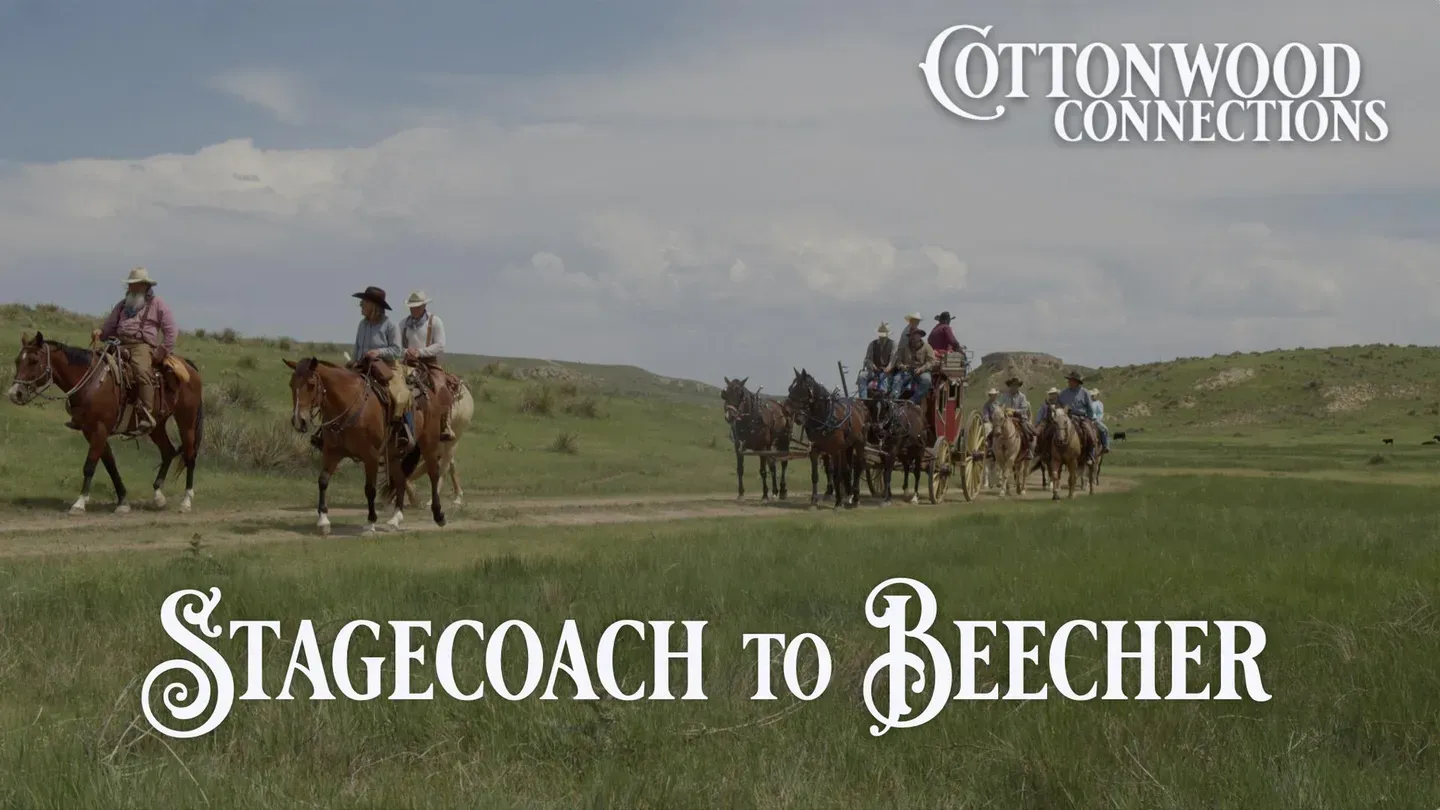
The Journey Stage Coach riders return for a trip from St. Francis, KS to Beacher Island, CO.
The riders of the Journey Stage Coach return to western Kansas for a trip from St. Francis, Kansas, to Beacher Island, Colorado.
Problems playing video? | Closed Captioning Feedback
Problems playing video? | Closed Captioning Feedback
Cottonwood Connection is a local public television program presented by Smoky Hills PBS
Cottonwood Connection
Stagecoach To Breecher
Season 9 Episode 3 | 24m 43sVideo has Closed Captions
The riders of the Journey Stage Coach return to western Kansas for a trip from St. Francis, Kansas, to Beacher Island, Colorado.
Problems playing video? | Closed Captioning Feedback
Where to Watch Cottonwood Connection
Cottonwood Connection is available to stream on pbs.org and the PBS app.
(upbeat music) A stagecoach rolling across the open prairie.
It is one of the most iconic images of the American West and one that can still connect people of today with the history and experiences of our frontier past.
(upbeat music) (upbeat music) There's a group called the Journey Stagecoach out of Missouri that has come to Western Kansas and they've been in the Cottonwood Connections along the Smoky Hill Trail and one of the last things that Journey Stagecoach did was a trail ride that went to Beecher's Island.
I'm JD Perry.
I'm from Wallace, Kansas and then I'm also a board member of the Fort Wallace Museum.
With the Journey crew we were introduced when they were out here looking for a route to go on the Smoky Hill Trail and then when they when we finished that run they started to talk about wanting to do another run out here in Western Kansas.
We decided on the Arikaree breaks, wanted kind of a challenge spot and something that they hadn't seen before.
We talked about from St.
Francis to Beecher Island.
Rick had been kind of interested in the Beecher Island area.
My name is Rick Hamby.
I live in West Plains, Missouri which is in southern Missouri.
Born and raised there.
We grew up farming and running cattle in that country and grew up with had a blessing of having grandparents who were most of them were born in the late 1890s, mid 1890s and was just always inspired by them and their stories and in 1999 I was blessed with finding an original 1880 Overland Stagecoach that had a great history to it and but as a family we've thought about it and prayed about it and decided we were going to do an Overland mail run from Springfield, Missouri to Tombstone, Arizona with the coach and since the old coaches carried mail we were going to carry mail and the mail we carry is we partner elementary school kids in Missouri with elementary kids out west and deliver pen pal letters.
So it's been a real treat.
It's been one of the greatest if not the greatest adventures in my life.
We have an incredible crew.
Everyone's for the same reason and it's about appreciating history, meeting great people like here in northwest Kansas and we've done this for 26 years now and honestly the people in this region there's something different.
The people have a depth to them of love of the land, camaraderie, helping each other, neighbors helping neighbors and they have just treated us so fantastic here and shared their history and their homes and their time with us.
A major element of the Journey Stage experience is the photography of Dennis Crider.
Well my name is Dennis Crider from Wichita, Kansas originally moved to West Plains, Missouri, 1969.
Worked for a newspaper for 39 years as a sports editor, head photographer for the West Plains Daily Quill newspaper.
About 15 years ago I hooked up with Rick Hanby and the stage coach crew and I think that what this does this keeps the West alive and I want to try to keep the West alive the best I can through the lens of a camera.
This trip has been exciting.
I've been able to have a radio show for the last 20 some years on American history and over the course of the time it's allowed me to research and study a lot of these great places and I've done a lot of these on Beecher's Island in this part of the country over the years and I always wanted to come up in here and stage coach and we were blessed to get to do a run on the Smoky Hill Trail.
Made some great contacts through that.
J.D.
Perry's our point man out in this area and he's a rancher's rancher, a cowboy's cowboy and just a top teamster in every way.
On the Smoky Hill Trail our driver broke his leg on that run and so we were needing a driver.
One of our younger crew members was wanting to start driving and J.D.
Perry is taking on the tutelage of him for this trip so it's really neat to see.
Been driving teams of horses since I was about eight years old and I have drove up to nine up at a time.
Matt Franks he was wanting to start learning how to drive the coach as far as he's never ever drovw a four up so I've kind of been teaching him how to how to handle a team of four up.
J.D.
's amazing he's just a wholesome guy I mean he wants he wants to do anything that he can to help you I mean he's he's fantastic.
You know he's he's took me under his wing I call him I tell him I'm his apprentice for driving I mean you won't find a guy that can handle a set of horses any better J.D.
Perry and and he's knowledgeable and he he wants to share that knowledge with you and I mean that that's that's rare to find people that want to slow down and take the time.
Fun it's fun you know it's a lot more stress I'll tell you that much you know when you look back behind you and you've got eight or ten people in that coach that you're responsible for and you got four horses stretched out in front of you that horses can be horses and they can do what you want so but it's fun I really enjoy it I mean it's a lot of fun to to drive and and visit with the people on the coach along the way too you know.
We're excited to see what each day holds and and how the good Lord will use it you know one of our goals is always to make a difference in someone's life and I think that is what we're here on earth to do is to lift up not to tear down.
We're going to be camping in the Breaks.
Today we'll be still on the plains but then I think tomorrow we drop off into the Breaks actually.
The Arikaree Breaks is northwest of St.
Francis, Kansas and north of highway 36.
You can take a road that goes up into the Arikaree Breaks by going straight north of St.
Francis and then you have to meander through that.
It's kind of a bad land or what people consider bad lands it's a lot of ravines and a lot of steep hills and it's is rugged country and is primarily ranch country.
The Native Americans were there for thousands of years they knew it and hunted in it.
And I can see why the old trails skirted north and south of it because of the terrain and and the it's ambush center for people from you know bandits or from Indians not so happy at having their land run over.
I can see why people went around it but I'm anxious to go right down through the middle of it.
Getting them into a spot that they'd never seen of western Kansas or Kansas period they didn't realize that the terrain could be so wild I guess is what you would call it in western Kansas.
Everybody talks about western Kansas being so flat and once you get off the beaten path there's there's a lot to see.
I was always told you know Kansas is flat as a pancake and it is in some places but up here in northwest Kansas holy cow you know it's it's gorgeous but uh it's challenging I tell you what J.D.
and I we we drove that coach through probably the most challenging terrain that's ever been in in 26 years.
Crossing through the old washes and gullies that there was time or two I seen this wheel right here off the ground and you have a load of passengers so.
Had a little moment where we we've gotten a pretty good bind that that could have been pretty bad on a big grade coming around we knew it was going to be pretty tough and you know we had ropes we have these ropes tied on the back of the coach and on the sides too for the tilt we'd ride our horses off to the side dally off to the side to keep the tilt from going too bad there was a couple of times I actually pulled the coach back down on the weight on its wheel yeah yeah it it was it was a nail biter.
By the grace of God and the outriders like Randy Harper and Rod Hamby I mean we got it all gathered back up and got everything pulled out and we kept her on the wheels and that's all that matters and we made it to the bottom so.
Just to see that breaks that I was and everyone was impressed with.
The Arikaree Breaks they're beautiful they're beautiful I wasn't sure what to expect and I was just amazed at the beauty of it and the enormity of it.
I've got some of the most fantastic pictures I think coaching the clouds are phenomenal I love photographing clouds some of the images that I've got I think are some of I've been on six runs I think the images I got on this trip are going to bypass everything else that I have gotten in these six runs.
And then as we come in we see a buffalo herd laying over on the hill and and you stop and you think my goodness I'm looking at something right here that honestly there was no fences no telephone poles no no high lines no windmills nothing and I'm actually blessed enough to be riding a good horse as courting a stagecoach across and I see buffalo laying here that probably looked the same exact way it did 150 years ago and it's rare in life that you get to see that.
But then boy of an evening when we were camped in a valley in the Arikaree Breaks one of the most of 26 years of coaching one of the most beautiful places I have ever been whether it was mesas on each side and a storm rolled in about 45 minutes before sunset in the sky the ominous clouds and everything and hail came and rain came.
I took a ton of pictures during that storm the book we're doing one chapter is going to be called the storm and then maybe 20 minutes before the sun went down there was a break in the western sky and you can see the sun and it was shining on the top of the mesa over here and it was fresh and green and the wind had died down and it was absolutely beautiful you have an appreciation for when the wind stops and you really soak it in.
The people are phenomenal out here and I think you see a holdover of I see a lot maybe more out here of people willingness to help others get make it.
I think the people that live out here in this region of the country uh have a camaraderie that's not even maybe spoken but they know the difficulties and and of just the weather and the terrain and and the elements and boy they just drop what they're doing and they come and they help you and they they help make sure that you've got what you need to get through.
I don't know there's a danger factor that comes in out here of just making sure you've got what you need but as we come across one thing I've been asked so many times what do you need what do you need and that's probably a phrase that we don't use as much as we should in our English vocabulary what do you need I don't know it's something to learn from that.
After navigating the Arikaree Breaks, surviving an epic western Kansas storm and getting a night of rest and nourishment under the stars, the stage crew prepared to travel the road to the Beecher Island Battle Site Memorial.
My name is Jeff Hurlburt and I'm a resident of about four miles south of here.
We're at Beecher island here so I became part of the board of back in like '05 I think and we're just pretty doggone excited about welcoming the stagecoach journey crew.
We put on a reunion of the scouts every year in September which is really close to when the battle occurred back in 1868.
In the mid 1800s people were moving west of course from the east coast and and Native Americans of course inhabited this place long before we did.
Native Americans were so mad because things were being done to eliminate them.
In 1867 and 1868 the Indians were still raiding all over.
They were they were getting desperate.
We're here to reenact the Battle of Beecher island.
Governor Crawford made a special task force of civilian scouts.
They couldn't get enough soldiers to patrol the area and their job was to trail the Indians and find them and then notify the army to get to where they ran.
And they were to be commanded by was at time a light colonel Foresyth.
He was supposed to get these frontiersmen.
They signed up first in Fort Harker in Kansas and then Fort Hays and then made their way onto Fort Wallace and embarked from Fort Wallace.
The men had to furnish their own horses because the army didn't have enough so they had to furnish their own horses but they furnished the arms.
They furnished repeating rifles which were some of the first they were Spencer's that were used in the late Civil War and also revolvers and also gave 250 rounds of ammunition for each man.
Long story short they ended up here on the banks of the Arikaree on the evening of September 16th 1868 and knew knowing full well that they were on the trail of a pretty large group of people native people.
The Cheyenne Dog Soldiers primarily but some Sioux and some Arapaho.
And they picketed their horses left some men out all night long to be on the lookout.
That morning they made contact.
The Indians had set up an ambush.
The scouts were just picking up the stuff to get mounted up to go and some young natives that was wanting to make a name for themselves ruined the ambush by coming down and trying to steal the horses run off the horses and the mules.
Really what that was was a wake-up call.
Everybody survived that initial attack.
Forsyth ordered everybody to get to an island which was a split in the Arikaree River, Arikaree Creek the middle fort to the Republican River here.
Get to the get to the island.
They started fortifying themselves digging holes in the sand.
Put their horses around the perimeter and just trying to fend off and survive.
A few minutes after that a group of some say six or seven hundred Native Americans were upon them.
The Indians put in a charge and their idea was to run over and this was a common thing to run your horses with the riders over the people and get them all confused and kind of shoot at them when they went by.
Well they had not realized that these people had repeating rifles so they had more of the fire power because as I stated very few muskets and mostly were relying on their bows and arrows.
The Indians charge the island and right off the bat Lieutenant Beecher gets shot and he's shot in the head.
It takes him all day to die and they charge the island several more times.
I think up to five of the scouts get killed.
I think Dr.
Moore gets killed.
Several get wounded and at that time they go back to get Roman Nose.
Roman Nose was a warrior.
He wasn't really a chief but he was still a leader in some Native's hearts.
That's what I feel that was at the time and he knew how to fight.
That was his thing.
He didn't want to conflict with bureaucrats of the tribes and so forth.
He didn't want to deal with that.
He'd rather just do what he'd you know he's like like a lot of us.
Why I wanted to do that?
I want to resolve the problem now.
That day Roman Nose didn't think he was going to battle.
They were going to fight yes but he was up there on the hill watching the battle with the chiefs and the leaders watching.
One of the leaders or chief told them they need you down there.
And there's a lot of things with that that he had broken his medicine.
That is the way he was supposed to live.
He was served meat from a steel kettle with a steel fork by a Souix and he wasn't supposed to eat meat served cooked or served with steel.
And usually normally you would bless before you go to battle and then you would bless you know that skillet because it was white man's metal.
So he probably blessed himself.
I read upon where he did a long blessing and cleansing himself.
And they said man we really need you and they kept galling him you know look at all your brothers and stuff dying here we need you to lead us in it.
So he got up and said he would and supposedly said this is where I die.
So when he went down and fought that battle was down there then he got shot.
It's said that he died at sunset and Beecher died at the sunset.
And that battle went for eight days.
They did send out some rescue folks two men the second night of the battle and another two men and some of them finally made it to Fort Wallace and some of them met up with the cavalry.
Captain Carpenter was with the company H of the 10th Calvary, the Buffalo Soldiers, was in the Cheyenne Wells area.
He got word first and came up here as fast as he could.
Today is a really big day to me.
I've been blessed to be able to do different radio shows on the Beecher's Island.
They're again one of those things that we read in history books.
Today you know we celebrate the fact that they're bringing in folks from the nursing home in Wray.
We get to deliver mail to them.
We've got special pen pal letters for those folks.
And we've got a bunch of kids going to show up.
Of course the stagecoach always carries mail and we've got kids here locally that have written letters and and they're eager to meet.
Meet the crew and exchange pen pal letters with young kids and seniors back in Missouri in the Ozarks.
We get to do a program with them and share history and God's love and the importance of there again the question what do you need and I think that's going to be kind of one of the themes that we talk about a little bit.
We have never been more received where people want to show us stuff and it's fantastic.
People bringing us waters and food just whatever we need.
We're truly blessed to just be welcomed and people want us to come and share the history of this area and it's so rich in history.
And so and then we're going to have a chuck wagon dinner all together and I'm sure hoping we can all sit around and play some music and sing and visit and talk about history later on this evening.
Even in this electronic age with all the competition of digital I've never seen a kid, little kids that do not like to sit and hear a story.
And I want to I would encourage everyone to be storytellers of your own history of where your come from and they will develop an interest and they will attach themselves to some point of history.
Really a neat memory for us 1964 I was five years old my older brother was seven.
My cousin right here was 12 and our mom and dad took us to Silver Dollar City and we got to ride this coach together and never dreamed that someday the Good Lord would have it back and plans again for us to get.
We wound up with it in 1999 and didn't know exactly I always say it was kind of like a dog chasing a car.
I didn't know what to do with it once I caught it.
But as a family we thought about it and prayed about it.
We decided to open our over overland stage line delivering mail from Springfield, Missouri to Tombstone, Arizona 1400 miles.
By the time we got to the end of that trip we realized that God had a mission for it and all along that route we got to meeting people who we needed and apparently they needed something we were doing too and there's not a better feeling in the world.
Storytelling will never grow old and that's where it starts with and then you take it from that and you help these these young ones then if you see a kid that's interested in some of these particular aspects of all this.
Spend time, take them to it you know search it out find them ways to be involved with it and they'll grow up doing something with it and it'll always give them uh we all like to know where we're from or why we're the way we are you know I look back and I think why why have I grown up loving history primarily it's because my grandparents were great storytellers.
My biggest encouragement is to storytell and and you will see a result long when we're gone you know but yeah tell stories never quit.
[Music] [Music]














Support for PBS provided by:
Cottonwood Connection is a local public television program presented by Smoky Hills PBS