SDPB Documentaries
Standing Proud: Women in Uniform
Special | 29m 50sVideo has Closed Captions
Inspiring stories of six women veterans and the impact of their service.
Standing Proud: Women in Uniform shares the stories of six women veterans as they reflect on their service, challenges, and achievements. From training to major world events like Vietnam, the fall of the Berlin Wall, and 9/11, they reveal how service shaped their lives, identities, and communities in South Dakota.
Problems playing video? | Closed Captioning Feedback
Problems playing video? | Closed Captioning Feedback
SDPB Documentaries is a local public television program presented by SDPB
Support SDPB with a gift to the Friends of South Dakota Public Broadcasting
SDPB Documentaries
Standing Proud: Women in Uniform
Special | 29m 50sVideo has Closed Captions
Standing Proud: Women in Uniform shares the stories of six women veterans as they reflect on their service, challenges, and achievements. From training to major world events like Vietnam, the fall of the Berlin Wall, and 9/11, they reveal how service shaped their lives, identities, and communities in South Dakota.
Problems playing video? | Closed Captioning Feedback
Where to Watch SDPB Documentaries
SDPB Documentaries is available to stream on pbs.org and the PBS app.
More from This Collection
War stories from South Dakotans

Swords & Plowshares - South Dakota & the Civil War
Video has Closed Captions
60-minute documentary about how South Dakota's Civil War veterans helped shape the state. (56m 45s)
Video has Closed Captions
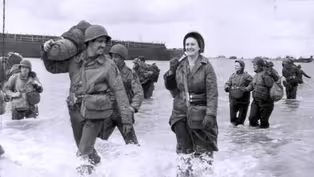
WWII Army nurses are interviewed today about their experience in France in 1944. (53m 57s)
Video has Closed Captions
Vietnam War veterans recounting some of their most poignant memories of their time overseas (56m 59s)
Video has Closed Captions
An estimated 26,000 South Dakotans served in the Korean War. These are some of their stories. (57m 22s)
South Dakota Heroes - World War II Stories
Video has Closed Captions
World War II stories that were shared with South Dakota Public Broadcasting in 2001. (26m 59s)
American Ace: The Joe Foss Story
Video has Closed Captions
The story of World War II ace & South Dakota Governor Joe Foss (57m 47s)
Providing Support for PBS.org
Learn Moreabout PBS online sponsorshipThis is a production of SDPB.
From the standpoint of a woman, all through history including the American Revolution, women have been involved.
Our democracy.
We need to make sure It'll be a safe place Everyone deserves freedom no matter what color or gender The people in uniform have volunteered to fight for that right.
We need to share.
We do.
We need to tell people what it was like and how far we've come today.
Standing proud.
Women in uniform is made possible with your membership in the friends of SDPB.
Thank you.
With help from Sentinel Federal Credit Union.
Proud to serve those who serve our country.
Sentinel recognizes the strength, leadership and dedication of women in uniform and the communities that stand beside them.
Thank you for your service.
And by Tactical Rehabilitation.
Promoting drug free rehabilitative injury management solutions.
Serving active duty veterans and their families nationwide.
We provide bracing, custom orthotics and at home therapy solutions.
Our certified team is dedicated to supporting your injury recovery.
Visit tacticalrehab.com or scan the QR code to learn more.
Travel.
That is what I really wanted, was travel.
And I've done a lot of traveling in the military and out of the military.
First door I walked into was the Marine Corps office "I want to join the military."
How tall are you?
And I was five.
Three.
What do you weigh?
"89 pounds."
"You're too skinny.
We can't take you until you were at least 100."
Oh, okay.
Went down the hall to the army.
Told them.
They said, "Oh, we'll fatten you up.
No problem."
So I joined the Army.
My goal was to live in Europe.
Live there for four years, learn a lot about the world, and come back and be a successful journalist.
And 28 years later, I retired from the Army.
USD, had a great program.
I was on a basketball scholarship.
and I didn't know anything about the military.
But as a future journalist, I thought I should.
So I took military science 101, and in the spring took 102.
They said, "You should apply for an ROTC scholarship."
and was like, "No, I'm not, I'm not really the military type."
My sorority sisters were like, "what?"
Well, wow.
That's interesting.
my family was, I would say, shocked, the cadet training was co-ed same standards, same courses.
back in the day, the commissioning ratio was they try to get 15%.
I don't know what it is today.
I've lost my last my pulse on that, but it was about 15% For me, it was a way to achieve what I wanted to in life.
Since I was 17, when I joined, I had to have both a parent sign.
My mom was all for it.
My dad was very apprehensive, and I caught him in a moment of frustration and busyness, and I just slid the paper across the kitchen counter and said, dad, I need you to sign this.
And he signed it.
That's.
Afterwards he realized what it was, but, I mean, he never farted or anything.
It was.
They were both proud.
It was a beginning of the rest of my life, and it turned out to be one of the best decisions I made being surrounded by people who didn't feel sorry for me, didn't know they should, I kind of got over feeling sorry for me too.
I was married Between my junior and senior year in college, and my husband was an AG teacher, went on a canoe trip in the Boundary Waters, and a storm came up he and some of his students died in, in the cold water it was ten days before our first anniversary, and a year later, I was ready to change careers looking at going and applying for jobs around Minnesota, just seemed overwhelming to me.
But going halfway around the world didn't.
So I looked at what was available in Vietnam, and there was a ship in the Navy off shore, and there were 70 Air Force nurses and 700 Army nurses.
And I said, with my advanced math skills, my best chance is the army.
So I went and got a guaranteed assignment to Vietnam.
1968.
My husband at the time, Bob Blom and I were married.
And he said, "Hey, you know, why don't you just do it too?"
And so I was like, "Are you sure?"
And he said, "yes, do it."
He said, "I think you will have a very good time and you'll learn a lot."
And he was right.
We, went down to Lackland Air Force Base together, and we get there and, we were separate.
Nothing was together.
Women were definitely separate.
were in the old World War Two barracks.
We had no air conditioning and It was kind of scary?
I've never really done anything like that.
You know, I was pretty much, a farm kid and, you know, and we didn't do a lot of traveling was mostly like up to the Black Hills and back.
So I didn't have a whole lot of background that way.
But going down it, it was nerve wracking at first, but then I realized I was really doing something I should be doing.
It was yes, I was there to be with my country.
I was there to say, I'm here.
I'm here to learn.
You tell me what I need to learn so that I can do my best because, that was that was what was in our family, our family history.
You do your best.
And so I didn't want to disappoint my parents.
Isn't that something to think like that?
But, yeah, I didn't want to disappoint them.
And there was a lot of things that we did, like the exercises and the marching and learning about, call it buddy care because it really was.
it was very difficult at first because I was not a runner.
And guess what you do.
You learned about not telling secrets.
That was really important thing that you learned.
Anything that you were told that you weren't supposed to tell outside.
It was very important to not do that.
And that was one of the, very important things that our instructors taught us.
You keep your mouth shut.
You don't share secrets.
I went to Fort McClellan.
And that was where my basic was and my advanced training, also When we were in basic and in our, advanced training, we wore the old blue PT uniforms that you starched so that that bell skirt stood up by itself.
We had tennis shoes for that.
If we were going to class and we had the old black oxfords.
mine finally wore out about 15 years ago.
I loved them!
probably '73, '74.
They introduced the new lime green, mint green uniforms.
And back then, secretarial was a big thing in the military.
So I went to the admin personnel clerical program that they had and Everything was Women only.
learned a lot about typing and the different forms and how to type up orders on the old way to make multiple copies.
It was a blue form for making multiple copies.
And then you took that out.
That was the original that they kept in the files.
You took that big blue form, and right now I'm smelling it.
Loaded it on to the mimeograph drum and twirled that thing as many times as you needed copies and that blue ink.
I can smell it to this day.
Oh, and basic training.
You went to a class on hygiene.
Makeup.
Hair.
How to dress, how to act like a lady.
We were not soldiers.
We were ladies.
[Training Video] "We do have certain ideas about how you should look in your uniform.
That the tailoring, the fit and how it should be kept.
And I guess sometimes we do express these feelings rather strongly.
Yes, ma'am. "
Oh man.
We would get out of class and the first thing we would do is if they weren't soiled or anything, you'd run in and you'd start starch in an ironing.
Otherwise, if you were washing them, we had a group that would wash them and another one that would starch them, and another one that would iron them and We marched everywhere.
we did not ride busses.
We marched everywhere.
You get there, you're scared.
Everybody's yelling at you.
But, you know, it was fun.
And, you know, just something we had to do.
my favorite was actually marksmanship.
When we got to learn how to shoot, I did really well.
a lot of it was just hands on obstacle courses, that sort of thing.
we were always told, you know, the North Dakota National Guard.
The most you'll do is maybe some sandbagging on the river.
And then, I'm in AIT and twin towers are hits.
They rolled in a TV, on a cart.
[News Broadcast] "this looks like it is some sort of a concerted effort to attack the World Trade Center that is underway."
and we were all just in complete shock and unsure as to what was going to happen there was a lot of talk of phone calls, and we weren't supposed to have cell phones and somebody had a cell phone.
So there was people getting in trouble for that.
And afterwards, that night was a long night.
Nobody really slept.
And I mean, we have to get through the training anyways, but that was always in the back of my mind, like, what is going to happen?
And then it was the night before I turned 20.
They call up and said, okay, we have our official orders.
You have to report here such and such date.
it was terrifying.
It it was absolutely terrifying.
My first duty assignment was Holloman Air Force Base, which was a, research development.
So they had the monkeys and the dogs doing the G-forces.
Then we had, fighter squadron.
And, we had a, 29 bed hospital.
We had nine nurses, doing three shifts.
24 hours a day.
In October of 64, I went to, flight school held in, Brooks Air Force Base, Texas.
to become a flight nurse.
And that's where I got my wings.
and my overseas assignment was goose Bay, Labrador, which is five hours by flight It was there for 15 months.
did all kinds of nursing, ob gyn, labor, delivery.
office nursing, med surge pediatrics, a little bit of everything.
August of 66, I was transferred to McGuire Air Force Base, new Jersey.
On flying status.
we flew 131 C-130 ones, from, Maine to Florida.
from Goose Bay Labrador to, Panama.
Puerto Rico.
if we had any emergencies.
We do emergency landings.
So, of the patients would probably say, "go sour."
They were they have complications and breathing.
And so we'd have to divert to the nearest military installation and, and offload.
And that would add to our a long day, our days usually about 18 hours.
All But that's what shift work is.
But we were seven days a week.
We had 42 missions a week, deadhead, but means without patients from, McGuire to Elmendorf, Alaska, which was Anchorage.
And there we picked up our flights that were casualties from the Vietnam conflict.
I don't know how I got to Saigon to talk to this lady that helped me get my assignment.
But anyway, I did that.
And then we finally took this back to Long Binh.
We were assigned a place to sleep for the night, and that was the most important thing.
It was so long since we have slept and you could hear the helicopters going in and out, but it didn't keep you awake.
another nurse and I are waiting to go there.
And while we're waiting, people would come by and say, where are you going?
And we'd say.
"Well as that second worst place you can go as a nurse, the worst is Tay-Ninh."
In Tay-Ninh they had underground housing for the staff if they needed it, And while we're waiting for our right, her orders are changed and she was sent to Tay-Ninh.
So.. And they took us on a helicopter to Lai Khe.
it was a mash.
The hospital wards were inflated quonset huts And they found out that they didn't stand up if something hit them.
Like a fragment of something.
So they put metal beams inside to hold them up if anything happened.
And the air had to be pumped in.
And so it was their conditioned to some extent, it was cooler than the rest of Lai Khe.
We lived in tents.
we had outhouses and we had a shower building the enlisted people were, 6 or 8 to a tent and officers were only four.
It's very temporary.
They're in and out.
It's it's life saving.
So you don't have a long relationship with them.
once they're able to transfer, they go to an evac hospital and free up our beds from more patients.
So we also saw people who were not soldiers like the lady who was walking along the highway and in American G.I.s to use her for target practice.
And, a young child who was injured during some kind of a raid and got separated from her, parents, she's like eight years old And when she's ready to be discharged, made arrangements for a couple of the men, officers from the hospital to take her and to find her parents.
And she's not real helpful with identifying who they are.
You know, their names are Vietnamese version of mommy and daddy.
so I'm using my rather meager Vietnamese skills.
And I'm saying to her, now you're going to ride with these people in the Jeep, say Jeep, and you're going to go and look for your parents.
And if you find them, you'll stay with them.
And if you don't, you're going to come back here And I'm saying what I think is in no crying, but I didn't get the right word.
And I said, "and no laughing."
And she cracked up.
And that first day they took her out and they found mommy and daddy.
The drive from El Paso out to white Sands, 50 miles out into the desert.
I went through the desert on a horse with no name that was playing on the radio.
When we were going out there, I thought, oh, how appropriate.
and my first day at White Sands, the group of us that had flown out together are sitting in the mess hall.
Well, word gets around, There's new women on base, you know.
So we're eating hen all the guys on post for some reason, that day wanted to eat in the mess hall.
So we're eating and this gentleman comes over and he's stooped down and starts visiting with us and talking with us and introduces himself to us, you know, and we talk and go about our business.
he eventually became my husband.
So who we met in the mess hall.
I was transferred to Panama which was a very exciting tour.
I, I loved it before it became huge like it is now.
Panama City is quiet, small city, where I served at with the 210th Aviation Battalion was on Albrook Air Force Base.
We were down at the far end of it.
My one and only time of guard duty was quite the fun experience.
It was a two hour tour.
I was from 2220 to 2400 I'm in my little mint green uniform and they give me my commo radio.
And my M16 out the door I go to walk the flight line for two hours.
Well, Panamanians were known to come up through the sewer system to steal parts off the aircraft.
Well, I get out there a ways and I see people out there.
So I say we get, you know, leaves on the flight line.
Okay.
I holler at him.
"Halt!
Who goes there?"
Well, they start scattering and I manage to get my M-16 pointed at two of them, get them up against the the Quonset hut out there.
It wasn't about 30 seconds and the CQ is out there with me with a handgun.
And the MPs are coming down the air strip from the air base.
When I say, "Less than Barney Fife," we had a weapon, but we were not allowed to have bullets or live fire on the flight line because you didn't want you to shoot a helicopter or an airplane.
So here I captured them with an empty M16.
None of the women were allowed to pull, guard duty at night anymore.
[German language over loud speaker] Upon that first deployment, during the Cold War of the war was still up.
I was serving in Germany.
Doing a signals intelligence mission, it was very exciting.
As a young lieutenant learning from senior noncommissioned officers.
Very important mission for our country.
Collecting intelligence on our adversaries, working with partners and allies and, no surprise adversaries, the wall was up, It was the Soviet Union.
Now, Russia, not much has changed there.
emitters from their military that we would try to track that data.
So then we could help assess our U.S.
military on countering that.
We had a really strong cohort of noncommissioned officers.
And because of their language skills, there weren't many places they could serve.
You know, so if you're a Russian linguist, you're probably not serving in Korea.
You may now [laughs] It was it really changing moment serving in Germany?
seeing the impact on their economy and the population and the culture.
And how do you now blend those two parts of your country?
So I would say less for the military aspect and more so for the cultural aspect where I was living.
On how that impacted, the people that that's all they had known.
And you know, in Augsberg.
You appreciate even more what you have, when you've, you've met folks that hadn't had that.
So it wasn't it was an interesting time.
being there from, you know, 22 to 25 years old is, you know, you learn a lot about yourself as a young adult.
from Germany, I went to Honduras and Belize for, counter drug missions.
I went for Desert Shield Desert Storm, but stayed at Central Command headquarters.
So it was never you can't do that because you're a girl.
Nationally, I think, people don't recognize, the strength of our adversaries.
I can tell you that they're, you know, outspending in some places out innovating, what the US is doing.
back to alliances are critically important.
We will not ever win a war by ourselves, ever.
The strength of our partnerships is are our allies.
So whether it's our NATO partnerships, partners in Indo-Pacific, Australia and others, we move forward as a collective.
back in the day, you know, it was us and Russia, and now there's, you know, near peer adversaries.
So and and China an example.
North Korea now in Russia fighting with the Russians.
Iran, we see it every day.
So, they're they're closing that gap.
the differentiator again will always come back to people are professionalization of our military force, the professionalization of our partners military forces.
We have been tested in combat.
We train together.
Folks will say, "Why are we spending money to help Ukraine?
Why are we spending money to help, other countries?"
Because that's a fight.
We don't have to go fight.
We were bridging company.
So everybody just assumed that we were going to be building bridges somewhere.
It ended up we did a lot of convoys because the HEMTTs.
if they offloaded the bridge pieces, they could put a connex box on there.
But we did a lot of convoys from Kuwait up to Iraq, back down to Kuwait, There was a border town that we would go through that the kids would climb on to your truck while it was moving and take stuff off of it.
And you had to be prepared that if you were driving, you might have to just keep driving.
And that was the very first really sobering event for me because I'm like, that's a kid, though.
But the situation you're in, it's a war zone.
You can't stop.
You have to just go some of our company was doing a boat mission, So they would go out onto the Euphrates Patrol.
I think it was like a five mile strip that they had to patrol, and it was time to switch people out.
I was going to be on this weekly trip.
They were going to switch me out for the other medic that was up there.
we had heard about convoys being hit and been prepared this had been a route that had been taken, by our first sergeant at the time.
And then he had a small crew that was on his gun truck, and he would take supplies up to them weekly.
And so my friend who died on that convoy was in the truck right behind me, I was in the back of the Humvee and just sandbags on the floor and the rest of it was not covered.
We were all watching.
this truck is coming up from the very end of the convoy.
I was the second vehicle in the convoy and everybody's aware of this.
Well, that truck tried to separate the convoy and an IED exploded on the other side, and it hit the truck that was right behind me.
And of course, then they start shooting.
We're shooting and we pull all the way forward and establish a perimeter, as you're supposed to.
And our first sergeant with his gun truck and his crew on there went back in to get the vehicle.
The two people from the vehicle that was disabled came up with, Erickson first, and he had lost his arm.
transferred him to the back of my Humvee, and I start treating him, and everything feels like it's in slow motion, but not at the same time.
I have tunnel vision, so I'm dealing with my patient at the time and trying to establish an IV and get a tourniquet on his arm, and the first sergeant in the gun truck pulls up with Fedak and said, Schmidt, we need you.
That's my maiden name, is my maiden name.
So I jumped in in the back of there and he had been hit and his injuries were so bad, I knew, there was nothing I was going to do.
He had no pulse, but I tried anyways.
He's my friend and I'm doing what I'm trying to do.
The first sergeant turns around and I remember him.
He said, Laura, he said, Schmidt, is he gone?
I didn't want to answer because I knew the answer and he was my friend.
He was one of my closest friends over there.
And, so I had to say, yeah, he is.
So we we stopped right away, and I got back in with Erickson and drove.
We drove the rest of the way while I was treating Erickson.
the troops were just, you know, 17, 18, 19, 20 year-olds level of education was, you know, high school at that, sometimes GEDs the level of reading was comic books.
I have touched many, many, many lives.
And many lives have touched me.
18 year old without arms or legs, just a body.
They had shrapnel wounds of the mind or of the brain.
I said, who's going to love this book after they come back to the States and their families didn't take care of them?
Who was going to take care of them?
The VA system?
When you have these serious injuries.
It's a lifetime.
It's just not going to get any better.
So I think, you know how, how many people did lose?
58,680 people.
And I was one of 10,000 females in Vietnam.
There was no nurses there, no females in Vietnam.
You knew that.
[grins and laughs] There's a big industrial military, reason for going to war and that's that, you know, it's how you sell the product.
Capitalism is a good thing.
Except when it's a bad thing.
Our freedoms are what we really need to strive for.
And if that means serving then that's what many of us are called to do.
I know we've come a long way since the 70s.
And I got out in 2003, and in the last 20 years things have improved enormously since then.
So we've got a long way to go, but we have come a long way.
Here's pictures of guys, okay.
and then you get to the women.
And then you flip this over and guess what?
There's the guys again.
Even back then, it was such a segregation and I thought, okay, but you know, women did it and they were very capable, very capable.
And I that always made me proud because, I did get to talking to people and they'll tell you the things that they were able to do, and they need to tell their story.
They really do, because there were strong women that really did help our nation.
We need to share.
We do.
We need to tell people what it was like For me, it's healing in a way to talk about it.
if we don't talk about it and we don't share your stories, then they disappear.
And I don't think they should disappear.
Good, and bad.
freedom.
don't take it for granted.
We live a really blessed life here in South Dakota.
you get to be able to do what you want to do and have an environment that provides for you to be able to do what you want to do, freedom of speech, not everyone has it.
Not everybody can go out and play.
Not everybody can play with somebody that looks differently than they do.
Not everybody can read any book, that they want to or anything that they want access to.
You can go do and become right.
If you grew up in America, you truly can be any thing that you want to be.
That's what freedom provides.
And so I encourage young people, go, go take a gap year, go volunteer, go see somebody that lives differently than you.
Because, I mean, I guarantee you will come back a better person.












Support for PBS provided by:
SDPB Documentaries is a local public television program presented by SDPB
Support SDPB with a gift to the Friends of South Dakota Public Broadcasting