
How Stanley Thurston and His Choir Elevate Black Choral Music in DC
Clip: Season 13 Episode 5 | 13m 29sVideo has Closed Captions
Go behind the scenes with Stanley Thurston and the new Heritage Signature Chorale Chamber Singers.
Go behind the scenes with conductor Stanley Thurston as he and the new Heritage Signature Chorale Chamber Singers prepare to perform Adolphus Hailstork’s Seven Songs of the Rubaiyat. The composition is an ambitious a cappella work that showcases the ensemble’s artistry and its mission to elevate African American choral technique, classical works by Black composers, and Negro spirituals.
Problems playing video? | Closed Captioning Feedback
Problems playing video? | Closed Captioning Feedback
WETA Arts is a local public television program presented by WETA
How Stanley Thurston and His Choir Elevate Black Choral Music in DC
Clip: Season 13 Episode 5 | 13m 29sVideo has Closed Captions
Go behind the scenes with conductor Stanley Thurston as he and the new Heritage Signature Chorale Chamber Singers prepare to perform Adolphus Hailstork’s Seven Songs of the Rubaiyat. The composition is an ambitious a cappella work that showcases the ensemble’s artistry and its mission to elevate African American choral technique, classical works by Black composers, and Negro spirituals.
Problems playing video? | Closed Captioning Feedback
How to Watch WETA Arts
WETA Arts is available to stream on pbs.org and the free PBS App, available on iPhone, Apple TV, Android TV, Android smartphones, Amazon Fire TV, Amazon Fire Tablet, Roku, Samsung Smart TV, and Vizio.
Providing Support for PBS.org
Learn Moreabout PBS online sponsorshipThe Washington, D.C.
area is home to hundreds of choirs, reflecting a wide variety of ensemble sizes, profiles, and performance offerings.
Among these is the 60-plus member Heritage Signature Chorale, HSC for short.
HSC was founded in 2000 by conductor Stanley Thurston, and today their new smaller ensemble, the HSC Chamber Singers, is about to debut.
[Choir singing] Define the tempo that I'm establishing.
2, 3, 4.
♪ Curry: It's an hour before the audience arrives, and conductor Stanley Thurston is still drilling sections of a composition by Virginia composer Adolphus Hailstork called "Seven Songs of the Rubaiyat."
[Choir singing] Thurston: You're still holding the tied eighth note when I said don't hold them.
It's time to perform, you all.
We need all the things.
[Choir singing] Thurston, voice-over: "The Seven Songs of the Rubaiyat" is a set of songs, all a cappella, and they have to be intertwined without re-pitching from the piano.
♪ Come fill the cup... ♪ Thurston: That's a level of musicianship that takes a little bit more kind of experience.
♪ If I did not have those ten years of vocal trainings, I wouldn't be able to do it at all.
♪ And the bird is on the wing... ♪ Ronald Johnson: I need to hear these intervals and where we are going to these key changes.
I said, you've got to really, really focus a little differently right now.
Curry: Thurston reached out to Heritage Signature Chorale Singers he thought could handle adding additional concerts to the regular season schedule.
Thurston: With all of the issues that were happening with funding and being cut back, we said, well, we need to be able to present more performances more often in a shorter window of time.
If you're in the chamber group, the idea is that you learn all the music on your own, come to a few rehearsals, and then you put the show up.
So this is our first year of trying it.
We'll see how it goes.
[Choir vocalizing] Yeah, right.
OK.
I think that's all we need to do.
Curry: Some members of the HSC Chamber Singers predate the big choir's founding in 2000.
It started with the CACS, which is the Church Association for Community Services, which started at First Baptist through my pastor emeritus, Reverend Frank Tucker.
He asked Stanley Thurston, who was the Minister of Music, to form a choir.
After CACS sort of started fading out, we decided we wanted to keep the choir together.
♪ Harris: There was plenty of gospel choirs in DC, but there was no choir of African American descent performing classical pieces.
Thurston: The mission of the Heritage Signature Chorale is to promote the African American choral technique.
It has a little darker kind of a timbre, and it's more expressive than the baroque type of singing.
♪ We did symphonic pieces, as well as Negro spirituals and music written by African American composers that are classical pieces.
♪ Curry: Negro spirituals is the term Harris and Thurston prefer for music sometimes called African American spirituals or just spirituals.
♪ Thurston: It's not gospel music.
It is not necessarily church music.
♪ It's the spiritual from the spirituality of the folk at that time and the story that's being told.
There were some that were just more work songs, just something to kind of keep the day going and not get too humdrum about the work that was being put on folks to do.
Singers: ♪ Wade in the water... ♪ Thurston: Some became what we're calling coded messages, like it's time to escape or whatever or "Meet down at the river."
Singers: ♪ Roll, Jordan, roll... ♪ Thurston: Or something that's just more upbeat, with the whole idea is just to make you feel better.
Singer: ♪ To hear Jordan roll ♪ ♪ Harris: When I'm singing something like Verdi's "Requiem," which we've done before, there's a very different sort of energy than when I'm singing Moses Hogan: "I Can Tell the World" or something like that... ♪ Harris: just for the sheer fact that there's a different connection for most singers, African American singers in particular.
♪ Thurston: I became aware of these songs as a child.
They were being sung in the church when I grew up.
Choir: ♪ Ride on, King Jesus... ♪ Thurston: So I heard them.
I didn't quite put a title on them, but I had heard the tunes.
It was later when I was, like, in college, I'm hearing where composers that have gone to study composition now have started writing them in.
Curry: Thurston grew up in Chicago, where his music training focused on traditional European classical repertoire.
Thurston: I was the fifth child.
Everyone took piano lessons.
Of course, piano was classical.
I was studying Clementi and, you know, Czerny and all those exercises, and Bach and Mozart.
I got into All-City High School Chorus, so I got a lot of exposure to choral music, and I had already been playing since I was 6 or 7.
Curry: For college, Thurston headed to Morgan State University, an historically Black university in Baltimore, intending to major in economics.
Thurston: Well, I said, well, you like to sing, so why don't you just go on over to the choir just for the fun, to have something fun to do.
♪ Sing Hallelujah ♪ ♪ Hallelujah... ♪ Thurston: And, of course, I walked into the choir not knowing the whole history of Morgan State University Choir, and I couldn't believe what I was hearing.
Ha le lu yah, page 46.
Curry: Under the baton of renowned choral conductor Dr.
Nathan Carter, Morgan State University's choir had become one of the most prestigious choruses in the nation and toured worldwide.
Thurston: I didn't tell the director I played piano or anything.
I just said, "Well, I just want to sing."
So I went back in the back and sang, and then the next week in rehearsal, he asked me to come to the piano.
From then on, I was assistant director of the choir.
And then I was in and I said, "Well, if I'm gonna do all this, I might as well get a degree in music."
Curry: His experience at Morgan State was a revelation.
Thurston: I wasn't aware of all these Black composers that had written classical music when I grew up in Chicago.
♪ And I loved the style of singing that came out of Morgan State, which was a little bit more of a robust sound.
♪ Thurston: When I graduated college, I said, "Well, we have to have an adult choir that does this."
So we started Heritage Signature Chorale for that reason.
Curry: After college, Thurston became the music director of many ensembles, performing all kinds of music, from opera to jazz, but the Heritage Signature Chorale has always stayed in his focus.
Johnson: Stanley brings his keyboard skills, his personality, his mastery for detail.
He's been able to attract some of the best singers because his whole heart has just been right in it.
3 and 1.
[Choir singing] He's a force to be reckoned with.
♪ Thurston: OK, folks, it's showtime.
Be very proud of the work that you put in, particularly like the "Songs of the Rubaiyat."
That was kind of the whole point of starting Heritage-- to bring those pieces to life.
And they're coming to life today, right?
Woman: Yeah!
Ha ha!
You're dealing with basic church choir members from all across the city, you know.
Thurston: Remember to smile when you go in.
Harris: So now you're asking them to do things that was completely out of their realm.
Here we go.
Harris: But we do it year after year and successfully to the high expectations that Stanley requires us to perform.
[Applause] Curry: Heritage Signature Chorale has performed with the National Symphony Orchestra, at Carnegie Hall, and in Paris, Vienna, and Rome.
[Cheering] [Piano music] Choir: ♪ Come!
Come!
♪ ♪ Come fill the cup ♪ ♪ Come fill the cup ♪ ♪ And in the fire of spring ♪ ♪ Your winter garment of repentance fling... ♪ Man: What's incredible about Stanley's work, what's incredible about the Heritage Signature Chorale is that they've done it under such adverse circumstances.
They have not had the access to the kind of funding that a lot of other choirs in Washington, D.C.
have had.
And yet they still make it go because they believe so passionately in the mission of it that they will never let it falter, and they will make sure that they're able to take advantage of every opportunity they can, and they need to be honored for that.
Everybody should be doing these works.
♪ Eanes: The elevation of music by African Americans into its rightful place in the choral canon has happened because there have been real champions of the art form, and Stanley is one of those people.
He has an encyclopedic knowledge of repertoire.
That makes him rise to the level of national treasure.
Thurston: The goal was really for this to become something that more groups would adopt.
I think for a long time, white choirs didn't think they should be singing it or they thought they might be shunned, you know, if they sang it.
♪ Thurston: So I think that door has swung a little bit where it's more acceptable to do this variety of music, even if it's not that authentic story of the people that are standing onstage.
♪ Thurston: And my thought is, it's actually not going to be a challenge.
I think it's going to expand just from the people that I've come across.
People are curious about it.
People want to learn something different.
And now it's so much to pick from.
Choir: ♪ I've been 'buked ♪ ♪ And I've been scorned... ♪ Lai, voice-over: I would never think that I would sing with a African American group, but I find out, Oh, this is something I should experience.
♪ Lai, voice-over: This is something I start to feel I have a sense of belonging because I love the music, and it is bringing my musicality to the next level.
♪ Lord, if I got my ticket ♪ ♪ Can I ride?
♪ ♪ Ride away... ♪ Johnson, voice-over: What I'm thinking is that Stanley sees something in me that he wants me to be at this level with him right now.
♪ Ride away to the heaven that morning ♪ [Applause] Johnson, voice-over: I am honored to be with him at this juncture of his life and on this journey.
McCoy: It was so wonderful to hear such a plethora of musical genres all in one concert and one evening.
So I'm on cloud nine.
♪ Lai, voice-over: I feel the conductor with me.
I could almost feel his heartbeat.
And that was amazing.
♪ Woman: The "Seven Songs from the Rubaiyat."
I never heard that before.
Every time I come, though, I learn something.
Choir: ♪ He's got the whole world in His hands ♪ Harris: "He's Got the Whole World in His Hands."
I've been singing it all my life as a child, so it's just something that's very personal.
♪ He's got the whole world in His ♪ ♪ Hands ♪ I feel excited.
It was great!
Oh, my gosh.
[Cheering] This was a high mark, particularly the Hailstork, "Seven Songs."
That's a huge accomplishment.
These composers have such a knack for creating these beautiful sounds on paper, but then it has to come to life.
It's just a piece of paper, right, unless you have people that are going to really take the art to make it beautiful.
To see everyone take charge of making the art come alive and to see them particularly grow from where we first started, that's magic.
Curry: You can hear more of the concert on our radio station, WETA Classical at 90.9 FM.
Go to weta.org/arts for details and... catch the Heritage Signature Chorale in concert on Saturday, February 21st, and Saturday, May 16th, both at 6 p.m.
For details and tickets, go to heritagesignaturechorale.org.

Inside DC Improv’s Two Faces Comedy Series at Lincoln’s Cottage
Video has Closed Captions
Clip: S13 Ep5 | 13m 1s | Stand up comedians perform at inside President Lincoln’s Cottage in Washington, D.C. (13m 1s)
Preview: WETA Arts February 2026
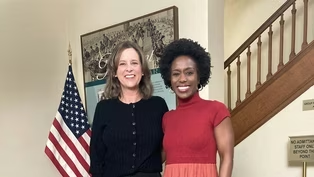
Preview: S13 Ep5 | 30s | Stanley J. Thurston’s Heritage Signature Chorale; DC Improv at President Lincoln’s Cottage (30s)
Providing Support for PBS.org
Learn Moreabout PBS online sponsorship

- Arts and Music
The Best of the Joy of Painting with Bob Ross
A pop icon, Bob Ross offers soothing words of wisdom as he paints captivating landscapes.










Support for PBS provided by:
WETA Arts is a local public television program presented by WETA