
Starter Villain - John Scalzi
Season 9 Episode 6 | 12m 6sVideo has Closed Captions
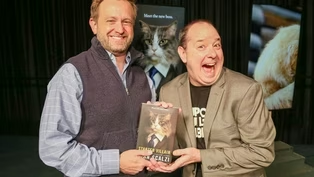
John Scalzi talks with Jeremy Finley about his book STARTER VILLAIN.
In John Scalzi’s novel STARTER VILLAIN, Charlie, a divorced substitute teacher living with his cat, inherits his long-lost uncle Jake’s supervillain business. Pulled into a war his uncle started, Charlie is up against a league of supervillains, but with unionized dolphins, hyper-intelligent talking cats, and a henchperson at his side, going bad is starting to look pretty good.
Problems playing video? | Closed Captioning Feedback
Problems playing video? | Closed Captioning Feedback
A Word on Words is a local public television program presented by WNPT
Starter Villain - John Scalzi
Season 9 Episode 6 | 12m 6sVideo has Closed Captions
In John Scalzi’s novel STARTER VILLAIN, Charlie, a divorced substitute teacher living with his cat, inherits his long-lost uncle Jake’s supervillain business. Pulled into a war his uncle started, Charlie is up against a league of supervillains, but with unionized dolphins, hyper-intelligent talking cats, and a henchperson at his side, going bad is starting to look pretty good.
Problems playing video? | Closed Captioning Feedback
How to Watch A Word on Words
A Word on Words is available to stream on pbs.org and the free PBS App, available on iPhone, Apple TV, Android TV, Android smartphones, Amazon Fire TV, Amazon Fire Tablet, Roku, Samsung Smart TV, and Vizio.
Buy Now
Providing Support for PBS.org
Learn Moreabout PBS online sponsorship(bell ringing) (mysterious music) - I am John Scalzi, and this is Starter Villain.
It's an average Joe inherits his mysterious uncle's James Bond super villainy business.
Things go from there.
Can we start the discussion with a conversation about what may be the best book cover of all time?
- Yes, absolutely.
Let's have that conversation.
Is this what you always imagined you wanted the cover of this book to be?
- I honestly didn't know what the cover was going to be.
While I was writing it, a lot of things lent itself to that.
I mean, it is very much of a book that is taking a sort of unswerving sarcastic hit to the James Bond villains and stuff like that.
So I figured there might be something along that line.
But when they showed me the current cover, which is done by a artist named Tristan Elwell, the first time I saw it, I just laughed, right?
And like a good laugh, not like a, oh my God, I can't believe they're gonna saddle me with this cover, right?
And so I loved it.
We showed it to our marketing people.
The marketing people loved it.
We showed it to the publisher of Tor Books and she loved it.
And here's a fun fact, when the publisher really likes the cover of your book, guess what?
That's the cover of your book.
- That's it.
- That's it.
And you're done.
- But the title as well, obviously, was it a struggle?
Because it seems to fit pretty perfect?
- No, the title was almost there before the rest of the book was.
The concept of a starter villain.
Now, there are two ways that common culture thinks of a starter villain.
If you play video games at all, a starter villain is the very first boss you meet, the one that you're gonna like, get a little workout for.
But then there are bigger villains along the way.
And in this case, wait for the book, it is this is the first time this fellow has encountered the world of villainy.
He's brand new at it.
He has no idea what he's supposed to do.
And so he's just at the beginning, he's a starter villain.
(soft music) One of the things that I like doing in my books, kind of examine a lot of the cultural tropes that we have and go, why?
Why is this?
So for example, with "Starter Villain," if you think about the James Bond villain, like their plans were like actually successful, and they were not thwarted by Jimmy Bond throwing them into a volcano or whatever.
You're like, okay, what then, right?
It's like, you now ruled the world.
Congratulations, now you have to worry about crop outputs in Uganda.
- Right.
- Right?
Because if you don't, then people are gonna starve.
There's just like no one ever talks about all the work.
And so what's real fun for me is to look at the mechanics of, if you take these tropes that we all know and we all love, and you kind of extend them to, how would they really work in the real world?
Then it becomes interesting.
Why does a supervillain have a volcano lair?
It's not because it's like a secret anymore.
We have spy satellites that are going over all the time, but there's a very good reason.
Geothermal energy, you can have all the energy you want comes from Mother Earth, and you can, for any villainous activity that you want.
It makes perfect sense.
So once again, take those tropes, extend them out.
Why would you have all the villains have cats?
I have a very good answer for that within the context of the book.
- Yeah.
- Just do it again over and over and over.
And after that happens, then a story kind of appears out of it.
Because now you've set up all the chess pieces and now you can go ahead and play the game.
- And you have to throw your every man into that mix.
Oh, absolutely.
I mean, it's always good to have an every man or every person, it doesn't have to be a dude.
And it's good to have a character that the audience can sort of empathize or sympathize with.
And in this particular case, Charlie, he's someone who is kind of down on his luck.
He used to be a journalist.
Yeah, there you go.
He's now working as a substitute teacher.
He came home to take care of his ailing father.
His ailing father has passed away, and now he's kind of in an economically shaky position.
And then all of a sudden this lifeline, so it seems, is being thrown by this mysterious uncle who he hasn't seen or heard since he was five years old.
But of course, whenever you're thrown a lifeline just out of the blue, it's like, okay, if I tug on this lifeline, what's on the other end of it?
And that's what Charlie gets to discover.
(dramatic music) - [Jeremy] So cats really are the best super villains.
- [John] Cats really are.
I mean, you've met a cat, right?
That's right.
I was like, the cat's like, I love you, but I will eat you.
- That's right.
- If I'm ever trapped in the house and it's you or me, it's gonna be you.
- And you couldn't do this with dogs.
- No, no, absolutely not.
The the thing is, dogs are, dogs are the best sidekicks, right?
they're gonna be, They're gonna be like, what adventure are we on?
I'm totally ready for this adventure.
Let's go, oh boy.
Whereas the cat is like, you're gonna die.
I'm gonna stay over here while you die, and I'm gonna laugh when you die, and then I'm gonna eat.
- And then I'm gonna eat you when it's all done.
- [John] Right.
- So you actually dedicate this book to your cat?
- I do.
- Did they critique you?
So I have one cat in particular, Spice who, so I'm at my desk and I'm typing, and she's always sitting right there.
And she's like, really?
You're gonna use that word?
Do you think you need that many adverbs?
I don't think you do.
You know, oh, what a a hackney line that you've done there.
Good to see that your years of education are finally paying off.
So and she doesn't say any of that, but of course she gives you that look.
And I'm like, oh.
- And that tail, when it wags, and it's just kind of a sarcastic, she's like, really?
- Yeah.
- [Jeremy] Really?
- This is the choice you made here.
Do you think that's the best you can do?
So yeah, that's Spice.
And then there's Sugar who is the pretty pretty princess cat.
It's like, like attention, gimme attention, gimme attention.
Go away, right?
- Yeah.
- And then there's Smudge who, if you look at the author photo, you can see him on my shoulder trying to eat my meal.
- [Jeremy] Yeah.
- He's basically a chaos demon.
- Yeah.
- And we love him for that.
It's like we have a dog, Charlie.
- Fantastic.
- Which the character is named after.
And so Charlie will pick a fight with Smudge and they'll play around and eventually I'll be like, all right, Charlie, leave the cat alone.
And then as soon as the cat, and the dog is like, okay, I'll be done.
And then the cat attacks, I'm like, no, Charlie, I changed my mind.
Go after him, clearly.
- That's right.
- And he's the instigator.
- And that dynamic is perfect for kind of hero villain kind of dynamic, right?
- Oh, absolutely, absolutely.
(dramatic music) - [Jeremy] Humor always runs rampant in your books.
- [John] Sure.
- And I wonder, is that by design?
And could you even write these books without humor?
- There was one time where I wrote a story and I did it specifically not using humor.
It's a novella that I wrote called "The God Engines."
And I wrote it to do writing that I knew I was not necessarily good at.
And also to avoid the things that I was good at, which can become crutches.
So not a lot of humor, not a lot of dialogue, and just basically trying to write something that was kind of a downer.
So I have done it, I had a blast writing it.
And at the end of it, people were like, I read your novella, "The God engines," do you need a hug?
Right?
And I was like, no, no, it was great.
- Yeah.
- But for me, humor I think is just a natural part of who I am as a person.
I tend to be quick with a comment and I try to be humorous because it's a great way to get people to connect with you very quickly.
I think there's a danger with that.
I do have a saying, which is, the failure mode of clever is a-hole.
And I think that humor is an aspect of that as well, where you're like, oh, I'm gonna be funny regardless of whether or not step on people's feelings.
So there's a line there.
But I have found that humor has done extremely well for me.
Particularly in science fiction there was a long period of time, not so much now, but there was a long period of time where they were very suspicious of humor.
- Right.
- And so it took a actually a fairly long time before I could put out a book, which was "Red Shirts," where we could just say, no, no, this is a funny book.
- [Jeremy] Yeah.
- And that went on to win the Hugo Award.
So it proves that even in science fiction, people like to have humor.
(dramatic music) - So you've tackled space adventure, a society that cares for the wellbeing of giant monster.
- Sure.
- The business of super villains.
- [John] Sure.
- It sounds like you're taking your imagination from when you were a kid and you've turned it into this wildly successful business of writing these books.
- I'm glad it looks like it was planned, because from my point of view, I am an accidental novelist.
I started off as a, I started off as a journalist.
My very first job right out of college was, I was a film critic for the Fresno Bee newspaper in California.
And as far as I was concerned, I always wanted to be in journalism.
I wanted to do the movie reviews.
I had a column when I was 23 years old, a newspaper column, which was a terrible idea.
Who was the person who thought it was a good idea to give a 20 something a column where it's like, let me tell you my opinions.
- That's right.
'Cause I've lived a lot and I know a lot at 23.
- [John] Oh yeah.
- So let me impart my wisdom upon you.
This was exactly it.
And of course, I was the guy who would be like, of course, I can tell you everything I have.
The wisdom of the ages has downloaded into my brain, but this was what I wanted to do with my life.
And then circumstances changed.
I went to AOL where I worked there for a couple years as their in-house editor and writer.
And then I went freelance.
And so basically what happened was I wrote a novel just to see if I could, and then having done that, I tried another one.
And then when it was sold, I said to my wife, Christine, I said, look, just so you know, no one makes money writing novels.
The plan is, I will do this every couple of years, I'll have a novel come out and it'll be fun.
And I get to say, look, I have a novel, but my money will be made doing what I was doing at the time, which was freelancing and working with corporate clients.
And then "Old Man's War," my first novel that was published took off like a rocket.
One thing led to another, and now I'm a novelist full time.
I was like, guess I was wrong.
- That's right.
And very happy to be wrong.
- Right, no, don't get me wrong.
this whole novel writing thing is a delight.
But it is unexpected and I kind of love it for that.
- Yeah.
- And I mean, those turns in life that you never expected.
Oh, no, no.
If I had had my way, I would've been the next Mike Royko, right?
And it turns out I get to be the first me.
- It was a real gift to have you on the show today.
- Oh, thank you.
- I appreciate you doing this, John.
- All right.
- And thank you for watching A Word on Words.
I'm Jeremy Finley.
Remember, keep reading.
Thank you for making Charlie a struggling journalist.
- [John] Sure.
- [Jeremy] What is it about the profession do you think makes such good characters?
Is it because we're all essentially train wrecks?
- [John] It's because we're all handsome and smart.
That's it.
- [Jeremy] I don't even know what you're talking about this train wreck thing.
- [Jeremy[ Of course, right.
Starter Villain - John Scalzi | Short
Video has Closed Captions
Clip: S9 Ep6 | 2m 30s | John Scalzi talks with Jeremy Finley about his book STARTER VILLAIN. (2m 30s)
Providing Support for PBS.org
Learn Moreabout PBS online sponsorship












Support for PBS provided by:
A Word on Words is a local public television program presented by WNPT