
Cottonwood Connection
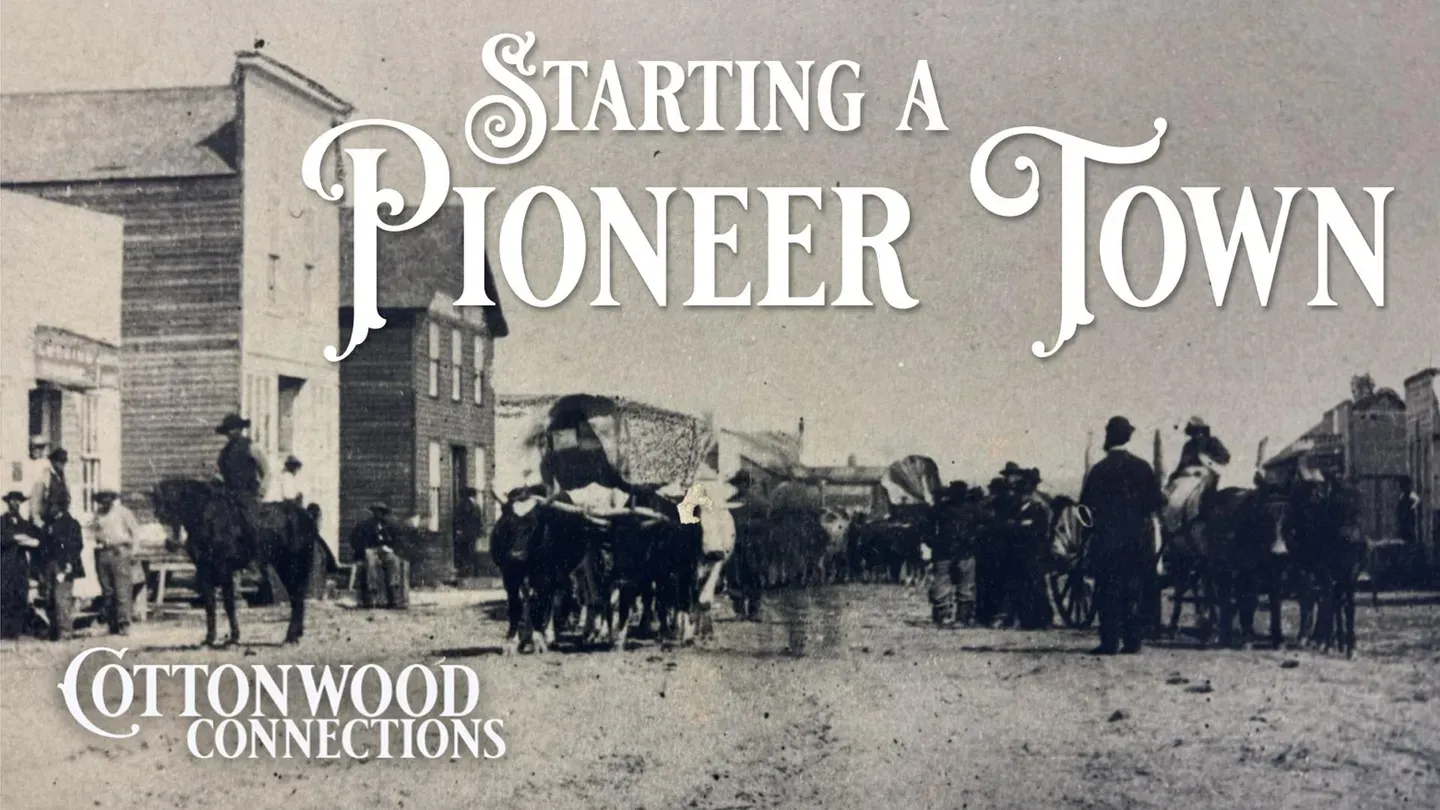
Starting a Pioneer Town
Season 8 Episode 3 | 24m 51sVideo has Closed Captions
Starting a town on the wide-open High Plains & the story of Mystic, Kansas.
Don Rowlison discusses the process of starting a town on the wide-open High Plains and we learn the story of Mystic, Kansas, a town that didn’t boom.
Problems playing video? | Closed Captioning Feedback
Problems playing video? | Closed Captioning Feedback
Cottonwood Connection is a local public television program presented by Smoky Hills PBS
Cottonwood Connection
Starting a Pioneer Town
Season 8 Episode 3 | 24m 51sVideo has Closed Captions
Don Rowlison discusses the process of starting a town on the wide-open High Plains and we learn the story of Mystic, Kansas, a town that didn’t boom.
Problems playing video? | Closed Captioning Feedback
Where to Watch Cottonwood Connection
Cottonwood Connection is available to stream on pbs.org and the PBS app.
[music] Driving through Western Kansas today, it is easy to spot a town, look for a grain elevator.
But in the mid-1800s, there were no towns, just wide open prairie.
So how did settlers decide where to put a town, and once built, what did it take for that town to succeed?
[music] Building towns in Kansas in the early days was somewhat complicated, but there were different sorts of towns.
There were corporated towns, or incorporated and unincorporated.
A incorporated town is where you have a city government, you have laws, you have usually under structure, such as sewage and stuff like that.
In the unincorporated town, it's a free-for-all.
You furnish your own water, you furnish your own sewers, there's no law enforcement except for the county law enforcement, there's no police force, there's no elected officials in the town unless it's pertaining to the township that it's in, and that was very loose.
For instance, Studley, Kansas, which is the closest to Cottonwood Ranch, was unincorporated.
And then Hoxie, the county seat, is incorporated because it is the county seat and other stuff.
So there's a lot of things where towns were chosen.
In western Kansas, in the western third of the state, it was very complicated.
There was a lot of towns that were started and died.
With my archaeology background, that a lot of the prehistoric archaeological sites are in the same location where a homestead might have been, especially in eastern Kansas.
And this is dealing with the resources.
They were close to water and maybe close to wood.
It was about the same out in western Kansas, but there was very little wood, or a lot less.
What are the natural resources out in western Kansas?
Soil and rocks.
There were no trees.
The resources don't have to be natural, it has to be something else.
There were a lot of towns set up on a high hill, and we'll use Kenneth in Sheridan County.
Kenneth was the first temporary county seat.
It was about three miles north of where Hoxie is now, on top of a hill.
They actually moved the whole town of Kenneth to the site of Hoxie because a railroad was coming through.
But they had a town company.
Kenneth had a town company, and this is a bunch of entrepreneurs in cases that had money, and they could buy land, and it might consist of bankers, or speculative investors, real estate people.
And as Kenneth was moved, they took those people who were early settlers and made the Hoxie Town Company.
So here you have an organization to start with that would incorporate a town because they had legal ledgers and stuff, and incorporation was a big thing.
And so it was people that were already established, they just moved their businesses.
With Studley, here you have one man, Abraham Pratt, who was the first settler of Studley.
He was an entrepreneur in a way, so he divided part of his land into town lots.
There was no town company doing this, but the railroad would help you because if you get businesses there for the train to stop, everybody makes money.
There's six and a half miles east of the Cottonwood Ranch is a town today that is incorporated by the name of Moreland.
Moreland had a tough time because the first town in the area was called Beach Grove.
And beaches and beach trees, there weren't any out there.
But it had a post office in 1879 that only ran until 1881 because Beach Grove folded as a small community.
And so it then became Fremont until they changed the name again to Moreland, which is on the south side of the river in 1892.
So the post offices changed.
So here there's one little place within a mile radius that had basically three towns in it in 10 years, well, 13 years actually.
And to start a town, it gets very complicated.
As I mentioned, you have to have a town company.
In my opinion, in my research, you need a town company to do it because the unincorporated towns are loose.
There's no control, no government, no anything.
And so a person would plat out or map an area that wanted to become a town.
And they had grand ideas.
The natural resources is you have to have water, but the built environment, the railroad, was what put it here.
Now, in the early days, the south fork of the Solomon River Valley was very nice.
It didn't have any trees, but it was spring-fed, a wide stream, and the major stream in the area.
So they had that.
But when the railroad came through, that makes a difference.
So you need a railroad and you need people.
People are the big things for a city.
And you have to have people depending on other things to make it work.
Well, in early days in Sheridan and Graham counties, there were a lot of homesteaders.
But they're mostly self-sustainable because they had, if they were good, they had chickens, cattle, as far as milk cows, probably some hogs.
And so they didn't eat a lot.
The only thing they didn't have is flour and sugar.
And there were no mills at that time and molasses and some of that stuff.
Things would break down with the homesteaders.
A plow would break or a bolt would break.
You need a blacksmith too.
And you need a blacksmith and then as you get that, you need a post office.
You need to have a place to get the mail and to have communication.
You need a school to have it so your kids can come and people will come to town.
So country schools were all over.
In fact, Sheridan County at one time had about 80 different school districts in the county, which today there are two.
There were a lot of farm families out with a lot of kids.
Ideally, there were supposed to be a school would be in an area where none of the students would have to go over four miles to get to school.
And so that's why they were alive.
With the homestaying days, you need somebody, a banker, or somebody that will loan you money.
Because it was too unreliable that you're going to have a crop every year and the prices were going to do it.
But that's where the railroad was a transportation.
So what are you going to do with your crops if you're growing them at home?
You'd grow more wheat than you could eat.
It doesn't make good cattle feed at that time or horse feed.
And so you'd want to sell that for money.
So you needed the railroad and you needed a grain elevator to handle it.
So you needed shipping things.
Also with shipping things, you need a place to take your hogs and your cattle.
And so you had a stockyard to load it on a train.
And with all this stuff, you need an implement dealer.
You know, things will breakdown and people are coming out here, a lot of them with no farm implements.
And although the environment was very healthy as they claimed, you do need a doctor for a town.
And you need people who come in for the doctor.
And with that, you need to have maybe a hospital.
It wasn't much.
It might have been two rooms somewhere.
But you needed a hotel for people to stay, to hang around or temporary housing.
You needed real estate agents.
Because yes, it was homesteading on a government land, but you come out in western Kansas and you came from Virginia, you would not understand the lay of the land.
And so you had real estate people, or some of them were called land locators, that would know the land because the sections and half sections were numbered, but it was hard to kind of find them.
And then somebody had to keep track of what had been filed for a homestead on.
So you'd have these land locators that take you out to vacant lands and show you and charge your fee for it.
But with you going out to look at it, you need a delivery stable for your horses and stuff, or to rent horses and vehicles to get from point A to point B. You could walk, but it could be a really long walk.
Another very important thing in western Kansas was a lumber yard.
There were no trees.
You either built out a sod or rock.
But you still needed lumber for your house, for rafters, for your roof.
And a lumber yard depended on the railroad.
With the lumber yard, you needed a lot of what they called at that time mechanics, which were everything from blacksmith to carpenters to build the houses.
Because you read some of the old newspaper articles about a new town being formed and all you could hear basically during daylight hours were people pounding nails.
So you need a hardware store on top of this.
The blacksmith couldn't keep up.
A blacksmith could make nails and bolts and stuff.
But you needed a hardware store to do this.
So you needed a lot of things to make it successful.
And some of the other things that people don't think about is usually there was some common ground that the town company had.
I will use Hoxie as an example.
People still had milk cows.
You didn't get milk at the store in a jug.
You got it from the cow.
And a lot of people had milk cows.
And so the Hoxie Town Company had a section of land that was used as the city pasture, is what it was called.
Because everybody in town or a lot of people had milk cows.
One, maybe some of the bigger family might have more.
So it was a range that somebody would take the cattle out to graze in the morning.
They'd get them through town.
And then at night they'd bring the cattle in and then sort them out.
Bossy went to the Smiths and old Ronie went over to the Joneses and stuff.
You'd have to divide them out.
And then the next morning they'd gather all these cattle out from the various people that had little barns and stuff in their backyards and move them out to the city pasture for grazing.
And so a lot of times when a golf course is close to town, such as Hoxie, the golf course of today was a city pasture of days gone by.
Also what developed too is you need a cemetery if you have a town.
Because the old days as a joke, they would advertise and promote an area of a town and said they had to kill somebody as in shoot somebody just so they could start a cemetery.
Because the atmosphere, the environment was so healthy that nobody ever died.
There was a lot of items you needed to make a successful town.
And it didn't really happen overnight.
A lot of people came in, tried different things.
Everybody was an entrepreneur.
Some people were successful and some not.
But most of them had to have ties with somebody in the east, we would say, that had money that could do this.
So you'd have investors that would sell shares and the railroad would help.
Well, the big draw to come to western Kansas after the Civil War was it was free land.
A lot of places were crowded.
And that's why a lot of English people came out here, even the Boga Germans.
Things were getting crowded and there were political ramifications too.
But they were coming out here for free land and taking a chance.
And most of them were young when they came out.
Sure there were some old ones who tried it, but they were experienced.
But they came out because of the free land.
The boom time was in the 1880s in western Kansas.
A lot of people came out and it was booming.
In the midst of this boom, some towns succeeded, others did not.
One attempt that became a thing of western Kansas legend was the community of mystic.
We have the advantage of talking to Dr.
Gregory Mosier.
Dr.
Mosier is an authority on the dream town of Mystic.
There was a guy by the name of Isaac Mulholland, who was out here.
And he was kind of a promoter.
He advertised in papers all the way around.
And he was big on marketing.
He was part of the Hoxie Town Company.
He came to Sheridan County early on.
And also the town we now know as Tasco was at one time Tasco and Guy.
And he was the head of the Guy Town Company.
But quite a promoter and you can tell us about him.
Well I'd first say it doesn't take a lot to be an expert on Mystic.
Because the whole city or town only existed for about two years after it was first created.
So you only have a couple of years you've got to know about what happened there with Isaac Mulholland.
But as you pointed out Don, he was a promoter.
And it's not clear where the moneyed interests were.
He was part of it.
But he also represented folks from other parts of the country that were interested in really a great economic boom that was taking place in western Kansas in the late 1800s.
And so lots of people had their eyeballs on western Kansas.
You know thinking this is a place where we can go make our fortune or double our fortune or whatever it is that they were trying to pursue.
So Isaac Mulholland was a guy who had his eye out for all of that in this part of Kansas.
As you pointed out he had a lot to do with a lot of different towns that started.
Some made it, some didn't.
But the one that I think is really very interesting is Mystic.
And you can start with just the idea of the name because it conjures up all kinds of thoughts about what was going through his mind as he created that.
The other thing that has really intrigued me about Mystic is how he advertised it.
[Music] There's some great old newspaper ads, big graphic images that show crowds dashing to Mystic because it's going to be the center of three different railroads that are going to just join there in this place and become in some ways I think he hopes the next Chicago.
The cultural hub of western Kansas.
Cultural hub of western Kansas, you betcha.
So a lot of just the imagery that comes with the idea of Mystic and then a lot of the background about the promoting of the business of creating towns that takes place.
And a little bit of the gamble that it involves because so much of it depends on where the railroad goes.
And people are guessing on that.
And there's a great case in point with Hoxie, which of course most of the whole thought process in Hoxie was the town of Kenneth, which was to the north of Hoxie, was where the railroad was going to go.
It was the county seat at the time.
And the county seat at the time.
And so everybody's betting on Kenneth until the railroad actually goes through where Hoxie is.
Well, and they did that because Kenneth was moved in 1886 and the railroad didn't go through until 88.
And that's when they were going to build to Mystic also.
Right.
They just moved the town two years before the railroad got there because they knew it was coming.
So Hoxie was named for Missouri Pacific engineer or promoter at that time.
Yep.
You know, okay, we can name it for that guy.
It's going to happen here.
And a lot of towns are like that.
Yeah, whatever it took to get an edge, basically.
And the railroads, you know, were beyond that.
A lot of the towns that are across western Kansas are at one time.
We're in western Kansas.
We're actually the rail head at one point in time.
So the railroad would build to a certain point.
Some sort of camp would spring up at that point before it extended further.
And there'd be a town.
There was another town by the name of Sheridan.
It was in western Logan County.
And the railroad stopped there for a while before it went on to Wallace.
And there were 4,000 people in a railroad camp.
There's nothing there now.
Yep.
Yep.
Yep.
And it's all great stories about how this whole thing comes together.
If you go look about Isaac Mohallen, you know, it wasn't just about advertising in the papers.
There's like three things in particular that I've taken note of about how he promoted that as a town site in Mystic.
And the first one is, is the way he tried to get people to populate this prospective town.
And he did it through a lottery system.
The distribution of lots in Mystic is the greatest scheme ever offered in northwestern Kansas.
For $25, you could buy a lottery ticket.
And that lottery ticket would give you a draw on one of the lots that was in the town that had a value anywhere from $25.
So you get your money back in theory for the $25.
And up to $500 if you had a lot on Main Street.
And so people were willing to take a chance with $25 about knowing they would get a lot that was represented to be worth $25.
Or maybe up to $500 in this new town.
Over 400 tickets sent out on orders the first week.
This scheme is offered to the public for the double purpose of bringing Mystic to the front as the coming railroad center of northwestern Kansas.
And to realize ready cash for the purpose of erecting buildings already applied for to rent.
Now when they actually came to the time of the drawing after people had bought all those things, they actually ended up delaying it several weeks.
Because they had tried to cobble it together a little bit with a drawing on some town lots in Hoxie that he was promoting at the same time.
It ended up they suspended the Hoxie drawing to do the drawing just on Mystic.
A newspaper account of the drawing described the town.
Mystic is beautifully situated and can be seen from any direction for miles.
Water is obtained at 100 to 120 feet.
It contains at present one good two story hotel, one general store, one agricultural implement and feed store, one blacksmith shop, one livery stable, and one land and loan office.
The proprietors of the above mentioned establishments all report that they are doing a good business and have a good deal of faith in Mystic.
The next thing that took place is he decided to throw a grand ball in the town of Mystic.
Actually had a hotel that had been built by that time.
He decided he was going to throw this big ball and invite people to a huge dance in the town of Mystic.
A follow up story in a newspaper out of Hoxie indicated there were over 50 couples who actually attended the great dance that took place in Mystic.
To participate in all the things that a city would have to offer in that particular location.
Mystic did herself proud and the merry crowd of dancers who attended have used every occasion to sing their praises of the hospitality shown and the grand success of the affair.
You fast forward a little bit from there, he schedules a baseball game between the town of Mystic and the town of Hoxie.
And lots of lead up to all that saying we're going to have the nine players from Mystic going to show up and show those Hoxie guys how baseball is played and all of these kinds of things.
A note in the paper stated, "The game of ball on the Hoxie diamond between the Hoxie and Mystic ball teams on Saturday last resulted in an easy victory for the Hoxie boys, the score standing 36-2 in their favor."
Again it was trying to show the level of activity that you would expect in a town so that it didn't look like you were just taking a chance.
Yeah it was, everybody was trying to get the business and it was pretty easy to get money from the east because the east when the planes were being settled they were getting a lot of money from especially England and Scotland and some from Ireland.
And so there was a lot of foreign money coming in because they saw it was a boom and a lot of people made good money on it.
What got you focused on Mystic?
Well it's a little bit going down a rabbit hole is what happened for me and I was going through some old newspaper archives looking just history generally because I have an interest in history.
And I came across that advertisement and the way it was approached was literally like it was going to be the biggest city between the Rockies and the Mississippi.
I mean it was going to be this huge city because of the convergence of the railroads.
And that kind of thing always interests me about what happened you know because people pour effort and money and their dreams into these kinds of projects.
I mean it's not an easy thing and there's a lot of time and effort and money that goes into this and then poof it's gone.
After the railroad avoided Mystic the newspaper briefly reported Mystic contemplates moving south to the new town on the UP railroad.
We understand the town will boom.
A later note stated, "Alas Mystic is soon to be no more."
Well I think at the end of the day you have to be a person who is driven by opportunity.
There's always risk.
You know you evaluate it the best you can.
My guest with you is Mulholland, new people who work for the railroads.
And he had financiers who were connected into that thing.
And so they're all, I can picture them going over maps, you know trying to pinpoint that exact location about that's where we think it's going to go.
But with that of course comes risk.
It's just the opportunity.
And we all do it all the time right.
I mean that's just kind of like a nature of human endeavor.
What is my opportunity?
What can I do?
Well there's land in western Kansas.
That's an opportunity.
I can go out there and I can get it for inexpensive.
I know some people with some money.
And still entrepreneurs today do the same thing.
I have an idea.
You know I can change this business process or I can change this product in such a way that there will be a market for it and people will be interested in it.
And so I think human beings are typically driven by opportunity.
[music]














Support for PBS provided by:
Cottonwood Connection is a local public television program presented by Smoky Hills PBS