
State Auditor Dave Boliek
5/11/2026 | 26m 46sVideo has Closed Captions
NC’s State Auditor Dave Boliek discusses the current political and financial landscape of the state.
State Auditor Dave Boliek discusses his role, working with the North Carolina General Assembly and how he views the current political and financial landscape of the state. He also talks about the Division of Accountability, Value and Efficiency (DAVE) Act, which aims to assess the needs for each state agency and recommends potential cuts.
Problems playing video? | Closed Captioning Feedback
Problems playing video? | Closed Captioning Feedback
Focus On is a local public television program presented by PBS NC
State Auditor Dave Boliek
5/11/2026 | 26m 46sVideo has Closed Captions
State Auditor Dave Boliek discusses his role, working with the North Carolina General Assembly and how he views the current political and financial landscape of the state. He also talks about the Division of Accountability, Value and Efficiency (DAVE) Act, which aims to assess the needs for each state agency and recommends potential cuts.
Problems playing video? | Closed Captioning Feedback
Where to Watch Focus On
Focus On is available to stream on pbs.org and the PBS app.
Providing Support for PBS.org
Learn Moreabout PBS online sponsorship- Hello, I'm David Crabtree.
Coming up, North Carolina State Auditor Dave Boliek on why he ran for office, the challenges he's faced, and the new responsibilities that have shifted to the Auditor.
Next.
- [Announcer] Quality public television is made possible through the financial contributions of viewers like you, who invite you to join them in supporting PBS NC.
[gentle music] [gentle music] - Dave Boliek, thanks for having us in your office.
- Oh, thanks for being here.
Welcome.
It's your office.
It's the people of North Carolina's office and State Auditor.
- You've been here now less than a year and a half.
You've seen a lot.
I know you've been aggressive and assertive on what you wanted to see come out of the Auditor's Office.
What do you consider the largest, most significant changes you have seen to date?
- Yeah, good question.
I mean, the Office of State Auditor, I called it a sleeping giant when I was running for office and when I first got elected.
I think over the last 16 months we've been able to wake up the giant, to some extent.
We're not where we wanna be, but we've produced a tremendous amount of work.
We've built a team.
We have produced things that look at return on investment of taxpayer dollars, not just, oh, here's what's happening or here's what's wrong.
The vision is to produce audits that get results.
And the the first real effective one we had was our audit of the Division of Motor Vehicles.
And that was, that was a really good audit.
- And that's been recognized now nationally, right?
- It has.
Our DMV audit that we released in August of last year has been awarded, and our team and myself will go pick up that award in June for the Audit of the Year across the country for, voted on by auditors from around the country as the Audit of the Year.
So we're real proud of that.
And I think that says something about the vision that we set for the office.
I think we're moving in the right direction.
- You know, people think about the Office of State Auditor, they think of audit.
We're gonna audit your books.
We're gonna look at what's happening in state government.
Is that a fair way to describe this office?
- It is in some respects.
I mean, we do audit the books.
We do the bread and butter work of the people of North Carolina.
We audit financial statements of agencies, universities, community colleges.
We audit the state's financial statement.
We also look at the federal funds.
28.1 billion of those funds this year.
And those audits serve as the backbone of the AAA credit rating of the State of North Carolina.
North Carolina, one of only 14 states in the nation with AAA credit rating.
And that rating comes largely bolstered by the audits that we produce here at the Office of State Auditor.
- You're proud of that?
- Very proud of that.
You know, the second part is moving into the areas where, how can we be effective?
How can we be relevant to everyday North Carolinians?
That was why I campaigned on auditing the DMV.
If you're 15 years or older, you come into contact with the DMV.
It wasn't working.
It became a shared priority of government.
After we released our comprehensive audit, the Legislature, the Governor's office, Commissioner of DMV, all took that up, brought it to the forefront.
It's getting better, getting results.
That's cooperative government.
That's what I think the people of North Carolina want.
So we're proud of that.
We're proud of being relevant to everyday North Carolinians.
- How does someone at state government know an audit is coming?
- It depends.
It depends on the topic.
Agencies or entities that receive a public dollar are subject to audit, potentially, by the office of state auditor.
It is an office.
The people of North Carolina have the most powerful state auditor's office in the nation.
We have the ability to look at the books and look at the processes of any entity.
So that could be a private corporation that does business or takes public money.
It's not something that is done all the time.
But in relevant audits, it's important.
And it often happens with a letter, we'll send a letter, make a phone call.
Usually try to be friendly about it because most folks that are the subject of an audit and understand what the Office of State Auditor's trying to do are really cooperative with us, because they want it to be done right as well.
- You've raised the visibility of this office.
Why is that important?
- Well, it's important for a lot of reasons.
One is, to your point about how do you know an audit's coming?
The more visible we are, the more people understand more what the State Auditor does, that we're not there to audit people's individual income tax returns.
That we are accountability on behalf of the taxpayer.
We wanna shine a light.
We want things to be transparent.
We wanna look at processes and procedures.
And we also, the more people understand our office, we're also able to communicate that it can be a cooperative effort.
It doesn't have to be adversarial.
It can be we are here to help move things along.
And it's not always throwing Molotov cocktails, as I like to say.
It is getting in there, getting in the weeds and trying to figure out how we do things more efficiently and effectively with taxpayer dollars to get a true return on investment.
- And I would presume, correct me if I'm wrong, if you're a division within state government, if you're a department, if an audit happens at a university, wherever it may be, if it happened with PBS North Carolina and you discover something, then those who are running those operations have the opportunity to say, yes, let me explain that to you.
Or, and I presume part of the process is your office asking a lot of questions?
- We do, and that's, as we move forward with technology, and look, artificial intelligence, let's not kid ourselves, that is here, and it works very well if used responsibly, particularly in the audit arena.
So, you know, as we are able to take large sets of data and put it together, we have found over these last 16 months here in office, and we've been really using the additional technology over the last 12 months, oftentimes we're able to inform leaders of entities across the State of North Carolina on things they may not themselves even know about.
Because we're able to look at that data and calculate it and give it to them in a usable format where they can say, oh, okay, hey, this is how that works.
And we're able to inform executives, so.
- Okay, how do you prompt AI in that regard?
- Well, we do it a couple of ways.
One is we've built our own, the artificial intelligence folks call it a sandbox.
We have our own internal sandbox here where we build our own algorithms.
We have a team of 18 data scientists that we brought on at the Office of State Auditor to build out the framework to ask the questions and do the data mining in a way that produces relevant results.
We also are in the process of harnessing large language models and keeping them enclosed.
Really important at the Auditor's Office to keep those enclosed.
We don't want personal identifying information getting out.
So we keep that information enclosed.
And these large data models over the last 24 months or so have realized that they have to be usable in a way that can housed in, for example, the Office of State Auditor or an agency in order to be used effectively.
So we've been pouring, as I'd like to say, jet fuel on that, to be able to take the large amount of data across the State of North Carolina, put it into relevant audits, relevant efficiency reports that can inform the Legislature and Executives across North Carolina on ways they might be able to get a better return on dollars.
- Is all of under what you established early on in your tenure of the DAVE Act?
- So the DAVE Act was passed by the General Assembly.
It really did not give us any specific additional authorities.
It gave us a few more resources, which allowed us to hire those data scientists.
But it also said, look, we anticipate, and we actually as a legislature want you to use artificial intelligence.
So they gave us that specific authority to bring in artificial intelligence, use it.
And where that matters is, like in our first Dave report, 8,800 vacant statewide positions across the State of North Carolina, we're the only office or agency in the State of North Carolina that could have calculated those numbers in the two-month period that we did it.
And found, for example, the two positions that have been vacant for 17 years.
So that's the type of granularity that artificial intelligence allows us to get to with respect to the data.
And it frees up our auditors, who are really smart, to go in, and as you sort of previewed earlier, contextualize those numbers.
Get what the agency has, okay, here's what our data says in black and white.
What does this mean where the rubber meets the road so that we can come to not only data-driven decisions based on numbers, but data-driven decisions that take into account the human element as well, so that we can be a really, really, really well working state government or state agency and continue to make North Carolina and keep North Carolina the best place to live.
- So a little context of the numbers.
How many state employees are there?
State employees?
- Almost a hundred thousand.
Probably a little short of a hundred thousand state employees.
And state employees come in a lot of different sort of categories.
You have some temporary state employees, you might have part-time state employees.
You have full-time exempt, full-time non-exempt.
You also have state employees who are paid by federal funds.
And you have state employees paid by receipts.
DMV, for example, completely receipt-driven.
Labor Department, completely receipt-driven.
So there's, you know, little shy of, just shy of a hundred thousand state employees.
- When you talked about those 8,800 vacant positions, why did it matter that you identified those?
- So it matters to policy makers in the General Assembly and in other parts of the executive branch of North Carolina.
To the General Assembly, it matters because they are appropriating dollars to fill full-time positions.
If those positions aren't filled, those dollars are still appropriated, those positions are still budgeted.
The dollars are used for other things in state government.
It helps give those appropriators clear vision of exactly where there is room to look and ask agencies, you know, hey, for the state highway patrol, for example, you've got a hundred vacant positions, you keep those positions vacant to pay for gasoline, how much do you need for gas?
Right, so they can ask that question.
It matters to the public because if you're appropriating money to a full-time position and those dollars are being used for something else, there's a transparency question here.
Look, I've learned one thing, Dave, for sure in 16 months.
Government never spent a dollar of government's money.
The only money government spends is the people's money.
And that is what we say at the beginning of every one of our internal meetings.
Remember, this is the people's money and they really, really want, I find it all across the state, they wanna know how their money's being spent.
- Early on, I visited with you just to check in after the election, and you were about to undergo an audit of the Auditor's Office.
- [Dave] We did.
- How was that experience?
- Well, it was interesting.
We found out, got an organizational chart, figure out where we were, found out how many positions we had, who we had doing what, where money was being spent within our own office.
You know, I'm not a, have not, I was a state employee years and years ago.
I worked for the Insurance Commissioner for a year, and I was an assistant DA, but I wanted to see how our office was organized and where our money was being spent.
It was eye-opening.
We found we had 40 openings, so we had 40 vacant positions here.
The General Assembly, as part of the DAVE Act that you mentioned, gave us 45 additional positions.
So we've hired with normal turnover, and those positions, we've hired more than a hundred new team members here at the Office of State Auditor over the last 16 months.
You know, and we hear, you know, stories around state government about not being able to get people hired.
And I understand there are challenges depending upon the agency, but we've taken an entrepreneurial approach here at the Office on the way we hire people and bring people in.
We want good people who wanna get things done on behalf of the State of North Carolina.
So we turned an administrative position into an a recruiter, and she's actively recruiting.
So we're knocking on doors and trying to actually pull people out of private industry and bring them over here to the State to serve people.
- Well, and by the way, go back to the DAVE Act for a moment.
For people who might not follow things, all things state government, that was for the Division of Accountability, Verification- - Value.
- Value.
- Division of Accountability, Value and Efficiency.
- [David] Okay.
- Affectionately known as the DAVE Act.
- I understand that.
By the way, what attracted you to numbers?
- Well, that's a good question.
You know, I was- - [David] But you have a legal background.
- I do.
I'm a lawyer.
I've got an MBA too, though.
I earned my MBA along with the law degree.
I think what attracted me to the Auditor's Office was the work as chair of the board at UNC Chapel Hill, when we were able to really get in granularly to the budget at UNC where there were 16 separate budgets running UNC Chapel Hill.
We ultimately consolidated that to one all-funds budget.
In the process, discovered a hundred million dollars structural deficit that our board, along with the administration, worked really hard to clean up and sort of get to a zero base.
We did that.
The rating agencies took notice and said that they had more confidence in the financial position of UNC Chapel Hill as a result of the new budget model.
And that single footnote really led me to the idea to running for State Auditor, 'cause I'm like, look, you can really affect things positively looking at the numbers.
- My gosh, what's it like to find a $100 million deficit?
- Well, I mean, you know, on 4.4 billion a year, that's probably, I mean, that's real money, but it can get hidden pretty, pretty easily.
- A hundred million dollars can- - Yeah, it was a hundred million dollars structural deficit.
So the university was having to dip into, you know, long-term savings in order to cover those funds.
Yeah, what that looks like is that, looks like every department across the university cutting their budget 1.3 to 1.7%, and you get in the weeds, you do it.
And then over a 13 to 14 month period.
Also shifting the budget from the provost, who's the chief academic officer to a full-time CFO, chief financial officer helped.
You do that.
And it's really, it's all about getting to work.
We do that here.
That's what we do.
- Where did you grow up?
- So I grew up in Durham, basically, from seventh grade, well, really eighth grade all the way through high school.
Before that, we were in Greensboro for two years.
And I was in Eden from four years old to fifth grade.
So I've grown up around North Carolina.
I was born in Lincolnton, so.
- What led you to law school?
- I was a news reporter and they weren't paying me enough, David.
[both laughing] - I understand that.
Your dad was a reporter, by the way.
- He was.
- I'm gonna talk about him in a moment, but where were you a reporter?
- I was a newspaper reporter at the "Thomasville Times."
- [David] Did you start writing obituaries?
- I started writing everything there.
I actually have a front page of "Thomasville Times."
And I don't mean this, I mean it's gonna come across bad, but I have every byline in a photo credit.
- Oh, I understand that.
- And it was a lot of work, but it was a lot of fun.
I used to sleep with a police scanner next to my bed.
- I've tried to tell people who wanna go in this business, that might be your social life for a while.
You get to know a police scanner.
- You did, is police scanner.
And I learned to wake up in the middle of the night when there was a spot news item on the on horizon.
- [David] Okay, your dad was a reporter for a long time.
- He was.
- Did he want you to follow in his footsteps?
- He wanted me to be happy.
And that was always the thing in our office is, you know, be happy.
He wanted me to work.
When I was 16, he made me get a job.
He told me if I wanted to go on a date and I wanted to put gas in the car, I better get a job.
So I started working early on.
He did want me to work, but he just wanted me to be happy.
And he was really proud when I got into UNC Chapel Hill and when I graduated from school there and, you know, went into media and enjoyed that.
Won a Press Award too.
So I was, felt like I was a pretty good reporter.
I just really, really, really got led to practice law.
Part of it was the money.
I don't mind telling you it was, it's hard.
It's hard as a reporter, you know, it really is.
Particularly newspaper reporter.
It's tough.
- I'm just sitting here thinking the way the public values reporters and lawyers- - [Dave] Right.
- I mean, you didn't exactly go into the top two fields of public relations.
- That probably true.
Will give you that.
I'll give you that a hundred percent.
But my law practice has been fun and I got to help people.
And my practice as a lawyer was in Fayetteville, North Carolina, and got to be an assistant district attorney.
I got to prosecute- - So you're prosecutor.
- Yep.
I started in traffic court doing speeding tickets and seat belts and DWI trials and got up to where I was doing murder cases and doing jury trials.
And went into private practice and did all kinds of stuff in private practice.
I represented in Fayetteville, homeless folks.
And I got to represent the wealthiest person in town.
So our practice was very broad and it put me in contact with a lot of different people and really just enjoy people probably more than anything.
- And you're also an Eagle Scout?
- Eagle Scout.
I have two boys that are Eagle Scouts too.
My two older boys are Eagle Scouts.
- And I'm looking at your merit badge sash here.
And I count 23, is that right?
- 23 or 24.
Yeah, that's about right.
- What was a great, what was the best thing about scouting for you?
- For scouting, to me was the idea that you can get into the woods every now and then with, you know, guys your own age and sort of cut up in the woods and play with a stick in the fire and learn how to cook, and be forced to sort of get through the night without your parents tucking you in.
That, to me, was the best thing about scouting.
- Well, that I would think prepared you for the world of politics, 'cause you sure have stuck a stick in the fire.
- Well, politics is a contact sport.
But I'll tell you, the service to the people of North Carolina and office like the State Auditor's Office is, to me at least so far, has been very rewarding.
The best part for me is being able to work with long-term team members here at the Office of State Auditor, who've been here 5, 10, 15, 25, even 30 years, and learn from them.
And then at the same time be able to bring in some new energy to sort of rev things up here in the office and provide some new perspective and new vision on the ways that we can hold government accountable at all levels.
- Does that make you a change agent?
I know that's a buzz phrase now, but it can be real.
- Oh, clearly, we are about change, which goes back to AI.
If we are not using artificial intelligence at the Office of State Auditor, we're making a mistake, because it'll be a very short period of time without us putting that emphasis on the new technology.
Very short period of time.
Our team, when they go to audit, an entity is gonna be on their heels because they're gonna be up against technology that surpasses our capabilities.
And I had a commitment from day one and I told the career team here, my commitment to the career team was, we are not gonna be on our heels with technology.
We are gonna be ahead of everyone in state government on technology, because it makes sense that the Auditor is out front on technology.
We have the opportunity to do it, let's go ahead and take it.
And we've had great buy-in from the team here on that.
- At one time in your life, you were a Democrat.
- Yep.
- [David] What changed?
- Democratic Party changed, in my opinion.
My values that I have align more with the Republican Party.
But overall, I think my personal values align with North Carolina and North Carolinians.
And that's what I think I'm trying to represent every day here at the Auditor's Office.
We look at it through the lens of what is, what are the people that I grew up with in Rockingham County, in Guilford County, in Durham County, the people that I worked with and lived with in Cumberland County for the last 27 years?
The people in Orange County and Durham County where I live today.
What do they care about?
And that's the lens that I look at things as I sit here, I mean, the State Auditor unique position takes an additional oath of office that no other member of the council of state takes, and that is an oath to be nonpartisan.
And so everything we do here at the Office of State Auditor is we leave party label at the door and we look at it through that lens: what do North Carolinians care about and what do they want to know about?
- You wanna run for Governor?
- I wanna make the State Auditor's Office the best State Auditor's Office in the country.
Winning State Auditor of the Year puts us well on our way.
And that's where I am now.
- The Auditor's Office is now involved with the Board of Elections.
- [Dave] Yes.
- Why is that important, and should it be?
- Well, it's not something I campaigned on or even expected.
It was sort of a decision, well, it was not sort of, it was a decision that was made by the General Assembly.
They had the authority to delegate duties to members of the Council of State.
They saw fit to move that authority over here to the Board of Elections.
So we got to work.
I mean, the Legislature tells you something to do, we do it, we got to work.
I think the view we take is to manage the office correctly.
It's all about management.
And again, I do think it fits in that wheelhouse of, you know, non-partisan.
I had an oath of non-partisanship, which is why we're looking to modernize the election system.
David, our elections computer system was built in 1998 when email was something new, right?
So this has got to be something that we take and move forward, we just have to.
So I put 12 Republicans and 12 Democrats on a commission to help form and inform the state board and make some determinations of what do the people want, and let's get a computer system and let's get a system for running elections that everybody can get behind.
So that there isn't any of this back and forth between parties on something that is so fundamental to North Carolinians and Americans and people of both political parties.
We wanna get that right, so.
- And make sure every vote counts.
- And counts once.
- Dave Boliek, the State Auditor for North Carolina.
Thank you for your time, sir.
- Very glad be with you.
- I appreciate it very much.
- It's always an honor.
- Thank you, sir.
[gentle music] [gentle music continues] - [Announcer] Quality public television is made possible through the financial contributions of viewers like you, who invite you to join them in supporting PBS NC.
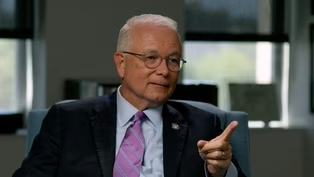
State Auditor Dave Boliek on Auditor’s Office Visibility
Video has Closed Captions
NC’s State Auditor Dave Boliek discusses raising the visibility of the auditor’s office. (54s)
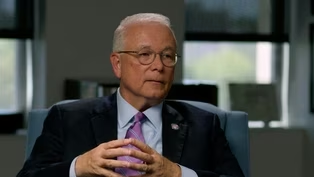
State Auditor Dave Boliek on NC’s State Board of Elections
Video has Closed Captions
NC’s State Auditor Dave Boliek discusses his involvement in the State Board of Elections. (1m 36s)
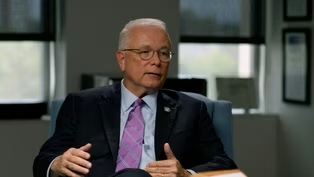
State Auditor Dave Boliek on Switching Political Parties
Video has Closed Captions
NC’s State Auditor Dave Boliek on why he switched from the Democratic Party to the Republican Party. (1m 13s)
Providing Support for PBS.org
Learn Moreabout PBS online sponsorship New Episode
- News and Public Affairs

Top journalists deliver compelling original analysis of the hour's headlines.
 New Episode
- News and Public Affairs

Today's top journalists discuss Washington's current political events and public affairs.

 New Episode
 New Episode
 New Episode
 New Episode
 New Episode
 New Episode
 New Episode
 New Episode
 New Episode
Support for PBS provided by:
Focus On is a local public television program presented by PBS NC