Chat Box with David Cruz
State Budget: How to Spend $53 Billion
3/25/2023 | 26m 46sVideo has Closed Captions
John Reitmeyer from NJSN talks NJ's budget, Henal Patel talks election transparency
David Cruz talks with John Reitmeyer of NJ Spotlight News as state budget hearings begin & questions about the school funding formula, corporate business tax, & transparency are raised. Then, Henal Patel with the NJ Institute for Social Justice about the controversy surrounding the Elections Transparency Act.
Problems playing video? | Closed Captioning Feedback
Problems playing video? | Closed Captioning Feedback
Chat Box with David Cruz is a local public television program presented by NJ PBS
Chat Box with David Cruz
State Budget: How to Spend $53 Billion
3/25/2023 | 26m 46sVideo has Closed Captions
David Cruz talks with John Reitmeyer of NJ Spotlight News as state budget hearings begin & questions about the school funding formula, corporate business tax, & transparency are raised. Then, Henal Patel with the NJ Institute for Social Justice about the controversy surrounding the Elections Transparency Act.
Problems playing video? | Closed Captioning Feedback
How to Watch Chat Box with David Cruz
Chat Box with David Cruz is available to stream on pbs.org and the free PBS App, available on iPhone, Apple TV, Android TV, Android smartphones, Amazon Fire TV, Amazon Fire Tablet, Roku, Samsung Smart TV, and Vizio.
Providing Support for PBS.org
Learn Moreabout PBS online sponsorship>> Major funding for "Chat Box" with David Cruz, making public schools great for every child.
Njm insurance group, serving the needs of New Jersey residents and businesses for more than 100 years.
Promotional support provided by insider nj, a political intelligence department.
Insider nj gives serious political players and interactive forum for ideas, discussion and insight.
Online at insidernj.com.
♪ David: hi, welcome to "Chat Box ."
I am David Cruz.
We usually give of your discretion warning when talking about the budget, but over $50 million you talk about real money.
Listen up.
Our expert, the state budget expert, is in demand at this time of year.
We are pleased to have a few minutes with finance writer, John.
Good to see you.
53 billion dollars, no new taxes, funding for everything under the sun.
You have seen your share of budgets.
Is this a budget on solid foundation?
John: That is a great question.
We do not know what will happen with the economy.
It is a modest revenue projection underlying this budget.
When you look at what we are coming out of in the current fiscal year.
We look at different economic indicators.
As our state economy goes, so does our budget.
When things are humming we have a lot of money to spend.
When things are not, spending cuts are usually necessary.
It is not a big growth estimate.
The challenge will be if we run into a recessionary environment.
That is when we have to wrap the current projection.
From where we look today, there are concerns about banking.
I do not think it is irrational to have the underlying projection they have right now, but it is one of those years when we do not know because this budget will be in place until the end of june 2024.
$53 billion, a big number.
David: Republicans point out Chris Christie's final budget was $35 billion and this one represents an explosion in state spending, $18 billion over his final budget.
Is it an explosion, or an increase in what things cost?
John: There are different ways to analyze it.
At face value, from the number of Chris Christie's last year until what we are facing in July, it is a big jump.
Adjusted for inflation it looks different, but we have to look at things being funded now that perhaps were not funded during former Governor Christie's 10 year.
It is something they have not been doing for over two decades, that is such a huge multibillion-dollar commitment being made.
.
We can talk about the property tax relief program initiative.
We were not spending to that level on direct property tax reviews seven or eight years ago.
Even if we wanted to rout education funding, a hot topic this year, the direct formula aid to K-12 public schools, money that gets into classrooms, is going up to almost $11 billion in the current budget.
It was increasing under the current governor, but is an area of growth in Governor Murphy's tenure.
When we look at where that extra spending is happening, making our commitment to the pension fund, providing more money for tax relief, for K-12 public schools.
A lot of growth is in those areas.
It is good to put those types of analyses in context so we can value judge, do we not want to make a full pension payment, do we not want to provide full property tax relief?
David: It is a reflection of priorities in that respect.
John: Yeah, and priorities in terms of just spending.
The other side of the coin is, New Jersey has enjoyed rapid growth in overall revenues since the first dip we saw at the beginning of the COVID-19 pandemic.
Part of that is inflation, sales tax is a percentage.
Prices go up, New Jersey collects more.
Part of it is wage growth.
People are paying income tax.
We had banner years on Wall Street.
I do not know if that will happen this filing season.
New Jersey has been almost printing money in recent years.
There is also an element from tax increases that Governor Murphy has approved that were resisted in prior administrations.
Namely, the millionaire's tax.
A higher income tax rate for those who make over $1 million in New Jersey.
There has been a surcharge on corporate revenues.
Those netting income over $1 million.
New Jersey is spending more, but also collecting more.
Some is policy changes, but some is growth we have seen without having to adjust tax rates partially fueled by inflation and partially fueled by a humming economy and financial market up until the bumping this -- bumpiness we have seen recently.
David: Let's talk about discretionary spending, the stuff you do not have to spend money on.
You are spending it at your discretion.
Here is budget committee member Mike from the first budget hearing this week.
Let's hear what he has to say and come back.
>> There is something seriously wrong with this budget.
Every reasonable request ought to be weighed against this.
Some of this is politics trumping sound policy.
John: An interesting topic that is fun to talk about.
Last year's budget, in place right now until June 30, there were items initially proposed as part of the governor's budget that Republicans took issue with.
There were also items added on by a majority of Democrats when they wrote the annual spending bill in June last year.
This type of spending typically occurs off budget.
There is still a lot of federal COVID-19 relief and stimulus money New Jersey is spending down.
A big chunk was spent for the current fiscal year.
There are a couple different buckets we see this type of discrepancy spending funded through.
New Jersey has a lot of programs in place where communities and to different organizations are forced to compete against each other, submit applications.
Those with the most merit scoring get funded.
Or those that meet standards get funding if they meet the thresholds.
Another bucket of spending we call Christmas tree items.
It typically does get approved at the end of the year without the type of scrutiny that Murphy's general proposals are getting like the one the senator just spoke at.
That is an issue in New Jersey for a long time.
A policy issue that deserves more attention.
Our colleague colleen O'Day wrote about this.
We have a Democratic governor and Democratic-controlled legislature.
The preponderance of this type of spending is going to districts represented by majority Democrats, but it is funded by taxpayers throughout the state.
There are arguments to be made that a project in one community like a ballfield may have merit for that community.
Think about all the communities with needs in New Jersey.
There is an argument perhaps state tax dollars are not the most appropriate for funding those projects.
David: At the risk of blowing through the time we have, I want to talk for a minute, the school spending formula.
Seems like in every year debate.
Lawmakers restored $102 million to certain districts, but Wildwood is taking a 54% cut.
Jersey City and a new work have billion dollars school budgets.
I guess there are always winners and losers, but they are talking about the need to change the funding formula which I do not understand as it is now.
How do we fix this every year problem of schools saying I had to lay off 100 teachers?
John: It goes to show in a $53 billion budget, a record high for the state, we still see a lot of areas where we are not spending enough at the state level.
The formula is always controversial.
The way it has changed over the last four or five years ago when a bill called s2 was enacted into law, taking away money from certain districts that have been reliance on getting more state aid.
I do not think any district in the state thinks they are getting enough money.
And some are losing funding while the overall amount is going up to nearly $11 billion, 20% of the budget.
At a time when the state has a $10 billion surplus building up.
It is an issue that will be looked at again more closely because I think we are getting to a point where those districts losing aid under the current formula, fair or not, it is starting to have an impact on communities.
When we see that we typically see political reaction.
This bill that restores funding, that is advancing this year as all 120 seats are up for grabs.
Senators are in tight -- are in tight races and would like to keep their seats.
A salvo, something we see more of.
It is starting to look like a few years ago when that bill S2 came into law.
There is a lot of acrimony around this issue.
David: It is an election year and nothing will stand between Democrats and a fluffy budget full of voter-pleasing items.
John: I would be really surprised.
You want to go into your election year making it look like you are functioning, helping address issues taxpayers are most concerned about.
A shutdown would make us not be able to use state parks, that is not an outcome anyone is interested in.
If anything would be a hiccup, it is what happens with the federal debt ceiling.
David: No likelihood we will see any memes of Phil Murphy at Island State Beach Park this year?
John: [LAUGHTER] David: Always good to see you.
Thanks for being on with us.
John: Always fun.
David: Transparency is in the eye of the beholder.
We are joined by the law and policy director at the New Jersey Institute for social justice.
Good to see you.
It is budget season.
We will talk about that another day.
Here we are.
The administration says the Executive Director of the election law enforcement commission is a homophone -- homophobe, as evidenced by an Email he sent.
Let's give the governor unchecked authority to elect all board members, advice and consent "B damned."
An oversimplification, but a good place to start.
The main sponsor of the elections transparency act -- just floored me.
Let's hear from Nick and then start our chat.
>> When you say they are qualified individuals, if you do not have the opportunity to vet, how do you say they are qualified and not just partisans handling the governor business?
>> We ensure they replace the current commissioners at the highest quality.
There is one vacant right now.
Those could have been replaced.
>> You ensured they are high quality by whom?
>> My conversations with the governor's office and what they have indicated to me.
David: We have assurances from the governor?
Two branches of government.
What is so wrong about what we just heard?
Guest: We have a process in place for a reason, not just for elect, but boards across the state, the judiciary, any number of appointments.
The governor nominates, the Senate considers and confirms.
That requires hearings, a public process, so there are questions asked, backgrounds checked, to make sure they are qualified.
It is not just this situation.
This is not how democracy should work.
We should not give a one off situation.
We are circumventing the process that works.
These are public, important for democracy.
We need a government that is accountable.
There are two branches for a reason, checks and balances.
This circumvents all of that.
David: In theory, and this is an exaggeration, the governor could appoint his wife and two sons to fill three seats, according to this one time 90 day window, correct?
There is no standard.
Guest: He could appoint anyone.
That is apparently what they are doing.
That is the question, whether it is this governor or another, it should not matter what party, should not matter who is holding those positions.
We have these rules for a reason, so the public has a role, so there is accountability, and we are taking away all of that for reasons that do not make sense.
I know as much about this as anyone and it makes no sense.
There is no justification at all.
There does not even seem to be a reason offered right now.
David: It is not an exaggeration to call this a total abdication of duty, no?
Guest: It is and they are doing it in law.
They are passing a law that does this.
A law that has a number of other issues, a statute of limitations issue.
Doubling contributions is a problem.
This law is troubling and should be for all of us who care about democracy.
David: Let's talk about other elements in the bill.
You referred to the statute of limitations on campaign and other complaints from 10 years to two years.
I think the standard is five years.
People who do not follow this may wonder why does it take 10 years?
Guest: Good question.
Think about how long it takes if you are a candidate or have been involved, when you report things to elect, your lobbying reports, public finance for how much you spent on your campaign, it is not due immediately after spent.
It is months later.
Then, the elect, generally understaffed, has to review it all and make a determination.
It takes a few years.
There is a conversation that needs to be had to maybe reduce it from 10 years, but two years is a short time.
You look at the recent decisions put out.
This month the decisions put out go back a few years.
This law does away with them.
Too bad.
You can just get away with your finance violations in the last few years.
David: There is this retroactivity clause that could affect how many -- who knows how many members of the legislature that have voted.
Guest: Exactly, and isn't that concerning, too?
I would hope every member of the legislature is following laws.
We have no reason to assume they are not, but they are implicated by this.
If there was any issue in the last few years, they will get the get out of jail free card.
In this situation it is too late, it applies retroactively.
There are a lot of things that should trouble voters across the state.
David: It also streamlines the pay to play laws.
Your town has its own rules that apply to pay to play which can get unwieldy.
If state guidelines get watered down, it is just another way to get around things.
Guest: Exactly.
Those of us who care about democracy, and I know so many in New Jersey do, democracy is hanging by a thread in this country.
Right now New Jersey should be a leader, taking a stand and fortifying it, expanding the right to vote, all kinds of things, and making it so money is not unchecked.
We are opening the floodgates and reducing levels of accountability all over the place.
That is not what we should be doing.
We know democracy is fragile.
We should not be taking it for granted or be doing these things so willy-nilly.
David: You talked about contribution limits that will be expanded.
There is an argument to be made, that brings it in line with our economic times.
Does that make sense?
Guest: Maybe tying it to inflation makes sense, but that is not what they are doing.
There are a lot of reasonable arguments being made.
They are saying 10 years is too long.
The contribution limit is too low.
But taking those arguments and running with them, doing these things that do not make sense, completely with a broad level changes when we could do things that are much more reasonable.
We have the League of Women Voters of New Jersey, providing other options, more reasonable options.
They do not want to do any of that.
David: It is like saying 25 miles per hour is to slow so let's increase it to 80 miles per hour.
Guest: Exactly, no discussion of 35.
David: There is a provision that makes a distinction between contributions to individual candidates and political parties.
Can you shed light on that?
Guest: There is a difference in how they will contribute.
The bill includes other organizations, nc6's, chambers of commerce and those types.
Those are things we should be paying attention to.
Making sure we are all comfortable with.
The bigger points are the ones we talked about, the ones that trouble us all.
The doubling the contributions that get to be made, the elements of the statute of limitations and whatever they are doing with elect that no one can make sense of.
David: Is there also another provision that creates what some have called the slush fund for things that are not directly related to campaigns, like rent, telephone, that has no limits?
Guest: I believe so.
There are elements -- we should be concerned about that.
There needs to be limits.
We need laws that create limits on how much is spent on elections, and we need to enforce those.
You can use this money for any number of things without limits, and if the elect starts to look into them, is this appropriate or not, you have a short time to do it.
If not, you will be fined.
David: Silence from Democrats except for one who spoke against it, Senator Neil Gill.
The only one who spoke in favor was the sponsor.
We saw a little what his thinking was.
It seems this is a done deal.
What is next, the assembly?
Guest: Yes.
There was a committee hearing today.
They will probably vote on it soon.
This bill has come back over again.
Voters have called elected officials and said we do not want this.
I am not talking that far in the past.
A month ago the legislature was pushing to move this.
They pulled it because voters made their voices heard.
Call your assembly members.
Say, this is terrible, do not vote on it.
It might stall it.
It did literally a month ago.
There are options.
If it does pass the assembly, tell the governor you do not want this.
David: Law and policy director with the New Jersey Institute of social justice.
Always good to see you.
That is "Chat Box" for this week.
Thanks also to John for being with us earlier.
You can follow me on Twitter and get a first look at "Chat Box" and reporters Roundtable as well as fresh content every day when you subscribe to the YouTube channel.
I am David Cruz.
From all the crew in downtown Newark, thanks for watching.
See you next week.
>> Major funding for "Chat Box" with the David Cruz provided by the members of the New Jersey education Association, making public schools great for every child.
Njm insurance group, serving insurance needs of businesses and residentss for over 100 years.
And, insider nj, a political intelligence network voted to New Jersey political news.
Insider nj giving serious political players and interactive forum for ideas, discussion and insight.
Online at insidernj.com.
♪
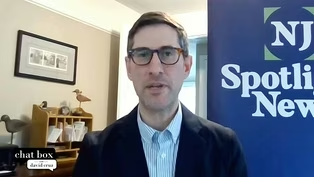
Beyond the Box: NJ's Corporate Biz Tax Cut Impact on Funding
Clip: 3/25/2023 | 2m 52s | David Cruz talks with budget & finance writer John Reitmeyer on corporate business taxes. (2m 52s)
Providing Support for PBS.org
Learn Moreabout PBS online sponsorship
- News and Public Affairs

Top journalists deliver compelling original analysis of the hour's headlines.

- News and Public Affairs

FRONTLINE is investigative journalism that questions, explains and changes our world.












Support for PBS provided by:
Chat Box with David Cruz is a local public television program presented by NJ PBS