
The State of Diversity, Equity, Inclusion in the Workplace
Clip: Season 50 Episode 31 | 12m 14sVideo has Closed Captions
Examining the state of DEI efforts in the workplace after George Floyd’s death.
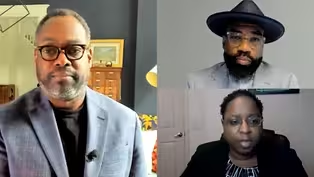
It has been more than two years since George Floyd's murder sparked huge commitments from businesses and organizations to expand their diversity, equity and inclusion efforts in the workplace. Promises were made, but were they kept? American Black Journal takes a look at whether DEI efforts in the workplace have improved since calls for racial and social justice re-ignited across the nation.
Problems playing video? | Closed Captioning Feedback
Problems playing video? | Closed Captioning Feedback
American Black Journal is a local public television program presented by Detroit PBS
The State of Diversity, Equity, Inclusion in the Workplace
Clip: Season 50 Episode 31 | 12m 14sVideo has Closed Captions
It has been more than two years since George Floyd's murder sparked huge commitments from businesses and organizations to expand their diversity, equity and inclusion efforts in the workplace. Promises were made, but were they kept? American Black Journal takes a look at whether DEI efforts in the workplace have improved since calls for racial and social justice re-ignited across the nation.
Problems playing video? | Closed Captioning Feedback
How to Watch American Black Journal
American Black Journal is available to stream on pbs.org and the free PBS App, available on iPhone, Apple TV, Android TV, Android smartphones, Amazon Fire TV, Amazon Fire Tablet, Roku, Samsung Smart TV, LG TV, and Vizio.
Providing Support for PBS.org
Learn Moreabout PBS online sponsorshipSo Mark, I'm gonna start with you.
We've had this conversation a couple times, right?
Right after the murder of George Floyd and the protests, you had these corporations come out and say, hey, we get it.
We gotta do better, we need to focus on equity, diversity and inclusion, we talked about a year ago.
I think about where we were.
We still, I think have some frustrations about what the response, the actual response has been by these corporations.
They've said they wanna do a lot, but brick and mortar, there isn't as much as we might expect.
- I think that's a very accurate statement.
Let's just circle back two years ago.
If you give for a quick moment, obviously after the George Floyd situation, we saw a huge increase in commitment statements and people were making that verbal commitment, if you will, to hiring DEI professionals at that point in time, that's fast forward to today.
And it's very mixed results.
It's actually somewhat frustrating in terms of the progress today.
But let me just give you a specific data point here.
Recently, a survey was done by the Creative Investment Research of the about 200 selling one U.S companies or corporations that made DEI pledges.
Now, financially, since that ratio injustice, if you were a couple of years ago, since the summer of 2020, these corporations estimated to pledge some about $67 billion estimated to pledge $67 billion behind DEI.
To the beginning of this year, only $652 million have actually been spent.
That's the 1%.
And as part of the frustration that we're seeing, there was a lot of gung whole excitement and commitment to it, but we put the dollars to the metal, so to speak, those are not coming through.
- And Nikki, one of the things that's also happening is that people are finding themselves in these roles in corporations and finding that maybe they're not all that they're chalked up to be and they're leaving.
Talk about some of the frustrations that are associated with just the idea of introducing these positions and these ideas into a corporate space that let's be honest is just not used to it.
- Yeah, that's a great question.
So I belong to two large like national organization or it's kind of an informal group of DEI practitioners.
And I also facilitate one myself and Mark has spoken twice and that he was hit and because he will give it to you.
He comes with that data and he gives it to you, Rob, you know, (indistinct) but I'll tell you what's happening now is we saw the trend of the bandwagoning post May 25th, 2020 when the world stops spending on its axis for 10 minutes.
And so these businesses, these organizations across all industries, we're clamoring and with these Chief Diversity Officers, CDO positions.
And so now we've revisited here, we are two years later.
And the feedback from my fellow practitioners in these groups they are very frustrated and I'm not gonna use an absolute and say all.
Some have made tremendous strides and really moved that needle.
But others are really frustrated and feel that they were set up to fail.
Where they have no budgets, so that means no professional development.
And everyone knows that this industry, I've been in and out collectively for 17 years, that is one of the fastest evolving industry.
So you have to keep up with trends.
So that means you have to get certifications or join organizations and with like-minded.
So yeah, that's where they are right now.
And in the beginning, I remember when I was having conversations with them, I'm like why the dashes and the slashes, like it would be CDO slash talent acquisition slash account manager.
I remember just getting that angry, but I was questioning it now they're grateful for it because now that the whole wave has kind of calmed down, they're able to return back to their TA positions or their accounting positions or their marketing positions or whatever it was.
And I always said in the beginning, like I called it the tap on the shoulder, like if you were black, if you were a woman, especially a middle-aged woman and expressed an interest, it's like, hey, you are new CEO.
And we saw that, and Mark, you could testify to this also, 'cause you have friends who this has also happened to.
So now the wave has kind of stopped and they're going to their respective corners and that's the way the trend is going.
- Yeah, no, I mean, that's really disappointing.
Mark, is this about a commitment that was harder to fulfill than these corporations thought it would be?
Or is this about, I guess a head fake of sorts that they said they were interested and turned out they weren't as interested?
- I think this is an issue with people, overly excited that put that in quotes, meaning that we have to do something, we have to do something.
We have to do something without properly planning for it.
And it was almost a knee jerk reaction to what happened in may of 20.
And what Nikki is saying is spot on a lot of people who were brought into these organizations and I'm just generalizing right now, okay.
Just generalizing, some people quite candidly were not prepared to take these positions.
And so with the organizations were doing, there was a knee jerk reaction, they brought them in.
And then when the people came in to Nikki's point, there was a lot of frustration, the average tenure of a person coming into it as to climb from 3.1 years in that position to 1.8 years in less than two year window, so think about that.
So bottom line was a knee jerk reaction, I think.
And as a result that there was not a proper planning and what we're seeing right now is a direct result of not having appropriate plans and resources in place.
- Yeah, one of the things that I think is really key to the success of people in these roles of course, is the senior management environment at these corporations, right?
And in a lot of cases, you've still got a senior management that doesn't reflect the general population.
There aren't enough women.
There aren't enough people of color.
Nikki, I wonder if you can talk about maybe the distinction between places that have done better with overall diversity and then introduce this idea of a DEI officer and places that still I guess are struggling with that concept or just not really embracing it.
It seems to me that the likelihood of success is at least in part dependent on how diverse the workplace that you're getting into is in its senior management.
- Yeah and there's so much research out there to support this McKinsey Reports.
I mean, all of that.
And, but I just wanna say... I just wanna kind of dial back a little bit where I think things look different now, if that makes sense.
And like, if you go on Indeed or any other of LinkedIn or any of the platforms where the CDO positions that are embedded in the C-suite, they're kind of brought down a tier.
Where they might not necessarily be in the C-suite or the S-suite or the V-suite, but that next tier like a directorship or but I always say, if you're bringing it down those tiers, make sure that they are a direct liaison to the S and V-suite.
So, yeah, so it just is looking a little different, I'll say that and also I'll say too, in the industry's slight defense now companies are trying to wrangle in this remote work.
So everything has shifted to that where now employees are... I mean, I'm sorry, employers and companies are like, okay, we're bringing everyone back and now they're losing people.
So it's just this whole... So I think it's shifted to that, again, I'm not... I am defending, but I'm not defending the industry, but yeah, it's just... And Mark, I don't know if you can.
- If I could just chime in for a second, 'cause all this is a direct result, a lot of factors, very briefly.
And what we're seeing here in terms of inter, not that lack of connectivity from the senior manage down in some cases that employees are beginning to feel alienated.
And so even the words, DEI, if you use the word diversity in side of organization, you have some employees they're becoming offended by that word.
And because they could feel as though the organization has not necessarily embraced it.
They may have verbally embraced it, but has not been socially embraced throughout the entire organization.
So it becomes a challenge of how do you make the employees feel that it is important throughout the entire organization, but what's happened the last 18 months or so, is that some employees viewed as a device of strategy and dividing people inside the organization.
And that's another challenge that needs to be dealt with as well.
- Yeah.
- Yeah.
And to kinda pick it up with what Mark is saying and what I'm seeing Stephen now is the employees are flipping it and holding the ELT teams and senior leadership accountable and calling them out.
As we see on all these different platforms where they're being very vocal and especially, I'm pro-millennials, so I don't wanna seem like I'm an anti, but they're really driving this narrative.
Like you made all these declarations two years ago, black people, we love you, we stand with you, we stand by you.
And some of these friends that I know personally were given promises and at like, okay, listen, we are gonna sponsor you.
We're done with mentorship, we're gonna sponsor you.
We're going pour all these resources in to you and to prepare you for that next jump that they did not receive.
- Yeah, yeah, I wanna talk just briefly about local and Southeast Michigan.
I know Mark, you work with a lot of local companies and Nikki, I know you did too.
Are we seeing something different here?
Something better maybe is maybe my hopeful, my hopeful statement there, or are we struggling as much as everybody else?
Mark I'll start with you.
- Thank you, I think from my perspective, I am working very heavily in this space.
I'm seeing people who are truly not just seeing a verbally, they're trying to make a change inside organization.
So I'm sure that outside of that spirit, there may be some other organizations that are grappling with this discussion as we're having this morning.
But by the same token, I think the people I'm working with, they get it, they're trying to make a change.
We still got a long ways to go all over.
- Yeah and Nikki, what are you finding?
- I'm seeing, like I said, it's slowed down a little bit and it looks different and I have more... I have clients literally from coast to coast-- - Everywhere, right?
- Yeah, yeah.
And I'm seeing that there are some industries more than others that are sustaining their commitment.
But then, like I said, now things have kind of shifted back to figuring out how they're gonna manage all the remote and stopped the bleeding from employees with the great resignation, they're dealing with as well.
So it's a lot of different variables, but I'll say the momentum is there is just lessened.
- Yeah, okay, all right, Mark Lee, Nikki Pardo, couldn't have had two better voices to talk about this issue.
Thanks so much for joining us on American Black Journal.
- Thank you for having me.
- Thank you very much,
New Ebiara Fund Helps Detroit’s Minority Developers
Video has Closed Captions
Clip: S50 Ep31 | 11m 3s | New Ebiara Fund Helps Detroit’s Minority Developers (11m 3s)
Providing Support for PBS.org
Learn Moreabout PBS online sponsorship New Episode
- News and Public Affairs

Top journalists deliver compelling original analysis of the hour's headlines.

- News and Public Affairs

FRONTLINE is investigative journalism that questions, explains and changes our world.
 New Episode
 New Episode
 New Episode



 New Episode
 New Episode
 New Episode

Support for PBS provided by:
American Black Journal is a local public television program presented by Detroit PBS