State of the Arts
State of the Arts: April 2023
Season 41 Episode 7 | 26m 46sVideo has Closed Captions
Poets Stephen Dunn, Gregory Pardlo, Robert Pinsky & Brenda Shaughnessy.
Meet four of America’s greatest poets, all with strong ties to New Jersey, on this episode of State of the Arts. Pulitzer Prize winners Stephen Dunn & Gregory Pardlo, former U.S. Poet Laureate Robert Pinsky, and Brenda Shaughnessy at the Dodge Poetry Festival.
Problems playing video? | Closed Captioning Feedback
Problems playing video? | Closed Captioning Feedback
State of the Arts is a local public television program presented by NJ PBS
State of the Arts
State of the Arts: April 2023
Season 41 Episode 7 | 26m 46sVideo has Closed Captions
Meet four of America’s greatest poets, all with strong ties to New Jersey, on this episode of State of the Arts. Pulitzer Prize winners Stephen Dunn & Gregory Pardlo, former U.S. Poet Laureate Robert Pinsky, and Brenda Shaughnessy at the Dodge Poetry Festival.
Problems playing video? | Closed Captioning Feedback
How to Watch State of the Arts
State of the Arts is available to stream on pbs.org and the free PBS App, available on iPhone, Apple TV, Android TV, Android smartphones, Amazon Fire TV, Amazon Fire Tablet, Roku, Samsung Smart TV, and Vizio.
Providing Support for PBS.org
Learn Moreabout PBS online sponsorshipNarrator: Over the years, "State of the Arts" has profiled many of our greatest poets -- Allen Ginsberg, Gerald Stern, Rita Dove, Billy Collins and Sharon Olds, to name just a few.
Today we look back at four extraordinary poets with strong ties to New Jersey.
Former three time U.S. poet laureate Robert Pinksy grew up in Long Branch.
Pinksy: Somebody asked me this afternoon, "Do I have any poems about Long Branch?"
And I responded, "All of my poems are about Long Branch".
It was the Great Depression.
Anything about a job sounded good to Milford Pinksy.
Narrator: Pulitzer Prize winning poet Gregory Pardlo spent his early years in Willingboro, New Jersey.
Pardlo: Going back was really wonderful, and I was so pleasantly surprised, not only at how well received I was, but how much I missed feeling at home.
"I make a starless night on my face before he asks, 'Are you ready?'
'Yeah, dawg, I'm ready.'
-Sure?'
'Sure.
Let's do this.'"
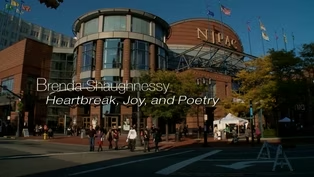
Narrator: We met Brenda Shaughnessy at one of her many appearances at the Dodge Poetry Festival.
It's the largest gathering of poets in North America.
We also sat in on one of her classes at Rutgers-Newark.
Shaughnessy: The first book, "Interior with Sudden Joy" is a book of love poems.
It's basically just a book about lesbian love gone wrong and terrible heartbreak, the kind of heartbreak that just made me feel like I couldn't go on.
And poetry really did feel like it was saving me then.
Narrator: And Pulitzer Prize winner Stephen Dunn.
For decades, he was a much loved teacher at Stockton University.
Dunn: I'm often called an honest poet.
I never think of myself that way.
Honesty is an achievement, if you're lucky.
Narrator: "State of the Arts" going on location this week with some of New Jersey's most extraordinary poets.
[ Music plays ] The New Jersey State Council on the Arts encouraging excellence and engagement in the arts since 1966, is proud to co-produce "State of the Arts" with Stockton University.
Additional support is provided by these friends of "State of the Arts."
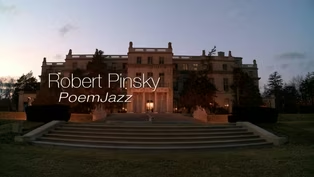
[ Music plays ] Narrator: We met Robert Pinksy in 2013 in his hometown of Long Branch, New Jersey.
The former U.S. poet laureate performed with a jazz ensemble and took us on a tour of his old neighborhood.
[ Music plays ] Narrator: Near Long Branch, New Jersey, at Monmouth University, a native son has returned to read poetry in concert with jazz musicians.
Robert Pinksy is a three-time U.S. poet laureate.
He grew up in this shore town, as did his parents before him.
Pinksy: Somebody asked me this afternoon, "Do I have any poems about Long Branch?"
And I responded, "All of my poems are about Long Branch."
Often only I could tell what they are.
This next poem -- poem is called "Creole."
And it will mention that one of the things I think is great about our hometown is that it is very mixed.
The ethnicities traditionally in Long Branch are all jumbled together.
[ Jazz music plays ] I'm tired of the gods.
I'm tired of the gods.
I'm pious about the ancestors: afloat flowed in the wake widening behind me in time, those restive devisers.
[ Jazz music plays ] My father, Milford Pinksy, had one job from high school until the day he got fired at 30.
[ Jazz music plays ] He and my mother met at Long Branch High School.
He and I -- this sounds impossible -- My father and I had the same homeroom teacher, Miss Scott, as though Miss Scott always got that part of the alphabet.
We had been living in a two bedroom apartment with three kids and renting it, and so that moving here to 16 Wooley Avenue was thrilling.
For what it's worth, that upstairs right hand window was the room where my brother and I slept on a trundle bed.
I'm sure it was a big moment for my parents to, to move to 16 Wooley Avenue from the two family house at 36 Rockwell Avenue.
Milford is a variant on the names of poets.
Milton.
Herbert.
Sidney.
Names that certain immigrants used to give to their offspring And Creole -- Creole comes from a word meaning to breed or create in a place.
Each time I'm aware of my father and how these streets were like a universe for him and that so much has deteriorated and changed, especially the downtown.
He had an optical office there and his father had a bar, the Broadway Tavern.
And the people with the shoe store, the kitty store, a lot of categories that don't exist anymore, people he knew.
This building on the right, the yellowish brick, that was the Garfield Grand Hotel named after two presidents who came to Long Branch.
[ Jazz music plays ] Sometime going from high school to college, I started realizing I wasn't going to be musical enough to have a musical career.
So almost without any transition, I went from wanting to be a great musician to wanting to be a great poet.
[ Jazz music plays ] And I never really lost a love for music, but it wasn't my métier anymore.
[ Jazz music plays ] Like all improvisation, it's simultaneous planning and surprising and responding to one another, listening very carefully.
I'm a non-singing vocalist, and what we do is I play with these guys.
We play in all senses of the word.
Sweet Babylon.
Coarse sugar of memory.
Salt Nineveh of barrows and stalls.
Candy Memphis of exiles and hungers.
Your bare feet, gray tunic of a child.
Hemp woman, whore merchant, the barber with his copper bowl.
Salt Nineveh of barrows and stalls.
Candy Memphis of exiles and hungers.
Healer, dealer, drunkard.
Fresh water, sewage -- wherever.
You died in the market sometimes your soul flies up out of you -- a hunting for buried Cakes here in this city.
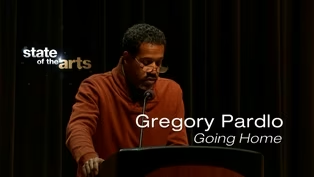
[ Jazz music plays ] [ Music plays ] Narrator: In 2015, poet Gregory Pardlo had just won the Pulitzer when we met him in his hometown of Willingboro, New Jersey.
He was still in grad school at the time.
Pardlo: They whip quick as an infant's pulse and a jumper before she enters the winking nods in time as if she has a notion to share.
Waiting her chance to speak.
But she's anticipating the upbeat like a bandleader, counting off the tune they are about to swing into.
Narrator: At the age of 46, Pardlo won the 2015 Pulitzer Prize for poetry, joining the ranks of Sylvia Plath, William Carlos Williams, Gwendolyn Brooks and Robert Frost.
Now he seems to be in perpetual travel mode, giving readings anywhere from Sri Lanka to his hometown in Willingboro, New Jersey.
Pardlo: The jumper stair steps into midair as if she's jumping rope in low gravity, training for a lunar mission.
Airborne a moment long enough to fit a second thought in.
She looks caught in the mouth bones of a fish as she flutter floats into motion like a figure in a stack of time lapse photos thumbed alive.
Once inside, the bells tied to her shoestrings roused the gods who've lain in the dust since the Dutch acquired Manhattan.
[ Applause ] Going back was really wonderful, and I was so pleasantly surprised, not only at how well received I was, but how much I missed feeling at home.
I felt legitimately like I belonged.
And I'd forgotten what that felt like.
Every place in South Jersey has some resonating memory for me.
I was born still and superstitious.
I bore an unexpected burden.
I give birth, I give blessing.
I gave rise to suspicion.
I was born abandoned outdoors in the heat shaped air.
Air drifting like spirits and old windows.
I was born a fraction and a cipher and a ledger entry.
I was an index of first lines when I was born.
Narrator: These days, Pardlo lives in Brooklyn with his family.
He has two books of poetry under his belt.
The second, "Digest," was the Pulitzer Prize winner.
He is the first to admit that the prize has made it a little harder for him to stay focused.
Pardlo: There is a big lure to jump at opportunities right away.
But my sense is that they'll be there.
The world is still going to be there, and I want to do my best to follow through with everything I set out to do before the prize.
"I make a starless night on my face before he asks, 'Are you ready?'
'Yeah, dawg, I'm ready.'
'Sure' 'Sure.
Let's do this.'
His rough hand in mine inflates like a blood pressure cuff, and I squeeze back as if we are about to step together from the sill of all resentment and timeless toward the dream source of unneeded.
The two of us hurdle sharing the cosmic breast of plenitude.
When I hear the coins blink against the surface and I cough up daylight like I've just been dragged shore.
'See, now you'll never walk alone,' he jokes, and is about to hand me back to the day he found me in, like I was a rubber duck.
And he says, 'You got to let go.'
But I feel bottomless.
And I know he means well, though I don't believe.
And I feel myself shaking my head no when he means let go his hand."
[ Music plays ] [ Music plays ] Narrator: We met Brenda Shaughnessy in 2015 during one of her many appearances at the Dodge Poetry Festival.
In the story, she tells us about her four practical, helpful tips on writing poetry.
[ Music plays ] Shaughnessy: Thank you for coming out on this morning.
It's such a pleasure to be at Dodge.
It really it's just an honor and a blast to.
I was weeping almost all day yesterday.
It was so good.
[ Laughter and applause ] Artless is my heart.
A stranger berry there never was, tartless.
Gone sour in the sun, in the sunroom or moonroof, roofless.
Narrator: For Brenda Shaughnessy, poetry is a deeply personal exploration of what she calls the real stuff of life.
The struggle between heartbreak and joy is most notable in her acclaimed third book, "Our Andromeda."
Shaughnessy: If anything does characterize my work overall, it's that there's no experience, it's all one thing.
You know, it's not -- there's not just sadness that overtakes you and there's no moment of joy.
There's never just joy within, you know, without any kind of critical central vein of despair.
The first book, "Interior with Sudden Joy," is a book of love poems.
It's basically just a book about lesbian love gone wrong and terrible heartbreak, the kind of heartbreak that just made me feel like I couldn't go on.
And poetry really did feel like it was saving me then.
The second book is called "Human Dark with Sugar."
In between heartbreak and death and joy, I tried to use humor to talk a lot about my uncertainty with what sort of -- what the stuff of life actually was.
There's a darkness there, and then I kind of hint, you know, a hit of sweetness.
And so then the third book, "Our Andromeda," was really a change for me.
When my son was born, there was a really terrible accident at the birth and it was a very -- it was a disastrous injury that he suffered.
And he survived, and he's seven years old now and he's wonderful.
I was so glad to have a 20-year practice of poetry behind me because I felt like this really bad thing happened and I don't know how to see out of it.
There's no other way to do this but pushed through it in poetry.
I just wrote and wrote and wrote and wrote, and it was this amazing express of crying and writing at the same time, Like, I was writing while crying.
"Our Andromeda" has to deal with the notion of alternate realities, alternate selves, doubles, twins, sisters.
The book is all about that.
What if this didn't happen on Andromeda, our sister galaxy?
It's possible that we could have been the same exact doubles of ourselves, just that the thing wouldn't have happened to my son and he would be healthy.
Both the heartbreak and the incredible generative world making power of poetry.
They both just came together in this book for me.
That's what I learned.
Miracles.
"I spent the whole day crying and writing until they became the same as when the planet covers the sun with all its might.
And still I can see it.
Or when one dead body gives its heart to a name on a list.
A match, a light, sailing a signal flare behind me for another to find.
A scratch on the page is a supernatural act.
One twisting fire out of water, blood out of stone.
We can read us.
We are not alone."
This poem doesn't take responsibility for anything.
I mean, it was like the moment.
We don't have any context, We don't... Narrator: Brenda is also an associate professor at Rutgers-Newark, and it's this approach of working with the real stuff in life that she brings to the classroom.
Shaughnessy: ...just about to happen, Miss, that actually makes me more dizzy than the actual description of it.
I teach in the Rutgers-Newark MFA program, and our graduate students are very committed to their poetry.
There are people who've already decided this is for me, I'm doing this.
I need to figure out how to create some practices for myself so that I can pursue this.
Well, that yielded something gorgeous.
Woman: Yeah.
Shaughnessy: I have these sort of very condensed five tips.
I give them to my students because I've learned that I need them myself.
So... You think that's a great idea for a poem, but the poem isn't an idea.
The poem is a physical action.
You have to do this or this or there is no poem.
There's so much knowledge.
I call it the back brain, that there's way more back there than you have access to generally.
Your poetry can find access to them.
Three, stare at something, anything, right in front of you.
And don't scan and search looking for something poetic.
That's the first thing you have to do to start to write a poem.
It's a great exercise because it forces you to defamiliarize what you see every day.
Sounds like you're giving yourself some kind of weird spiritual title, but it's a practice.
And the practice is the identity.
And if you write poetry, you call yourself a poet because that naming has power.
It means that there's something about that subject that is important to you.
It's the kind of thing where you might actually spend your whole life writing around to, against, with that fear.
Woman: You know, the man who who approaches him... Shaughnessy: Working with emerging poets, trying to communicate the necessity of bringing the real stuff of you to the page and to the class, that's really hard.
The truth is we don't really like going to the bad places.
We like to believe that we're kind of in control of things.
If bad things happen to us, we're sort of over them.
And poetry forces us to not just sort of acknowledge those cracks, but to actually pull them apart and go, you know, what's in there?
How deep does that go?
What started them?
What is the seismic activity that still rocks this person?
So it's unfortunate, but I do tend to say to them, if it hurts, that's where you should be going.
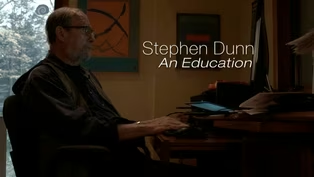
[ Music plays ] Narrator: Pulitzer Prize winner Stephen Dunn taught at Stockton University for decades.
We met the poet in 2018 at his home in Frostburg, Maryland.
He died there in 2021 on his 82nd birthday.
Dunn: An education.
"For a while you believe by putting just one phrase on paper or a splash of paint on a canvas, a gesture, random and accidental.
You were on your way to the beginning of an order."
Narrator: Outwardly, there was little in his early life to suggest that Stephen Dunn would become one of America's great poets, a Pulitzer Prize winner and a much loved teacher.
But that's what happened.
The New York native attended Hofstra University on a basketball scholarship, was the first in his family to graduate from college and played pro ball for a year.
Then he became an advertising man.
Dunn: My case is so much different than anybody else's.
I didn't have any teachers that taught me poetry in any successful way.
I had no devotion to anything except playing ball.
But I was a serious reader.
I had read all the great books by the time I was 20 it seemed.
My first job after college, after I played a year of basketball, was with National Biscuit Company, in which I answered an ad in the New York Times for a writer.
I was good at it.
Actually, getting promoted terrified me.
Narrator: So Stephen quit the corporate world and went to Spain for a year.
Dunn: Went to write a novel, and wrote a bad novel, threw it away.
And my only literary friend, Sam Takara, came over to Spain to visit, and he confirmed that the poetry I was writing, that I started to write then was good.
If he hadn't done that, I might not have continued.
The professor emeritus at Stockton University is the author of more than a dozen volumes of poetry, and his poems appear in magazines like "The New Yorker."
The poet married writer and essayist Barbara Hurd in 2003 and moved from New Jersey to Frostburg, Maryland, where she was teaching.
Hurd: I had taught his work for years and admired his work and that contrarian mind that he has.
Dunn: "After I asked about their souls, they laughed and stumbled toward an answer, then gave up, turning the question back to me.
Because mine was always in jeopardy.
I said it went to the movies and hasn't been seen since."
[ Laughter ] [ Applause ] Narrator: For more than 20 years, Stephen Dunn has led seminars at the annual Murphy Writing Retreat, now held at the Stockton Seaview Hotel.
Hurd: For him whom it feels like a community of people that have been on this poetry ride with him for a long time.
Murphy: He loves teaching, but he says, in our class, what we teach at Stockton is it's hard to write a good poem.
I'm not sure any of you can write a good poem, and by the end of the semester, it's like, you know, some of you wrote some good poems.
Dunn: Ona has a difficult time writing a bad poem.
[ Laughter ] And this is -- this is a good poem.
But one of the things that makes it for me is -- is the cooperative sounds, your ends and your ends.
Murphy: And his poems are accessible.
You can read a Stephen Dunn poem and get it.
Dunn: I'm often called an honest poet.
I never think of myself that way.
I think honesty is an achievement, if you're lucky.
Murphy: Stephen loves to play with contraries, so that he might have a poem about a relationship, let's say, between a husband and wife.
And you're expecting it to go one way, but it turns in a different way.
Narrator: At home in Frostburg, Stephen Dunn chose to read a poem called "Propositions" from his recent collection, "Whereas."
It includes the line, "Before I asked my wife to marry me, I told her I'd never be fully honest."
And it concludes with a line that he says completely surprised him when he wrote it.
Hurd: It was a poem that came out of a conversation, actually, that we did have at some point, and it was related to this conversation of honesty being an achievement and not not something you just blurt out because that's what you're thinking at the time, that that's not necessarily honest at all.
But, you know, to be digging deeper for what is really honest.
"Propositions."
"What does a pig know about bacon?
Anyone who begins a sentence with 'In all honesty' is about to tell a lie.
Anyone who says 'This is how I feel' has better love form more than disclosure.
Same for anyone who thinks he thinks well, because he has thought.
If you say you're ugly to an ugly person, no credit for honest, which must always be a discovery, an act that qualifies as an achievement.
If you persist, you're just a cruel bastard, a pig without a mirror, somebody who hasn't examined himself enough.
A hesitation hints an attempt to be honest, suggests a difficulty is present.
A good sentence needs a clause or two, interruptions, set off by commas, evidence of slowing down or rethinking.
Before I asked my wife to marry me, I told her I'd never be fully honest.
No one, she said, had ever said that to her.
I was trying to be radically honest, I said, but in fact had another motive.
A claim without a 'but' in it is, at best, only half true.
In all honesty, I was asking in advance to be forgiven.
[ Music plays ] [ Music plays ] Narrator: We hope you enjoyed meeting these four remarkable poets.
Visit us online and make sure to let us know what you think of the show.
Thanks for watching.
[ Music plays ]
Video has Closed Captions
Clip: S41 Ep7 | 6m 47s | Poet Brenda Shaughnessy at the Dodge Poetry Festival and at Rutgers University-Newark. (6m 47s)
Video has Closed Captions
Clip: S41 Ep7 | 3m 31s | Pulitzer Prize-winner Gregory Pardlo, poet, returns to to his hometown in New Jersey. (3m 31s)
Video has Closed Captions
Clip: S41 Ep7 | 5m 39s | Meet two-time US Poet Laureate Robert Pinsky in his hometown of Long Branch, NJ. (5m 39s)
Video has Closed Captions
Clip: S41 Ep7 | 6m 10s | Pulitzer Prize-winning poet Stephen Dunn returns to Stockton University. (6m 10s)
Providing Support for PBS.org
Learn Moreabout PBS online sponsorship

- Arts and Music
The Best of the Joy of Painting with Bob Ross
A pop icon, Bob Ross offers soothing words of wisdom as he paints captivating landscapes.











Support for PBS provided by:
State of the Arts is a local public television program presented by NJ PBS