State of the Arts
State of the Arts: April 2024
Season 42 Episode 6 | 26m 46sVideo has Closed Captions
Gun & Powder, architect Edward Bowser Jr., and artist Jack Larimore.
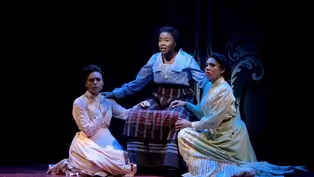
Paper Mill Playhouse’s new musical ""Gun and Powder"" tells the true story of how two Black sisters became bank robbers. African American architect Edward T. Bowser, Jr. trained with the legendary Le Corbusier and designed at least a dozen houses and buildings throughout NJ. And artist Jack Larimore explores competition in the world of nature in “Bonding,” at Rowan University Art Gallery.
Problems playing video? | Closed Captioning Feedback
Problems playing video? | Closed Captioning Feedback
State of the Arts is a local public television program presented by NJ PBS
State of the Arts
State of the Arts: April 2024
Season 42 Episode 6 | 26m 46sVideo has Closed Captions
Paper Mill Playhouse’s new musical ""Gun and Powder"" tells the true story of how two Black sisters became bank robbers. African American architect Edward T. Bowser, Jr. trained with the legendary Le Corbusier and designed at least a dozen houses and buildings throughout NJ. And artist Jack Larimore explores competition in the world of nature in “Bonding,” at Rowan University Art Gallery.
Problems playing video? | Closed Captioning Feedback
How to Watch State of the Arts
State of the Arts is available to stream on pbs.org and the free PBS App, available on iPhone, Apple TV, Android TV, Android smartphones, Amazon Fire TV, Amazon Fire Tablet, Roku, Samsung Smart TV, and Vizio.
Providing Support for PBS.org
Learn Moreabout PBS online sponsorshipNarrator: Jack Larimore calls himself a maker.
A new solo show at Rowan University Art Gallery reveals his passion for playful self-expression inspired by nature.
Larimore: I mean, it almost seems ridiculously like it's play or something, like I'm in kindergarten.
That's sort of what it is.
I mean, you hope to be actually to be able to regress back to kindergarten so you can do some good work.
Narrator: New appreciation for one of America's first Black architects, Edward Bowser Jr., who lived and worked in East Orange, New Jersey.
Godlewski: The story I'm about to tell you is one about one of the first African-American architects, an apprentice of Le Corbusier, amateur photographer, father, and a proud son of East Orange.
Man: [ Singing ] ...barbershop, in the brothel house... Narrator: And in a new musical at Paper Mill Playhouse, Wild West outlaw sisters who were Black, the real-life ancestors of playwright Angelica Chéri.
Chéri: My great-great aunts, they passed for white because they appeared to be white, and they were outlaws.
Bayardelle: [ Singing ] And beware, my darlings, there's no secrets in the sun.
Narrator: "State of the Arts," going on location with the most creative people in New Jersey.
Bayardelle: [ Singing ] That great, wide-open plain.
Announcer: The New Jersey State Council on the Arts, encouraging excellence and engagement in the arts since 1966, is proud to co-produce "State of the Arts" with Stockton University.
Additional support is provided by... ...and these friends of "State of the Arts."
[ Music plays ] Godlewski: The late architect Le Corbusier would often be heard saying that the history of architecture is the history of the struggle for light, for any student of history knows that the tale of this nation has often included as much as it has kept out.
The story I'm about to tell you is one about the struggle for light, which makes it a characteristically American story.
It is my great honor to shed light on one of the first African-American architects, an apprentice of Le Corbusier, amateur pilot, photographer, father, and a proud son of East Orange, a man whose indelible mark on history deserves to finally see the light.
This is the story of Edward T. Bowser Jr. [ Music plays ] [ Car door slams ] [ Music plays ] Godlewski: Hello.
Bowser: Hey, how are you?
This house reminds me of Ed's house on 41 Oak Street in East Orange, so it's so nice to come back and have all these fond memories from the early 1950s.
So East Orange in the '50s and '60s had a reputation of being one of the cleanest cities in the country.
We used to ride our bikes.
There was a milkman.
Very hometown-organized.
And, you know, we went to church.
My grandfather -- he had a very prominent role in the Calvary Baptist Church.
He also built a lot of churches as an architect.
We were in East Orange next to Uncle Eddie's house.
My grandfather's house was in the middle.
So we spent Christmas, Easter, Thanksgiving going from house to house.
Uncle Ed -- he was a very inspirational guy.
He was one of my mentors when I was growing up.
He was a innovative photographer, that he actually set up a dark room in his bedroom.
He's got a pilot's license.
So he took us flying a couple of times.
Godlewski: You told me he was a veteran?
Bowser: My uncle Ed joined the Navy when it was segregated.
There were people who had illustrious military careers, but they were treated differently.
He was exceptional in school.
He and my Aunt Carmen got married, and they had my cousin Kathryn.
Godlewski: How did they end up in France?
[ Man speaking French ] Everybody looked at Le Corbusier as sort of a renowned international architect.
Le Corbusier was one of the most important architects of the modernist movement in Europe.
Bowser: My uncle sent a note to Le Corbusier and said, "Can I come and study with you in Paris?"
[ Ship horn blows ] It was kind of amazing for a young African American to go to Europe and study with Le Corbusier.
Godlewski: When did your uncle come back?
Bowser: Ed came back from Europe end of 1952.
And then, of course, he built his house, which was one of a kind.
Godlewski: He wanted to create beautiful houses, but also wanted people to live in that space.
Bowser: But there was a lot of discrimination.
Uncle Ed wasn't able to get an architectural license in New Jersey.
It was a tough environment to be a professional, and the fact that he later got his national architectural license shows that he must have been an exceptional guy.
[ Birds chirping ] Godlewski: I think I was always meant to live in this house.
As a young architect studying at Cooper Union, I designed a nine-square-grid house like this, built a model of it, you know, between a road and a brook, and I live now in a nine-square-grid house between a road and a brook at the edge of the forest.
Remarkable.
It's a contemporary house, but where it distinguishes itself is in the warm and brilliant details -- the cork floors, the wooden ceilings.
The windows are such that there are beautiful rays of sunlight that stream into the house all day long until sunset.
Edward Bowser Jr. took the modernist box in the air, and it arrives from the sky to America.
Having discovered this house has given me a very definite purpose.
When I started doing this, there were about 12 Bowser houses, and now more are coming to light.
There's about 18.
Mariconda: Hi.
I'm Glenn.
Hi.
Nice to meet you.
Godlewski: Until a month ago, I didn't know any of you.
And I didn't know that your Bowser houses existed.
Walker-Bennett: We have this commonality enjoying where you live and caring about where you live.
Horne: Yes.
This is my community.
I have found the people who appreciate this.
Mariconda: I'm Glenn Mariconda.
This is my home here at Nutley, New Jersey.
My wife, Asaka, and I have been here for a little over three years.
We're transplants from Brooklyn.
And the moment we walked in, we just, you know, fell in love with the house.
We had, like, an affinity for the house immediately.
We'd been looking for a Mid-Century house.
We saw this house for sale.
In the listing, there was just a little note at the end saying, "Oh, this architect worked for Corbusier."
And the story was completely intriguing to us.
We had never heard of Bowser.
It's, you know, got all these modernist elements.
But it's also built for living.
[ Music plays ] Fred: Well, I'm Fred Kingston.
My wife and I live in the house right next door.
I was a young man.
I just got out of the Navy.
I was 20 years old.
I used to drive by all the time with the truck just to look at it.
And these were the only two houses up here.
I was on duty.
The woman that lived here had a little fire, and I came up with the trucks and I put out the fire, and I made her an offer on the house, and, lo and behold, I wound up getting the house.
I've never had more fun in a house.
This is like living in your vacation house.
Colleen: Nutley is a very old town.
There are other historic houses.
One of them was Annie Oakley's house.
It is now gone.
There was another one where Jackie Kennedy's aunt lived -- gone.
[ Laughs ] Fred: It's all about money.
It's all about the dollar.
Colleen: It's all about money.
Fred: And it's funny that I'm just finding out within the last year or so more about the house than I ever knew in the 25 years that we've been here.
Edward T. Bowser Jr., architect, East Orange, New Jersey.
Sklar: My name is Janet Sklar.
I'm a real-estate agent, and my house is over on North Mountain in Montclair, New Jersey.
The story of Mr. Bowser definitely resonated with me immediately.
My father is an architect, and two of the houses that my father built for us had carports.
And this house had a carport, and you don't see those a lot.
It makes your day-to-day just feel more special living in a place like that.
Bowser: He had done everything that he could do here.
They got to Ghana in 1977.
He built a house, of course.
They had a technical school, and they would teach kids how to fix computers.
Before they moved out to Ghana, Ed built Kuzuri Kijiji, went to means "beautiful village" in Swahili.
It was supposed to be affordable and use materials to suggest an African village.
Godlewski: I believe it's being used for fire practices.
You know, that's how badly it's being treated.
Like, they want to knock it down.
So much of his work is being demolished or modified.
In the end, Bowser found peace in Ghana, where he died in 1995.
Remember his name.
Remember his story.
It is on all of us, especially those who live inside his wonderful creations, to make sure that that struggle for light will never be a struggle again.
[ Applause ] [ Music plays ] Narrator: Later on the show, a new musical at Paper Mill Playhouse -- "Gun & Powder."
But first, a former furniture maker is now a maker of art.
[ Music plays ] Salvante: He talks about himself as a maker.
And I think, with viewers, that shifts your perspective.
You're like, "Well, what's the difference?
You know, you're a maker, you're an artist.
[ Music plays ] Larimore: I've really settled on the word "maker."
I think it's the best term, Because everything I do revolves around making.
Sculpture is the term that's used to describe the things that I'm exhibiting.
But what I do is make.
[ Music plays ] We live on a farm here, a little farm, 10-acre farm.
It's sort of a funny farm.
We grow a lot of weeds.
It's interesting to end up here.
I grew up on a farm in Michigan.
And then in between, I spent most of my adult life in the city, in Philadelphia.
Salvante: So, we met a number of years ago.
This is over 20 years ago.
When I first met Jack, I knew him as a furniture maker.
After moving to New Jersey, he has been making art pieces since then, which I think has probably been over 15 years or so, surrounded by this rural environment.
You could start to see the influence of his interest in the natural world.
His work really started to respond to that.
His studio is this fantastic, glorious old barn that feeds his creative process.
He collects his materials maybe not knowing what he's gonna do right away, but you just have a sense that he's got a plan, and it will come together.
[ Drill whirring ] [ Music playing ] Larimore: It almost seems ridiculously like it's play or something, like I'm in kindergarten.
That's sort of what it is.
I mean, you hope to be able to regress back to kindergarten so that you can do some good work without your brain getting in the way.
Quite often, it's pretty slow-paced.
[ Music plays ] A new material that I'm using in this exhibition now is cotton -- cotton bolls, which are the way that it's harvested by hand.
In order for me to use those well, I just have to handle them and be with them a little bit and pile them up over here and spread them out over here.
Overarching concept for the exhibition is bonding.
The thing about cotton that makes it such a valuable fiber -- all these individual fibers are just prone to bond to each other.
And yarn's really a strong thing because of all the fibers bonding together.
And it's just, like, one of these "aha" moments when things come together for you.
[ Chain saw buzzing ] Salvante: It's almost a gift.
Nature is giving him a gift.
Here is this log.
Do something with it.
[ Music plays ] He might cut it a certain way... ...to give it a beautiful texture and color.
Then he will pair it with other materials like cloth or fabric, which brings in a softness, blending industrial farm equipment with natural, organic elements.
But when they come together, there's this push and pull, this conversation.
As he works with the materials, his themes and his narratives begin to emerge.
[ Music plays ] Larimore: I think -- yeah, I think the light...
When you look at the work, you're not gonna say, "Oh, this is all about bonding."
That's meant to be provocative.
But if you offer that, if you just offer that out and sort of, like, say, "Look at this through this filter," you know, you can look at through any filter you want to, but I'm offering that as a possibility.
It was a lot of fun to get it set up, and it sort of activates this long wall.
They are pieces of a story.
Each one's a story, and then they're pieces of a bigger story.
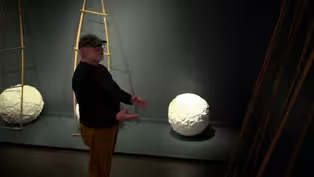
So the spheres are covered in fragments of bed sheets.
They're old bed sheets from the thrift stores.
The wood structures -- they're salvaged from a very old antique agricultural thrashing machine.
This is the kind of materials that love the lighting.
The hieroglyph on the wall, which is the shadows, adds another sort of layer.
These things keep expanding my experience.
So they're not done with me, which is cool.
So I brought these in.
These are incredibly interesting things in and of themselves.
I left the last ball without a structural form around it because it gives a sense of continuum.
This is not a done deal.
In the same way, maybe these pieces can reinforce that sort of idea.
These are not assembled into structures.
They're almost like they're raw materials.
This almost looks like the way they were in the studio.
This is the way so much of the work gets done.
You got to try it to see.
I'm having a good time.
It becomes sort of a thing, the conversation between inanimate objects, you know, but I believe in it.
I'm as excited to see this all installed and be in the gallery with it as anybody 'cause of what I'll learn.
It's sort of a rich and provocative experience of this piece just to see into this little window and see the chain in there, and it invites you to come around and check it out a little bit more.
And then, within the same view is this other new piece titled "Hand."
I think these two are having this great conversation.
Salvante: With the exhibition "Bonding," it's not just a collection of works.
It's a journey of the soul of a maker, and his profound experience and relationship with his materials that fuel it.
Nature is his muse.
And as a maker, being in that environment influences him.
He takes inspiration from his surrounding area.
Larimore: Self-expression is sort of an interesting thing to be able to pursue.
It's a really rich way to keep growing and find out about yourself and about the world.
Being here and working here, I get to have all these experiences with nature.
I get to feel really connected to the land.
It's really kindled that part of me that I had as a kid.
So it's like a little bit of a complete circle.
It's lovely, actually.
[ Music plays ] Narrator: Last on the show, at Paper Mill Playhouse, the adventures of two Black sisters in the Wild West.
[ Music plays ] Woman: [ Singing ] We got a story to tell you.
Man: [ Singing ] It's been passed down throughout the years.
Woman #2: [ Singing ] We gon' tell it like we heard from our kinfolk point of view.
But you know how family stories do.
Woman #3: [ Singing ] So we believe it's mostly true.
Man #2: [ Singing ] It starts with two... Narrator: A story long told in playwright Angelica Chéri's family is brought to the stage in "Gun & Powder," a new musical at the Paper Mill Playhouse in Millburn.
Chéri: My grandmother is the niece of Mary and Martha Clarke, and she would show me photo albums filled with my relatives, African-American people, and it was always striking because in the middle of that photo album, we would see two white women.
These are actually my great-great aunts, and she would explain that they passed for white.
And they were outlaws.
And there was always some different spin on the story that she would explain as to, they robbed a bank, or they jumped a train, or they killed this person.
It was never the same story.
And no matter who else I would speak to, whether it was an uncle, an aunt, a cousin, everyone had a different perspective about what these women committed as their notorious outlaw escapades.
And so I thought that was just so fun and rich and musically potent.
Walker-Webb: Angelica Chéri, my book writer and lyricist, while she's giving us her family folklore, she's put it in the truth of its historical context so that we can all look back at this moment in American history and see just how fierce and powerful the people who survived that time period were.
Man #3: [ Singing ] In the barbershop, in the brothel house, in the Baptist church, barely steering clear of jail.
Renée: Throw it in the bag!
Narrator: In the Wild West, women outlaws and gunslingers were rare but not unheard of.
For Black women outlaws like the Clarke sisters, a society prejudiced against gender and race made their story even more exceptional.
Chéri: This is something that has been a part of not just American culture because of the stratification of race and colorism, but also around the world and what it means to have to suppress a part of yourself in order to survive.
Renée: [ Singing ] Oh, sleeping on these stiff straw beds.
Narrator: Mary and Martha Clarke, the sisters at the center of the story and Angelica's great aunts, are played by Liisi LaFontaine and Ciara Reneée.
Renée: I can just tell in the way that she writes how much care she has for this story, how important it is to her.
Walker-Webb: What Angelica has done is she's taken this story, where it would normally be two men at the center, she's made two women.
She's placed them at the center of the story.
So you get all of the capers and all the action and all of the story of a Western, but it's following two Black women.
She's kind of created a new genre.
It's kind of like, you know, you got the spaghetti Western.
I feel like she's creating, like, a soul-food Western.
You know, it's, like, really, really incredible.
Renée and LaFontaine: [ Singing ] ...all along.
We could stay here waiting for a change to come, pray to God the world will change its mind.
Chéri: We learn that they are living on a plantation.
They are no longer enslaved.
However, they are living in the Reconstruction period, picking cotton in order to pay rent.
And so we learn that their mother has a share-cropping debt, and she's in danger of losing her home.
Walker-Webb: The two daughters, they are very fair-skinned.
They're half-Black, half white.
And they get this crazy notion that they should pass for white and see if they can go find work that would be more lucrative for them.
So to place it in 1893, on their journey, they discover that they're in the West.
They're in the Wild, Wild West and people are gunslingers, and people are like, you know, doing whatever they can to survive, and they're like, "Well, maybe we should do that, too."
[ Laughs ] And so it becomes a little bit of, like, a "take from the rich and give to the poor" story, a little bit of "Robin Hood."
Chéri: When they stumble upon robbing people and becoming outlaws, it was something that was born out of a moment of survival, but then it becomes their new way forward.
Bayardelle: [ Singing ] And beware, my darlings, there's no secrets in the sun.
You won't have no... Walker-Webb: Martha is the sister who kind of wants to, like, save everybody, and Mary is the sister who desperately wants to save herself and is willing to do anything to do that.
And then, over the course of the play, these two women discover that you need a little bit of both.
Chéri: Thinking about it in the context of the American Western is very, very new in terms of our consciousness.
So it's exciting to mine this territory.
Walker-Webb: There's something about the American Western that just captures, like, what it means to be American.
You know, you see these characters on the frontier fighting to survive.
And because it's so dangerous, the love is richer, the heartbreak is richer, right, just because of the stakes of their environment.
Renée: [ Singing ] I am a woman I never, ever thought I'd be.
[ Sings indistinctly ] Chéri: The romance is extremely dangerous for two women who are passing for white.
When one falls in love with a white man, that has a different connotation than the other who falls in love with a Black man.
The romance ratchets everything up to the next level.
LaFontaine: [ Singing ] I gave my word.
I can't change course to wander and roam.
Bayardelle: What I love about this musical is that we're dealing with an issue that America has been dealing with for a very long time, which is race.
We're dealing with two girls who are both Black and white.
You're gonna go on their journey and what it feels like to be one person, but in two worlds.
So I think that's a story that a lot of Americans can sit with.
Renée: We get set up in the gravity of this situation.
And then we also get to see the resilience and the excellence and the comedy and the beauty of enslaved people, of Black people, of us, these women who are empowering themselves.
Chéri: Paper Mill has such a legacy of raising big new shows, so I'm really excited to bring this in such a heightened way to the conversation.
Cast: [ Singing ] Oh, oh.
Renée: [ Singing ] Ohhhhhhhhhhh-oh-ohhhh-oh-oh-oh!
[ Cast sings indistinctly ] [ Music plays ] Narrator: That's it for "State of the Arts" this time.
Find all these stories and more at StateoftheArtsNJ.com.
While you're there, sign up for our newsletter.
Thanks for watching.
[ Music plays ] [ Music plays ] [ Music plays ] Announcer: The New Jersey State Council on the Arts, encouraging excellence and engagement in the arts since 1966, is proud to co-produce "State of the Arts" with Stockton University.
Additional support is provided by... ...and these friends of "State of the Arts."
[ Music plays ]

Video has Closed Captions
Clip: S42 Ep6 | 8m 37s | Edward T. Bowser Jr., one of the first Black Architects to work in mid-century NJ. (8m 37s)
Video has Closed Captions
Clip: S42 Ep6 | 6m 31s | A new musical, Gun & Powder, about Black outlaw sisters in the American West. (6m 31s)
Video has Closed Captions
Clip: S42 Ep6 | 7m 31s | Jack Larimore explores competition in the world of nature in “Bonding,” a new exhibition. (7m 31s)
Providing Support for PBS.org
Learn Moreabout PBS online sponsorship

- Arts and Music
The Best of the Joy of Painting with Bob Ross
A pop icon, Bob Ross offers soothing words of wisdom as he paints captivating landscapes.











Support for PBS provided by:
State of the Arts is a local public television program presented by NJ PBS