State of the Arts
State of the Arts: Art Comes of Age in America
Season 41 Episode 4 | 26m 46sVideo has Closed Captions
In the 20th century American artists created new modernist works that continue to inspire.
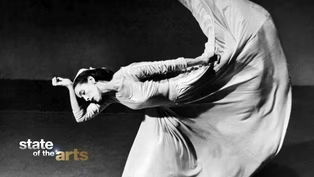
In the early 20th century, American painters, dancers, and playwrights experimented with the new styles they'd learned in Europe. State of the Arts takes a look back at New Jersey's early Impressionists and at the new modernist art in the 1913 Armory Show. Plus two American classics that continue to inspire today: Thornton Wilder’s Our Town and Martha Graham’s Appalachian Spring.
Problems playing video? | Closed Captioning Feedback
Problems playing video? | Closed Captioning Feedback
State of the Arts is a local public television program presented by NJ PBS
State of the Arts
State of the Arts: Art Comes of Age in America
Season 41 Episode 4 | 26m 46sVideo has Closed Captions
In the early 20th century, American painters, dancers, and playwrights experimented with the new styles they'd learned in Europe. State of the Arts takes a look back at New Jersey's early Impressionists and at the new modernist art in the 1913 Armory Show. Plus two American classics that continue to inspire today: Thornton Wilder’s Our Town and Martha Graham’s Appalachian Spring.
Problems playing video? | Closed Captioning Feedback
How to Watch State of the Arts
State of the Arts is available to stream on pbs.org and the free PBS App, available on iPhone, Apple TV, Android TV, Android smartphones, Amazon Fire TV, Amazon Fire Tablet, Roku, Samsung Smart TV, LG TV, and Vizio.
Providing Support for PBS.org
Learn Moreabout PBS online sponsorshipAnnouncer: America was still a young country as the 20th century dawned.
Painters, dancers and playwrights followed the style set in Europe.
But art in America was about to come of age.
By mid-century, it was the center of the modern art world.
This special episode of "State of the Arts" takes a look back, starting with the early Impressionist painters of the Jersey Shore.
Many had studied in France.
Allan: Winter months, they'd be in Paris looking at the galleries, museums, and then their teachers encouraged them to go into the more rural settings.
So when these artists came back to the United States, they kind of imitated the same patterns working in Philadelphia, New York, sometimes teaching, and then on the warmer weather, traveling to shore regions to paint what they saw outside.
Announcer: In 1913, The Armory Show in New York shocked the public with radical new paintings and sculpture by artists like Picasso and Matisse.
100 years later, the Montclair Art Museum focused on the sometimes-overlooked American artists included in the exhibition.
Stavitsky: One of the really outstanding works that we'll be featuring is by an artist who lived in Paris, Kathleen McEnery, and it is a large painting of a nude that shows the influence of Matisse.
Announcer: Artists were using new, modern techniques to explore the world around them.
In 1938, Thornton Wilder's play "Our Town" premiered at the McCarter Theatre in Princeton, New Jersey.
Gaines: The name of our town is Grover's Corners... Saint: It's still avant garde.
It's not a naturalistic four-walls, kitchen-sink drama.
The style is theatrical and the subject matter, because he's taking little bits from our daily lives and literally expanding on them to a more sense of the mystical, the universe, our past, our future, our ancestors, our descendants, and so it's very poetic.
Announcer: Dance was becoming modern as well.
American choreographer Ruth St. Denis broke with the traditions of European ballet, and in the 1930s, her student Martha Graham completed the revolution.
Eilber: If anybody asks you, "What exactly did Martha Graham do?
", you can say she took natural gesture, the things that we do unconsciously when we're sad or when we're happy, euphoric, stressed, and she took those gestures and those ways that we embody how we feel and turned them into a dance language.
Announcer: Martha Graham's iconic "Appalachian Spring" was re-created at PEAK performances in Montclair.
Coming up, a look at the art that shaped America's past and that continues to inspire artists today.
[ Music plays ] "State of the Arts," on location with the most creative people in New Jersey.
[ Music plays ] The New Jersey State Council on the Arts, encouraging excellence and engagement in the arts since 1966, is proud to co-produce "State of the Arts" with Stockton University.
Additional support is provided by these friends of "State of the Arts."
[ Music plays ] Announcer: Some remarkable American Impressionists from the turn of the 20th century are being rediscovered today.
An exhibition at Morven Museum and Garden in Princeton features works painted at the Jersey Shore.
[ Music plays ] [ Music continues ] Webb: Tonight, we're having the opening reception for "Coastal Impressions: Painters of the Jersey Shore, 1880-1940."
Morven's mission is to, among other things, to interpret the cultural history of New Jersey.
And if this doesn't do it, nothing does.
It's organized around the collection of Roy Pedersen, who is known to have been the primary collector of this particular group of painters who painted at the Jersey Shore.
Narrator: Roy Pedersen is a collector and dealer based in Lambertville, New Jersey, just across the river from Bucks County, Pennsylvania, a place known for its early 20th century Impressionist painters.
Pedersen: I knew the Bucks County painting pretty well.
I'd worked in that area for quite some time and was familiar with it.
I also began to notice that there was -- that New Jersey was silent.
And at some point, you notice the silence, what's missing, more strongly than the presence of something else.
And that's when the process began.
And I kept reviewing whether this was simply an enjoyment of discovering more about the area I grew up in, or was it a real and strong classification of art history that had been missed?
And I became certain of the latter.
These are great painters who painted marvelously.
The stories, their personal commitments to art at the Jersey Shore, were the equivalent of anything I've seen anywhere.
Narrator: Some of the earliest painters going down the shore had studied with the French Impressionists.
The early artists' work in the Jersey Shore studied in France, and during the winter months they'd be in Paris looking at the galleries, museums, and then their teachers encouraged them to go into the more rural settings, away from urban scenes, to paint light and sky and water and reflections.
So when these artists came back to the United States, they kind of imitated the same patterns working in Philadelphia, New York, sometimes teaching, and then on the warmer-weather months, traveling to shore regions to paint what they saw outside.
Narrator: Often they lived near each other, forming small artist colonies, even painting together as they had learned in France, out-of-doors in plain air.
Allan: Yeah, I mean, it really continues today.
You still see artist groups working, and it's just a natural community.
Artists meet each other and want to paint and overlapping with teacher and student along the way.
Narrator: It was along the Manasquan River where one of the earliest New Jersey artist colonies formed.
In 1880, the Philadelphia painter Thomas Eakins stayed in nearby Point Pleasant Beach, followed by his student Edward Boulton.
Boulton took photographs of local fishermen.
They became a favorite topic of his paintings, as was the nearby Manasquan River.
Pedersen: It was very rural.
It was about the last stop for the railroad.
And that's what artists were looking for.
They -- many of these painters were searching for an honesty in the people and a clarity in the environment.
There was an understanding that in that simple, hardworking culture, you could produce an honest art, the stronger art than the decorative art or the historical art that was otherwise being painted.
And once you got off the railroad in Manasquan, you were in a rural fishing village type of community.
Narrator: Albert Reinhardt was another European-trained artist who chose to paint along the Manasquan.
Later, Ida Wells Stroud and her daughter Clara Stroud painted there.
Allan: Ida Wells Stroud was born in New Orleans, and after the death of her husband, she traveled to New Jersey with her daughter Clara, where both of them worked to become painters.
They both attended Pratt in the city, and then Clara Stroud, the daughter, purchased a farm in Point Pleasant near Bricktown, and where she opened the Stroud Studio.
And Ida would bring her students from Newark down to paint at the Stroud Studio on Clara's farm.
And, really, their output is enormous.
It's half of this gallery, and there's many more paintings by them out there, actually.
[ Music plays ] Narrator: In the late 19th and early 20th centuries, painters were working all up and down New Jersey's coast from Cape May to Sandy Hook.
They're now being rediscovered for a new century in this exhibition at Morven Museum and Garden, and in a new book by Roy Pedersen, "Jersey Shore Impressionists: The Fascination of Sun and Sea, 1880-1940."
Pedersen: The experience of regional art is as powerful an art experience as most people are probably gonna have, more so than seeing a show of simply a great painter who you have nothing to do with, say, a --- a Rembrandt.
If you see a show of your region's painters, you identify with them immediately.
You identify with what they paint.
And there's something about them that you recognize also exists in you.
And you begin to see the world in the same ways that they painted it.
And that transformation is as powerful experience as art can provide.
[ Gulls crying ] [ Music plays ] [ Music plays ] Announcer: In the early 20th century, artists were experimenting with form and rejecting tradition.
Paris was the center of the art world, but, as seen in our next story, American artists were very much a part of the scene.
Narrator: The International Exhibition of Modern Art, better known as The Armory Show, held at the 69th Regiment Armory in Manhattan in 1913, is often referred to as the moment modern art arrived in America.
Stavitsky: The Armory Show was really the first big modern art show in America.
So it's the exhibition that introduced artists like Picasso, Matisse, Cézanne on a large scale to America.
Narrator: 100 years later, the Montclair Art Museum has a different version of the story to tell with "The New Spirit: American Art in the Armory Show."
Stavitsky: It's really finally giving the American artists their due.
And I think one of -- two of the myths that came up, one is that, "Oh, the show was mostly important because of the European artists like Marcel Duchamp and Matisse and Picasso and Brancusi," and that the American artists were ignored and didn't really get much attention at the time of the show, and that's actually not true.
John Marin and Marsden Hartley, for example.
These artists sometimes -- in some cases, they got just as much criticism as the European artists.
In other words, their work was regarded as, you know, as radical and as difficult, as challenging as some of the European artists.
So they were put on a par with them.
One of the really outstanding works that we'll be featuring is by an artist who lived in Paris, Kathleen McEnery, and it is a large painting of a nude that shows the influence of Matisse.
And what's fun is that we're actually going to show a Matisse painting called "Nude in Wood" right next to Kathleen McEnery's "Going to the Bath" to compare the use of bold color and simplified, abstracted forms in both paintings.
[ Music plays ] It certainly did attract a lot of attention from critics and also cartoonists.
There were a lot of very humorous cartoons about the show and how, you know, crazy the artists were.
In a way, the whole history of American art has often been that America was really not a major player in the art world until around World War II, with the rise of abstract expressionism in America -- Jackson Pollock, for example.
Those are the kind of artists that first achieved an international reputation, a lot of attention.
So that's why often the artists earlier in the century, the American artists, tend to be kind of forgotten.
And so we want to correct that.
[ Music plays ] [ Music continues ] Announcer: In 1938, playwright Thornton Wilder eliminated naturalistic sets and spoke right to the audience in his Pulitzer Prize-winning drama "Our Town."
It's still one of America's most popular plays.
A production at the George Street Playhouse in New Brunswick involved the community.
Apostle: I drew love, I drew a fish, you know what I mean?
Peaceful things so kids could look at it.
You know, when we come together and do things like this, it brings back to this town because at this moment, we're not really -- we're not really doing so good.
But, you know, we could do better.
Narrator: What is it that makes a place our town?
In New Brunswick, art on the street and on stage at the George Street Playhouse asks this question.
Gaines: The name of our town is Grover's Corners, New Hampshire, just over the line from Massachusetts, latitude 42 degrees, 40 minutes, longitude 70 degrees, 37 minutes.
The first act... Ballard: It's a play in three acts.
The first act is called "Daily Life."
The second act is called "Love and Marriage."
And the third act is "Death and Dying."
The message is simple, really.
It's that we don't realize life while we live it every, every minute.
I mean, that's one of the lines in the play.
Narrator: The stage manager, or narrator, is played by four-time Tony Award winner Boyd Gaines in the George Street Playhouse production.
Gaines: Now we'll get back to Grover's Corners.
It's evening.
Narrator: "Our Town" first opened in 1938 at the McCarter Theatre in Princeton before moving to Broadway.
Playwright Thornton Wilder was friends with writers like Hemingway and Gertrude Stein, and "Our Town" shares their spare, modernist style.
The play has the barest of sets and is acted without props.
Saint: It's not a naturalistic four-walls, kitchen-sink drama.
The way it's told, the style, is theatrical and the subject matter, because he's taking little bits from our daily lives and literally expanding on them to a more sense of the mystical, the universe, our past, our future, our ancestors, our descendants.
And so it's very poetic.
Gaines: Why are you in bed?
Ballard: I don't know.
I just can't sleep yet, Papa.
The moonlight's so wonderful.
Narrator: The poetic style of "Our Town" lends itself to telling other stories as well.
Jim Jack, Director of education at the George Street Playhouse, pulled together stories from all over New Brunswick for a play called "Our Town Now," starring people from the community.
Jack: So lights up on an empty stage.
There's a wooden table, a piano.
Images of New Brunswick are projected onto a screen.
We thought this was such a ripe opportunity for George Street to explore this collectively.
And so we started asking questions of people that, what would it be -- how can we celebrate the people who live and work in New Brunswick through the arts?
Man: The name of our play is "Our Town Now."
And it takes place here in New Brunswick and owes its inspiration to another play that premiered in this state 75 years ago.
I'm talking, of course, of Thornton Wilder's "Our Town."
Woman: That play takes place in a small town called Grover's Corners up in New Hampshire in the early years of the 20th century, with a population of just over 2,000 people.
Even in those days, New Brunswick was 10 times as big as Grover's Corners.
Man #2: We interviewed over 50 people.
Jack: There's going to be evocations of some of the past and then some questions about, where are we now?
Narrator: New Brunswick is called Hub City because the river, highways, trains, and all kinds of people cross paths here.
"Hub City Our Town: A Celebration of the Arts and Community in New Brunswick" took the classic American play citywide.
The American Repertory Ballet performed "Our Town: The Dance."
[ Music plays ] There was a photo contest, topic -- "New Brunswick Our Town."
And on a very windy day in April, the New Brunswick Community Arts Council staged "Paint Our Town."
Blithe: It's what New Brunswick means to you.
What inspires you?
What are your favorite parts of New Brunswick?
What do you think of when you think of New Brunswick?
And put that on the vinyl.
Apostle: It shows people, like, you know, listen, this is how we feel about this town, you know?
We want you to feel what we feel.
We want you to understand where we're coming from.
Narrator: The casting for "Our Town" brought collaboration with the community full circle.
Theatrical veterans were joined by students and alumni of the acting program at the Mason Gross School of the Arts, just up the block from the George Street Playhouse.
And the production was directed by David Esbjornson, head of the theater department at Mason Gross.
Ballard: This is the first time that Mason Gross and George Street Playhouse are collaborating, which is fantastic.
Actor: What'll you have?
Ballard: Uh, I'll have a strawberry phosphate.
Actor #2: No, Emily, have an ice cream soda with me.
Ballard: Well... Actor #2: Two strawberry ice cream sodas, Mr. Morgan.
Saint: We decided we wanted to start off this collaboration with an American classic.
And when we started looking at the different American classics, the minute David Esbjornson, the director, and I saw "Our Town," we thought, "That's it," because the play is such a celebration of life, but also of a community.
And since this was the first time we were working with the whole community, including Rutgers University and Mason Gross, we thought, "How perfect."
[ Gaines speaks indistinctly ] [ Laughter ] Actress: Doesn't she make a lovely bride?
[ Gaines speaks indistinctly ] Jack: When we can speak to each other and share the different stories from different communities together, we stop becoming so isolated, and I think that's a big challenge of our time, is how do we stay connected, you know?
It asks us what type of community we want to be.
And I think New Brunswick and every city is always at a crossroads of that question.
[ Music plays ] Announcer: Modernism was all about making it new.
It's what choreographer Martha Graham did in "Appalachian Spring," her meditation on the American frontier.
In the 21st century, the dance and its music continue to inspire.
[ Music plays ] [ Music plays ] Narrator: In 1944, the choreographer and dancer Martha Graham premiered the now iconic "Appalachian Spring" at the Library of Congress.
She had asked the American composer Aaron Copland to write the score.
He won the Pulitzer Prize, and their collaboration made history.
[ Music plays ] Eilber: Jed Wheeler at PEAK Performances and I were attracted to the idea of celebrating the 75th anniversary of "Appalachian Spring" by commissioning something completely new but that would be a companion piece that would relate in some way to the 20th century classic.
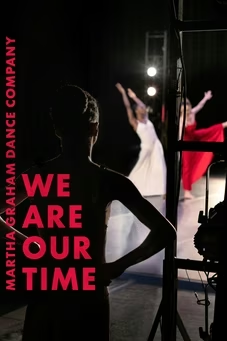
Narrator: After a performance of "Appalachian Spring" with the original set pieces by Noguchi, the Martha Graham Dance Company performed the new dance created by composer Augusta Read Thomas and choreographer Troy Schumacher.
It was commissioned by PEAK Performances at Montclair State University.
The music for both works was performed live by the renowned International Contemporary Ensemble.
[ Music plays ] Eilber: "Appalachian Spring" is iconic because the artists were determined to represent American optimism, hope for the future.
This was 1942, '43.
It was during the difficult days of World War II.
because both of these artists, Aaron Copland and Martha Graham, were modernists, that new American artistic revolution to simplify things and say things in a very stripped-down, non-decorative way.
They created a work that distills so much of the American conversation, who we are as a country, into these eight characters and this beautiful, simple American score.
Narrator: Janet Eilber, now the artistic director of the Martha Graham Dance Company, worked directly with the famed choreographer as one of her principal dancers in the 1970s.
Eilber: Martha Graham revolutionized dance in the 1930s.
And if anybody asks you, "What exactly did Martha Graham do?
", you can say she took natural gesture, the things that we do unconsciously when we're sad or when we're happy, euphoric, stressed, and she took those gestures and those ways that we embody how we feel and turned them into a dance language.
[ Music plays ] Narrator: PEAK Performances and Jed Wheeler gave choreographer Troy Schumacher and composer Augusta Read Thomas the task of creating an homage to "Appalachian Spring."
The result is a work called "The Auditions."
Schumacher: Going into this, we had -- you know, I had really no idea what they were expecting this ballet to look like.
It was kind of both scary and really freeing, and I could just go in there and I felt very comfortable using my impulses.
Narrator: Troy Schumacher is a soloist with the New York City Ballet.
He's also the founder and director of Ballet Collective in New York and has become one of his generation's most acclaimed choreographers.
[ Music plays ] Read Thomas: Several years ago, Jedediah Wheeler e-mailed me and said he was really interested in possibly working together, and was there anything that would interest me to do?
And I wrote back instantly saying, "Thank you, thank you, thank you.
Dance.
I'd love to write for dance."
And he wrote back right away and said, "Got it."
Narrator: Augusta Read Thomas is a Grammy-winning composer based in Chicago.
Her music has been commissioned and performed by orchestras and soloists around the world.
A couple of years ago, in fact, she was the most widely performed living composer in America.
Schumacher: The composer and I, Augusta, we spent a lot of time watching new and old videos of "Appalachian Spring," and we just kind of, like, digested that all.
One moment that really kind of stood out to me as somewhat heartbreaking in "Appalachian Spring" is, there's this moment where the husband walks to the downstage-left corner of the stage, and he's just standing at this fence, kind of, like, looking out, like as to, like, "What's next?
Where do I go next?"
It's that, you know, insatiable human experience.
And that's both inspiring and depressing about, like, why are we always trying to be pioneers?
Why are we always trying to find what's next?
Read Thomas: So the concept that Troy and I developed for our piece, which is called "The Auditions," is a piece that exists in a way in two planes.
There's some other sphere, whether it's a spiritual place, a religious place, an interior space.
It could be really read differently by different members of the audience, but there's some other space.
And the people on Earth, so to speak, are auditioning to get up to that other space.
And that's why it's called "The Auditions."
So on the one hand, it's a very serious piece.
We're talking about questing.
On the other hand, it's quite humorous because down on Earth, you have all these dancers that are competing with each other and dancing hard and virtuosically to win the slot to go up to this other space.
[ Music plays ] Eilber: All the collaborators for this production are extraordinary.
Of course, it's Aaron Copland and Martha Graham and Troy Schumacher and Augusta Read Thomas, but also accompanying us, the International Contemporary Ensemble, ICE, is an extraordinary collaboration.
So you'll hear the classic "Appalachian Spring" score and this world-premiere score by Gusty performed by some of the top musicians in the world, along with the top dancers in the world, the Martha Graham Dance Company.
[ Music plays ] Announcer: That's it for "Art Comes of Age in America."
a special episode of "State of the Arts."
Visit us online and make sure to let us know what you think of the show.
Thanks for watching.
[ Music plays ] [ Music continues ]
State of the Arts: Art Comes of Age in America
Preview: S41 Ep4 | 30s | State of the Arts: Art Comes of Age in America (30s)
Providing Support for PBS.org
Learn Moreabout PBS online sponsorship

- Arts and Music
The Best of the Joy of Painting with Bob Ross
A pop icon, Bob Ross offers soothing words of wisdom as he paints captivating landscapes.










Support for PBS provided by:
State of the Arts is a local public television program presented by NJ PBS