State of the Arts
State of the Arts: December 2022
Season 41 Episode 3 | 26m 46sVideo has Closed Captions
The Bay Atlantic Symphony, Undersung Black Artists, and Playwright Alice Childress.
Violinist Stefan Jackiw joins the Bay Atlantic Symphony for Benjamin Britten's lyrically expressive Violin Concerto. The Arts Council of Princeton exhibits undersung 20th century Black artists, all colleagues of painter James Wilson Edwards. Plus Alice Childress: in 1957, she was almost the first Black woman to have a play on Broadway, but she refused to compromise. Now, she's being rediscovered.
Problems playing video? | Closed Captioning Feedback
Problems playing video? | Closed Captioning Feedback
State of the Arts is a local public television program presented by NJ PBS
State of the Arts
State of the Arts: December 2022
Season 41 Episode 3 | 26m 46sVideo has Closed Captions
Violinist Stefan Jackiw joins the Bay Atlantic Symphony for Benjamin Britten's lyrically expressive Violin Concerto. The Arts Council of Princeton exhibits undersung 20th century Black artists, all colleagues of painter James Wilson Edwards. Plus Alice Childress: in 1957, she was almost the first Black woman to have a play on Broadway, but she refused to compromise. Now, she's being rediscovered.
Problems playing video? | Closed Captioning Feedback
How to Watch State of the Arts
State of the Arts is available to stream on pbs.org and the free PBS App, available on iPhone, Apple TV, Android TV, Android smartphones, Amazon Fire TV, Amazon Fire Tablet, Roku, Samsung Smart TV, and Vizio.
Providing Support for PBS.org
Learn Moreabout PBS online sponsorshipNarrator: Playwright Alice Childress was almost forgotten, but productions at Two River Theater and the Shakespeare Theater of New Jersey are part of a new wave of attention.
Smiling: I'm, like, so excited to, like, dive into these plays because it feels like a missing component.
Alice Childress definitely belongs to stand with the great playwrights of America.
Woman #1: She must think she's White.
Woman #2: Florence is brown-skinned!
Narrator: A circle of Black artists sheds new light on a regional group of painters at the Arts Council of Princeton.
Ponder: And you're looking at thicket and how much work it would take to prune to get rid of racism, but he has a strong Black man with an axe.
Narrator: And violinist Stefan Jackiw returns to the Bay Atlantic Symphony with Benjamin Britten's 1939 concerto, the composer's response to the horrors of war.
Gaylin: Britten was horrified by war, and of course, he felt the winds of war kicking up again throughout Europe.
And so the piece deals with premonitions.
It's got sublimely beautiful moments.
It's got some fierce moments, and so I think it's a piece which speaks to our time very much.
[ Music plays ] Narrator: "State of the Arts" going on location with New Jersey's most creative people.
Narrator: The New Jersey State Council on the Arts encouraging excellence and engagement in the arts since 1966, is proud to co-produce "State of the Arts" with Stockton University.
Additional support is provided by these friends of "State of the Arts."
[ Music playing ] How would I describe Alice Childress?
Well, Alice Childress was a playwright and a novelist and a performer and a director.
Narrator: Born in Charleston, South Carolina, the great-granddaughter of a slave, Alice Childress became a writer of keenly observed, funny, uncompromising plays.
More than 70 years after her first play, she's been rediscovered with new productions on Broadway and across America.
She started as an actress with the American Negro Theater, working alongside future stars like Sidney Poitier and Ruby Dee.
But Alice was frustrated by the lack of good parts.
Thomas: There weren't great roles written for Black women.
This is, you know, shocking.
There weren't great roles, and legend has it, and I think it has been confirmed by him at one point, by Sidney Poitier, he was like, "Well, you go do it?"
In two days, she brought back "Florence."
Man: I'll be here.
Narrator: The play that Alice brought back, her very first, was "Florence."
It takes place deep in the Jim Crow South in a segregated waiting room.
Like many of her plays to come, it features a strong Black woman... Woman: Howdy, ma'am.
Narrator: A White woman, Mrs. Carter, strikes up a conversation with her, describing a scene from a new book, which she says is all about 'your people'.
Mrs. Carter: Just before she jumped.
Woman: You mean she killed herself?
Mrs. Carter: Of course.
Close your eyes and picture it.
Woman: Yes.
Mrs. Carter: Now she's standing there on the bridge in the moonlight, and out of her shabby purse, she takes a mirror.
By the light of the moon, she looks at her reflection in the mirror.
Woman: I can see it just as plain.
Mrs. Carter: Tears roll down her cheeks as she says, "Almost.
Almost white, but I'm Black.
I'm a Negro."
And then she jumps and drowns herself.
Woman: Why?
[ Laughter ] Mrs. Carter: She can't face it, living in a world where she almost belongs but not quite.
Oh, it's so, so, so tragic.
Woman: That ain't so, not one bit.
Mrs. Carter: But it is.
Woman: I know it ain't.
Smiling: It's not that Mrs. Carter isn't trying, and I think a lot of people today are trying, White people are trying to understand what it means to be Black, but keep stepping in it.
And that feels so present in the play at the time, and still a constant thing that we're going to have to deal with just because of our history in this country.
And it's a muscle that we have to keep exercising of checking our assumptions.
Thomas: She found that she wasn't going to get to play the kind of roles that she wanted so she could write them.
Woman: I mustn't hurt you, must I?
Narrator: In 1955, Alice wrote a brilliant satire called "Trouble in Mind" that premiered off Broadway.
It was a play about slavery within a play about putting on a show.
It was a hit.
Thomas: It was immediately optioned for Broadway.
It was supposed to go to Broadway in 1957.
She was going to be the first Black woman to be produced on Broadway.
And they wanted more changes, and they wanted more changes and they wanted more changes.
And finally, she just said, No, I can't, I can't.
So by the time she got to "Wedding Band" and they said, "We need, you know, can we have more Herman?"
She's said, "No."
Narrator: Herman is a White man in love with a Black woman in Alice's 1966 play "Wedding Band: A Love/Hate Story in Black and White."
Alice refused to make changes.
She didn't want it to be a play about what happened to a White man.
Man: I'm producing Alice Childress' new play, "Wedding Band."
Narrator: A Black woman was at the center of her story.
Here Alice is reading with actress, singer and civil rights activist Abbey Lincoln.
Lincoln: And that's the only kind of love they want from us.
Childress: It's wrong to hate Lincoln: And it's wrong to love, too.
Childress: We got to be good, got to be three times as good just to make it.
Lincoln: Why?
When they mistreat us, who cares?
When we mistreat each other, who cares?
Why we got to be so good for them?
Childress: 'Cause, Julia Augustine, you hard-headed thing, 'cause they'll kill us if we not.
Lincoln: They doing it anyway.
Last night I woke up thinking all of my people that's been lynched.
I dreamed that all the dead Black men gathered together and sit at the foot of my bed, standing in the corners of my room, quietly waiting for something.
I've always been afraid of dead people, though I know they can't do any harm.
Narrator: In 1974, ABC broadcast a production of "Wedding Band" starring Ruby Dee.
In the South, some stations blocked it.
Alice's plays were often seen as political, but she was writing about the world she knew.
Thomas: Everybody is alive, right?
They're not representing a point of view.
They have a point of view.
It springs from something.
There may be a position that we're supposed to loathe, but I don't think that we're ever supposed to feel comfortable dismissing any of the people in her plays.
Narrator: In her later work, Alice Childress turned to writing plays without White characters, focusing fully on Black lives.
1969's "Wine in the Wilderness" is set in Harlem with a riot going on outside.
In this scene, Old Timer is looking to hide some loot left behind by rioters.
Man: And Sonny-man calls this the people's revolution.
A revolution should not be looting and stealing.
Revolutions are for liberation.
Dirden: It's a comedy with a little drama in it, right?
And what I love most about this particular experience is that I hit the lottery and been able to cast Crystal Dickinson in the role of Tommy.
Listen, full disclosure, we're married.
We've known each other for 20 years when we met in grad school, but I've never seen Crystal better.
Narrator: Tommy's apartment has been barricaded during the riot, and a young group of artsy intellectuals has invited her up.
But Tomorrow Marie, that's Tommy's real name, begins to realize that they see her as a type, an uneducated local.
Woman: And there are other factors.
Tommy: What's wrong with me.
Dirden: In directing this play, I looked through the script, and one thing I notice was how many questions Tomorrow Marie asks.
And she's only -- she's one of the only persons in the play of the five who ask questions.
The others have all the answers, but we see Tomorrow Marie, hopefully by the end of the play, as someone who is so much more evolved than the other well-educated type.
Thomas: She wanted to write about people who were ordinary, you know, who didn't finish grad school or college or high school, to show them as worthy of full attention.
Narrator: Alice herself never finished high school.
She had to work after her grandmother died, but she had a love of knowledge and later was a resident scholar at Harvard's Radcliffe College.
Here, she remembers how her own journey as a writer began soon after she moved to Harlem at age nine.
Childress: Even though I was with the American Negro Theater, I think my grandmother started me writing really.
And she would sit by the window with me and say there's a man going home.
I wonder what his name is.
And I'd give him a name, and then we'd say how much -- she'd ask how many children he had and where he worked and what he had done and so forth.
And I don't think she called herself making me a writer.
She was fascinated.
Perhaps she should have been a writer.
Narrator: For decades, plays by Alice Childress were rarely produced, but she was always writing.
In 1978, her award-winning young adult novel, "A Hero Ain't Nothin but a Sandwich," became a film starring Cicely Tyson.
Tyson: Benjie, you're driving me out of my mind.
Narrator: Now her plays are being rediscovered by a new generation in a new time.
"Trouble in Mind" finally made it to Broadway in 2021, 65 years after it was first optioned.
In 2022, "Wedding Band" had an extended run at Theatre for a New Audience in Brooklyn.
Two River Theater in Red Bank opened their '22-'23 season with "Wine in the Wilderness," and at the same time, the Shakespeare Theatre of New Jersey in Madison produced two of her one acts, "Florence" and her 1970 play "Mojo: A Black Love Story."
Smiling: I'm, like, so excited to, like, dive into these plays because it feels like a missing component.
We talk about the classics of Tennessee Williams and Arthur Miller, you know, great playwrights that everybody totally embraces as part of the American theater tradition.
And Alice Childress definitely belongs to stand with the great playwrights of America.
Dirden: When a playwright is able to clearly articulate a truth about humanity, that will never get old.
Thomas: Black American culture is American culture, and Black history is American history.
And we are all in it together, and we are all trying to navigate, you know, how we're going to go forward.
So that's why I would go see Alice Childress.
[ Train approaching ] [ Train horn blaring ] [ Music playing ] Narrator: Later on the show, Black painters overlooked no more in a new exhibition at the Arts Council of Princeton.
Narrator: But next, Benjamin Britten's concerto about the horrors of war.
[ Music playing ] [ Music playing ] [ Indistinct conversations ] Narrator: Violinist Stefan Jackiw has been a featured soloist with conductor Jed Gaylin and the Bay Atlantic Symphony eight times over the past 20 years.
[[ Music playing ] He was still a freshman at Harvard when he first played Prokofiev's "Violin Concerto No.
2" with the orchestra.
Gaylin: Stefan Jackiw is, I think, one of the world's great violinists.
He's an incredibly passionate musician and thoughtful.
You know, he's one who really combines mind and heart and technique to burn.
He's a great collaborator.
So, I kind of moved this along coming into it, and then we even notched it up more.
But you want to go still faster?
Jackiw: Yeah, I think so.
Gaylin: I would love it if we just set it by what happens here.
Jackiw: So it's not a sudden cut, yeah.
Gaylin: Yeah.
Is that okay?
Jackiw: Let's do that.
Gaylin: Okay.
Everything is yes, and what might we do differently and how and what do you think about it.
And he's open to it.
Jackiw: I think maybe I pushed it this time.
Right at 38 I'm talking about.
Narrator: In 2022, Stefan returned to Stockton University's Performing Arts Center to tackle Benjamin Britten's concerto.
Gaylin: Benjamin Britten is an English composer as his name would suggest, not spelled the same.
And he comes on the heels of some of his English patriots, Ralph Vaughan Williams especially.
And Britten is more of an internationalist who is still something of a nationalist at the same time.
Jackiw: The Britten Violin Concerto was written in 1938 and 1939, and it is a piece that reflects its time.
Britten was a pacifist, and this piece is both kind of his reaction to the horrors of the Spanish Civil War, as well as the looming strife in Europe.
And it's a piece that is mournful, I'd say blisteringly virtuosic, cathartic, wailing and just deeply affecting both to listen to and to play.
[ Music playing ] Gaylin: It opens itself up to pretty much and demands all kinds of techniques from harmonics, these whistle sounds, you know, that you've played, you know, playing pizzicato with the left hand while he's bowing.
Many double stops and quadruple stops when, you know, he's playing four notes at once and bristling fast passages to really sustained passages over full orchestra.
I mean, it's a -- it's fiendish.
[ Music playing ] Britten wrote this piece in 1938, 1939, the Spanish Civil War was raging.
Britten was horrified by war.
And of course, he felt the winds of war kicking up again throughout Europe.
The piece was completed exactly one month before Hitler invaded Poland.
And so the piece deals with premonitions.
It's got sublimely beautiful moments.
[ Music playing ] It's got some fierce moments.
[ Music playing ] But the end, I think, is is one of the things that it's one of the most shimmeringly ambiguous ends.
Is it major?
Is it minor?
There's these beautiful trombone chorale chords that sound almost renaissance.
And then the violin is ruminating on those with a kind of passion that at times feels very vulnerable, at times, feels very angular and at times feels hopeful.
And he leaves you right on the edge.
There's a trill that takes you right between major minor, and it just leaves you, like, who knows what's going to happen.
And so I think it's a piece that speaks to our time very much, because I think we feel, and certainly in Ukraine, I think everyone feels like like where are we going to end up.
And it's great to have art that allows us to express not only the joys of humanity, but the worries that we have, the strivings that we have, all those things.
[ Music playing ] [ Music playing ] Narrator: Last on the show, five Black artists connected by friendship and place.
Narrator: An exhibition at the Paul Robeson Center at the Arts Council of Princeton brings together the work of five extraordinary Black artists who lived and worked in the Princeton area during the second half of the 20th century.
Until now, their work had largely faded from history.
Ponder: The show is retrieving the life and art of James Edwards and a circle of Black artists, including Hughie Lee-Smith, Rex Goreleigh, Selma Burke and Wendell T. Brooks.
The origin of the idea started with Lewis Tanner Moore, who was a collector.
Narrator: Lewis Tanner Moore has spent a lifetime collecting the works of African-American artists.
Loans from his vast collection formed the foundation of the exhibition.
Moore: Having grown up in a house where art was valued and loved, and then I have a relative who was an artist, and my father had friends who were artists.
I was very surprised to see in the history of Art of the World, there were almost no women, almost no African-Americans, almost no Asians, almost no...down the line.
Narrator: In fact, Lewis's great uncle Henry Ossawa Tanner, was the first African American painter to achieve international success.
He was a favorite student of Thomas Eakins, who painted this portrait of Lewis's great uncle in 1902.
Retrieving the life of James Wilson Edwards and a circle of black Artists is co-curated by Judith Brodsky and Rhinold Ponder.
Rhinold is an activist, lawyer, writer and creator of Art Against Racism, a website he started during the Black Lives Matter protests.
Brodsky: And the two of us are doing an exhibition that's going to be a focus on your father, James Wilson Edwards.
Narrator: Judith is a renowned artist, printmaker and professor emerita in the visual arts department at Rutgers University.
Brodsky: One of the things that was most important was that instead of the Princeton, Trenton, Bucks County area being predominantly a White history of the cultural activity in this area during the second half of the 20th century.
There were African-American artists who were important figures.
Ponder: It's absolutely clearly influenced by what's going on in the black arts movement.
Brodsky: The most exciting thing for me was the whole detective activity that we had to pursue in order to find out about the artists themselves.
Ponder: Of course, their lives were a mixed bag.
These artists were not as well known or well respected as we thought they should be.
[ Indistinct conversations ] Narrator: We asked Louis Tanner Moore if one of James Wilson Edwards paintings was especially meaningful for him.
Moore: A painting that comes to mind is one that's an untitled portrait of a head.
That's just a woman staring straight out from the canvas at you with a sort of garden scene that's obscured in the back.
And it's just a haunting, simple, direct portrait in some ways, but it just has a mood and a character that speaks to his view.
And it's just a beautiful Black woman being presented to the world.
I think some of his work that is most delightful really is work that tells a story.
There's another painting of a woman on a rooftop that is a den of dancers outfit.
And you can't see the painting without imagining who she is and how she got there and what she's -- what she's dancing away from or what she's dancing to.
And then to see him in the context of the artists that were part of his circle, that, you know, someone like Rex Goreleigh.
Narrator: Rex Goreleigh was recruited to Princeton from Chicago in 1947.
Ponder: So, Rex Goreleigh was invited by a very diverse group of individuals in the Princeton area, Quakers, Jews, including politicians who were interested in starting Princeton Group Arts, an art center that crossed all boundaries of discrimination.
Judith and I love the same painting.
[ Laughs ] And it's to Rex Goreleigh.
Rex Goreleigh makes a political statement here, and you're looking at that thicket and how much work it will take to prune to get rid of racism.
But he has a strong Black man with an axe who is self-determined to make change.
And that represents power to me.
So, I do love that painting.
[ Music playing ] Brodsky: Wendell Brooks is a little bit younger than the generation that we've been talking about, but we felt that it was really important to include him.
And of course, what he brought in terms of art and artistic diversity is that he is an incredible printmaker.
[ Music playing ] Rex Goreleigh and Hughie Lee-Smith we're also strong proponents of dream imagery, kind of a form of American surrealism but using African-Americans as inhabitants of a dream world with empty landscapes.
And Hughie Lee-Smith actually commented on the fact that while people may think it's a universal loneliness that he's documenting, he said it also has to do with the fact that he was African-American and felt isolated in the general society.
Here were four men, part of this group in the exhibition and Selma Burke.
Selma Burke was a very well known sculptor.
She had a long life.
She came to live in Bucks County.
When she was just a young sculptor starting out, she won an international commission to do a portrait of Franklin Delano Roosevelt.
FDR sent her photographs and she wrote back to FDR and said, "This is not enough.
You have to come and sit for me.
I don't work from photographs."
And so she is the only artist that he actually sat for in person while he was president of the United States.
Then that particular image is the image that is still on the dime.
So if you have a dime in your pocket, you pull it out and you see the image of FDR, that is by Selma Burke.
[ Music playing ] Ponder: We hope that, first of all, that others collaborate the way we've collaborated on this particular project, but that others also take the mantle of capturing regional artists, particularly regional artists of color and regional women artists, and bring them to the fore so that people have a better understanding of these communities.
But not only the communities for Black folks and brown folks, also their humanity.
[ Music playing ] Narrator: Watch or share any of our stories online at StateoftheArtsNJ.com.
Narrator: While you're there, let us know what you're thinking.
We'd love to hear from you.
Thanks for watching.
[ Music playing ]
Video has Closed Captions
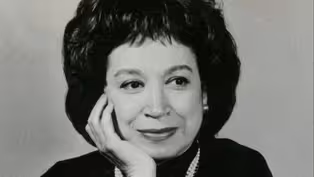
Clip: S41 Ep3 | 9m 56s | Alice Childress, whose plays were almost the first by a Black woman on Broadway. (9m 56s)
Britten's Violin Concerto: Bay Atlantic Symphony and Stefan
Video has Closed Captions
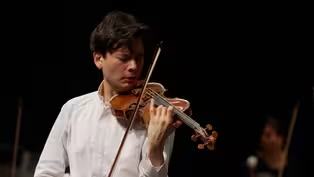
Clip: S41 Ep3 | 5m 7s | Violinist Stefan Jackiw and the Bay Atlantic Symphony perform Britten's Violin Concerto. (5m 7s)
James Wilson Edwards and a Circle of Black Artists
Video has Closed Captions
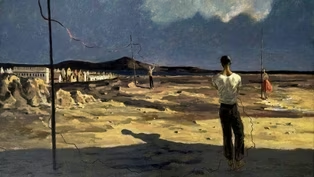
Clip: S41 Ep3 | 8m 5s | An exhibition of 20th century Black artists in the circle of painter James Wilson Edwards. (8m 5s)
Providing Support for PBS.org
Learn Moreabout PBS online sponsorship

- Arts and Music
The Best of the Joy of Painting with Bob Ross
A pop icon, Bob Ross offers soothing words of wisdom as he paints captivating landscapes.











Support for PBS provided by:
State of the Arts is a local public television program presented by NJ PBS