State of the Arts
State of the Arts: February 2023
Season 41 Episode 5 | 26m 46sVideo has Closed Captions
Artist Layqa Nuna Yawar at Newark Airport, the Chivalrous Crickets, and the Inness Gallery
Newark Airport commissions an expansive mural by Newark resident and Ecuadorian-born immigrant Layqa Nuna Yawar. The Celtic/American band The Chivalrous Crickets are seen in rehearsal in Princeton and performance at the Museum of the American Revolution. And, The Montclair Museum has the only gallery in the world devoted to the work of renowned painter George Inness, once a Montclair resident.
Problems playing video? | Closed Captioning Feedback
Problems playing video? | Closed Captioning Feedback
State of the Arts is a local public television program presented by NJ PBS
State of the Arts
State of the Arts: February 2023
Season 41 Episode 5 | 26m 46sVideo has Closed Captions
Newark Airport commissions an expansive mural by Newark resident and Ecuadorian-born immigrant Layqa Nuna Yawar. The Celtic/American band The Chivalrous Crickets are seen in rehearsal in Princeton and performance at the Museum of the American Revolution. And, The Montclair Museum has the only gallery in the world devoted to the work of renowned painter George Inness, once a Montclair resident.
Problems playing video? | Closed Captioning Feedback
How to Watch State of the Arts
State of the Arts is available to stream on pbs.org and the free PBS App, available on iPhone, Apple TV, Android TV, Android smartphones, Amazon Fire TV, Amazon Fire Tablet, Roku, Samsung Smart TV, and Vizio.
Providing Support for PBS.org
Learn Moreabout PBS online sponsorshipNarrator: Newark Airport's new Terminal A just opened in January 2023.
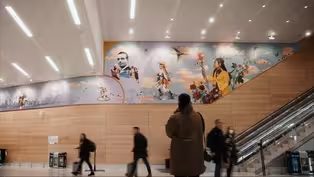
It features massive new artworks, including a mural by Newark artist Layqa Nuna Yawar.
An immigrant himself, Layqa's work celebrates a diverse group of the famous and not so famous.
Nuna Yawar: I hope people see themselves when they see this mural.
[ Tender tune plays ] I think like all artists' work helps us better understand ourselves and what identity means.
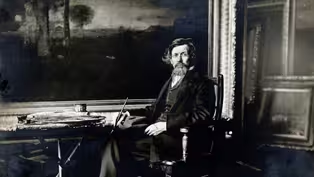
Narrator: The visionary landscape painter George Inness, one of the most famous artists of his time, spent the last 15 years of his life in Montclair, New Jersey.
The only gallery dedicated to his work is at the Montclair Art Museum.
Bell: It's a prismatic view of Inness' life and work in one space, and in a space that is designed as a kind of a chapel.
Not a denominational chapel, but as a spiritual space, as a space of contemplation.
The Chivalrous Crickets: [ Singing ] And I must, I must be at the king's side.
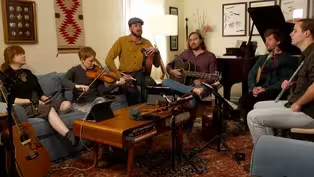
Narrator: And The Chivalrous Crickets play music based in Celtic and American folk traditions.
The group of family and friends include sisters Genevieve King and Fiona Gillespie.
Genevieve: One of the key elements of the sound of The Chivalrous Crickets is that there are sister voices in it.
There are some times when Fiona and I will listen back to a recording and, if we didn't know our parts, we wouldn't know which one was singing.
The Chivalrous Crickets: [ Singing ] Narrator: "State of the Arts."
Going on location with New Jersey's most creative people.
The Chivalrous Crickets: [ Singing ] La la la la.
La la.
Announcer: The New Jersey State Council on the Arts, encouraging excellence and engagement in the arts since 1966, is proud to coproduce "State of the Arts" with Stockton University.
Additional support is provided by these friends of "State of the Arts."
[ Plane engines whining ] [ Tender tune plays ] Nuna Yawar: An airport is like a blank canvas, in a way.
It's the first thing that millions of people see when they land to a country.
It's an introduction to a land, a people, a history.
How we approach that introduction is important.
[ Camera shutter clicking ] [ Keys jingling ] For this project, it is very interesting that I'm part of that introduction because I could argue that I'm not a person that belongs in here.
I left Ecuador when I was 14.
My whole family tried to find a better place to live or a way to move forward socially, so they migrated.
I spend a lot of time thinking about what that meant.
Like why did my family leave or who am I because of that?
So, I think it's an interesting [indistinct] and a beautiful engine for the future, to be an immigrant, to create home, to carry home with you, and to really expand the idea of what home is and what belonging means.
[ Poignant tune plays ] I think, as an artist, it is my sort of duty to learn from this land.
I am also thinking about large-scale public works and how they challenge or change a place.
And, somehow, that's what the airport needed and what they were asking for.
[ Bright tune plays ] They were looking for a mural that would reflect what it means to be from here.
Woman: There's almost never any representation of actual workers in their places.
Nuna Yawar: My process started with research and spending some time at the airport, just having conversations with people.
Woman #2: My original country is from Peru, from Lima.
Nuna Yawar: The collaboration itself, it was important to me.
Woman #2: My job is on call.
If somebody try to breach a door, I respond by the radio.
Walela: Good morning, ma'am.
You need a wheelchair?
How's your morning?
Walela: It's good.
Nuna Yawar: I think a lot of the figures that populate my work are a lot of the figures that I see in my everyday.
You know, maybe some people would say not important people and that's what I think makes them important.
That's why it makes me want to celebrate them.
Walela: When you say you're from Newark, people give you this look, like a negative vibe.
Nuna Yawar: Mm.
Walela: I wanted to let people know that Newark is alive and thriving.
Nuna Yawar: Sort of like this?
Walela: Like this?
Nuna Yawar: Yeah.
[ Camera shutter clicks ] [ Click ] I think there's a really beautiful dance that happens in public art when we think about who gets to be represented, who gets to be remembered, made into a huge mural.
I didn't want to sort of try to reflect icons and iconography that are known or established for New Jersey.
I wanted to make new ones.
I'm focusing on labor.
I'm focusing on just everyday, you and me, people because this is a mirror of the land.
This is a mirror of its very contentious history, of it's reality of the people that are living here.
I think the best thing that I could do with my work is to sort of amplify those narratives.
Because that's how we learn and that's how we push things forward.
[ Bright hip hop plays ] [ Bright hip hop plays ] [ Bright hip hop plays ] [ Bright hip hop plays ] [ Bright hip hop plays ] [ Beeping ] So, basically, I'm going to move from that edge all the way down here, just cutting [indistinct].
And then I should be done.
Man: Alright.
Do what you got to do Nuna Yawar: [Indistinct] Man: and then we'll talk and then I'll [indistinct] yeah.
[Indistinct] Somebody dropped some paint on a [ Voice fades ] [ Whirring ] [ Whirring ] Nuna Yawar: This amplification of someone's identity or personhood is sometimes the most powerful thing you could ever do.
To me, it's not political.
To me, it's just a celebration, right?
The political happens when it becomes public, when other people look at something and then they have a different opinion of what this is.
[ Whirring ] My job, as an artist, is to be challenging.
Challenge the question of what represents New Jersey.
Any sort of reaction that comes from that...
...I welcome it as a point of conversation.
[ Tender tune plays ] [ Tender tune plays ] [ Tender tune plays ] Man: Yeah.
Nuna Yawar: I hope people see themselves when they see this mural.
I think like all artists' work helps us better understand ourselves and what identity means.
Like understanding and accepting myself as a person that doesn't have to be divided.
Understand that I do belong to this country, as much as to the one that came before.
Woman #3: See?
This is her!
Right there!
Woman #2: Hi!
Hello!
Walela: The hummingbird, which is my part Native American roots and my given name, Walela.
Woman #2: And then, you know, getting all the like -- like getting a flower, like, you know, you growing.
Walela: Mm-hmm.
Woman #2: But for me, I see the people like that, where you growing.
Yawar: What would I like to have seen when I landed in the USA?
Maybe I would've felt differently, seeing this.
Maybe I would've felt held and understood.
You know, maybe now, other people will.
[ Tender tune plays ] [ Tender tune plays ] Narrator: Later on the show, a gallery becomes a chapel devoted to the work of visionary painter George Inness.
But, first, music from a Princeton-based Celtic band.
The Chivalrous Crickets: [ Singing ] Heave her ho, boys.
Let her go, boys.
Sailing homeward.
To Mingulay.
Heave her ho, boys.
Let her go, boys.
Swing her head round.
Into the weather.
Man: Please give a warm welcome to The Chivalrous Crickets.
[ Cheering and applause ] Narrator: Up-and-coming Celtic band The Chivalrous Crickets performed an all-Scottish program at the Museum of the American Revolution in Philadelphia.
[ Bagpipers playing "The Minstrel Boy" ] The Philadelphia St. Andrew's Society owns a sword, on loan to the museum, that once belonged to General Hugh Mercer.
Gillespie: Hugh Mercer, after needing to escape Scotland, sailed over here to America.
He befriended George Washington and he ended up fighting in the revolution here.
He fought in the Battle of Princeton, which is actually where he died, and Mercer County is named after him.
My family's Scottish and, when we were younger, they wanted to put us into Highland dancing, but there wasn't a place at that time a studio to learn that anywhere near us, so, we got involved in Irish step dancing, instead.
Genevieve: I grew up in a family of musicians.
My parents played musicians professionally.
My mum owns a violin studio and teaches at the collegiate level, And so my two sisters and I were sort of born with instruments in our hands.
We're all trained classically.
But she, my mother, had already gotten very involved in Irish music, so, then we all got very involved in Irish music.
[ Playing jaunty tune ] It's a band of husbands and wives and sisters and best friends and old friends and -- Gillespie: Genevieve, the fiddler, is my sister; and Bradley, our bass and cello player, is her husband.
Paul, who is our many plucked instrument player, is my partner.
And Ben Matus is one of our oldest friends since college age.
And then Benya Stewart in the band is born and raised in Appalachia, so, he brings to us, probably, the most pure American tradition.
One of the key elements of the sound of The Chivalrous Crickets is that there are sister voices in it.
There are some times when Fiona and I will listen back to a recording and, if we didn't know our parts, we wouldn't know which one was singing which.
I even have trouble identifying whose voice is whose.
-[ Singing ] Weary spell she's laid on her.
She'd be with child for long and many's the year.
But the child she would never bear.
And in her bower.
Genevieve: Many of the members of the band are early musicians and what that really means is they play music that was written before 1800.
They are trained to do that.
[ Playing mellow tune ] Gillespie: [ Singing ] Cold, cold December.
When the wind blows to bring the bodies near.
Narrator: The name The Chivalrous Crickets is derived from the medieval bestiary, a catalog of animals in which the cricket is described as a small, jolly animal who sings, forgetting all else.
Genevieve: [ Singing ] So much.
I love you so much.
[ Speaking] And that was really -- that resonated with us because, in our lives, no matter the responsibilities we've had, or the challenges or the pressures on us, we're always just, you know, in our family, bursting into some song and, ultimately, we're always just going to be making music whenever we can.
[ Singing ] So close to me.
All night.
Bradley: [ Singing ] Do do do do.
Genevieve: [ Speaking ] The other tradition that we bring into the group is Appalachian and old time music.
Stewart: American folk music, you can almost think of it as like the Mississippi River, that it has all these tributaries from various other traditions.
Genevieve: [ Singing ] Stewart: One huge branch of it is from the Scots Irish people who settled in the mountains.
But another, massive, part of American folk music that you cannot ignore is the music that was brought by people who were enslaved here.
And the banjo is an African instrument, but the Celtic music blended with this African music and, ultimately, random groups of other people who were coming through and then these tunes just kind of stuck in these little communities.
I think there is a balance to be struck between preserving something that has come down to us.
We're artists, we're creative types, and I think every artist, every singer, puts their own little spin and their own little flare.
[ Playing tranquil tune ] Genevieve: [ Singing ] Narrator: The Chivalrous Crickets practice in the Princeton Junction home of members Genevieve and Bradley King.
They've performed at the nearby West Windsor Arts Center and in Princeton's Herronton Woods.
Bradley, once the lead singer for the Philadelphia Boys Choir, directs the community choir at the historic Dutch Neck Presbyterian Church.
Choir: [ Singing ] Genevieve: [ Singing ] [ Resumes singing ] Gillespie: An overriding trend in this band, for whatever reason, is, instead of writing songs that come from a personal place, the majority of us write songs that are influenced by anecdotes, stories, pieces of history.
Genevieve: She wrote a song about Joan of Arc because that's a wild story.
We're all used to kind of the story of that, but when you really look into it, you're like, "Wait, what?
This was crazy!
And true!"
Gillespie: We all know she was burned at the stake.
I don't know if people know much past that.
She was only 14 when that happened.
She was quite religious growing up, I mean, from a very young age, and she claimed to have all of these visions.
And, at a certain point, she became obsessed with getting an audience with the king of France, to let him know that she had heard a message from God that told her how to defeat the English in the Hundred Years War that was going on at the time.
And she marched with him at the head of the French Army for close to a year and, during that time, they actually did experience enormous success.
They won most of their battles.
Until she was captured by the English.
And what's really sad is that, when that happened, the French made no effort to ransom her back.
The Chivalrous Crickets: [ Singing ] There'll be no help if not from me.
Across the fields of Burgundy, the voices.
Bradley: Making music, the creation of music, writing a song, it's essentially magic.
People talk about music as being the only true universal language.
And that's really true.
We all can do it and we all can do it together, no matter where we come from.
The Chivalrous Crickets: [ Singing outro ] The Chivalrous Crickets: [ Singing ] Narrator: The last 15 years of his life were the most important.
They were spent in Montclair.
Up next...a visit to the George Inness Gallery.
The Chivalrous Crickets: [ Singing ] [ Tender tune plays ] Bell: Who are we?
What is the self?
What is the divine?
What's the relationship between the natural world and the spiritual world?
Big questions!
Metaphysical questions.
And they drove him throughout his life.
One of his interviewers said, "What do you do, Mr. Inness, when you get weary of painting?"
And he said, "I turn to theology.
It's the only thing, except art, which interests me."
I think it's very unusual to find an artist who is so deeply invested in those two fields.
Not painting simply to paint, but painting to answer big questions that we all grapple with.
Stavitsky: The George Inness Gallery is really a special place because it is the only gallery in the world devoted to Inness and on this scale.
It was really designed as a chapel for Inness.
Narrator: By the time he died, in 1894, George Inness was one of the most revered landscape painters in America.
He didn't start off that way.
In fact, for most of his life, he barely made a living.
But in his last 15 or so years, George Inness was widely admired for his deeply spiritual gestural paintings.
He could now afford to buy a country place, accessible by train to New York City.
He found it in Montclair.
Stavitsky: The property was very rustic.
It had a lot of charm to it.
He rechristened it as "The Pines."
There were beautiful trees on the property.
He had a cow pasture, wheat fields.
So, it was just this very idyllic place where he painted often.
He went over to Eagle Rock Reservation, would paint there.
I mean, there were many areas that he would paint, so, he had a very strong association with this area.
Narrator: The Montclair Art Museum opened the George Inness Gallery in 2001.
By 2022, it was ready for a makeover, starting with the color of the walls.
Urbay: The color originally, for this room, was a beautiful, rich green.
Very beloved, well-chosen.
So, that was a challenge.
How do you change it and do something well and different?
I would say I looked at approximately 30 or so colors.
Choosing a yellow was to kind of like flip the switch.
So, do the almost the exact opposite of the green -- something that was fully saturated, something that would maybe blend a little bit more with the frames, the gilded frames.
So, in the room setting, essentially, do the same thing that the gilded frames are doing and, overall, we're enhancing the green of the paintings.
In doing this, you really see the subtlety in all the darkness and the greens, and that glowing light of the sunset almost seems to emerge from the wall.
The other thing that was also going to be a challenge, and, certainly, to our curator, was to hang everything salon-style.
Stavitsky: Before we had a more modern concept of having a lot of space, a lot of breathing room between the paintings, and then, as I entered conversations with our registrar, Osanna Urbay, who served as exhibition designer, we talked about the idea of -- and I really have to give her credit -- of what would these paintings look like?
How would you have experienced them when you went to see George Inness' work hanging at the National Academy of Design, for example, in the late 19th century?
And, indeed, one of the paintings in this gallery, Winter Morning, of 1882, hung at the National Academy of Design in one of its annual exhibitions.
And what your experience would be is much closer to what you see here, where paintings are stacked.
So, we wanted to give that sense of fullness, the salon-style hanging that really was prevalent, you know, until the early 20th century.
Narrator: Most of the Montclair Art Museum's extensive collection of George Inness' work can now be seen in the reimagined gallery.
Seen together, they tell the story of his growth as an artist.
Bell: The gallery itself is a perfect synopsis of Inness' work.
He began his career, as did many other artists of his generation, studying the old masters.
You have the Hudson River School-themed work.
Then you have this kind of break in the 1860s, with a painting called -- it used to be called Christmas Eve.
Now, it's called Winter Moonlight.
And you see him breaking out of the Hudson River School confines and painting much more freely and expressively.
Then he goes to Italy for four years, 1870 to '74, so, you see works that he produced in Italy, extraordinary paintings in their own right.
And then the last wall, these beautiful paintings from the late period.
It's a prismatic view of Inness' life and work in one space, and in a space that is designed as a kind of a chapel.
Not a denominational chapel, but as a spiritual space, as a space of contemplation.
Inness was actually trying to find a language to convey what he felt was the actual reality of the world that we live in, the fact that it's constantly changing.
So, that sense of activity and movement and obscurity and uncertainty are actually fundamental to the way nature functions.
To see his paintings is to see an artist who is thinking big thoughts and allowing us, therefore, to think those big thoughts ourselves.
[ Tender tune plays ] [ Bright tune plays ] Narrator: Watch or share any of our stories online at StateoftheArtsNJ.com.
While you're there, let us know what you're thinking.
We'd love to hear from you.
Thanks for watching.
[ Bright tune plays ] [ Bright tune plays ] Announcer: The New Jersey State Council on the Arts, encouraging excellence and engagement in the arts since 1966, is proud to coproduce "State of the Arts" with Stockton University.
Additional support is provided by these friends of "State of the Arts."
Video has Closed Captions
Clip: S41 Ep5 | 7m 9s | The Princeton-based Chivalrous Crickets blend Celtic, English, and American folk music (7m 9s)
Video has Closed Captions
Clip: S41 Ep5 | 8m 47s | Ecuadorian artist Layqa Njna Yawar creates a mural at Newark Airport (8m 47s)
The Montclair Art Museum's George Inness Gallery
Video has Closed Captions
Clip: S41 Ep5 | 6m 45s | The unique, chapel-like George Inness Gallery at the Montclair Art Museum (6m 45s)
Providing Support for PBS.org
Learn Moreabout PBS online sponsorship

- Arts and Music
The Best of the Joy of Painting with Bob Ross
A pop icon, Bob Ross offers soothing words of wisdom as he paints captivating landscapes.












Support for PBS provided by:
State of the Arts is a local public television program presented by NJ PBS