State of the Arts
State of the Arts: July 2021
Season 39 Episode 7 | 26m 46sVideo has Closed Captions
Pianist Min Kwon's America/Beautiful, Clarinetist Dan Levison and Ceramist Alan Willoughby
Korean-born American pianist Min Kwon asked 70 composers to create variatios on “America the Beautiful,” written in 1882 by the organist of Grace Church in Newark, NJ. Also, jazz clarinetist Dan Levinson performs outdoors at the Morris Museum, and the backyard kiln of Alan Willoughby—he uses it for both pottery and pizza.
Problems playing video? | Closed Captioning Feedback
Problems playing video? | Closed Captioning Feedback
State of the Arts is a local public television program presented by NJ PBS
State of the Arts
State of the Arts: July 2021
Season 39 Episode 7 | 26m 46sVideo has Closed Captions
Korean-born American pianist Min Kwon asked 70 composers to create variatios on “America the Beautiful,” written in 1882 by the organist of Grace Church in Newark, NJ. Also, jazz clarinetist Dan Levinson performs outdoors at the Morris Museum, and the backyard kiln of Alan Willoughby—he uses it for both pottery and pizza.
Problems playing video? | Closed Captioning Feedback
How to Watch State of the Arts
State of the Arts is available to stream on pbs.org and the free PBS App, available on iPhone, Apple TV, Android TV, Android smartphones, Amazon Fire TV, Amazon Fire Tablet, Roku, Samsung Smart TV, and Vizio.
Providing Support for PBS.org
Learn Moreabout PBS online sponsorshipNarrator: On the Morris Museum's back deck, Dan Levinson and his band recreate sounds from the golden early days of jazz for his devoted fans.
Levinson: It's not such an esoteric art form as other styles of music.
You know, jazz, it's really a people's music.
Narrator: In rural Deptford Township, ceramic artist Alan Willoughby turned to words of empowerment in his frustration with the state of our nation.
Willoughby: For many years, the idea of putting words on pots -- just, like, not my cup of tea.
I just wasn't there.
With everything that was happening in our country, I realized I had -- I had to do something more.
Narrator: Pianist Min Kwon spent the pandemic asking composers to reimagine "America the Beautiful."
Kwon: I wanted to really show that even musicians of so many different styles and sounds and philosophy can all come together on the same common goal or purpose.
Narrator: Up next on "State of the Arts," going on-location with New Jersey's most creative people.
Announcer: The New Jersey State Council on the Arts, encouraging excellence and engagement in the arts since 1966, is proud to co-produce "State of the Arts" with Stockton University.
Additional support is provided by... the Geraldine R. Dodge Foundation and these friends of "State of the Arts."
[ Piano music playing ] Kwon: I've been always a fan of "America the Beautiful."
I love the simple, beautiful melody of it.
Narrator: Min Kwon, New Jersey-based arts advocate, a professor at Mason Gross School of the Arts, and a world-class pianist, commissioned more than 70 composers to create variations on "America the Beautiful."
[ Piano playing ] Min began premiering the new works on July 4th, 2021, in a series of streaming performances, many of them recorded right here at Grace Church in Newark.
[ Piano music continues playing ] Kwon: As I started the project, of course, I started doing research on the song itself -- You know, who wrote it?
Where was it written, you know?
And I was so pleasantly surprised that it was written probably right here, because the composer was working here as the choir director.
Bates: Sam Ward, who wrote the tune to "America the Beautiful" -- The tune name is "Materna."
He wrote it here in the 1890s when he was organist, music director at Grace Church.
The tune "Mother Dear, Jerusalem," You can tell that the "Materna" is from "Mother Dear, Jerusalem."
And that was the original text that it was set to.
Narrator: In 1910, a popular poem by Wellesley College professor and social reformer Katharine Lee Bates was set to Samuel Ward's melody.
"America the Beautiful" was an instant hit.
Bon Jovi: [ Singing ] America Kwon: And there has been so many different versions of the song, you know, sung by so many different icons in American music.
Bon Jovi: [ Singing ] God shed His grace on thee Charles: [ Singing ] 'Cause He, He crowned thy good He told me He would Say, with brotherhood [ Piano music playing ] Narrator: Min Kwon contacted a wide range of composers to create variations on the familiar song.
She e-mailed and Zoomed with them during the locked-down summer and fall of 2020, one of America's darkest times.
Adu-Gilmore: Your prompt, Min, of thinking about "America the Beautiful" and the piece coming together as, you know, all these varied people in the United States.
So I decided to call it "United Underdog" to think about the people who maybe don't have visas, who are stuck across the border, who are working here in the pandemic without health insurance.
And so that's my dedication, is for the unhoused, the incarcerated, the Black, brown, yellow, trans, gender-nonconforming, domestic workers, food gatherers, delivery workers, and underdogs that make these United States.
[ Piano music playing ] Kwon: I knew that I was kind of catching them at their most vulnerable moments.
We were all confined in our little space.
So, composers, when I [Chuckles] gave this call to please write something in "America/Beautiful," first reaction, of course, that I got from many of them is like, "What do you mean?
America is not beautiful.
It's the last thing I'm thinking about right now."
And, you know, with some, it took some persuasion, but I'm I'm pretty persuasive, I think.
[ Laughs ] [ Piano music playing ] And I said, "That's exactly why we have to do this project now."
I wanted to really show that even musicians of so many different styles and sounds and philosophy can all come together on the same common goal or purpose and create something that's very new and powerful and moving.
[ Piano music playing ] Masaoka: Everybody in the bus was basically Japanese-American Nisei, born in the United States, second-generation, who had been -- who had lived in the camps, and we were all doing this reunion.
And they broke out into "America the Beautiful."
And I was just shocked.
They were starting to cry, and they were all singing the song.
[ Piano music playing ] Kwon: As I got to learn, adopt, and kind of absorb, assimilate their language, the way that they express themselves, you know, that became a really wonderful lesson for me, you know, as an artist, also as a -- just a human being.
[ Piano music playing ] Narrator: Each composer took a different approach, including some who traveled far from the original tune.
[ Piano music playing ] Iyer: I mean, I changed the melody, and I changed the harmony, and I changed the rhythm, so I don't know what's left.
[ Chuckles ] And there's no lyrics, so you can't really recog-- I don't know.
You have to hear it in context to know that it is somehow connected to the piece.
[ Piano music playing ] Narrator: When Min asked jazz composer and pianist Vijay Iyer to write a variation, the pandemic was in its most lethal phase.
[ Piano music playing ] Iyer: I didn't really want to write a song in tribute to this nation or any nation, you know, in a time of mass suffering, you know, and mass death brought about because of politics.
In fact, I just wasn't going to do it.
And I was ready to say no, but something just drew me to the piano.
I said, "Yeah, this is a terrible idea," and I started playing.
[ Laughs ] And then just in that moment, I came up with this version that I wrote out for Min.
[ Piano music playing ] It's almost like a perspective on the nation from an outsider's place.
[ Piano music continues playing ] Kwon: Vijay brings a different perspective to the project.
It's mourning about our state of the country, you know, but in sort of very kind of Zen kind of way that this is what it is, and we endure.
Narrator: Min's project grew.
She's recorded more than six hours of newly composed music.
Kwon: Artistically, it's inspired by a project that about 200 years ago, a very famous Viennese music publisher named Anton Diabelli, he wrote a little, simple waltz.
[ Piano music playing ] And then he gave it to about 50 composers that were active in Vienna around that time, because Vienna being the center of classical music, and asked them to write a little variation on this waltz.
Currier: The Beethoven Diabelli, I love.
Most people don't know those other variations that were written by composers in Vienna at the time that included Schubert, Liszt, and so on.
Beethoven wrote 33 variations.
Kwon: And this is the Diabelli variation that everybody knows.
And I remember talking to Sebastian.
I was kind of joking, "How long do you want this to be?"
And I said, "Well, maybe two, three minutes, you know, but I'll leave it to you.
If you get inspired like Beethoven did, you know, I'm not going to stop you."
[ Chuckles ] [ Piano music playing ] Currier: I've always enjoyed doing miniatures, and so actually, I have -- My piece is only six minutes long, but it's 23 variations, so they're 10 seconds each.
They're very short.
[ Piano plays ] Kwon: Or -- [ Piano playing ] Currier: Yeah, that's okay like that.
Narrator: Spanning over four live streams and two in-person concerts, "America/Beautiful" brings together works by a diverse group, including many of the most original composers of our time.
[ Piano music playing ] Min Kwon, herself an immigrant from South Korea, calls it a literal united composers of America.
[ Piano music playing ] Kwon: I feel very American, having lived here over 30 years now, and it's really in my DNA, I think the spirit of America, the strength, the tenacity, you know, diversity, everything that the country represents.
I am proud of my country.
[ Piano music playing ] [ Piano music playing ] Narrator: Later on the show, more American music, as Dan Levinson brings back some favorite jazz standards from the 1920s and '30s.
Up next, two ceramic artists create a refuge even as they respond to the worrying politics of our time.
[ Piano music playing ] [ Guitar music playing ] Narrator: Ceramic artist Alan Willoughby has a recent work included in the 2021 New Jersey Arts Annual, hosted this year by the Newark Museum of Art.
Willoughby: It's the first time I submitted the work that I made with the words on them to a show, and it was really nice and felt it was a real honor to get it into the Newark show.
I was a little shocked.
[ Chuckles ] Narrator: Alan and his wife, Linda, also a ceramic artist, share a large, sunny studio at their home in Deptford, New Jersey.
Alan designed and built the wood-fired kiln in the backyard.
Shusterman: We've been married since 1987, and we met at a crafts group meeting in Philadelphia in 1977.
Willoughby: Our ceramic work, really, I break it into three categories.
Linda has her style, I have my style, and we have work that we collaborate on together.
Narrator: The fireplace in the living room, for example, was a collaboration that includes both of their works.
Willoughby: Well, I think it started with -- We had a brick fireplace, and we realized that, you know, we're ceramic artists.
We got to do something about it, 'cause was sort of ordinary.
It was nice, but it was ordinary.
And I don't know exactly how we came up with the idea, but we -- Inevitably, you have pots that go through the firing process, and they don't work out properly.
So somehow or other, we got the idea, "Let's cut some of these pots in half and mount them on -- on the facade of the fireplace and then do the mosaic around them."
And we felt like we came out with what we'd call a real -- a potter's fireplace.
[ Calm music playing ] Linda's work goes in one direction with a painterly quality.
Mine goes in another with its own kind of painterly, but a little bit more about the surface.
Narrator: Alan creates his surfaces not with bright colors, but with organic earth tones using their wood-fired kiln.
Shusterman: I originally was working with a lot of painted surfaces, highly colored things that are fired in a gas kiln, which has a lot more control.
In the wood kiln, there is no absolute control.
It depends on where it is in the kiln, how the flame hits it, where the wood ash falls.
So there's a lot more unexpected results.
Willoughby: One of the things I see over time is my going back, getting -- trying to get more connected to nature, And on many different levels, as a ceramic artist, firing in a wood kiln with wood as the fuel source is one of those ways.
I try to get most of the wood from storm-damaged trees or old wood that's died.
I'm digging my own clay and processing it as a part of what I do.
So, this is wild clay of New Jersey that I picked up down in Millville, New Jersey.
A good potter friend of mine has a couple dump load trucks of it that was mined very near his studio.
What I love about the wood kiln is you can set it all up, load the kiln and everything, but there are so many factors involved.
You set the framework and the context, but nature or the kiln or the kiln gods all play a role.
For many years, the idea of putting words on pots -- just, like, not my cup of tea.
I just wasn't there.
But this grew -- this came out of, I really think, the very strong influence of my upbringing, my parents and the family that I was raised in, and a belief that it's really important to be involved in terms of socially and in your community.
I was brought up as a Quaker, and I'd say in my family, we were radical Quakers.
My parents were always on the forefront of nonviolence and social change.
Very, very amazing people.
90 years old, my mother was arrested and went to jail for two weeks for protesting the bombing of Iraq.
With everything that was happening in our country, I realized I had -- I had to do something more.
I just couldn't be satisfied and I wasn't comfortable making beautiful handmade work.
And the idea of just taking words that could get us to a better place really came to mind.
And then eventually, it evolved into some phrases that might get us to a different place.
So another one that I've used is "Good trouble, necessary trouble," John Lewis' statement.
[ Guitar music playing ] Narrator: This Empowerment series, with words stamped into the clay, also inspired the creation of his Empowerment pizza oven.
It's proved to be a big hit with neighbors and friends.
Shusterman: We started out with just a basic form, and it looked so kind of pathetic, because here we are, ceramic artists -- Willoughby: It sort of looked like a turtle.
Shusterman: Yeah, it looked like a turtle.
So -- Willoughby: Without a shell.
Shusterman: I said, well, we've done outdoor mosaic projects, so why not mosaic the pizza oven?
And Alan said, "Aha.
I'm going to make wording, empowerment words."
[ Guitar music playing ] [ Indistinct conversations ] Aww.
[ Laughter ] Woman: Lucky Gander.
Shusterman: Gander?
Yum, yum, yum.
Willoughby: We're allowed to spoil him.
Right, Gan?
Narrator: Next up, one of Morristown's favorite musicians brings his band to the museum's new outdoor performance spot.
[ Jazz music playing ] Messenger: He's a really early jazz specialist.
He's sort of the reincarnation of Benny Goodman.
He is so beloved by our audiences, he could run for mayor of Morristown.
Levinson: I've been a Manhattan resident for about 38 years, but I've been coming here since 2001, I think.
And I played here in October, so coming up on 20 years, I've been performing here, right there in the Bickford Theatre.
And we came outside and did our first concert for Jazz on the Back Deck in July.
[ Singing ] Gray skies are gonna clear up Put on a happy face Brush off the clouds and cheer up Put on a happy face Take off that gloomy mask of tragedy It's not your style You'll look so good Narrator: During the pandemic, the Morris Museum moved their music performances out to the back parking deck so everyone could be socially distanced.
Picnics, sunsets, and an amazing view made the concerts an enormous success.
Messenger: When you sit down in what normally is a dingy, 53-year-old parking lot, and the sun starts to set on the hills, and the live music starts to play, suddenly, it's something that's way more special.
Levinson: Oh, this is my favorite audience in the world.
It really is.
And I feel I know most, if not all of these people here.
They've been -- They've been loyal and devoted fans and friends for many years, and many of them are very good friends.
So these are my people.
I feel more at home with these people than I do in my own apartment.
Langton: Dan is one of my heroes, one of my oldest friends.
We discovered many things in common, certain -- certain passions, not just old jazz, but old movies.
Dan becomes an expert in everything he pursues.
So you have to be very careful when you tell him something, 'cause he's usually going to correct you, say, "Actually, actually, I think you'll find --" Narrator: But his true expertise is in early jazz, from its beginnings at the start of the 20th century through the 1930s.
Levinson: The Great American Songbook composers like Irving Berlin and George Gershwin and Cole Porter, Hoagy Carmichael, they were all part of the Tin Pan Alley scene in the early 20th century and created this massive canon of music that is still -- some of it's still very popular today.
And other songs are not as popular but deserve to be.
[ Jazz music playing ] Man: Yeah.
Levinson: Before I was ever a musician, I was a fan of this music.
It's not such an esoteric art form as other styles of music.
You know, jazz, it's really a people's music.
This early jazz, you don't have to know anything about music, but it has a beat, and it has has great rhythm and melodies and harmonies, so many components -- the different instruments improvising simultaneously in the front line.
I felt as though it always was a part of my life.
Ryan: [ Singing ] Clouds have all departed, get lighthearted Spring has started to break through Levinson: Molly Ryan, who's been with me on a lot of shows here, I also happen to be married to her.
That's a whole other dynamic, a husband and wife team.
Ryan: [ Singing ] Here's a thing to do now Take your last red penny Borrow some if you haven't any Get yourself There's a new one that I learned only in -- during the pandemic, and it's called "Get Yourself a New Broom."
And as soon as I heard it, I thought, "Oh, my gosh.
I want to sing this."
[ Singing ] Get yourself a new broom And sweep the blues away Unless I miss my guess Happiness doesn't hide around corners It's not just about, like, smiling and being happy.
It's, "Get rid of those negative feelings, get rid of that sadness, and just, like, get yourself a new broom and sweep all the other stuff away."
[ Singing ] Get yourself a new broom And sweep the blues away [ Jazz music playing ] [ Applause ] Narrator: In addition to having his own band, Dan is a fixture on the New York jazz scene.
And he's played with Vince Giordano and the Nighthawks for more than 20 years.
Levinson: The Nighthawks did all the music for "Boardwalk Empire," all five seasons, and I'm on that with Vince.
I mean, he's the real genius behind that, because he put all the music together and worked on the arrangements.
And I just sat there and played the arrangements.
But it was an honor to be part of that and to work with so many great singers who joined us in the studio for that, "Boardwalk Empire," and also on "The Aviator" with the Nighthawks and "The Marvelous Mrs. Maisel" and a bunch of other soundtracks and television shows that we worked on over the years.
[ Jazz music plays ] Man: Alright.
[ Cheers and applause ] Ryan: [ Singing ] Happiness comes double After a little pain Levinson: I thought the world and the folks here in Morristown needed some uplifting music after what we've been through over the past year or so.
I put together a program of songs about happiness and sunshine and sweeping the clouds away and -- and put on a happy face, and if you want the rainbow, you must have the rain.
Ryan: [ Singing ] If you want the rainbow You must have the rain [ Jazz music playing ] Narrator: To find out more about Min Kwon's "America/Beautiful," Alan Willoughby's Empowerment series, and upcoming performances by Dan Levinson, visit our website at StateoftheArtsNJ.com.
Thanks for watching.
[ Jazz music continues playing ] Announcer: The New Jersey State Council on the Arts, encouraging excellence and engagement in the arts since 1966, is proud to co-produce "State of the Arts" with Stockton University.
Additional support is provided by... the Geraldine R. Dodge Foundation and these friends of "State of the Arts."
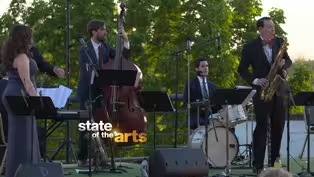
Jazz on the Back Deck: Dan Levinson and his Band
Video has Closed Captions
Clip: S39 Ep7 | 6m 28s | Jazz clarinetist Dan Levinson and his band perform outdoors at the Morris Museum. (6m 28s)
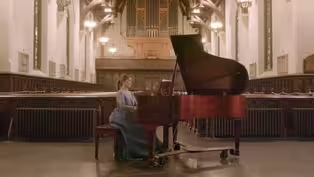
Video has Closed Captions
Clip: S39 Ep7 | 10m 9s | Pianist Min Kwon performs variations on America the Beautiful by dirverse composers. (10m 9s)
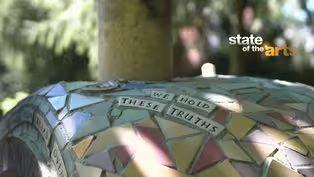
Video has Closed Captions
Clip: S39 Ep7 | 6m 45s | Ceramic artist Alan Willoughby uses his backyard kiln for both pottery and pizza. (6m 45s)
Providing Support for PBS.org
Learn Moreabout PBS online sponsorship

- Arts and Music
The Best of the Joy of Painting with Bob Ross
A pop icon, Bob Ross offers soothing words of wisdom as he paints captivating landscapes.











Support for PBS provided by:
State of the Arts is a local public television program presented by NJ PBS