State of the Arts
State of the Arts: July 2022
Season 40 Episode 8 | 26m 47sVideo has Closed Captions
Audible collaborates with Newark artists to create large-scale artworks, from a comic-book
Audible's Newark Artist Collaboration, Artist Monica Camin & Resistance Revival Chorus
Problems playing video? | Closed Captioning Feedback
Problems playing video? | Closed Captioning Feedback
State of the Arts is a local public television program presented by NJ PBS
State of the Arts
State of the Arts: July 2022
Season 40 Episode 8 | 26m 47sVideo has Closed Captions
Audible's Newark Artist Collaboration, Artist Monica Camin & Resistance Revival Chorus
Problems playing video? | Closed Captioning Feedback
How to Watch State of the Arts
State of the Arts is available to stream on pbs.org and the free PBS App, available on iPhone, Apple TV, Android TV, Android smartphones, Amazon Fire TV, Amazon Fire Tablet, Roku, Samsung Smart TV, and Vizio.
Providing Support for PBS.org
Learn Moreabout PBS online sponsorshipNarrator: Large new murals made by Newark artists tell stories of the city's history and the people who live there.
Katz: We wanted to basically have a representation on the walls of the beauty of the city, the artistic depth of the city.
This is a way to to bring people together.
And it's beautiful.
Narrator: It's part of Audible's Newark Artist Collaboration.
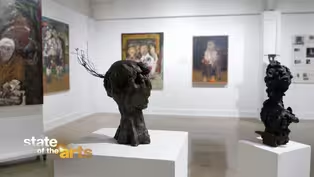
Narrator #2: At the Monmouth Museum, artist Monica Camin grapples with her family's history in Nazi Germany, Argentina, Israel, and the United States.
Camin: Being in the arts, I always think it's like therapy.
I learned about my past and how important it is.
Narrator: Her show is called "Perpetually Settling Dust -- Art as Memoir."
Chorus: What the world needs now Narrator: And at SOPAC, the Resistance Revival Chorus, women and non-binary performers, carry on part of a long tradition of music for a cause.
Koomson-Davis: The words were in the streets, and the signs were in the streets, and the people were in the streets, but really wanting to ensure that the tradition of music was in the streets.
Chorus: What the world needs now Is joy in resistance Announcer: "State of the Arts," going on location with New Jersey's most creative people.
Chorus: [Singing] Is love in resistance Announcer: The New Jersey State Council on the Arts, encouraging excellence and engagement in the arts since 1966, is proud to co-produce "State of the Arts" with Stockton University.
Additional support is provided by these friends of "State of the Arts."
Dixon: There's a real love of the arts here.
The East Coast is, you know -- it's a hustle kind of place.
It's, you know, you got to get going, you got to hit it.
And so you don't always have the time or breath to think of the arts, but Newark always does.
There's poetry, there's always music.
There's always a party in the summertime, right outside the park where I live in my building.
There's always some element.
of arts going on.
And then I think, again, the murals tie right into that.
Narrator: The murals that Jocelyn is talking about are all around the library's neighborhood in downtown Newark, close to the Broad Street Station and near Audible's headquarters.
Audible, the spoken-word company best known for their audio books, commissioned the new murals and other public artworks as part of their Newark Artist Collaboration.
Speaker: ...large-scale installations and public arts... Narrator: The community was invited for a celebratory opening event.
Speaker #2: ...put murals all over the city.
Glover: At our core, what we really tried to do is make direct community investments.
And so the Newark Artist Collaboration really kind of embodies that, working collaboratively with local artists and local institutions to put direct funding into the arts and creative economy here and help beautify our neighborhood.
Narrator: The 20-plus artists chosen to create new works all hail from Newark, as does the lead coordinator of the project, Rebecca Pauline Jampol, an artist herself.
Jampol: So, we collaborated with the Newark Public Library to create three pretty transformative installations.
On Essex Street, there is an incredible mural by Malcolm Rolling and Hans Lundy of YENDOR.
Narrator: YENDOR is a Newark-based arts organization focusing on art for the public, including theater and the visual arts.
The YENDORians working on this project teamed up to tell a story with meaning for both of them.
Hans moved here from Haiti when he was 10 years old.
Malcolm's family has lived in Newark since the early 1900s.
Rolling: We wanted to talk about the African diaspora and how our difference in ethnicity and culture from the islands to here and in mainland America -- it still kind of connects how we can use that connection to find community within each other.
Lundy: So, "Souvenir de la voix" means "remembering the voices," right?
Within, like, the mural, we wanted to really portray and show, like, our ancestors, but also our modern-day traditions that we carry as people.
So that's why you see, like -- in the background, you see the grandparents in black-and-white, but you'll see that little girl listening to music in color and vibrant and everything like that.
Jampol: The little girl is wearing these ladybug headphones that speak to imagination, and at night, the headphones illuminate and you can see those throughout the neighborhood.
Narrator: "Souvenir de la voix" is on the exterior wall of the library annex right next to the Audible headquarters.
On the other side of the library, another artist team took an old alleyway and made it a place where children are welcome.
Jampol: Patricia and Nancy -- they are an aunt-and-niece duo who have been creating work for a very, very long time together.
When we thought about this space, which was, for so long, just an empty alleyway, they seemed like they could transform it into something that was fantastical and exciting for the youth of the area.
Saleme: It was like the sun never been there and the whole thing was, "Let's put a sun there."
And... Cazorla: Light.
Saleme: Light and, you know, happiness.
Cazorla: Places to see, places to play, perhaps a table for children.
Imagine blooms of flowers everywhere in the alley.
Our work is conceived in that idea of welcoming anybody.
[ Music plays ] Narrator: The third library artwork is in a courtyard where events are held.
To find out more, all of the artworks have labels and QR codes, bringing you to an app where the artists talk about their work.
Smith: The theme is really about movement and rebirth and connections.
Narrator: Some of the Newark Artist Collaboration pieces are inside Audible's headquarters, but most spread out into the neighborhood.
A block away, on University Avenue, is a piece called "Cosmic Microwave Background."
It's outside of Fortress of Solitude, a comic-book store that's been in Newark for over 40 years.
Linardaki: So, the idea came from Rebecca and Audible.
We had a meeting online, and they said, you know, "We have this wall, this massive wall that's over a comic book store.
And do you know anything about comic-book culture?"
And I was like, "Ooh-la-la."
[ Laughs ] Mm!
So I said, "Yes, of course I do."
You know, I have two sons, and that's all they talk about.
And we asked people, you know, "If you were a superhero, what would be your powers?
If you had an alter ego, what would it be?"
So people sent us pictures, you know, of their children posing as superheroes, and they were like, "I'm flying.
I have lasers coming out of my eyes," you know.
Narrator: From these photos, Eirini created large-scale silhouettes, transforming them with colors and patterns.
Jampol: And they fly across the facade as a swarm of superheroes.
[ Music plays ] Robles: I loved it.
It was a great idea.
And it represents the kids in Newark, what they really believe in.
[ Bell dings ] Narrator: Farther down on University, artist Noelle Lorraine Williams creates art that engages with history.
"Monumental Newark" re-imagines sites of 19th-century Newark as a series of four billboards at the old Westinghouse site, an area that's been fenced-off and vacant since the 1980s.
Williams: I used to live near Westinghouse.
I often go past the Broad Street Station.
I want the public to understand the history of these spaces that they're walking through.
A lot of these sites that I profile in the images are actually on University, which was originally called Plane Street.
Narrator: In 1849, the great writer and abolitionist Frederick Douglass spoke at the Plane Street Colored Church, which was a center of the anti-slavery movement.
Williams: There, I have the opportunity to show this connection between this space and someone -- a luminary, almost like a giant, like Douglass -- but to also have people think about the other people that made up this community.
There was a community that actually surrounded the whole field.
There's a house that was an Underground Railroad house.
There was another Black church there.
This was the nucleus of the African-American community here on University -- formerly Plane Street.
And so it's just, to me, an opportunity for folks to connect.
Jampol: There's a certain kind of magic in our neighborhood now.
I believe that truly has to do with the collaborative effort.
It's not that we're just putting up artwork.
Everybody is involved.
Katz: We wanted to basically have a representation on the walls of the beauty of the city, the artistic depth of the city.
So to have this incredible talent, people telling stories of their history on the walls, this is a way to to bring people together.
And it's beautiful.
[ Applause ] Soloist: [Singing] America the beautiful Narrator: Later on the show, music by the Resistance Revival Chorus.
Narrator #2: But next, memories and family history inspire an artist's work.
Miller: Monica's work is very gripping.
It's powerfully expressive.
And it's expressive of the strength and the resilience of individual people and families that have been faced with oppression.
[ Music plays ] Camin: Being in the arts, I always think it's like therapy.
You express yourself.
I follow my instincts.
And I learned about my past and how important it is.
Narrator: Monica Camin has been a sculptor and painter all her life, but at a certain point, after raising children and caring for her family, something changed for her.
It began when her mother gave her an old family photo album.
Camin: I was ready to fly.
What it means for me, I didn't know.
But I started to look at my album -- photograph.
Narrator: A self-portrait called "Unravel," a painting with sculptural elements, captures this moment in time.
[ Music plays ] Her parents, both Jewish, fled Nazi Germany early in the war and settled in Argentina, where Monica was born and raised.
Later, she lived in Israel for 10 years before immigrating to the United States, where she's lived for the past 40 years.
[ Music plays ] The Monmouth Museum's exhibition of Monica Camin's work is called "Perpetually Settling Dust -- Art as Memoir."
Camin: History collect dust on top of things.
And that resound with me, especially my parents coming from World War II.
And I needed to decide my nationality even that I'm born in Argentina.
And things happened in Argentina, too.
It was the Dirty War, where they killed students.
It's collecting dust -- perpetually settling dust.
Miller: The paintings are the inherited collective memories of her family.
Camin: This one -- it's about an aunt and an uncle.
He was in Argentina, my uncle.
His cousin was in France.
Narrator: One painting tells the story of her mother, aunt, and uncles as teenagers in Germany before the war.
Camin: The side of my mother, there are four siblings.
I really didn't know why I started to paint them, aside that they were beautiful.
Then I realized that behind that beautiful photograph, it was a story.
And the story is that when they were living in Germany and they were young, they went to each school and they took measurements about -- the children's, the color of the eyes, the color of their hair, the color of their skin, the height, the nose, everything.
And they wanted to show how the pure Aryan features exist and Jewish will not have those.
So it was a huge assembly, and they said that they came out with the perfect Aryan beautiful children, and they were the Watermann.
That's the last name of my mother's family.
So somebody ran and told them to stop the assembly because they were Jewish.
[ Music plays ] Narrator: Another work in the Monmouth Museum show is called "Prayer."
It was created during the time Monica spent in the hospital with her daughter.
Camin: My daughter was pregnant, and in the fifth month, she lost all the water.
It's extremely dangerous for the baby.
So she called me.
I went, and she was in the hospital for two months.
For me, it was constantly, I pray.
And I pray, for me, it's to my ancestors.
If it is to God, God help me.
But my ancestors -- I know them.
So, I needed to be busy.
And I started embroidery -- something that I never did in my life.
But I could sit there and be with my daughter.
She couldn't move at all.
Everything, I needed to do for her.
And it was a prayer.
This piece belongs to my grandson.
He came, you know -- he born.
His arm was very swollen.
His foot, too.
His breathing was not good.
They called me when he born, and the doctors showed me, brought me to the room.
I look at him and I said, "He's a perfect baby."
And he said, "No, he's not perfect."
And I told him, "You know nothing.
He's perfect."
[ Music plays ] Narrator: Other works in the show deal with forgotten German heroes who helped Jews escape the Nazis, a grieving Pope John Paul II, and there are pieces about Monica's grandfather.
He fought for Germany in World War I, narrowly escaping with his life.
His good friends saved him three times.
In World War II, that same friend joined Hitler's army, but remained loyal to Monica's grandfather, forging documents to help him and his family escape to Argentina.
Narrator: My grandfather -- the one that fought in World War I -- he always said that 40 generations of German blood wasn't enough to be German.
And I understand that.
And I realized that today, I connect with something bigger than a country, globally, to every country.
In a way, I think we all the same.
And we have so much in common.
More than we think.
[ Music plays ] [ Music plays ] Narrator: Last on the show, songs of protest and liberation by the Resistance Revival Chorus.
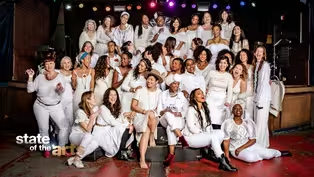
Chorus: What the world needs now Is joy in resistance Pace: The Resistance Revival Chorus is made up of women and non-binary performers, educators, activists who wanted to explore their musical side and musicians who wanted to explore the activist inside of them.
All types of people who had one common goal in mind -- breathe joy into the resistance and center the voices of people in the movement.
Koomson-Davis: I teach ethics, and I've taught literature and history, and I sing.
And so this felt like, "Oh, here's an opportunity to sort of marry all of these competencies and bring it to bear in something that feels really important and something that feels really pivotal."
An ensemble that was singing for justice.
Narrator: The Resistance Revival Chorus was co-founded by now-manager Ginny Suss and others after their work organizing the original Women's March in January 2017.
Koomson-Davis: They had been inspired by what they experienced at the Women's March.
The words were in the streets, and the signs were in the streets, and the people were in the streets, but really wanting to ensure that the tradition of music was in the streets.
I thought that was an amazing opportunity.
Pace: Our very first performance was a flash mob on Times Square, and we were all dressed in white, singing and clapping, and people didn't know what was happening.
But we knew this was something that was bigger than us, and after that, it just took off.
We performed at Carnegie Hall and at the Grammys, at lots of marches.
Narrator: With over 60 members available to participate, the chorus combines performance tours with educational workshops and public actions in support of activists.
They even produced a 2020 release -- "This Joy."
Desai: When the Resistance Revival Chorus started, it was such an exciting way for me to use my activist voice in a different way through music, and I've been singing my whole life, so that was really lovely, to be able to work with the Desai Foundation and also the Resistance Revival Chorus to feel like I'm giving people a voice that don't have one.
Chorus: [Singing] We want justice We want it now Simpson: As the Girls' Club, we often have amplifying events around social justice hosted in the space.
We've had everyone from Michelle Obama to Stacey Abrams to Colin Kaepernick in this very room, actually.
And there was an event here where Ginny Suss was in attendance.
And I said, "I love the chorus.
I just want to be involved."
And she's like, "Come."
It's been such an incredible blessing to be able to express the work that I'm doing on the day-to-day in a creative capacity, and especially when you're actually really trying to uplift young people in doing the work.
So it's great to be able to do the work myself in community with other amazing women.
Koomson-Davis: So, let's just sing all the way through the first part.
Wherever we go, how do we bring together community to be able to celebrate in the moments of joy that we experience and to be able to mourn and grieve the indignities, the inequities that people face?
That's what we're doing.
We're not showing up at a venue to do a show, right?
We're showing up wherever we've been asked to come to bring communities together.
Lam: If you find The eye of the storm They used to host nights like Resistance Revival Nights where they would invite guest artists to come and perform with them, and I was just so in love with everyone that I met that I was like, "Can I join?"
[ Laughs ] Chorus: Shine on Lam: The song is really just an invitation for individuals, especially if they come from an underrepresented or marginalized community in this country, I just wrote this as an encouragement for people to just find a light, shine that light, share that light, and create more balance in this country.
Billia: They are filled with tremendous, beautiful energy and joy in their singing.
It's not only the music, but it's the joy of bringing that message.
They'll link between music and activism, which is such a strong historical link.
Laird: How can music be used for activism and to promote social justice?
Billia: For special events like this one, we will do a panel.
This is a community that's very invested in social justice issues.
So when I came across the Resistance Revival Chorus, I thought this might be a great way to serve our community better.
Moses: That we can use music and we should use music to teach and to inspire.
Ansari: And I've been on panels and people is like, "Why you keep talking about that racism thing?
Can't you talk about something else?"
And I'm like, "Sorry, I can't."
But a song allows people to hear something different.
So I think there's this beautiful thing of music in having people being able to hear.
And I just wanted to say, the folks who are on the other side singing that or hearing that, who are experiencing the oppression.
it is still painful, even in the claps and the applause at the end.
Dobson: Say Her name Pace: When Abby Dobson breathes that first breath of "Say Her Name," we all hold hands and just think about the message, and it pretty much takes my breath away.
All: Tatiana Jefferson.
Dobson: Sandra Bland.
All: Sandra Bland.
Dobson: Breonna Taylor.
Pace: It really is a call out to freedom.
These women have become our ancestors now, and we owe it to them to continue to fight for freedom.
Dobson: Say Say Say her name Pace: It's a long road To walk on When you see other women do things, it gives you just the motivation to try things yourself.
There are women who have become my mentors without even knowing it.
Oh, to carry on I don't know if you'll be there But I hope we've come The movement of human rights -- civil rights has been going on long before I've been on this planet, and I can reach out and touch it.
There was a time my grandmother couldn't vote, and now I'm going to the polls with her.
My father marched in the March on Washington with Martin Luther King, and in the song "I Hope," I just needed to express that at the point in which you get tired, someone else will continue it for you, and to continue to encourage each other because it's working and we need it so badly.
Chorus: I hope Ooh Pace: Oh, yeah, yeah, yeah [ Music plays ] Narrator: Watch or share any of our stories online at StateoftheArtsNJ.com.
Narrator #2: While you're there, let us know what you're thinking.
We love to hear from you.
Thanks for watching.
[ Music plays ] Announcer: The New Jersey State Council on the Arts, encouraging excellence and engagement in the arts since 1966, is proud to co-produce "State of the Arts" with Stockton University.
Additional support is provided by these friends of "State of the Arts."
[ Music plays ]
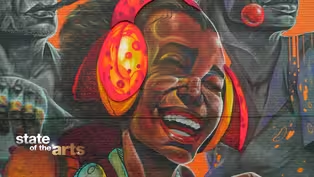
Audible and the Newark Artist Collaboration
Video has Closed Captions
Clip: S40 Ep8 | 8m 13s | Spoken word company Audible collaborates with Newark artists to create large-scale works. (8m 13s)
Video has Closed Captions
Clip: S40 Ep8 | 7m 12s | Artist Monica Camin explores her history as the child of Jews who escaped the Holocaust. (7m 12s)
Video has Closed Captions
Clip: S40 Ep8 | 7m 36s | Resistance Revival Chorus, a collective of more than 60 women and non-binary singers. (7m 36s)
Providing Support for PBS.org
Learn Moreabout PBS online sponsorship

- Arts and Music
The Best of the Joy of Painting with Bob Ross
A pop icon, Bob Ross offers soothing words of wisdom as he paints captivating landscapes.











Support for PBS provided by:
State of the Arts is a local public television program presented by NJ PBS