State of the Arts
State of the Arts: June 2024
Season 42 Episode 8 | 26m 46sVideo has Closed Captions
Jewel Box at NJ Ballet, artist Bony Ramirez, and stained glass artist J. Kenneth Leap.
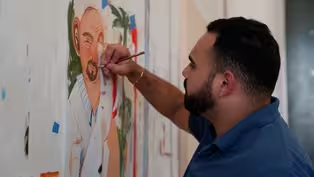
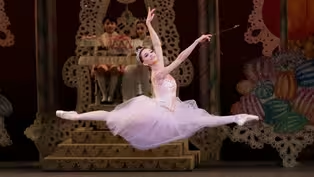
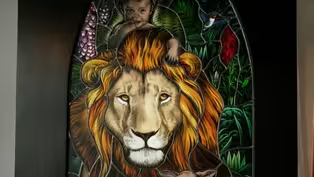
"The New Jersey Ballet explores new directions with the premiere of Lauren Lovette’s “Jewel Box."" In a solo exhibition at the Newark Museum of Art, the young Dominican American artist Bony Ramirez uses surrealism to probe the legacies of colonialism and tourism. And, J. Kenneth Leap creates grand public art in stained glass. You'll find his work at the NJ State Capitol and Boardwalk Hall in AC.
Problems playing video? | Closed Captioning Feedback
Problems playing video? | Closed Captioning Feedback
State of the Arts is a local public television program presented by NJ PBS
State of the Arts
State of the Arts: June 2024
Season 42 Episode 8 | 26m 46sVideo has Closed Captions
"The New Jersey Ballet explores new directions with the premiere of Lauren Lovette’s “Jewel Box."" In a solo exhibition at the Newark Museum of Art, the young Dominican American artist Bony Ramirez uses surrealism to probe the legacies of colonialism and tourism. And, J. Kenneth Leap creates grand public art in stained glass. You'll find his work at the NJ State Capitol and Boardwalk Hall in AC.
Problems playing video? | Closed Captioning Feedback
How to Watch State of the Arts
State of the Arts is available to stream on pbs.org and the free PBS App, available on iPhone, Apple TV, Android TV, Android smartphones, Amazon Fire TV, Amazon Fire Tablet, Roku, Samsung Smart TV, and Vizio.
Providing Support for PBS.org
Learn Moreabout PBS online sponsorshipNarrator: J. Kenneth Leap has traveled the world making grand stained glass artwork.
If you've spent time in New Jersey, there's a good chance you've seen his work.
Leap: I'm always telling some sort of a story.
So it's the story of a community or a town or a personal client.
So it's trying to create, what is the narrative?
Narrator #2: After years working construction, a self-taught young artist from the Dominican Republic has had a meteoric rise -- new work by Bony Ramirez at the Newark Museum of Art.
Ramirez: If I am going to tackle hard topics, things like colonization and different things that I really wanted to show the true colors of it without putting too much makeup on it.
Narrator: In its 65th year, the New Jersey Ballet begins a new chapter with a new work, "Jewel Box," by Lauren Lovette.
Former principal dancer with the New York City Ballet, she's now the resident choreographer with Paul Taylor Dance Company.
[ Music plays ] Narrator #2: "State of the Arts," going on location with New Jersey's most creative people.
Announcer: The New Jersey State Council on the Arts, encouraging excellence and engagement in the arts since 1966, is proud to co-produce "State of the Arts" with Stockton University.
Additional support is provided by... ...and these friends of "State of the Arts."
[ Music plays ] [ Music plays ] Leap: I should say I've never really had a plan.
I have just said yes to opportunities.
Weichmann: A lot of what Ken does is on a grand scale.
Painted glass windows, when you look at them, they feel like they're surrounding you.
[ Music plays ] Leap: I went to college at the Rhode Island School of Design to study illustration.
I was doing drawing and painting, which I had done for a lot of my life up to that point, and I was home in my apartment having dinner, and a little voice came into my head and said, "Ken, change your major."
So I said to the little voice, "What should I go into?"
And the response was, "Go into glass."
So I learned to blow glass and cast glass, and I learned the basics of stained glass, but as I was nearing the point of like my senior year getting ready to graduate, stained glass began to make sense in a way to reconcile my abilities to draw and paint and render with also working in glass.
[ Music plays ] The older tradition of stained glass goes back to the way that stained glass was being made for the medieval cathedrals, and it's working with a different type of a glass.
So, that glass is actually a transparent color that's allowing light to come through it.
What makes stained glass different from painting on a canvas is that you are really modulating the light that is coming through the window, or whatever it happens to be.
And also, I kind of set myself up to specifically work with architectural stained glass.
The pigments that I work with are made from very finely ground up particles of glass and metallic oxides, and the main difference is that the different colors will fire at different temperatures.
So the way to think of it a little bit is the way that ceramic glaze goes on to a piece.
Narrator: One of Ken's first large commissions was a skylight at the New Jersey State Capitol.
Leap: That was very pivotal for me because I was young, I didn't have a large body of work.
The idea that I had for this stained glass skylight would be to depict historical places and important points of interest around the state by creating a -- an illustrated map.
It's called "New Jersey: A 360-Degree View."
In a way, it was an opportunity to not only highlight things that I think I had a hope would be preserved, and this is in a room where the legislative body would have a chance to see it.
So it was kind of a way to also say, "This is important."
There's a wonderful scene in the south of the Victorian homes in Cape May, and it has a depiction of Blackbeard the pirate, which not many people knew Blackbeard was also vacationing down in Cape May, you know?
There were a couple of great waterfalls that I included from North Jersey.
So one is the Great Falls in Paterson.
You want to look for the diving horse at Atlantic City.
George Washington is in there.
Albert Einstein is in there.
There's also a small self-portrait.
There's a shipwreck going on, and there's a small figure with his arms up in the air kind of being overwhelmed.
And that -- that was sort of me.
[ Music plays ] Over the years, I've done a number of stations for New Jersey Transit, so I've done Edison Station, Red Bank Station, the Pennsauken Transit Center, um, Lindenwald Station.
Edison was one of the first ones that I did, and that actually has leaded glass panels that are protected behind tempered glass pieces.
[ Music plays ] And then later I began to do things that were digitally printed.
The last one that I did was the Pennsauken Transit Station, and that one has over 2,000 feet of digitally printed glass.
I would say it's my favorite.
The whole thing tells a story as you go through it.
[ Music plays ] [ Indistinct conversations ] [ Woman speaking indistinctly ] Narrator: Ken has long been involved with the internationally acclaimed glass center at Wheaton Arts in Millville, New Jersey.
He's had a studio there for more than 30 years.
[ Music plays ] On a recent rainy day, he painted a mural during Wheaton's annual ECO festival.
[ Music plays ] [ Ringing ] By chance, it was also World Labyrinth Day, so he led a labyrinth walk.
Leap: The idea behind World Labyrinth Day from the Labyrinth Society is at 1:00 local time across the world, people are encouraged to walk a labyrinth and meditate on world peace and also on the healing of the planet.
[ Ringing ] [ Bowl hums ] Weichmann: He has gone all over the world to create and install glass art, but what he's doing for the town of Runnemede I think is extremely special.
He has roots there.
His family has a strong history there, and I think that passion and that care is symbolic of who he is.
Leap: Murals on the businesses actually help with the recognition and also make people feel good about the town.
I am the president of a small arts nonprofit called Reimagine Runnemede, which I started with a couple of my friends.
It was sort of three of us got together in 2018 and began to think that there should be maybe something that happened with the arts.
And at that same period of time, I ended up purchasing this building.
I've seen the ways a lot of other towns have used the arts to help to revitalize the local economy, and some of the projects that we've done have involved doing murals.
The first one was a mural on my building, so there were 17 people from the community that came out and helped me paint the mural on the wall here.
And then I went off and did other murals on my own through town, and we are continuing to do murals in town.
Narrator: Ken's hometown studio is just a few doors down from the building where his grandparents had a supermarket in the 1930s and '40s.
The building now houses a barbershop and a Polish grocery store.
Leap: I painted a mural on their building with a big Polish rooster on it.
[ Music plays ] What ties all of that work together for me is I'm always telling some sort of a story.
So it's the story of a community or a town or a personal client.
So it's trying to create what is the narrative and then how do I express that.
[ Music plays ] [ Music plays ] Narrator: Later on the show, a new dance inspired by a music box.
But first, a rising young art star originally from the Dominican Republic.
[ Music plays ] [ Music plays ] Ramirez: This is the one piece in the show that I wanted to feel a little bit more like contemporary or like in the current times.
Muñoz-Rodriguez: Bony Ramirez is a local artist who was born in the Dominican Republic, and he immigrated to New Jersey in 2009 when he was 13.
Narrator: After high school, Bony wanted to study art, but college was too expensive, so for seven years he worked full time in construction while pursuing his art on the side.
Muñoz-Rodriguez: For me, I see it as marking him in a positive way.
He's really proudly self-taught.
And in 2020, during the pandemic, he really decided to kind of take this leap of faith and become an artist full time.
And since then, he's really just had this meteoric rise.
Narrator: It's been an act of self-invention, right down to his name.
Bony was what he called his much-loved stuffed bunny in English when he first arrived in the U.S. Ramirez: In Spanish, we write things how we pronounce them, and it was "bonny" as B-O-N-Y.
And I think once I became like a "professional artist," I was trying to look for a name that was a little bit more unique.
And that's where I was like, oh, Bony.
It sounds pretty unique.
When I became an artist full time, I basically felt like I was living for the first time.
That was also like that sign of like, this is the new person that I am today, which is the person that I always wanted to be.
Narrator: Bony Ramirez's solo exhibition at the Newark Museum of Art is part of their ongoing Global Contemporary series, where artists are invited to explore and respond to the museum's collections.
Muñoz-Rodriguez: So it's an opportunity for an artist to kind of sort of be an artist in residence at the museum for a year.
They get full access to our collections and storage, and they work with a curator to develop and respond to our collection with a new body of work.
Narrator: Bony started his residency by returning to a painting he remembered from the first time he came to the Newark Museum of Art about 10 years ago, when he was still a teenager.
Ramirez: I don't know if it's like, you know, the 18-year-old me, but it was, you know, just seeing, like, this very tropical landscape, really felt like home.
That's why I really connected with that painting and basically was the cornerstone/starting point of the whole exhibition.
[ Music plays ] Narrator: The show has a sense of magical realism about it.
There's an undercurrent of unease or even violence that's part of the beauty.
Muñoz-Rodriguez: He's really kind of been leaning more into the difficult histories of the Caribbean, as well as the difficult realities of the Caribbean present.
Narrator: Such as the tourist trade.
In "Caribe Express/Caribe Tours," Dominican workers deliver fresh towels and serve drinks to guests at the swim-up bar.
Ramirez: When I want to specify more like Dominican culture itself, I use these carnival masks that we have in Dominican Republic.
Throughout the Caribbean, they're also very common, but these are very specific to the island as well.
Narrator: In this almost 27-foot painting, Bony centers the experience of the local islanders.
Their masks have a double meaning, as during COVID, tourist spots in the Dominican Republic stayed open for business despite the danger to workers.
Ramirez: Lives were actually lost for not having those restrictions too.
Muñoz-Rodriguez: The horse skull on that third panel is just this idea, you know, a horse is a labor animal.
So this idea of kind of working yourself to death for someone else's version of paradise.
Narrator: The resort guests are cutouts created with wallpaper and collaged onto the painting.
Ramirez: I think I wanted to show the otherness.
I focus on very European wallpapers.
I source them from like different -- like eBay or different, like, antique stores.
Like, I want them to feel and look like from a certain period of time.
I think I've always loved that juxtaposition between, you know, like, black and brown figures with these, like, European wallpapers, usually whether they are on curtains or in dresses, but they always start to make that conversation.
You know, to kind of like switch up the narrative a little bit, I was like, how -- how does colonizing the colonizer feel like?
Muñoz-Rodriguez: Although he's self-taught, his practice is really steeped in art history.
He's really influenced by mannerist painting and surrealism and kind of the tradition of magical realism in Latin America.
And so the painting of three little girls, he sees them as sisters.
They're sitting on a bed, and two of the girls are sprouting foliage for arms, and they are kind of gently turning the third girl.
[ Laughs ] So they're touching her hand, and he's incorporated some bits of kind of like confetti to almost, you know, simulate this moment of transition.
Ramirez: When I started using taxidermy in my work it was mainly as a way of, you know, how do I open myself up a little bit more about myself?
For this particular work, I wanted to talk about more like my experiences, for example, working construction or just having, you know, the urge to be like an artist or somebody else that couldn't escape, like, the conditions of life.
[ Music plays ] Muñoz-Rodriguez: He's doing something really interesting by drawing in the viewer with these -- these kind of vibrant colors or these really beautiful elements.
But then, you know, encouraging them to sit a little bit longer with the work and say, okay, wait, what's actually happening here?
Or what am I supposed to be taking away from this?
And I think he's also trying to show a more -- a more nuanced view of Caribbean life and Caribbean culture.
I think there's this really one-dimensional view of the Caribbean as this really beautiful tropical paradise.
And he's like, yeah, but there's also this.
Ramirez: If I am going to tackle hard topics, like colonization and different things that I really wanted to show the true colors of it without, you know, putting too much makeup on it, if that makes sense.
I like the viewer to really feel the exhibition beyond just a good feeling.
It's almost like challenging the viewer with a lot of the works themselves.
[ Music plays ] [ Music plays ] Narrator: Last on the show, Paul Taylor Dance Company's resident choreographer Lauren Lovett creates a new work for the New Jersey Ballet.
[ Music plays ] [ Music plays ] Lovette: "Jewel Box" is a new piece I'm making for New Jersey Ballet.
It's about the inner workings of a jewelry box -- the music kind that has the ballerina and the center that spins.
There's this enchantment that you hear, this reference to something old in the music, something almost ghost like.
It interrupts itself all the time and keeps you guessing.
There's 6 movements in just a 20-minute time frame, so the music really does propel you forward.
It gave me an opportunity to feature a lot of different dancers in this company, which I wanted to do.
Something you haven't seen before and something you haven't heard before is the goal.
[ Music plays ] [ Cheers and applause ] [ Music plays ] I've been a fan of Maria since I can remember.
Maria Kowroski was a ballerina I looked up to as a student.
I watched her countless times on stage.
She was the pinnacle, the ideal ballerina.
So when Maria Kowroski came to me and said she wanted something new for the company, I had to say yes.
[ Music plays ] Kowroski: Hi, I'm Maria Kowroski, artistic director of New Jersey Ballet.
As a dancer, I was at New York City Ballet for about 25, 26 years, which is a really long time.
[ Chuckles ] I started at this company in November 2021.
I was the acting artistic director for about a year and then really, really dove in.
[ Music plays ] I know Lauren from many years at New York City Ballet.
She's younger than I am, but I remember her as a young dancer and being very inspired by her.
I loved watching her grow as a dancer, but to be able to watch her grow as a choreographer has been really amazing too.
So I feel very fortunate and grateful that she has been willing to help, but also sees my vision and understands where I'm trying to go.
[ Music plays ] Well, New Jersey Ballet is a very special company.
It's existed for 65 years.
It was founded by Carolyn Clark.
She was a former American Ballet Theatre dancer.
We have 22 dancers, and we actually now have a trainee program, which is amazing.
So we're kind of teaching students how to transition from student to professionals.
A lot of people living in New Jersey haven't heard of New Jersey Ballet, which I find strange for a company that's existed for so long.
So I'm trying to get us on the map, get us a new location, performance venues around the state to kind of give some more exposure and to give people, you know, more awareness of what we're doing.
I mean, I think we all know "The Nutcracker" is very popular story ballet.
"Sleeping Beauty," "Cinderella," I think those are ballets that people know.
But I think for me, when I'm building a repertory program, I really try to think about things that would excite the audience, move the audience.
And when I do a repertoire evening, I have usually four different ballets on the program, and I'm hoping that if you're coming to the ballet for the first time, one of those is going to hit something inside.
[ Music playing ] Lovette: What I love about New Jersey Ballet is it feels like this pocket of opportunity.
I feel like it's untapped potential.
It's this company with an extreme amount of talent that I feel is just underexposed.
Like the world doesn't know about it yet, but it's right here.
I think ballet is for everybody.
I do, and I really do feel like it's this incredible art form that makes you feel music in a different way.
[ Music plays ] The music is extraordinary.
It's intricate, it's complicated.
Kevin Puts actually sent the music to me himself, so it's a score that isn't really out there yet.
It hasn't been publicly released.
I think he's one of the greatest composers of our generation.
So when this music came to me, it felt serendipitous.
Lopena: The score is very intricate.
Trying to put the dynamic of the movement with the music is very exciting, exhilarating.
It gives the audience the opportunity to be pulled in and constantly on their toes, because you never kind of know what's happening.
And then with that, the movement is honestly always on a revolving door.
It kind of gives that sensation of a jewel box.
Things are always working underneath, and then there's so much happening with this beautiful piece on top of it.
Ledford: It's a beautiful and very interesting ballet at the same time.
It's very new movement.
It's based off of classical ballet, but it's definitely more neo classical.
So it has those touches of beauty.
But then when you look on the inside, it's very angular, very architectural.
It's many different things going on at once.
So she definitely brought inspiration from the aesthetic part of the music box, and then the internal parts that actually make the music box work.
Lovette: I really do feel like I have the best seat in the house, because I'm right there in front of the dancers.
I'm -- I'm as close as you can get to the magic.
I work with human beings, not paint brushes.
And I think that's so cool because they really bring aspects of themselves into the process that you can't...
I can't physically cultivate that on my own.
[ Music plays ] Lopena: It's just a very collaborative and unified experience.
She takes in consideration the dancer and the person in front of her, so a piece could be set that she already created, but she's willing to adapt that to the dancer up front.
And you can see that camaraderie from the studio to the stage.
Ledford: Since Maria has come in, I think she's wanting to bring in not just new experiences for us as dancers, but for people in New Jersey to experience.
Lopena: The whole thing is about, you know, new direction.
And so it's bringing a more exciting new work, something the audience of today can understand and see and get something from.
[ Music plays ] Kowroski: I think with ballet, you're going to the theatre to escape life and to be mesmerized by the beauty and formations that the dancers are creating, and they're dancing from their soul.
They're giving you something from inside, which is something that is priceless.
And I think that that's really, really what ballet is about and who it's for.
And I hope that we can bring in more and more and more people to really experience that.
[ Music plays ] [ Music plays ] [ Music plays ] [ Music plays ] [ Cheers and applause ] [ Music plays ] Narrator: To share these stories or to sign up for the "State of the Arts" newsletter, visit StateoftheArtsNJ.com.
Narrator #2: That's it for this week.
Thanks for watching.
[ Music plays ] [ Music plays ] [ Music plays ] [ Ringing ] Announcer: The New Jersey State Council on the Arts, encouraging excellence and engagement in the arts since 1966, is proud to co-produce "State of the Arts" with Stockton University.
Additional support is provided by... ...and these friends of "State of the Arts."
[ Music plays ]
Video has Closed Captions
Clip: S42 Ep8 | 6m 35s | Dominican-born artist Bony Ramirez uses surrealism to probe the legacies of colonialism. (6m 35s)
Jewel Box: Choreographed for the New Jersey Ballet by Lauren Lovette
Video has Closed Captions
Clip: S42 Ep8 | 8m 4s | The New Jersey Ballet premieres Lauren Lovette’s “Jewel Box.” (8m 4s)
The Painted Window: artist J. Kenneth Leap
Video has Closed Captions
Clip: S42 Ep8 | 8m 9s | J. Kenneth Leap creates grand public art in stained glass. (8m 9s)
Providing Support for PBS.org
Learn Moreabout PBS online sponsorship

- Arts and Music
The Best of the Joy of Painting with Bob Ross
A pop icon, Bob Ross offers soothing words of wisdom as he paints captivating landscapes.











Support for PBS provided by:
State of the Arts is a local public television program presented by NJ PBS