State of the Arts
State of the Arts: May 2022
Season 40 Episode 7 | 26m 46sVideo has Closed Captions
The OK Trenton Project, drummer Billy Hart, Olmsted's Cadwalader Park and Ride the Cyclone
At Passage Theatre, “The OK Trenton Project," based on a true story of kids, art, and gangs. In his 80s, jazz drummer Billy Hart was named a 2022 NEA Jazz Master. Frederick Law Olmstead’s parks transformed cities across America, including his last major design: Cadwalader Park in Trenton, NJ. And “Ride the Cyclone,” directed by McCarter Theatre’s new artistic director Sarah Rasmussen.
Problems playing video? | Closed Captioning Feedback
Problems playing video? | Closed Captioning Feedback
State of the Arts is a local public television program presented by NJ PBS
State of the Arts
State of the Arts: May 2022
Season 40 Episode 7 | 26m 46sVideo has Closed Captions
At Passage Theatre, “The OK Trenton Project," based on a true story of kids, art, and gangs. In his 80s, jazz drummer Billy Hart was named a 2022 NEA Jazz Master. Frederick Law Olmstead’s parks transformed cities across America, including his last major design: Cadwalader Park in Trenton, NJ. And “Ride the Cyclone,” directed by McCarter Theatre’s new artistic director Sarah Rasmussen.
Problems playing video? | Closed Captioning Feedback
How to Watch State of the Arts
State of the Arts is available to stream on pbs.org and the free PBS App, available on iPhone, Apple TV, Android TV, Android smartphones, Amazon Fire TV, Amazon Fire Tablet, Roku, Samsung Smart TV, and Vizio.
Providing Support for PBS.org
Learn Moreabout PBS online sponsorshipNarrator: In 2015, kids helped make a sculpture for Trenton, but the authorities took it down.
A new play by Passage Theatre Company tries to figure out what happened.
Castillo: Why are they moving this?
Narrator: In Princeton, McCarter's new artistic director, Sarah Rasmussen, directs "Ride the Cyclone."
Rasmussen: Well, it certainly has been a challenging two years, and I have very much missed being in a rehearsal room.
Narrator: We visit Frederick Law Olmsted's last great urban park.
It opened in Trenton in the late 1890s.
Bosted: Olmsted had the vision that a park could provide an outlet.
Narrator: And NEA Jazz Master Billy Hart.
He's performed with all the greats.
"State of the Arts," going on location with New Jersey's most creative people.
[ Music plays ] Announcer: The New Jersey State Council on the Arts, encouraging excellence and engagement in the arts since 1966, is proud to co-produce "State of the Arts" with Stockton University.
Additional support is provided by... ...and these friends of "State of the Arts."
Narrator: In the summer of 2017, on the corner of Perry and North Montgomery in Trenton, a giant hand appeared.
It was a sculpture made of pots and pans and old scrap metal.
Kids in a summer arts program made it with an artist who works with found materials.
[ Sirens wailing in distance ] Four days after installation, it was removed.
Brown: When they create something and then society pushes it aside, what kind of message does that give to young people?
Bradford: The main rule is you're not supposed to... Narrator: A new play called "The OK Trenton Project" tells the story of the big hand and tries to figure out why it was taken down.
Smith: ...do have other pieces of art.
Narrator: In the summer of 2021, Passage Theatre Company gave their play in progress its first public reading at the Mill Hill Amphitheatre.
Chapman: The residents who lived on Wood Street, they thought it was beautiful.
It was, like, reflecting the light 'cause it was metal and had this big red nail.
Bergen: I did it sheerly as a juxtaposition of color, you know, and red fingernails.
Domingues: We felt it was an important story that we wanted people to hear.
We didn't want the story to die with the statue coming down.
We really focus on shows that have to do with the Trenton community.
And this show is, word for word, verbatim, from interviews by people in the Trenton community and it's about an event that happened in Trenton.
Bradford: So, then, is Trenton a violent city?
For some people in some areas, it is.
Is it an overall violent city?
No.
Is it a gang-rule city... Peeples: Some of my words were used in the play and I really, really found them entertaining and insightful being read by somebody else.
Bergen: One kid reached in the hat and pulled out the OK sign.
Schultz: I was not aware how much of the story my part and the kids' part was.
I didn't really get that we were like the spine of the whole thing, really, until here.
Chapman: This is a good story for the neighborhood.
This is a good story for Trenton.
This is three organizations, this is kids from around the region working together to make art.
Bradford: Did either of you speak directly to David Foster at The Trentonian?
Bergen: He called me -- uh, like 40 feet up on a lift, moving a giant sculpture through the air.
It's just like, "Who is this?"
Narrator: "The OK Trenton Project" tells a complex, reality-based story.
Each actor plays multiple parts, including the kids who built the structure, the artists who worked with them, people from the neighborhood, gang members, TV news reporters, and local politicians.
Peeples: I guess some of the more frustrating things were some of the quotes that I heard from some of the politicians here locally that were used in the piece.
It's, you know, it's like they... Like, the question was asked, "Where are the bad guys?
More bad guys need to be in this piece."
And I'm thinking, "You just didn't listen closely enough for the bad guys that are in the piece.
They show up in the form of those people who were the naysayers.
And they don't have to be -- they didn't have to be many.
What they said was powerful enough because they were able to force this to be changed.
Castillo: They should never have taken it down.
I feel like a lot of the police are a part of that good old boys club, you know what I mean?
White: People said that it was the police that ordered it be taken down, but then other police officers said no, they had nothing to do with it.
Pretty much everyone denied having anything to do with taking down the sculpture.
Narrator: On a snowy night in February '22, "The OK Trenton Project" premiered.
Bradford: As a Black person, to me, dealing with this play, it seemed a little... like some of the stuff that people were saying and, like, the reasons why this this statue was removed was kind of unsurprising to me, a little bit.
There was this one girl, she's Blood.
And she comes up and she's like... Smith: What's going on, homey?
Bradford: They're saying they trying to remove the sculpture because it could possibly be Blood.
Smith: What?!
Bradford: Yeah.
Smith: So, y'all protesting it?
'Cause I'mma stand right here, right here with you.
Castillo: Yo, why are they moving this?
Bradford: They saying something about it got something to do with Blood affiliations.
Smith: Aww, now, that's messed up, man.
'Cause you know, I know one of the kids who did this.
Narrator: As we learn in the play, after the sculpture was installed, a rumor started that the "okay" hand gesture had something to do with a gang called the Bloods.
It didn't.
In fact, it turns out that the "okay" sign is sometimes used by white supremacists.
But none of that was on the minds of the kids who made it.
Smith: No, it was taken down, like, really quickly.
Castillo: Everyone was just really sad, and, like, the expressions on their face... Narrator: And the decision to take it down had lingering effects.
Smith: I'm passionate about government as a force for good, right?
And I find it so destructive that, especially at a young age, people feel failed -- hey -- by institutional power.
Then we all see the repercussions when there are no trusted institutions.
And then we're left with a situation.
Like, why would -- why would you trust institutional power, right?
Narrator: On one level, "The OK Trenton Project" is just about a summer art project gone wrong.
But if anything, over the years the writers and actors worked on the play, the importance and impact of the events surrounding the removal of the giant hand grew even stronger.
White: The pandemic happened, and then there was this huge racial reckoning happening across the country.
And now suddenly sculptures are coming down, statues are coming down.
And it's not just happening in Trenton.
It's happening everywhere.
It's not so innocent.
Bradford: Who is it affecting most in a negative way, right?
Who feels the most uncomfortable?
Whose voice really actually counts when it comes to, like, making these decisions?
[ Music plays ] Narrator: Later on the show, America's great landscape designer, Frederick Law Olmsted.
But next, new fame for a jazz musician who's been playing for decades.
[ Music plays ] Narrator: Legendary drummer and Montclair resident Billy Hart is a 2022 National Endowment for the Arts Jazz Master, without a doubt one of America's highest honors.
Hart: It was a great surprise, huge surprise.
I'm very lucky and honored.
I'm honored to get that.
Reeves: It is my honor and joy to present you with this award this evening.
You are so deserving.
And thank you.
Iverson: He's on over 500 records, and by some calculations, he's the most recorded modern jazz drummer.
Billy Hart was born in 1940 and came of age in the great explosion of small-group modern jazz.
You know, as a teenager, he got to see Miles Davis and John Coltrane live and up close, and he eventually played with most of the greats.
Hart: Well, Ethan is one of my closest friends.
He's been involved in my music, but I've also been involved in his music.
Iverson: His playing has a kind of euphoria in the beat.
When I was just a teenager collecting records, I'd always buy the album if Billy Hart was on drums because I knew that that euphoria, the swing would be there.
And that's why he's on 500 records, by the way, is it always feels so good.
[ Music plays ] Narrator: Billy's maternal grandmother lived in an apartment in Washington, D.C., across the hall from the legendary saxophone player Buck Hill.
Hart: Buck Hill -- I walked -- I walked in his apartment, he came home from work and gave me two Charlie Parker records.
I heard the music.
I fell in love with it.
That's the whole Billy Hart story right there.
I fell in love with the music.
There was no other way.
There was no other way that I would have heard that music.
[ Music plays ] Narrator: Buck Hill continued to mentor the young drummer and at some point invited the teenager to sit in on a Sunday afternoon jam session at one of Washington's local jazz clubs.
Hart: I went down to this jam session and I played a couple of tunes.
And I didn't do terrible, but it wasn't great.
But about the third tune, I did terrible.
And then I was heartbroken because that, you know -- I knew it was bad.
So I began to be really hurt and depressed.
And after I got off of the bandstand, I walked somewhere to be by myself so I could lick my wounds by myself.
As I was walking away, somebody grabbed me by the back of my pants and said, "You know, it wasn't all your fault.
It takes three of us to make a rhythm section."
Which is my first jazz lesson, my first music lesson.
When I looked up, that was Shirley Horn.
I didn't realize that she had been playing the piano.
Narrator: Shirley Horn was not yet famous.
Billy Hart went on to perform and record with her for decades, until she died in 2005.
Horn: [ Singing ] I'm getting hungry.
Peel me a grape.
Narrator: Billy was also the drummer on Herbie Hancock's 1971 "Mwandishi" album.
The tune "Sleeping Giant" starts with a famous drum solo.
Hart: Herbie Hancock is this genius that debuted with the Chicago Symphony when he was 11 years old, and he ended up somehow meeting Miles Davis and performing with Miles.
And he became a star, and somehow he ended up hiring me.
It was The Herbie Hancock Sextet, and we had met a guy that taught us some Swahili greetings, so, and we ended up having Swahili names.
If you look on a lot of records that I'm on, you'll see this name -- instead of Billy Hart, it'll be Jabali.
And Herbie had a name, too, and his name was Mwandishi.
[ Music plays ] Narrator: In his early 80s now, Billy Hart shows little sign of slowing down.
He tours with his own band with Ethan Iverson on piano.
He teaches at Oberlin College, the New England Conservatory of Music, and other universities.
And he plays with his longtime buddies in The Cookers.
Hart: I've been knowing Eddie Henderson since we were high school.
Cecil McBee is older than I am.
Henderson: But everybody in this particular group are around the same age group -- late 70s, early 80s.
And we all come from that particular generation.
[ Music plays ] Harper: He's connected to the drums.
Once he's connected and we start playing, then something's gonna happen.
Magic.
The magic happens.
Yeah.
Henderson: He is a modest person.
And, but in terms of his musical prowess, it's grandiose.
Narrator: Next up, the history of Frederick Law Olmsted's last great city park in Trenton.
[ Music plays ] [ Music plays ] Narrator: Cadwalader Park in Trenton, New Jersey, is the last great urban park designed by the founder of American landscape design, Frederick Law Olmsted.
And it's his only park in New Jersey.
This year, nationwide celebrations are marking the 200th anniversary of the birth of the designer of New York's Central Park, Boston's Emerald Necklace, the grounds of the U.S. Capitol, and New Jersey's own Cadwalader Park.
Gusciora: It's just such an area of beauty and serenity for many of our residents who just like to come and dog walk or take a jog around the park.
It's a thrill to have a park that was designed by a landscape architect who was the father of landscape architect in America.
Bosted: Frederick Law Olmsted could never quite find himself as a farmer or as a sailor.
He would travel through the -- through Europe and also through the American South, writing about what he saw.
And he was a public health official.
He saw the public health benefits of parks where people could go and sort of shed their urban stresses and just walk around -- what people now call "forest bathing."
The property had some distinction even before, and great beauty, as a summer retreat and an architectural place to put a beautiful building in a prime spot.
Trenton City was heavily industrialized from the Civil War on.
And the industries that located in Trenton proved to be very profitable.
Steel and wire rope and ceramics were all things that America needed.
However, they were all very polluting.
Public health was not so great in Trenton.
They did have sewers, but there were also 20,000 outhouses.
It was a very dense urban area.
There was a lack of recreation.
But Olmsted had the vision that a park could provide an outlet.
People would get dressed up to come to the park.
It was a way to show off.
Olmsted had a set of design principles that are still valid today.
The curving walkways and the curving driveways.
He made it look as natural as possible, even though 100% of these trees were planted.
Narrator: After opening to large crowds at the turn of the 20th century, Trenton's Cadwalader Park continued to evolve from Olmsted's original vision.
Bosted: It was thought that every park worth its salt should have a zoological park or zoo within it.
And Cadwalader Park was famous for its deer paddock, which is over against Hiltonia in that direction of the park, but also its bear den.
But the most famous is probably the monkey house.
Someone thought it was a good idea in the WPA period to attract federal funding to convert this beautiful Italianate mansion into a monkey house.
Narrator: The monkey house was closed in the 1970s, and in 1978, the restored mansion opened as the Trenton City Museum at Ellarslie.
Cadwalader Park has been and continues to be a hub of activity.
Bosted: Bocce has been played here.
Skating on the ponds, which are up against the Hiltonia neighborhood.
There was boating on the Delaware and Raritan Canal.
Richardson: During our summer concert series, we present at least two concerts here in the park, Saturdays and Sundays.
[ Music plays ] Gusciora: We want to keep as much as the original vision as possible, but still make modern improvements -- basketball courts and the like, the tennis courts, the tennis pavilion.
Like any city, such as New York -- they have Central Park, which was similarly designed by Frederick Olmsted.
All the great cities in America have beautiful park system, and Trenton has 60 parks in our city, one for each of the neighborhoods.
And this seems to be the jewel in the crown.
Baum: And it's the trees and the topography that make the park so special.
And as the trees age out throughout the park, we are on an aggressive campaign to get them replanted for the next generation.
Gusciora: We have visitors from all over that want to come and experience the design that Frederick Olmsted brought to Trenton.
[ Music plays ] Narrator: Last up on the show, a musical at McCarter Theatre about a fateful roller coaster ride.
[ Music plays ] All: [ Singing ] It's just a ri-i-i-i-i-i-ide.
Schwartz: "Ride the Cyclone" is complex in terms of musicals.
When I first saw footage of "Ride the Cyclone," I was like, "What are we doing here?"
And then you just get into the fun of it.
All: [ Singing ] We're all just sailing through space.
Brown: Literally within the first three pages, they die, and you're like, "Wow, okay."
"Now what?"
Right?
But it is not a show about death.
It is a show about how you choose to live while you're alive.
[ All vocalizing ] Christine: One of the themes lyrically in the show is "it's just a ride" and this idea that we're all on this journey through life.
Rasmussen: I was absolutely enchanted when I first encountered "Ride the Cyclone," and as a director sitting in the audience, I just felt like I have to work on this piece someday.
And I think that's such a fun feeling as a director, to feel like I love what this is and I also can feel sort of simultaneously what I would want to do with it.
"Ride the Cyclone" is a little bit hard to describe in that it starts as a story where in this surreal circumstance, six kids die in a roller coaster accident.
They're thrown together.
They don't know each other very well.
While that's a little bit of a dark setup to a comedy, I think it allows for kind of a magic to happen in the audience, because while we're watching people reflect on their life and say, "This is what was meaningful to me," "This is what I wish I would have done," or, "This is who I really was, I'm showing you now," they come to know themselves more deeply, and each other.
Narrator: "Ride the Cyclone" is Sarah Rasmussen's first opportunity to direct since becoming McCarter's new artistic director in August of 2020.
Nearly two years of pandemic restrictions put the project on hold.
Rasmussen: Well, it certainly has been a challenging two years, and I have very much missed being in a rehearsal room with artists.
But I also think great lessons came out of the pandemic.
Definitely the team here at McCarter and I, I feel like we bonded really quickly because we were in such uncertain circumstances.
We all had to really pull together.
Dunn: So, when Sarah joined us at McCarter, one of the first projects she talked about being excited about bringing here was "Ride the Cyclone."
I really understand why Sarah was so passionate about bringing it here.
We have the opportunity to showcase.
some young artists and their abilities and their talents, and tell a different story than we've told here at McCarter in the recent past.
Man: Greetings, children.
All: [ Singing ] 'Round and 'round and 'round.
Schultz: This show has the most elements I've ever worked on as a stage manager.
There's turntable.
There's projections.
There's a live band that make appearances on the stage.
Something new at every turn and every musical number.
Brown: You know that they're dead, but they're also literally sailing through space, which is a part of the show, like, that lyric.
What does that mean?
How does that feel?
How do we create that world?
I think McCarter does a fantastic job with every single one of their departments bringing this world to life.
Jane Doe: [ Singing ] Just John and me, forever eternally.
Christine: These students find themselves in this kind of limbo/afterlife space.
In a way, each of them have a chance to present a song that represents who they are.
And because they're wildly different people, musically, we have wildly different genres represented.
Ricky: [ Singing ] Space age bachelor man.
[ Speaking ] Let's dance, kitties.
Christine: There's a character who chooses to express themself through autotuned hip-hop.
Mischa: [ Rapping ] My life is awesome.
This beat is awesome.
Christine: We have a character who wishes they were in a '40s, femme fatale, French noir, cabaret sort of thing, and so the music really reflects that.
Noel: [ Singing ] My life's one never-ending carnival.
All: [ Singing ] What the world needs is people like me.
Christine: There's a character who sings in, like, very 2000s bubblegum pop.
All: [ Singing ] I'm the mover, I'm the shaker.
I'm the headline maker.
Mm, I get up, I get up.
Christine: There's a character named Jane, and she has a song and she's written vocally to be this kind of coloratura lyric soprano.
But the music starts in almost like a funeral dirge and then turns into this, like, New Orleans brassy, hard-edged, background vocal while she's doing this really light, floaty, coloratura soprano thing that's haunting.
Then when you see the show and you find out more of her story, you understand why.
Jane Doe: [ Singing ] Left with no family and no friends.
Mischa: [ Singing ] Talia, my Talia.
Christine: Musically, it's really exciting because we get to go on this really, really diverse and eclectic musical journey.
And the through line is that it's based on who the people are.
Constance: The Blackwoods have been in uranium since they opened the mines.
My family had pride when it came to that.
Rasmussen: "Cyclone" definitely is inspired by the legendary play "Our Town" that first premiered here in the 1930s by Thornton Wilder, won the Pulitzer Prize.
We are on the other side of the wall, literally in the other theater, right next to the one where that play was first performed in the 1930s.
Constance: [ Singing ] Up, up, up and above all that sugarcoated candy.
I wouldn't changed my life for a thing.
Brown: There are similar themes about asking, do we really know that we're living while we live it?
How do we really look at what we have while we have it?
What does it mean to live?
What does it mean to take advantage of that life while you're living it?
Constance: [ Singing ] Sugar cloud.
[ All vocalizing ] Christine: The show really examines, in the way that a lot of classic drama does, what it means to be alive, what it means to be a person, what it means to be here and connect with each other.
[ All singing ] Rasmussen: We are in conversation with what happened before and we are also hopefully paying it forward to future generations that will forever shape a new musical that others will take and perform.
And I'm proud that McCarter is a part of that journey.
All: [ Singing ] 'Round and 'round.
Narrator: Watch or share any of our stories online at StateoftheArtsNJ.com.
That's it for this episode.
Thanks for watching.
Horn: [ Singing ] Peel me a grape.
[ Music plays ] Pop me a cork.
French me a fry.
Crack me a nut.
Bring a bowl full of bonbons.
Chill me some wine.
Keep standing by.
Just entertain me, champagne me.
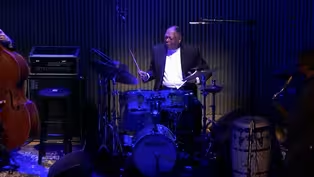
Video has Closed Captions
Clip: S40 Ep7 | 5m 58s | A profile of jazz drummer Billy Hart, now in his 80s and a 2022 NEA Jazz Master. (5m 58s)
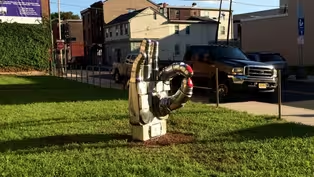
Video has Closed Captions
Clip: S40 Ep7 | 6m 24s | “The OK Trenton Project" is a new play based on a true story of kids, art, and gangs. (6m 24s)
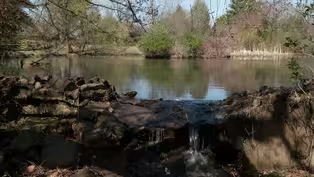
Olmsted's Last Great Park: Cadwalader
Video has Closed Captions
Clip: S40 Ep7 | 5m 19s | Frederick Law Olmstead’s last great design, Cadwalader Park in Trenton, NJ. (5m 19s)
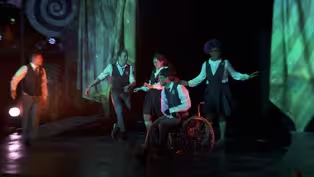
Ride the Cyclone at McCarter Theatre
Video has Closed Captions
Clip: S40 Ep7 | 7m 3s | “Ride the Cyclone,” directed by McCarter Theatre’s new artistic director Sarah Rasmussen. (7m 3s)
Providing Support for PBS.org
Learn Moreabout PBS online sponsorship

- Arts and Music
The Best of the Joy of Painting with Bob Ross
A pop icon, Bob Ross offers soothing words of wisdom as he paints captivating landscapes.











Support for PBS provided by:
State of the Arts is a local public television program presented by NJ PBS