State of the Arts
State of the Arts: May 2024
Season 42 Episode 7 | 26m 46sVideo has Closed Captions
A Return to Ellis Island, artist and writer Nell Painter and The Scarlet Letter on stage.
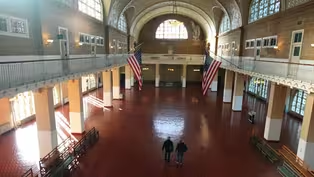
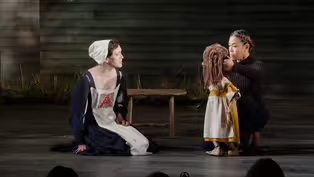
In 1974, teenagers Phil Buehler and Steve Siegel explored the ruins of Ellis Island and made a film. 50 years later, they revisit the island. Artist, historian and bestselling author Nell Painter on her new book of essays and art: “I Just Keep Talking.” And at Two River Theater in Red Bank, the world premiere of The Scarlet Letter, Kate Hamill's stage adaptation of Hawthorne's classic tale.
Problems playing video? | Closed Captioning Feedback
Problems playing video? | Closed Captioning Feedback
State of the Arts is a local public television program presented by NJ PBS
State of the Arts
State of the Arts: May 2024
Season 42 Episode 7 | 26m 46sVideo has Closed Captions
In 1974, teenagers Phil Buehler and Steve Siegel explored the ruins of Ellis Island and made a film. 50 years later, they revisit the island. Artist, historian and bestselling author Nell Painter on her new book of essays and art: “I Just Keep Talking.” And at Two River Theater in Red Bank, the world premiere of The Scarlet Letter, Kate Hamill's stage adaptation of Hawthorne's classic tale.
Problems playing video? | Closed Captioning Feedback
How to Watch State of the Arts
State of the Arts is available to stream on pbs.org and the free PBS App, available on iPhone, Apple TV, Android TV, Android smartphones, Amazon Fire TV, Amazon Fire Tablet, Roku, Samsung Smart TV, and Vizio.
Providing Support for PBS.org
Learn Moreabout PBS online sponsorshipNarrator: In 1974, two teens from New Jersey rode out to Ellis Island and made a film.
50 years later, they revisit the now restored island as The New York Times presents their original film in their Op-Docs "Encore" series.
Nell Irvin Painter was a professor of history at Princeton and a bestselling author before she became an artist.
Now she's back at her writing desk with "I Just Keep Talking."
Painter: I work in two different ways -- as an artist and as a historian.
It's not like I could write for a few hours and then turn around and make some art for you.
It really means shifting gears.
Narrator: And at Two River Theater in Red Bank, Kate Hamill's radical adaptation of "The Scarlet Letter."
Hamill: We still very much live in a world in America that is misogynistic, that is deeply suspicious of female sexuality, interested in controlling women's bodies.
Narrator: "State of the Arts," going on location with New Jersey's most creative people.
Announcer: The New Jersey State Council on the Arts, encouraging excellence and engagement in the arts since 1966, is proud to co-produce "State of the Arts" with Stockton University.
Additional support is provided by... ...and these friends of "State of the Arts."
[ Music plays ] Siegel: What is now this gorgeous Liberty State Park was, back 50 years ago, an enormous, decaying industrial wasteland that had been abandoned.
Buehler: "Planet of the Apes" -- the ending, where all of a sudden you see the Statue of Liberty poking out of the sand.
When we first were exploring Jersey City, that's what it kind of seemed like 'cause there was the Statue of Liberty.
You can kind of see it over the ruins of New Jersey at the waterfront.
We saw just across the water Ellis Island literally a stone's throw away.
Narrator: They decided they just had to get there.
17-year-old photographer-explorers Phil Buehler and Steve Siegel rowed across to Ellis Island.
In 1974, it was the only way to get there.
What they found was an undisturbed, decaying ruin.
[ Music playing ] [ Music playing ] Siegel: It is a grand space.
Buehler: I'd never seen a picture of this hall, and it's pretty grand to kind of stumble upon.
It looked a lot like this, except the paint was peeling, the floors were covered with dust, and there were some old chairs and things lying around.
But it was big and empty, and this space is pretty much the way it looked.
The rest of the island was a total wreck, a lot of papers and mattresses and all sorts of things, but this room looked surprisingly similar.
Siegel: I gather that when the immigrants got off the boat, this is the first thing they saw as they came in.
So this was a very dramatic place.
A lot of emotions must have been felt very strongly.
This was the beginning of a new life right here.
[ Music playing ] Narrator: When they first arrived on the island, Phil and Steve took photographs of the ruins they found, but their real mission was to make a film.
[ Sea gulls squawking ] Buehler: Our high school didn't have any film equipment.
It was not something you taught, especially 16 millimeter.
There was an organization on the Lower East Side of Manhattan called Young Filmmakers Foundation's Film Club, and we were the kids coming in from Jersey to make documentaries.
They would show us how to edit or, you know, talk about what we were doing, but we were mostly on our own most of the time.
Narrator: The film they made about Ellis Island included the ruins, but also historical photographs and the voices of immigrants.
Keat: Most people did have to undergo a thorough examination.
They had to undress for this.
I do recall that someone looked at my eyes and into my ears and asked me to open my mouth and look to see if I had any kind of an infection.
Siegel: We were able to locate people who came through Ellis Island, and we were able to record lots of these interviews.
And it just seemed to work.
Potelsky: They separated me and my sister from the rest of my family because we had lice over us.
The ship wasn't very clean, you know?
And, uh, I was just frightened out of my wits.
Narrator: The hospital, isolation wards, and even a small morgue are on the south side of Ellis Island.
Nowadays, you can take a hardhat tour of the south side and see the series of murals created by the French artist and activist JR in 2014.
But when Phil and Steve were first here in 1974, these ruins had long been abandoned.
Buehler: It was just fascinating to us that there was this history in these abandoned places that nobody cared about.
[ Music playing ] The immigration station was really the north side, where you kind of got processed and went to New York.
But if you had a communicable disease, they'd isolate you here until you were cured.
And some of them had, like, a view of the Statue of Liberty, which must have been, like frustra-- crazy frustrating for an immigrant to be, like, so close.
There's the statue, but they can't go.
And they might actually be sent back.
And the fun thing about this room in particular is this mirror here that's still on the wall.
If you actually stand here, you can see the Statue of Liberty out that way, bouncing off the mirror.
Siegel: Well, the Statue of Liberty -- What can one say?
Everything has been said about it.
It's such a powerful and potent symbol worldwide.
Today, with the immigration debate raging, the statue, in a sense, has become even more potent.
And in some ways, it is almost a radical symbol, in my view, because it represents, at least to some people, the idea expressed in Emma Lazarus' poem of the golden door, the famous last lines of the poem -- "Give me your tired, your poor, "your huddled masses yearning to breathe free.
I lift my lamp beside the golden door."
[ Music playing ] Narrator: The high school seniors made an evocative film, and people noticed.
It won awards and still attracts attention.
It was one of the first selections for the New York Times' Op-Docs "Encore" series of short independent films that haven't been seen in decades.
For the teenaged Phil and Steve, the film was a turning point.
They realized that the visual power of the spectacular ruin was made even greater by its history.
Buehler: Sometimes I'll go to a place without knowing much of the history, and then I'll look up the history later.
Ellis Island was a little bit like that for me.
Now I know both sets of grandparents, the Italian ones and the German ones, came through Ellis Island.
My grandmother on the Italian side came in 1922.
If she decided to come two years later, she wouldn't have got in because the Immigration Act of 1924.
I wouldn't be here.
That's when they didn't want any more Italians, no more Poles, no more Italians, no more Jews from Eastern Europe, no more Chinese, no more Japanese.
Siegel: So, the golden door was slammed shut, and Ellis Island, ironically, in the last 30 years of its use, because it closed in 1954, was a deportation center.
Although it was architecturally significant, the power of the place is knowing the history and the context.
Buehler: This was so different and unique, and nobody had been photographing like this these abandoned places because they were inaccessible.
They're kind of scary a little bit.
But for us, it was just kind of beckoning.
And as you understand the history, it's almost like you're going in to rescue something.
Siegel: We've been friends for 50 years, through thick and thin, and we've made many films together.
We've gone on little photographic safaris together.
We've had some wonderful adventures.
One of our best -- probably the best -- is right here, right here in Ellis Island.
[ Music playing ] Narrator: Restoration began in the 1980s.
[ Air horn blares ] And now 3 to 4 million people visit Ellis Island every year.
It's a far cry from what Phil and Steve found in February 1974.
Buehler: No life preservers, no cellphones.
You know?
I didn't tell anybody where I was going.
And we came out here four times.
Siegel: "I have a rowboat.
Phil, let's do it."
Buehler: "I have my brother's car.
Let's strap it on the roof and go."
Siegel: "And so, whatever it takes, "we've got to make it here "because we're both interested in history, "we're both interested in adventures, "we're both interested in photography, and this has to be done."
Buehler: Two kids from Jersey.
There's no frontier out west.
The frontier is the New York waterfront.
This was quite the adventure.
[ Music playing ] Narrator: Later on the show, the sexual politics of "The Scarlet Letter" on stage.
But first, artist and writer Nell Painter's "I Just Keep Talking."
[ Music playing ] Woman: Tonight's event celebrates Nell Irvin Painter's brand-new book "I Just Keep Talking: A Life in Essays."
This book gathers more than 40 essays and dozens of visual works from Dr. Painter's academic and artistic career.
Painter: You all know about Huey Newton, right?
Woman: Yes.
Painter: I was in high school with Huey Newton.
[ Laughter ] Woman: I love it.
Narrator: Nell Irvin Painter is a sought-after scholar, a guest on everything from "The Colbert Report" to Ken Burns' "The U.S. and the Holocaust."
Painter: And we are a democracy.
And in our better moments, we are very good people.
Narrator: She chairs the board of the prestigious MacDowell artist colony in New Hampshire.
Now the writer, historian, and artist is on the road for her new book, "I Just Keep Talking."
Painter: I'm going to Maplewood.
I'm going to Princeton.
I'm going to Brooklyn.
I'm going to Philadelphia.
I have the Columbia Journalism School.
I have Claire Potter's podcast.
I have the Newark Public Library.
Narrator: The acclaimed "Sojourner Truth: A Life, A Symbol," written while Nell was a professor of history at Princeton University, has just been reissued.
Now Nell focuses on some of the same issues in her art.
Painter: So often, when we think about Black lives in the United States, we think about hardship, even trauma.
And on the one hand, I was spared that.
That's why I say I had a charmed life.
And I was recognized for the work I did.
Not every woman can say that.
Not every Black woman, especially, can say that.
Narrator: After decades as an esteemed professor of American history at Princeton University, Nell Painter embarked on a new chapter -- to become a practicing artist.
Her PhD from Harvard alone couldn't get her into a good MFA program, so at the age of 64, the author of four books, including the New York Times bestselling "The History of White People," enrolled as an undergraduate at the Mason Gross School of the Arts.
She followed that up by getting her MFA at the Rhode Island School of Design and writing about it in "Old in Art School."
Painter: I work in two different ways -- as an artist and as a historian.
I don't toggle from one to the other.
I do visual things because it takes a while to loosen up the relationship between the hand and the eye.
It's not like I could write for a few hours and then turn around and make some art for a few.
It really means shifting gears.
So, in the last years or so, I have been writing, but I took time out in '22.
I had a month's residency at Yaddo, and I made some new images to go with Sojourner Truth.
Sojourner Truth taught me to heed and love visual images.
So, everything we know about her in words comes from other people.
It's what we call mediated.
And it's all over the place.
"Oh, she was terribly smart."
"Oh, she was just a quaint little darky."
"Oh, she was powerful."
"Oh, she was just religious."
So, I'm trying to figure out, how does she think of herself?
What does Sojourner Truth want us -- How does Sojourner Truth want us to see her and think about her?
And the answer was in the photographs.
She had her photographs taken, and she sold them.
And the legend is, "I sell the shadow to support the substance."
So, it started with the failure of words, and it got into the pleasure of images.
What so many Americans know about Sojourner Truth is "Ain't I a Woman?"
Most people know "ain't" instead of "aren't," and she didn't say that.
If you want to remember Sojourner Truth, remember her as the patron saint of self-published authors, as the patron saint of knitters, as a great American activist.
But don't sum her up in words she didn't say.
In 2020, I came out of the closet as a knitter.
We were stuck up in the Adirondacks for a really extended period and missing my friends in Newark, like Adrienne Wheeler.
So I made Adrienne a pair of socks, and I made an art piece called "I Knit Socks for Adrienne," which combines text and image.
"'I Knit Socks for Adrienne "is the most personally declarative piece of art "I have ever made, "more personal even than self-portraits, "precisely because it's personally declarative in words "that wrench the artist Nail Painter "out of the closet as a knitter.
"For a long time, I stayed closeted as a knitter.
"I previously thought, 'Let you see me as an artist, "'as a historian, as an artist who uses history, "'not let you see me as a knitter, a craftswoman, "'an old lady sitting around with her needles and yarn.'
"That mental image wasn't one I had been able to expose.
"But 2020 opened my closet door "to reveal me knitting to hold myself together.
"There was all the death, "searing, painful deaths by the hundreds of thousands, especially of Black people."
And then returning to Sojourner Truth, and the image that I used on "Sojourner Truth: A Life, A Symbol" and that you see very, very often is Sojourner Truth holding her knitting.
Just the ability to see, to focus on, to talk about Sojourner Truth as a knitter is something I can do now that I couldn't do in the '90s.
When I was a little kid, my teachers told my parents, "Nell talks too much!"
[ Laughs ] I just keep talking.
As a historian, I got my PhD in 1974 at Harvard.
And I was very productive.
I've written books.
You know, I've done everything you need to do.
But for a long time, I felt like I wasn't being read.
Part of this is because of the -- well, I'll call it a prejudice against citing Black women.
It got enough of a reception to get me promoted and tenured in three years and a full professor again in another three years.
So, it worked out.
But to have the feeling that I was reaching people -- I didn't have that.
But rather than just say, "Well, I'm not getting through," I just kept talking.
I just kept writing.
I just kept publishing.
And finally, I'm getting through.
Narrator: Last on the show, America's Puritan heritage explored on stage in a new adaptation of "The Scarlet Letter."
[ Music playing ] Chillingworth: Are you the child of misrule?
Pearl: [ Laughs ] I am my mother's child.
Chillingworth: Ah.
And, uh -- And who is your father?
Hester: Who is your heavenly father?
Pearl: I do not have one!
Narrator: Playwright Kate Hamill adapts literary classics for the stage, and she is a seasoned master at it.
Hamill: I've done "Sense and Sensibility," "Pride and Prejudice," "Dracula," "Little Women," "The Odyssey," "Vanity Fair."
I do radical adaptations.
So, I do plays that are not just sort of copy-and-paste versions of the original.
I want them to be in conversation with the original, but I want them to be really interesting to people both who know the classic very well and who have no relationship with it whatsoever.
I want people to be surprised.
I'm a feminist playwright, and I really believe that the classics are cultural touchstones for us.
Narrator: Kate's latest adaptation is based on "The Scarlet Letter."
The play premiered at Two River Theater in Red Bank.
Six actors and a puppet bring to life Nathaniel Hawthorne's archetypal tale of sin, punishment, and redemption in a 17th-century Puritan colony in Massachusetts.
And there are surprises, like this kiss... and this outburst from Hester's child, Pearl.
Hester: Pearl, who is your heavenly father?
Pearl: I do not have one!
Hamill: I really wanted to write a piece at least partially about the history and the legacy of wanting to control women and women's sexuality and fear of women's sexuality.
And I felt like "The Scarlet Letter" is a really good story with which to examine that.
Hawthorne himself wrote the novel at least partially out of guilt because his own ancestor was involved in the Salem witch trials.
Butler: When she's creating an adaptation, she really essentializes, gets to the core of the action, and has a fresh, modern take.
Everyone stopping and taking that in landed nicely... And having her in the room with us as we bring her world premiere to life is incredibly exciting.
Governor Hibbins: I'm afraid we have other business here, Mistress Prynne.
Goody Hibbins: Sacred business.
Butler: It's set in Massachusetts Bay Colony.
It follows a woman named Hester Prynne from 1642 to approximately 1647 in our play.
She has gotten pregnant, but her husband has not yet come to Massachusetts Bay Colony, has been missing for two years, and is presumed dead.
Hester: My child has no father, save a heavenly one.
Governor Hibbins: Mistress Prynne, I am a tender-hearted man.
I do not wish for you and your daughter to be perpetually locked away in darkness.
But I serve a higher power.
Butler: So, it's clear, whoever the father is, this is an act outside of marriage.
Narrator: In fact, the father is the town's unmarried minister, Reverend Dimmesdale, in love with the already married Hester.
He's tormented by his secret sin.
Dimmesdale: Hester!
Governor, it is me!
It was me.
I alone am to blame.
I -- [ All murmuring ] Hester: Look at me.
You must be well.
Dimmesdale: I wish I could be free.
Hamill: The "A" stands for "adultery."
And what's interesting is Hawthorne just wrote, when she does this, she's given a scarlet "A," which she embroiders and makes more and more elaborate.
But what they actually did to Massachusetts Bay Colony for people who committed adultery is they would flog you publicly.
Hester: Ahh!
Hamill: Then you would wear the "A."
And in other parts of the country, people were put to death for adultery.
Hester: Ahh!
Butler: Hester's daughter, born out of wedlock, born in sin, is Pearl.
And Pearl is a 4-year-old, and she hasn't really been socialized.
She's borderline feral.
[ Laughs ] And that makes her incredibly humorous.
It makes her fun to watch.
And Kate's spin on Pearl is particularly delicious.
Pearl: I am your little Pearl!
Hester: Do not use that terrible voice.
You know I do not like it.
Pearl: I like it!
Hester: You cannot run about in your shift.
Pearl: Why?
Hester: Because it is not decent.
Pearl: Why?
Hester: Because God said only animals may be naked without shame.
Pearl: Then I will be an animal!
Yip!
Yip!
Butler: As a mom, I'm particularly compelled by the moment where Hester thinks she might lose her child, faced with a bunch of men, for the most part, who may be threatening her ability to keep that child.
So, I find that moment quite visceral.
Governor Hibbins: A complaint has come to us recently, Mistress, of the life you're living in the woods.
Pearl: She lives like a witch in the cottage in the story!
Hester: Hush!
Chillingworth: Will you end up like your poor mother?
Pearl: No.
Chillingworth: Hmm?
Pearl: I will never have a scarlet letter when I am grown.
I shall never wear one at all.
Chillingworth: No?
Hamill: We are inheritors of a cultural legacy from the Puritans.
Their colony helped build some of our systems of government, so we still very much live in a world in America that is misogynistic, that is deeply suspicious of female sexuality, very interested in controlling women's bodies.
Hester: The only sin was in the shame.
Hamill: And we still live in a society where, if you do something wrong, there's not a really clear path to being totally reintegrated, to being forgiven.
I don't think we really have that.
Dimmesdale: I have seen the strange man, the devil in this world, and his face was mine!
And yours!
And yours!
And -- [ Gasps ] Goody Hibbins: It is her!
Help!
Narrator: That's it for "State of the Arts" this week.
To share these stories or to sign up for our newsletter, visit StateoftheArtsNJ.com.
Thanks for watching.
[ Music playing ] [ Music playing ] Glenn-Copeland: [ Singing ] Let it go, let it go down.
It's okay.
[ Music playing ] Let it come, let it take all thoughts away.
[ Music playing ] Announcer: The New Jersey State Council on the Arts, encouraging excellence and engagement in the arts since 1966, is proud to co-produce "State of the Arts" with Stockton University.
Additional support is provided by... ...and these friends of "State of the Arts."
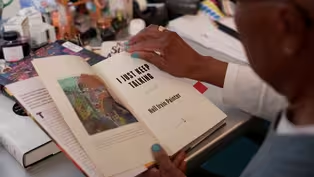
Nell Painter: She Just Keeps Talking
Video has Closed Captions
Clip: S42 Ep7 | 7m 53s | Artist, historian and bestselling author Nell Painter on her new book of essays and art. (7m 53s)
Video has Closed Captions
Clip: S42 Ep7 | 8m 36s | Teenaged filmmakers row out to Ellis Island in 1974, then return 50 years later. (8m 36s)
Video has Closed Captions
Clip: S42 Ep7 | 6m 34s | Kate Hamill's adaptation of Hawthorne's classic "The Scarlet Letter" at Two River Theater. (6m 34s)
Providing Support for PBS.org
Learn Moreabout PBS online sponsorship
- Arts and Music
The Best of the Joy of Painting with Bob Ross
A pop icon, Bob Ross offers soothing words of wisdom as he paints captivating landscapes.














Support for PBS provided by:
State of the Arts is a local public television program presented by NJ PBS