State of the Arts
State of the Arts: New Jersey Heritage Fellows - Part II
Season 43 Episode 3 | 27m 47sVideo has Closed Captions
Five New Jersey Heritage Fellows preserving age-old art forms (Part II).
In 2024, the NJ State Council of the Arts honored ten artists preserving age-old art forms as the first NJ Heritage Fellows. On this State of the Arts, we meet five: Afro-Peruvian Cajon player Hector Morales; African American storyteller Queen Nur; Korean dance master, Lena Mija Kim; and Puerto Rican Bomba y Plena performers, percussionist Juan Cartagena and dancer Nanette Hernández.
Problems playing video? | Closed Captioning Feedback
Problems playing video? | Closed Captioning Feedback
State of the Arts is a local public television program presented by NJ PBS
State of the Arts
State of the Arts: New Jersey Heritage Fellows - Part II
Season 43 Episode 3 | 27m 47sVideo has Closed Captions
In 2024, the NJ State Council of the Arts honored ten artists preserving age-old art forms as the first NJ Heritage Fellows. On this State of the Arts, we meet five: Afro-Peruvian Cajon player Hector Morales; African American storyteller Queen Nur; Korean dance master, Lena Mija Kim; and Puerto Rican Bomba y Plena performers, percussionist Juan Cartagena and dancer Nanette Hernández.
Problems playing video? | Closed Captioning Feedback
How to Watch State of the Arts
State of the Arts is available to stream on pbs.org and the free PBS App, available on iPhone, Apple TV, Android TV, Android smartphones, Amazon Fire TV, Amazon Fire Tablet, Roku, Samsung Smart TV, and Vizio.
Providing Support for PBS.org
Learn Moreabout PBS online sponsorship-[Narrator] New Jersey is home to an amazing array of traditional artists, each a keeper of an age-old art form.
In 2024, the New Jersey State Council on the Arts honored ten of them in the first ever class of New Jersey Heritage Fellows.
On this special edition of "State of the Arts," we meet five.
-[Narrator 2] Hector Morales is an Afro-Peruvian music percussionist, a master of the cajón.
-I am also a teaching artist, which is something I didn't know existed.
I say okay.
Together.
-You pass on from this life... -[Narrator 2] Queen Nur is a storyteller of many dimensions.
-My stories come from many different places, but when I tell them they come from my heart.
I believe.
-[Narrator 2] As a young woman, Lena Kim was a renowned dancer in South Korea.
-She is one of the last masters now.
Her dream is to give it to me.
-[Narrator 2] Juan Cartagena and Nanette Hernández are celebrated keepers of the Puerto Rican tradition of Bomba and Plena.
Juan sees it as an extension of his work as a civil rights attorney.
-How to ensure that inclusion is actually respected and valued goes hand in hand with the kind of work that we're doing in Quimbamba.
-[Narrator] "State of the Arts" going on location this week with some of New Jersey's most accomplished traditional artists.
♪♪ ♪♪ -I think the cajón, for example, serve, I think, as a bridge between peoples.
And that's something that's central to music.
-Muchas gracias.
-[Narrator] Hector Morales is an Afro-Peruvian music percussionist, drummer, and a much loved teaching artist.
He was born and raised in Lima, Peru, and came to the U.S. as a college student to study jazz at William Paterson University.
[ Percussion ] -I'm a percussionist, but my two main instruments are the cajón, which is the box drum, which is the main instrument in the music of the coast of Peru.
It's an instrument of Afro-Peruvian music.
And then the drum set, which was the instrument that brought me here, actually, to America, 'cause I fell in love with jazz at some point.
[ Drumming ] I think my father is one of the most important people in me becoming a musician.
Although he was not a musician, he will always play music, and particularly music from the coast of Peru -- criolla music.
♪♪ That was the music that filled my space, especially in the car, because in those days, you could not choose what was going to be played.
♪♪ I am also a teaching artist, which is something I didn't know existed, or that you could be, until somebody when they called me and say, "Hey, we need somebody to come and teach Latin percussion in school in the Bronx."
I have no idea, I say, "Okay."
-[Narrator] One of the places Hector teaches is the Institute of Music for Children in Elizabeth, New Jersey.
Alysia Souder is the institute's director.
-He's so much more than just someone who teaches kids how to drum.
He's really just one of the most dedicated, intentional teachers who's able to connect with children of all abilities.
-One more time.
And together.
-Mister Hector is a really nice man.
Always happy.
Always gives us a smile.
What I like about the class is that when we hit the drums, and it gives a satisfying sound.
I just love that.
[ Drumming ] Mr. Hector is the best type of drummer in history, I think, and I love the way that he always smiles.
And he always, he always brings joy to me.
-Right?
-It would always be like, I'm walking by and I'm like, "What's Mr. Hector doing?"
Or I'd always see him with like, the congas and the jawbones and all, like everything.
And it sounds amazing.
-I'm going to play your beat, but then I'm going to change it.
I'm going to start doing something else.
Are you going to follow me?
No, don't follow me.
You stay with the main beat.
-[Mullings] He always likes to include people.
Like if somebody is slacking or just not in a good mood, he always finds a way to bring them up and uplift them through the music.
[ Percussion ] -Hey!
[ Percussion ] Okay.
Sounding nice, sounding nice.
♪♪ -[Narrator] Longtime friend and colleague Naomi Sturm-Wijesinghe invited Hector to co-teach one of her classes at the New School.
It's called Global Music and Dance Tradition -- Peru.
-Hector, I've known for 20 years.
Very close colleague of mine, amazing person, and he comes to the course and he teaches the students about Afro-Peruvian music, the cajón instrument.
And this year we were able to have an event here at Terraza 7, which is a very important space here in Jackson Heights, Queens, where the students will actually join Hector at a gig that he has.
So it kind of comes full circle.
♪♪ ♪♪ [ Cheers and applause ] -Terraza 7 is also a very special venue I think it's a core or the center of Latin American culture in New York.
♪♪ That's what music does naturally.
Bring people together.
It's almost like an invisible magic that happens, you know, and I don't even need to do much, you know, as long as I let the music take over.
♪♪ ♪♪ ♪♪ -[Narrator 2] New Jersey Heritage Fellows preserve traditional music and craft new stories from old tales.
-All of our ancestors who were in the bowels of the ships, chained, and never got a chance to bear a child and whisper, "God is great" into their ear.
We say -- Come on -- "We are your children."
I am a mother, a grandmother, a storyteller, a folklorist.
I am a Muslim.
And my name that was given to me at birth was Karen Maria Boulter, but it turned into Queen Nur, and that came to me spiritually.
♪♪ Nur is the 24th surah of the Qu'ran.
And as I looked at it, I looked at the responsibilities.
It talked about women.
Nur actually means light.
...with the empty pot.
-[Narrator 2] Storyteller Queen Nur has performed throughout the United States, Canada, and Africa.
She's a past president of the National Association of Black Storytellers and received their Zora Neale Hurston Award, among many other honors.
-And you won't believe the flowers that they had in their pots.
Can somebody tell me their favorite flower?
Anybody have a favorite flower?
Or name one.
Can you give me one?
Yes!
Well, one child had a hundred daisies in a pot!
Can somebody give me another one?
Another one?
What's your favorite one?
Yes, I am African American.
[ Laughter ] And my father told us when we were in grade school.
He said, always look for the black precedent.
I follow Jaliyaa -- a term used in Africa, in West Africa.
that means the art of storytelling.
And as an African American storyteller, I follow the tradition of the griots, the jelis, the jalis.
So my stories come from many different places.
But when I tell them, they come from my heart.
You pass on from this life into the next life.
[ Laughs ] Hoping for Paradise.
This is life.
It is just that I believe that I will not dare retreat in the forest of the ancestors.
I will be one who will be forgotten.
-[Narrator 2] Percussionist Dwight James has performed with Queen Nur for the past 17 years.
-Today I use antique cajóns, a modern cajón, and West African djembe, and a South African i-leek-ay which is mostly known as a thumb piano, and I use a North African modern drum called the pan drum.
What motivates her is history and sustaining our culture.
She's a wonderful person.
-This is Pop Pop's mother.
Grandpa Boyd was never married.
That's Lorraine.
That's my grandmother.
My beginning, in terms of being a professional storyteller -- I lost my husband in 1992.
My late husband, his name was Carl Abdul-Malik, and I had a three year old, a five year old, and a ten year old.
My daughter, the youngest one, was going to a preschool And they asked us if I could teach them about Kwanzaa.
I said you share your favorite stories.
And I read "Abiyoyo," which was written by Pete Seeger, but it's a South African tale.
It was my husband's favorite tale.
♪♪ And that same month, I took it to my son's kindergarten class.
And the two kindergarten teachers at Twin Hills Elementary said, "You ought to do this as a profession."
♪♪ 1975, I graduated from high school, and my sister, Brenda, she got me a job in Philadelphia, at the Medical Records building, there was a man named Salahuddin Abdullah.
And he would talk to me about Islam.
And I was like, "Mm, I don't know."
I said, "Look, this is a little different for me."
You know, I hadn't heard of it.
But then that same summer, I read "Malcolm X."
And when I finished reading the book, "Malcolm X," I went to work and I said, Salahuddin, I'm ready.
I went back to school in 2012 to go to college, so I became a folklorist after that.
Doll collection is a part of that.
It's part of our folk culture, and particularly my focus is African American.
-[Narrator 2] Queen Nur's doll collection was part of a recent exhibition at the Smithville Mansion in Burlington County, New Jersey.
-Molly Red is my favorite doll and the reason is, is she was a gift to me from my father.
This doll was made through the history of Topsy-Turvy dolls.
So Topsy-Turvy dolls came about because during the enslavement period, Black children were not allowed to have black face dolls, or neither they were not allowed to have white face dolls.
So the dolls were made with black faces on one side and white faces on the other, and so they were hidden until they went into their cabins and they could play with the other side.
♪ Storytelling time Clap your hands ♪ There's certain people say it kind of was a reawakening or a reconnection, but it never -- it never went away.
Even though they took our languages and they took our drums, when they found out that we were playing drums to send messages still.
It's a way for us to teach and to pass on our rich traditions and our morals and our values.
♪ You tell yours and I'll tell mine ♪ ♪ Storytelling time ♪ ♪ Clap your hands, stomp your feet, get on down ♪ -[Narrator] New Jersey Heritage Fellows tell stories for a new age and perform dances that evoke a vanishing world.
♪♪ ♪♪ [ Speaking native language ] -I'm originally from Pohang, South Korea.
I was introduced to dance at the age of five when my mom took me to my first dance class.
I fell in love right away and attended performance schools and simply loved it.
-Lena Kim was very renowned, one of the most respected and popular Korean folk dancers.
-In Korea, my grandma is really famous.
I think she's a great dancer and she inspires many Korean people in the nation and in Korea.
[ Speaking native language ] -For me, there was always a fire inside me.
A lot of people do call me tiger mom, tiger teacher.
[ Drumming ] Always challenging myself to do something, something more difficult, something that's not attainable.
But for me, that only makes the fire burn more.
[ Speaking native language ] -So in 1967, I was able to receive the National Performance Award while I was just in my middle school.
1972 was the first time that I received recognition for my hunchback dance.
-[Narrator 2] Lena Kim was an acclaimed master of traditional dance in South Korea when she immigrated to the United States in 1982.
She was in her early 30s.
She then spent years working at a Korean fish market and a grocery store in the Bronx.
In 2014, Lena returned to Korea and began to dance again.
It had been more than 30 years.
[ Speaking native language ] -Even though it's been 30 years, my body definitely was older, but my insight, the passion, the dream, the fire inside me was burning throughout those 30 years, and all I wanted to do was just get back on stage and dance again.
-[Narrator 2] Now, dancers and teachers from throughout the U.S. and abroad come to study with Lena at her studio in Palisades Park, New Jersey.
-Palisades Park -- The economy wasn't doing too good during the '80s.
Korean Americans saw this opportunity, came here to start to rebuild it again.
And this is what you see right now.
About 65% are Korean Americans or descendants.
-[Narrator 2] Lena performed at the town's Korean Arts in Motion festival.
♪♪ ♪♪ ♪♪ -She is one of the last masters now because she is in her mid 70s, so the masters that taught her are all gone now.
She is very sad that it might die with her.
Her dream is to give it to me.
She wants me to learn it so that I could pass it on to the next generation.
She's been asking me for years, and I've been saying, "That's a ridiculous dream.
I have no idea what you're doing.
I mean, seriously, give it to someone who knows what they're doing."
But there's a few lessons with her.
I feel that fire that she's talking about, so we're considering it now.
[ Drumming ] The dance is called Koban Nam-Moo Dance, originally performed mostly for the kings and nobles of Joseon Dynasty, starting back in 1300s.
It's considered one of the most glamorous dances, and it has its artistry with culture and refinement.
[ Speaking native language ] -The reason why I see Koban Nam-Moo Dance being different than any other dance, goes back generations from the early stages from when Korea was first formed.
There's a word in Korea called "Han."
If you translate it into English, it's just simply soul, but it doesn't do a full translation because Han itself embodies the soul going through all the different emotions such as sadness, joy, wisdom.
And Korean traditional dance embodies Han, that soul.
♪♪ ♪♪ -[Narrator] From Korea to Puerto Rico, New Jersey Heritage Fellows honor their roots.
♪♪ ♪♪ Shortly after getting married, four decades ago, Juan and Nanette started looking for ways to preserve and celebrate their Puerto Rican heritage.
♪♪ -We both really were looking for ways to connect to traditions that our own parents did and different parts, because I was born and raised here in Jersey, and she was born and raised in Pennsylvania.
But we both have the same Christmastime traditions of music, live music, that comes around Christmastime, and a tradition called Parrandas, which means basically caroling with live music, house to house to house.
-For me, Juan Cartagena is a very important mentor and elder to me.
I think he's a wonderful example of a beautiful, healthy masculinity within Puerto Rican culture and within any culture.
-There's so much beauty in how much family and community that they bring and how welcome they make everybody feel.
-Bomba from Puerto Rico goes back at least 450 years.
It is played on large barrel drums, but it reflects the incredible history of the middle and western parts of Africa, particularly areas that were now Congo of Africa.
A lot of the languages and words that we still use in our Bomba music today are also derived from Congo languages of of that region of Africa.
♪♪ -We are an ensemble based in Jersey city, and for me personally, this has been honestly my family's work.
My parents are the founders of the organization, and so I have been part of the group since I -- before I could remember, honestly.
The group plays Bomba and Plena in Jersey City and throughout the Tri-State Area.
We've also toured in Spain, Barbados, and Puerto Rico, as well.
-[Narrator] Every spring, all of Segunda Quimbamba's students and their families come together for a grand performance.
♪♪ ♪♪ -[Rosa] And my mother, Nanette Hernández, she's our master dancer within the group, and she has been really the leader of our education program.
♪♪ -There are thousands of children in New Jersey that have benefited from the incredible work of Nanette.
♪♪ What makes Bomba super unique is that the dancer is a major element of the music.
-The movements can be from your upper body or your lower body.
It can be footwork.
And then there are certain patterns that you learn to dance in certain counts and certain moves.
When I go -- dot dot boom, dot dot boom.
-I'm trying to anticipate her dance movements, but because she knows I'm trying to anticipate it, and because we've danced and chanted together for so long, she may not give me a four beat count.
She'll just stop at two and I'm over here, we're getting ready to strike at the third and the fourth, and if I did it, I blew it.
And if I blow it, she gives me this look like, "What are you doing?"
And it's, look, it's a conversation now, now it's a conversation between, you know.
♪♪ [ Applause ] -My father has really instilled in both my brother and I, and I think also in our community, a real sense of purpose and identity, both culturally in this music and continuing to practice these forms, but also politically.
-When we started doing Plena and Bomba, for me, it was a logical extension of the work that I do professionally, which is that I'm a civil rights attorney, and I've represented both Latino-Latina communities in the United States for decades and decades and decades, along with African American communities.
And those kind of elements about how to ensure that inclusion is actually respected and that everyone's contributions to our -- this beautiful country that we live in, are respected and valued, goes hand in hand with the kind of work that we're doing in Quimbamba.
-As we were younger, you know, I think we would have Father's Days where his idea of celebrating Father's Day was going to a protest, and that's where we would be, you know.
He'd say, "I know it's raining, but it's Father's Day, and that's where I'd like to be."
♪♪ -Plena's portable.
All the percussion instruments are hand-held and Plena is also anchored in the lyricism of its words.
It's played at every baseball game in Puerto Rico, and Puerto Rico loves its baseball.
Then it's played in every protest, every labor strike.
We play Plena at wakes -- -[Nanette] And graduations.
-And graduations.
And baptisms.
It's the gamut.
♪♪ [ Cheers and applause ] -This year, Juan and myself have been recognized with Segunda Quimbamba as honorees of the National Puerto Rican Day Parade in New York City.
♪♪ It's very exciting.
It's very affirming.
♪♪ We do this music, we preserve this culture, not solely for the joy that it brings and the immense musical talent that we can kind of cultivate within our family and with our community as a whole, but also because it is very much a part of our resistance as people who are descended from colonial subjects that are still colonized to this day.
♪♪ [ Cheers and applause ] ♪♪ -[Narrator] That's all for this special edition of "State of the Arts," celebrating the amazing diversity of New Jersey's cultural landscape.
-[Narrator 2] To find out more about these New Jersey Heritage Fellowship artists and others, visit StateoftheArtsNJ.com.
-[Narrator] Thanks for watching.
♪♪ ♪♪ ♪♪ ♪♪ ♪♪ -The New Jersey State Council on the Arts, Encouraging Excellence and Engagement in the Arts since 1966, is proud to co-produce "State of the Arts" with Stockton University.
Additional support is provided by the Pheasant Hill Foundation.
Philip E. Lian and Joan L. Mueller in memory of Judith McCartin Scheide.
And these friends of State of the Arts.
♪♪
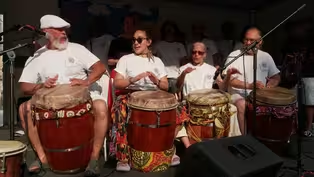
Bomba y Plena: Juan Cartagena & Nanette Hernández
Video has Closed Captions
Clip: S43 Ep3 | 6m 29s | Juan Cartagena and Nanette Hernández blend social justice with Puerto Rican Bomba y Plena. (6m 29s)
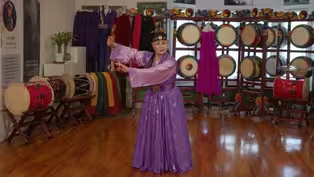
Korean Dance & Drums: Lena Mija Kim
Video has Closed Captions
Clip: S43 Ep3 | 5m 32s | Lena Mija Kim, a master of Korean dance, passes the art form down to the next generation. (5m 32s)
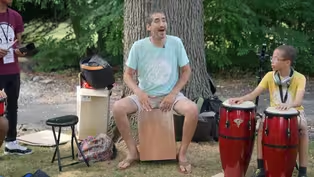
Peruvian Cajon Player: Hector Morales
Video has Closed Captions
Clip: S43 Ep3 | 5m 24s | Hector Morales brings traditional Afro-Peruvian music to the U.S. from Lima, Peru. (5m 24s)
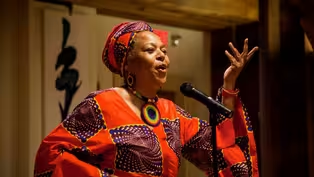
Video has Closed Captions
Clip: S43 Ep3 | 6m 36s | Queen Nur shares her ancestral history and preserves African culture through storytelling. (6m 36s)
Providing Support for PBS.org
Learn Moreabout PBS online sponsorship

- Arts and Music
The Best of the Joy of Painting with Bob Ross
A pop icon, Bob Ross offers soothing words of wisdom as he paints captivating landscapes.











Support for PBS provided by:
State of the Arts is a local public television program presented by NJ PBS