State of the Arts
State of the Arts: October 2021
Season 40 Episode 1 | 26m 46sVideo has Closed Captions
Songwriter Rose Marie McCoy, Climate Art, a Field Companion, and Armenian American Artists
Rose Marie McCoy was one of the first Black women songwriters to make it in the popular music industry. Along the Jersey coast, artists raise public awareness of climate change. Nadia Hironaka and Matthew Suib create a microcosmic forest based on their rambles through the Pine Barrens. And Before/After: Reflections on the Armenian Genocide brings together artists with a shared cultural heritage.
Problems playing video? | Closed Captioning Feedback
Problems playing video? | Closed Captioning Feedback
State of the Arts is a local public television program presented by NJ PBS
State of the Arts
State of the Arts: October 2021
Season 40 Episode 1 | 26m 46sVideo has Closed Captions
Rose Marie McCoy was one of the first Black women songwriters to make it in the popular music industry. Along the Jersey coast, artists raise public awareness of climate change. Nadia Hironaka and Matthew Suib create a microcosmic forest based on their rambles through the Pine Barrens. And Before/After: Reflections on the Armenian Genocide brings together artists with a shared cultural heritage.
Problems playing video? | Closed Captioning Feedback
How to Watch State of the Arts
State of the Arts is available to stream on pbs.org and the free PBS App, available on iPhone, Apple TV, Android TV, Android smartphones, Amazon Fire TV, Amazon Fire Tablet, Roku, Samsung Smart TV, and Vizio.
Providing Support for PBS.org
Learn Moreabout PBS online sponsorshipMale Narrator: The New Jersey Pine Barrens inspires an immersive video installation at the Rowan University Art Gallery.
Female Narrator: In 1915, over a million people were murdered in the Armenian Genocide.
The children and grandchildren of the survivors keep their memory alive.
Male Narrator: Artists find surprising ways to shed light on the threats posed by climate change.
Female Narrator: in the 1950s and '60's, Rose Marie McCoy wrote over 800 songs.
Born in Arkansas, she made her name in New York City, and lived in Teaneck for over 60 years.
Male Narrator: "State of the Arts," going on location with New Jersey's most creative people.
Announcer: The New Jersey State Council on the Arts, encouraging excellence and engagement in the arts since 1966, is proud to co-produce "State of the Arts" with Stockton University.
Additional support is provided by these friends of "State of the Arts."
[ Music plays ] McCoy: I was born in O'Nien, Arkansas, April 19, 1922, in a shabby little tent-house shack.
When the winter winds blew, it creaked and cracked in an open field down on the farm.
First sound I heard that I understood -- Papa chopping down trees, Mama in the water.
Female Narrator: Rose Marie McCoy always had a gift for telling stories with her songs.
Man: [Singing] Yeah, my mother stood crying.
My father had an aching heart.
He said, "Son, son, please don't let us part."
Female Narrator: In the 1950s and early '60's, Rose Marie McCoy was writing hits.
Popular music was changing, and Rose was there, becoming the first Black woman to really make it as a songwriter.
Man: [Singing] I'd like to love you every day.
If I may.
Otis: The things that she had to go through when she was writing successful songs, I can't imagine it being much harder for anyone, in whatever position.
This African-American woman persevered, even with all these odds against her.
Everyone still wanted to deal with her because of her talent, and because of her perseverance.
She made it.
Franklin: [Singing] It's pitiful.
Feeeel so sorry for me.
Female Narrator: Aretha Franklin, Ike and Tina Turner, and Elvis Presley all recorded her songs.
But Rose's first dream was to be a singer.
Growing up in rural Oneida, Arkansas, Marie Hinton -- that was Rose's name back then -- sang in church and helped on the farm.
But she went to high school in Helena, 18 miles from Oneida, but a world away.
Marie thrived at Eliza Miller High School.
She was voted Most Friendly and Queen of the Football Team.
She sang at school, too.
Music was everywhere.
Traveling bands played at Eliza Miller.
She heard the Jimmy Lunsford Orchestra.
and the Sweethearts of Rhythm.
[ Singing ] Well, my mama gave me something.
Would take me anywhere.
Corsano: And that's when she said, "That's what I want to do," because they were dressed up so pretty.
Female Narrator: To become a singer, Marie decided she'd have to move to New York or Chicago.
Corsano: She had to go to one or the other, because you couldn't make it as a singer in Arkansas.
Most people from Arkansas went to Chicago, because the trains would go right up.
But as she said, "I always liked to be different, so I chose New York."
Female Narrator: She changed her name, becoming Rose Marie, and boarded a bus to New York.
Rose began singing anywhere she could -- sometimes in clubs, where part of her job was mixing with the customers.
On a visit back home in 1943, Rose married her high school sweetheart, James McCoy, just before he shipped out to fight in World War II.
He was gone for 2 1/2 years.
Rose made ends meet by ironing shirts for laundries that paid by the piece.
She kept singing, getting some gigs opening for big acts like comedian Moms Mabley.
McCoy: [Singing] To keep from going to jail.
Female Narrator: In 1952, Rose auditioned for a small rhythm and blues label called Wheeler Records.
She was 30 years old.
Corsano: So, Rose went down there, and she sang.
And the woman said, "Can you write your own songs?"
Because they needed songs, too.
And they wanted the Blues.
So, Rose went home, and wrote two songs.
And the record came out, but as Rose would say, it didn't make no noise, but people heard it Producers heard it.
Other record companies, owners heard it.
And they started going after her.
Female Narrator: Next, she wrote "Gaben Blues" for a new artist called Big Maybelle on OC Records.
Rose based it on The Dozens, a game where two people insult each other until one gives up.
Rose is the one doing the talking.
McCoy: Here come old evil chick, always telling everybody she come from Chicago.
Got Mississippi written all over.
Maybelle: [Singing] You better stop trying to run my business.
McCoy: [ Laughs ] Who's got business?
Maybelle: [Singing] Or I'll have to do... And that was her first hit, and my first hit, got the Cashbox Award.
Female Narrator: Rose's songwriting career took off.
She teamed up with Charlie Singleton.
They'd work all day, sometimes writing songs in the morning that they'd sell in the afternoon.
Nappy Brown had a hit with their song "Piddily Patter Patter."
Brown: [Singing] My heart goes piddily patter patter.
Piddily patter patter.
Every time I look at you.
Page: [Singing] I don't know what's the matter.
Female Narrator: Patty Page made it a hit, too.
Man: [Singing] I've been traveling over mountains.
Female Narrator: "Tryin' to Get to You" was recorded by an obscure R&B group called "The Eagles," and by Elvis Presley.
I've been traveling night and day.
I've been running all the way.
Baby, tryin' to get to you.
Female Narrator: The business was changing, and Rose was rolling with it.
She stayed independent, both writing songs on her own and teaming up with other writers over the years.
Herman Kelley was one of her writing partners.
My job was primarily to keep the groove going.
I played the guitar, and Rose would say, "Well, what do you think about this?"
And she said, "Oh, try me."
McCoy: [Singing] Oh, try me, and see.
If you don't believe.
All you have to do is just try me.
Kelley: I think Rose was at her best writing period in the '60's and '70's.
She was slick.
She was always evolving, and always wondering what the next step was.
McCoy: They just come from everywhere.
You might've said something right now that gave me an idea.
[Singing] I know it's gonna work out fine.
It's gonna work, work.
I know it's gonna work out.
It's gonna work.
I know it's gonna work out fine.
I know.
Male Narrator: Later in the show, artists grapple with their personal legacies of the Armenian Genocide.
But first, public art focused on how climate change is threatening the Jersey Shore.
[ Music plays ] Woman: The purpose of this climate arts project is to bring awareness to the residents of New Jersey on how to be resilient in the face of climate change, and specifically the rising sea level.
LaTourette: New Jersey has a greater risk of sea level rise than most other places on the planet.
Male Narrator: Art projects at four different places on the New Jersey coastline were commissioned by NOAH, the National Oceanic and Atmospheric Administration.
The idea was to focus on threats posed by climate change and rising sea levels.
NOAH partnered with the New Jersey Department of Environmental Protection and the New Jersey State Council on the Arts.
Sean LaTourette is the commissioner of the New Jersey Department of Environmental Protection.
LaTourette: I think art encourages us to be thoughtful, and reflect upon our experience of the world.
And I think it changes us, in a way, by helping us to appreciate the urgency of what's being communicated, and compelling us to act.
Male Narrator: In Port Norris, at the Bayshore Center at Bivalve, on the Delaware Bay in southern New Jersey, Ceramic artist Gail Scuderi created tiny houses made from handmade tiles.
The historic oyster fishing village is now highly prone to flooding.
Scuderi: My partner and I have created a series of tiny houses that are up on stilts, to give an immediate visual of raising the house, so, when the sea level rises, you won't have a flooded basement.
I began first by doing a lot of research myself, and the fact that, not only is the sea level rising, but New Jersey itself is sinking due to natural geologic reasons.
We invited members of the community to come and create clay tiles that would then be used in making some of the houses.
[ Music plays ] In Long Branch, choreographer Lynn Needle and her dance company, The Art of Motion, created a myth-inspired multi-media work about the ocean.
I wanted to address coastal fragility through the power of the ocean, and through what my work is about, as a choreographer, which is legend, and myth, and nature.
[ Music plays ] [ Music plays ] Male Narrator: Menacing storm clouds gathered during the performance, and as the dance was about to end, the heavens opened up -- a vivid reminder of how the climate is changing.
[ Music plays ] At Dundee Island Park in Passaic, artist Adriane Colburn created sculptures that show historic and projected water levels along the Passaic River.
Colburn: The project consists of these two markers, and they're made out of a ship mast.
I've taken the data from the USGS stream flow gauges that are in the Passaic River, and I've carved the mast on a ledge as determined by, like, the course of water passing through the gauges.
So, if there's more water passing through the gauges in 1965, it's a kind of fat section.
If there's less, it's a lean section.
So, one of the posts will kind of represent that stream flow, as well as the annual average temperature.
So, it's painted in a color that corresponds to the average temperature.
We're getting more water coming down in high concentrations, and the amount of rainfall is going up.
Male Narrator: Prior to installation, Hurricane Ida completely flooded the park.
At the Absecon Lighthouse in Atlantic City, artists Nancy Agati and Rebecca Schultz created a mosaic made of permeable surfaces.
Our project is called "Water Table."
The general idea is that it's an in-ground permeable surface, made up of different materials, to show the public how water gets absorbed into the ground.
A lot of folks will pave around their houses, thinking that that water will go away.
But where does it go?
And it doesn't absorb into the ground.
And this is a beautifying way of allowing the water to absorb.
Schultz: All of my work is really focused on really encouraging people to see the natural world in different ways, in new ways, and understand that we're just part of it.
We're not the masters of it.
We're not -- This idea that we kind of want to dominate is what's kind of gotten us to the point that we're in.
One of the kind of main starting points for us in coming up with the image for the piece was to look at maps of the New Jersey coast, and particularly there are all these interactive tools, now, that you can use to see what different areas will look like with certain, you know, increasing levels of sea level rise.
Agati: A young man who helped us yesterday, and you know, he saw part of it go in.
And he looked at and he was like, "I could -- I could do this in my yard."
And that's -- like, that's what we want.
Schultz: Scientists and artists are working together more and more because scientists are really seeing the value of art, of communicating, and getting people to think about environmental issues.
[ Music plays ] Female Narrator: Next, an immersive video installation at Rowan University Art Gallery inspired by the New Jersey Pine Barrens.
[ Music plays ] During the pandemic, we were out a lot.
I mean, I'd say probably every three days or two days, I think we would go out on a hike.
3 feet of snow, we were going out, you know?
Or rain, we were going out.
Man: The Pine Barrens is still such a wild space because it's this landscape that doesn't lend itself to intense development.
Woman: And I believe the New Jersey Devil surfaces every so often in the Pine Barrens.
With foraging, there's not so much an interest in speed, and trying to get to your end destination very quickly.
It's very much about being on the trail, but then, actually kind of walking off the trail.
Man: Moving slowly and looking closely is so different than how we experience -- most people experience the world around them on a daily basis.
Woman: Often, we separate ourselves from all the creatures, all the plant life that we see outside in the woods.
And it's kind of a spectacle, and something we maybe enjoy, but we're isolated, and we're separated from that.
I think the more and more time you spend out in the woods, you definitely start to break that illusion.
Man: There's always a chance you're gonna see something certainly that you've never seen before, but possibly no one's ever seen before.
When we first met, she was making films unlike anything I had really seen.
Woman: We'd always had our individual practices, and actually, it was a little bit challenging for a long time, because we were often each other's competition.
Man: We had several attempts at collaboration before we actually kind of figured out how to pull it off.
Woman: During COVID, obviously, we were kind of limited, with trying to do anything with large groups of people.
But we still were really having a wonderful time going out in the woods.
And we're like "This experience means a lot to us.
How can we embody that experience, and then show it to another group of people?"
We decided to create a terrarium.
And for us, that was a contained space that showcased all of the beautiful plants that we were seeing as we were going out on our hikes.
Man: Careful to not make it too much of a literal representation of it, because we wanted to invite a little bit of imagination, and fantasy.
Woman: And creating what seemed like a very vast, large, sort of forest space, even though it would be on a much, much smaller scale.
Having this terrarium was a lot, I think, like having a pet.
I mean, we really had to care for it.
We had to maintain it.
We had to trim the plants regularly, and we had to water everything, And then, we were filming it, in addition.
Man: We wanted it to be a space where you could sort of lose yourself, and you know, believe that animals and plants are talking to each other, you know, and that you can sort of tune in to this conversation as if the narrator of some strange nature show had just walked off set.
[ Music plays ] We were trying to imagine what happens in a forest after all the humans are gone from that forest, you know.
When we're not hiking through it, observing things, what's going on, you know?
Like, are the animals getting together, and having a dance party?
[ Music plays ] Everything in this terrarium that we fabricated plays a role in sustaining that environment, just as everyone on our block, you know, has a role in the neighborhood.
Collaborative survival is sort of one of the fundamental lessons found in an ecosystem.
If you can contribute something, you're you're part of that self-sustaining system.
And there's room for -- for oddballs.
[ Music plays ] Male Narrator: In April 2021, President Biden officially acknowledged the Armenian genocide of 1915.
Descendants of survivors grapple with the trauma, and seek to recover their culture through art.
[ Music plays ] Casey: Before/After is the concept that, what is Armenian heritage before the Armenian genocide?
What did those communities look like?
What kind of symbolic elements did they have?
And then, talk about, well, what's the impact of the genocide?
And that's the After.
People find it overwhelming to think about 1.5 million people being killed.
That's an overwhelming statistic.
But by breaking it down, and showing individual stories, and family stories, it makes it personal.
People connect with that.
Every artist in the show is either dealing with the Armenian genocide directly in their work or responding to it within their family.
Jolley: Mary Zakarian was my mother's sister.
And my mother and her siblings were children of a survivor of the Armenian genocide -- the 1915 genocide of the Armenians.
My grandmother and my grandfather, each one had a family that was wiped out in Turkey.
Each one found their way to America, and raised a new family.
The genocide, and the trauma of it, impacted all the children.
But Mary somehow crystallized that "child of survivor" experience.
Her mother was her most frequent subject.
She considered her most important work "My Mother's Endless Lament," a painting of five heads of her mother depicting the idea that the suffering of a genocide survivor does not end.
Mary considered putting her own portrait in the center, to show the effect on this next generation, but she decided against it because she said the painting spoke for itself.
Mary's work does not specifically address genocidal trauma.
What she was obsessed with doing was seeing into somebody's heart and soul, usually seeing the more tragic aspects of a person, the sadness in a person.
Mary's work is as much about her biography as it is her mother's biography, because it winds up being a biographical look at how trauma impacts later generations.
Jolley: There is such a thing as inherited trauma.
A survivor of trauma somehow can pass that down to the next generation.
Anxiety and depression were the legacy of something like genocidal trauma.
Casey: The whole show talks a little bit about, like, what we call "collective memory."
We have works that are actually documenting survivors.
But we're also talking about generations after saying, "Well, these are the memories that people have passed down to me, that I'm still kind of coping with, that I can look back, and I can remember my grandmother speaking about this."
Sperandio: My great-grandfather and great-grandmother both fled, as teenagers, during the genocide.
At my grandmother's house, there was one of two remaining rugs my family used, somehow, in trading, to get them out of Turkey.
There are bits and pieces of the story that my grandmother was able to share with me, which is how I've started to gather work about it.
So, the rug is embodying the memory of an immigration story.
We all forget things, and it's not the whole story.
So, the rug has some distortions.
It's got a lot of missing pieces.
It sort of, for me, represents like, the truth of the story.
And as it goes outward, the materials change, and they change also as they come to America.
The most original design is in the center, here.
Nothing is distorted.
It's all, like, the original rug that made it over, and is in my family's possession.
Casey: This memory often gets distorted, and if you talk about denialism, gets even lost.
There's a real strong motivation for artists like Jessica to recreate those ideas, and recreate objects.
Sperandio: Things were destroyed to erase culture.
And art is culture.
Continuing to make it, and show it, means it's still there?
You can get rid of it, but it's gonna come back.
Odabashian: These are two birds.
All four of my grandparents were genocide survivors.
My father's mother spoke to me about it.
She would always say, "I'll tell you more when you're older."
I was never old enough for her to tell me what it was.
Reliquaries is inspired by a 10th century church called Agh'tamar.
And it has rows of low relief, bands of Old and New Testament figures, grapevines called "the vine scroll," humans and animals, like, interspersed.
A reliquary is a vessel that contains a sacred object.
My take on that is that I'm not so much encasing an object, but encasing the spirit or the soul of Armenian past.
There's a lot of symbolism.
Megherian: My father was born in 1921, and they were still running from the Turks.
My grandfather wanted to throw him in the snow, as they always said, because it was too hard to carry the baby.
But my grandmother was, "No."
She kept him alive.
"Khatchkar," literally translated, is "cross rock."
In Armenia, there are these beautifully, intricately gorgeous carved stone memorials for people.
When I read about the khatchkars of an enclave of Azerbaijan, Nakhchivan, where there were, like, 100,00 cash khatchkars.
And there are none today.
Some were as old as 1,500 years old -- completely eradicated.
I had to make something to honor these.
I used the letter F, which, in the Armenian alphabet, if it's lowercase, it means "is," because I'm saying these were.
This is.
I wrote 10,000 letter Fs, really honoring them, and taking that time.
I took the size from St. David of Avranches.
There's this two, huge, 16-foot khatchkars there, that are in Turkey.
So, the Armenians don't have them.
I just call it a "truth-telling piece," because, in Azerbaijan, one of the things that was said about the khatchkars is, "We didn't take them away, we didn't eradicate them, because they were never there."
To say something never existed, that was right there, enraged me.
So, it was really important for me to make this piece, to say "Yes, it was."
It is.
the Armenians are very proud of the fact that they're the first... Casey: To consistently keep a heritage alive, it requires you to consistently recreate the things that made that heritage important.
Because there was a really good chance that those things would be forgotten.
Personal stories tend to get at people a lot more than a statistic, because it makes it something that people have to take with them.
And I hope that's a catalyst for people to become motivated to speak out.
[ Music plays ] Female Narrator: Visit "State of the Arts" online for more.
And thanks for watching.
[ Music plays ] [ Music plays ] [ Music plays ] [ Music plays ] [ Music plays ] [ Music plays ]
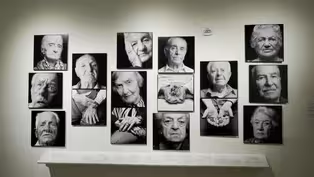
Before/After: Reflections on the Armenian Genocide
Video has Closed Captions
Clip: S40 Ep1 | 7m 6s | Armenian American artists explore the traumatic legacy of the 1915 Armenian Genocide. (7m 6s)
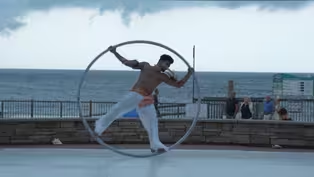
Video has Closed Captions
Clip: S40 Ep1 | 5m 58s | Four artistic teams explore the devastation being wrought by climate change in New Jersey. (5m 58s)
Field Companion: Matthew Suib & Nadia Hironaka
Video has Closed Captions
Clip: S40 Ep1 | 4m 10s | Nadia Hironaka and Matthew Suib create a microcosmic forest rooted in the Pine Barrens. (4m 10s)
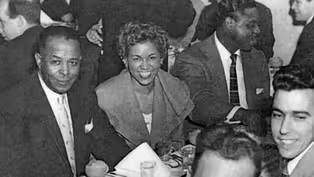
Rose Marie McCoy: It's Gonna Work Out Fine
Video has Closed Captions
Clip: S40 Ep1 | 6m 48s | Rose Marie McCoy wrote over 800 songs for Elvis, Aretha Franklin, Ike & Tina Turner and mo (6m 48s)
Providing Support for PBS.org
Learn Moreabout PBS online sponsorship

- Arts and Music
The Best of the Joy of Painting with Bob Ross
A pop icon, Bob Ross offers soothing words of wisdom as he paints captivating landscapes.











Support for PBS provided by:
State of the Arts is a local public television program presented by NJ PBS